
AQR’s Cliff Asness Says Investors Are Repeating Dot-Com Era Mistakes
Sunday, May 24, 2026 · Johnny Hopkins
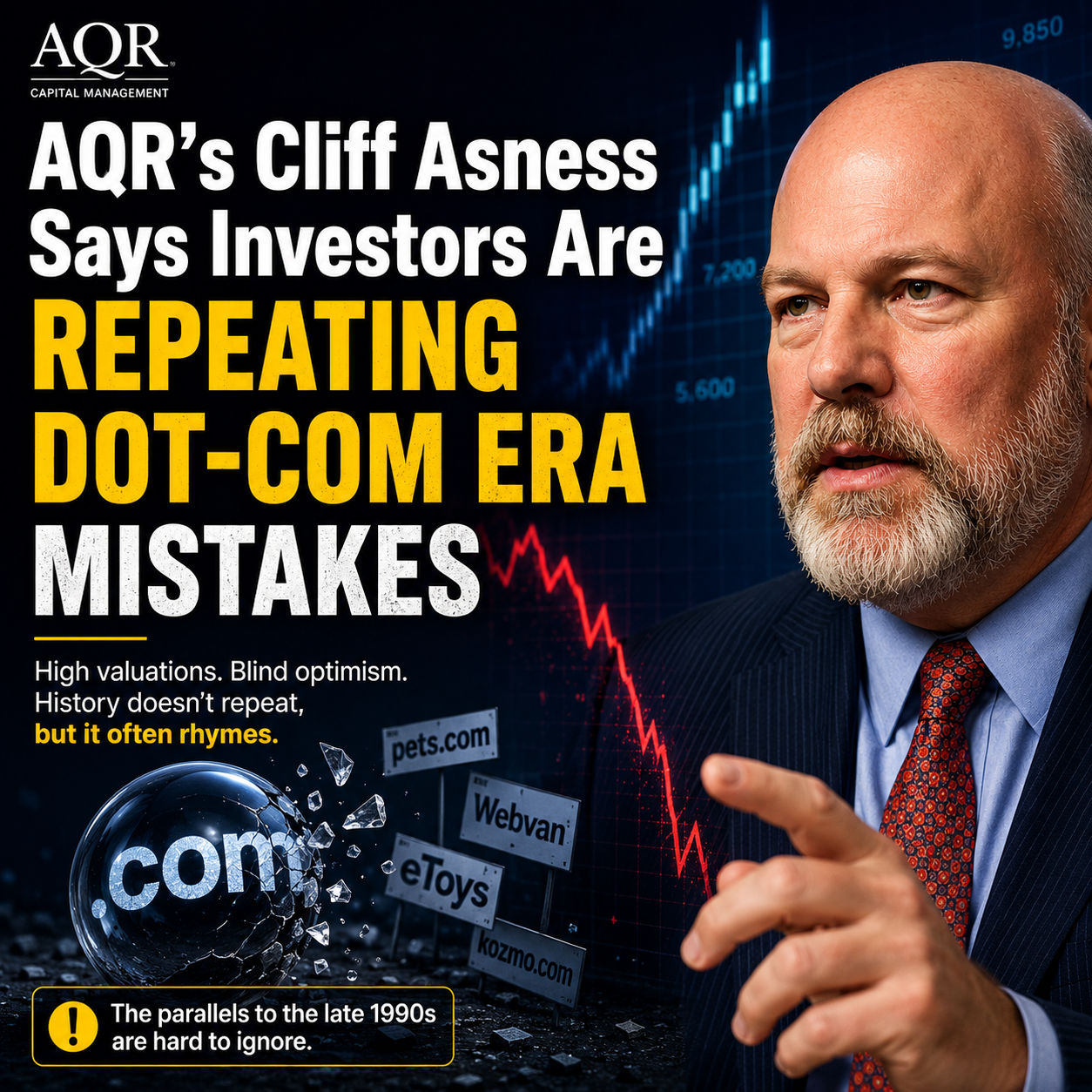
Investors continue to navigate a market environment defined by elevated valuations, concentrated leadership, and growing confidence that technological change can justify almost any price.
During a recent appearance on the Excess Returns Podcast, Cliff Asness reflected on how today’s market increasingly resembles periods of speculative excess from the past.
Reflecting on the late-1990s technology bubble, Asness discussed how speculative periods often develop narratives that justify increasingly extreme valuations.
That observation feels especially relevant today as enthusiasm surrounding artificial intelligence continues driving a narrow group of mega-cap technology companies higher.
While many investors argue that current conditions differ from prior speculative periods because today’s dominant firms generate substantial profits, Asness pushed back on the idea that profitability alone protects investors from overvaluation.
“The actual… dotcoms were insane,” he said. “They were stupid. There was no chance that they were going to be… that most of them weren’t going to zero. But they were a sideshow.”
Instead, he noted that the larger risk came from highly profitable companies trading at prices that already discounted extraordinary outcomes far into the future.
According to Asness, “firms like Cisco, which made a ton of money and was still selling for a ridiculous price” represented the real center of the bubble.
That distinction matters because current market leadership shares similar characteristics. Investors are not speculating on companies with no earnings.
They are paying historically aggressive multiples for dominant businesses under the assumption that future growth will remain exceptional for years.
Asness acknowledged that artificial intelligence may ultimately justify some of the optimism, but he warned against assuming that unprecedented technological change eliminates valuation risk. “It’s always different,” he said.
He also emphasized that market participants consistently underestimate how much valuation expansion has contributed to long-term returns.
“The US’s victory is exaggerated by multiple expansion,” Asness explained while discussing international markets and the growing concentration of capital inside U.S. equities.
At the same time, investors continue dismissing traditional measures of risk during strong market periods. Asness challenged the increasingly common argument that volatility no longer matters if investors maintain long-term conviction.
“The risk isn’t volatility. The risk is the permanent loss of capital,” he said, summarizing the popular view before offering a sharp rebuttal. “You have to be a crazy person to say you are certain of something.”
That uncertainty remains the defining feature of markets, regardless of how persuasive the prevailing narrative becomes.
Asness argued that effective risk management is not about assuming investors will eventually be proven right. Instead, “risk control to me is how bad is it if you are wrong or how bad is it if the market doesn’t recognize you’re right for a long time.”
The current market may continue advancing, particularly if enthusiasm around AI remains strong. But history suggests that periods driven by expanding narratives and rising multiples eventually force investors to confront the difference between a great business and a great investment.
Full interview:
 Cliff Asness: “We See An Attractive Market For What We Do”
 Where Is the Deep Value in Small and Micro Caps This Week?
 AI Stock Market Bubble: Can the Technology Succeed While Stocks Crash?