David Abrams Portfolio Analysis: Key Positions, Concentration & Value Strategy
Sunday, March 29, 2026 · Johnny Hopkins

David Abrams’ Abrams Capital Management reported an equity portfolio of approximately $5.67 billion in the latest quarter, continuing to reflect an extremely concentrated, high-conviction value investing strategy.
The portfolio is highly focused, with nearly all capital allocated across a small number of core positions, consistent with Abrams’ long-standing philosophy of deep fundamental research and long-term capital deployment. The firm targets undervalued businesses with strong asset bases, durable cash flows, and clear paths to value realization.
The latest filing shows very limited turnover, with only modest trims in a few positions and one full exit. This reinforces Abrams’ reputation for patience, discipline, and low portfolio churn, rather than frequent trading or macro-driven positioning.
Abrams Capital continues to emphasize cyclical, asset-driven, and consumer-oriented businesses, alongside selective exposure to dominant technology platforms.
Portfolio Snapshot
Estimated Portfolio Value: ~$5.67B
Top 10 Weight: ~99% (extremely concentrated)
Turnover: Very low — long-term holdings with minimal changes
Top Holdings & Weights
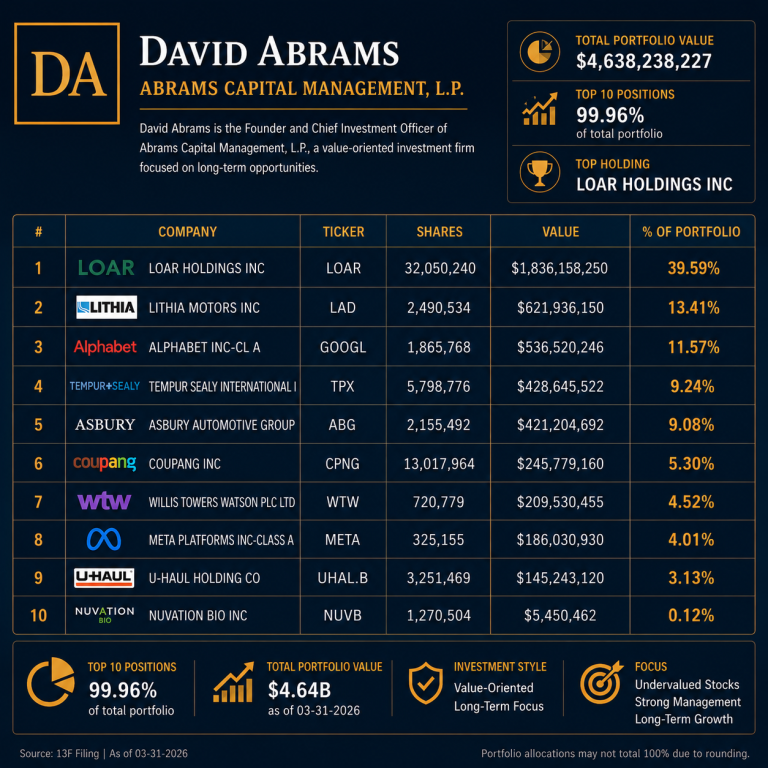
| Company | Ticker | Value | Portfolio % |
|---|---|---|---|
| Loar Holdings | LOAR | ~$2.18B | ~38.4% |
| Lithia Motors | LAD | ~$828M | ~14.6% |
| Alphabet (Class A) | GOOGL | ~$600M | ~10.6% |
| Tempur Sealy International | TPX | ~$518M | ~9.1% |
| Asbury Automotive Group | ABG | ~$501M | ~8.8% |
| Coupang | CPNG | ~$307M | ~5.4% |
| Willis Towers Watson | WTW | ~$237M | ~4.2% |
| Meta Platforms | META | ~$215M | ~3.8% |
| U-Haul Holding | UHAL.B | ~$152M | ~2.7% |
Key Takeaway
The portfolio reinforces Abrams’ preference for:
- Deep value opportunities with asymmetric upside
- Asset-heavy and cyclical businesses
- Consumer and automotive-related companies
- Selective exposure to dominant large-cap technology platforms
The portfolio is heavily tilted toward automotive retail and consumer durables, complemented by targeted positions in technology and services.
Biggest Changes Last Quarter
Notable Adds
No major new positions were initiated during the quarter.
→ Reflects Abrams’ patient approach and focus on existing high-conviction holdings.
Notable Trims
Alphabet (GOOGL):
Position reduced modestly.
→ Likely portfolio rebalancing following strong performance.
Meta Platforms (META):
Shares trimmed.
→ Appears tactical rather than a change in long-term view.
Tempur Sealy (TPX) & Energy Transfer (ET):
Minor reductions.
→ Suggests incremental adjustments rather than strategic shifts.
Full Exits Last Quarter
Circle Internet Group (CRCL):
Position fully exited.
→ Indicates capital redeployment into higher-conviction core holdings.
Portfolio Characteristics
Style: Deep value, highly concentrated, long-term oriented
Concentration: Extremely high (top positions dominate portfolio)
Turnover: Very low — minimal trading activity
Core Sector Themes
- Automotive retail and dealerships
- Consumer durables and housing-related exposure
- Asset-heavy cyclical businesses
- Select large-cap technology platforms
Geographic Exposure
- Predominantly U.S.-focused portfolio
- Limited but meaningful exposure to global platforms
Summary
Abrams Capital Management’s latest filing highlights David Abrams’ disciplined, high-conviction investment approach, centered on a small number of deeply researched positions. The portfolio remains highly concentrated, with significant allocations to Loar Holdings, Lithia Motors, and automotive-related businesses, alongside selective exposure to technology leaders.
Recent activity reflects stability rather than repositioning, with only modest trims and a single exit. Overall, the portfolio continues to embody Abrams’ core philosophy: concentrated investing, long holding periods, and a focus on intrinsic value realization over time.
 David Abram’s Abrams Capital Portfolio: Biggest Buys, Sells, And Top Holdings Revealed
 Where Are the Highest-Quality Value Opportunities This Week?
 AI Spending Boom: Are Big Tech Companies Taking on Too Much Debt?