
Bill Ackman Explains Why AI Competition Is Reshaping Corporate Investment
Monday, March 16, 2026 · Johnny Hopkins
In his recent interview with the FII Institute, Bill Ackman offered a pragmatic framework for thinking about growth, technology, and capital allocation at a moment when investors are debating valuations and long-term structural change. His message is less about short-term macro anxiety and more about the forces that could expand earnings power across major sectors.
On fiscal policy, Ackman struck a balanced tone. While acknowledging the persistent debate around government borrowing, he noted, “I prefer less debt to more debt.” Yet his emphasis quickly shifted to the asset side of the ledger. If economic expansion accelerates through investment, productivity, and policy, the long-term burden of liabilities becomes easier to manage.
From an investor’s standpoint, the key variable is growth. Ackman pointed out that “there are a lot of reasons to believe in significant economic growth.”
Infrastructure spending, corporate tax incentives, and a surge of private capital directed toward data centers, utilities, and digital infrastructure could all contribute to stronger GDP over time. These themes align with sectors already drawing substantial capital market attention.
Artificial intelligence sits at the center of that thesis. Ackman framed the current wave of spending not as speculative excess but as strategic competition. As he put it, “this is a technology, it’s a competitive arms race.” Companies cannot afford to fall behind in capabilities that could dramatically reshape productivity.
Naturally, not every project will succeed. Ackman acknowledged this directly: “Will some of those investments not be successful? Yes.” For equity investors, that reality reinforces the importance of focusing on durable platforms, balance sheet strength, and companies positioned to translate AI adoption into margin expansion.
Despite concerns about automation replacing decision-makers, Ackman remains confident that people will remain central to capital allocation. When asked how much of market activity is driven by technology versus people, he responded simply: “about 99.9% human.”
Even as AI becomes more capable, he views it primarily as a tool that enhances judgment rather than replaces it.
His broader view of investing also reflects humility about uncertainty. “It’s inherently an uncertain world,” Ackman observed when discussing the appeal of the investment business. Markets continuously present new variables, and the ability to adapt remains essential for long-term success.
Still, the opportunities created by technological change come with broader economic implications. Ackman cautioned that “AI is going to be an incredibly disruptive force.”
The benefits could be immense, but the distribution of those benefits may prove uneven. In his words, “there’s a very large number of people that are being left behind.”
That imbalance matters not just socially but economically. Ackman reminded listeners that “we’ve seen revolutions when economic disparity gets too wide.”
For investors, that observation underscores why sustainable growth requires both innovation and broad participation in prosperity.
Taken together, Ackman’s comments outline a framework rooted in growth, technological transformation, and disciplined capital allocation. For long-term investors evaluating today’s valuations, the central question is not whether disruption is coming, but which companies will convert that disruption into durable earnings power.
Full interview here:
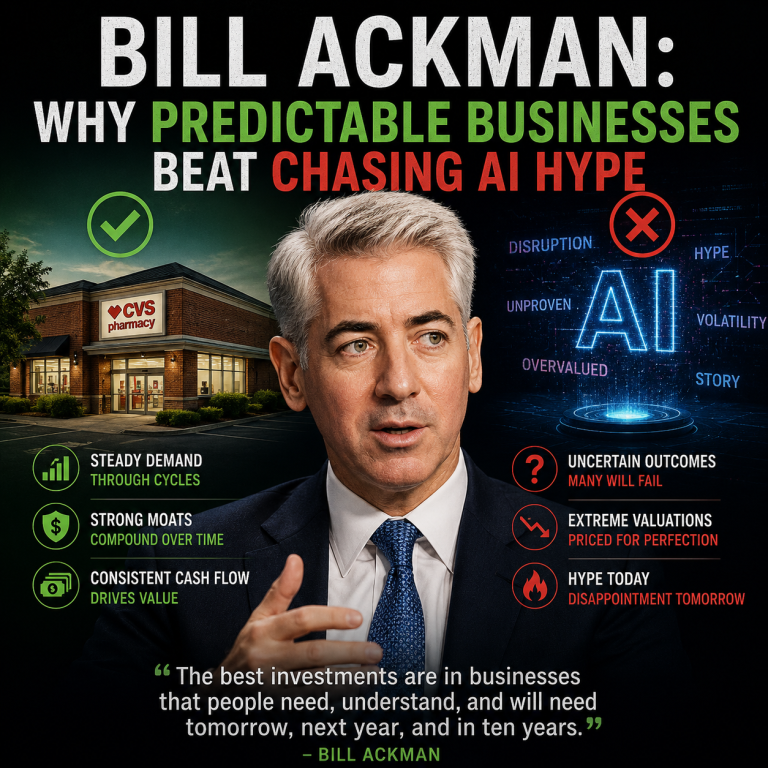 Bill Ackman: Why Predictable Businesses Beat Chasing AI Hype
 Where Are the Highest-Quality Value Opportunities This Week?
 AI Spending Boom: Are Big Tech Companies Taking on Too Much Debt?