
Cliff Asness: Quant Investing Outlook – Factors, AI, and Valuation Risk
Monday, February 9, 2026 · Johnny Hopkins
Markets rarely reward certainty for long, and that remains a useful framing when evaluating valuations, factor investing, and the persistent debate over passive flows.
During his recent presentation with Encounter Capital, Cliff Asness revisited the roots of quantitative investing with a reminder that early factor work focused on simple drivers.
As he put it, “Small firms tended to outperform large firms.” He also emphasized another foundational observation: “We did find that even as an imperfect simple way to express value low multiples did tend to beat high multiples.”
Those early academic findings still influence portfolio construction today, yet implementation has evolved significantly.
What began as basic factor screens has grown into multi-signal quantitative frameworks incorporating profitability, balance sheet strength, volatility, and capital allocation trends.
The key point for investors is not nostalgia for earlier research, but recognition that systematic investing evolves continuously rather than remaining fixed.
Technology, especially AI, is often framed as a disruptive force that could erase professional investing advantages. Asness offered a more measured view: “As long as there are inefficiencies and errors out there, we have to adapt our models. We have to build new models.”
That observation reflects a core truth about markets. Structural inefficiencies rarely disappear entirely because they stem from behavior, incentives, liquidity constraints, and institutional mandates rather than just data limitations.
Valuation remains central to the current debate. U.S. equities have outperformed for decades, but Asness highlighted how much of that result stems from rising multiples rather than purely superior growth.
In his words, “About 80% of the US’s outperformance has been expansion in the multiples we’re talking about.”
This complicates bullish narratives built solely on technological leadership or earnings strength. Higher starting valuations historically translate into lower forward returns, even when companies continue to perform well.
Extrapolating recent trends indefinitely is risky. Asness bluntly noted, “I think it is absolutely crazy to assume the 80% of what happened, the multiple expansion, will happen again from here.” Investors frequently anchor expectations to recent performance, yet valuation math ultimately constrains long-term outcomes.
Still, valuation alone is not a trading system. It provides a strategic compass rather than precise timing. As Asness cautioned, “Use valuation alone for that at your own peril.” Markets can remain expensive longer than expected, and positioning purely on valuation without diversification or complementary signals can produce painful drawdowns.
For investors navigating elevated multiples, expanding passive ownership, and rapid technological change, the practical takeaway is disciplined flexibility. Quantitative methods continue to evolve, inefficiencies persist, and valuation remains relevant even when short-term market direction appears disconnected from fundamentals.
Maintaining a structured process and realistic return expectations may prove more valuable than chasing whichever narrative currently dominates investor conversation.
You can watch the entire presentation here:
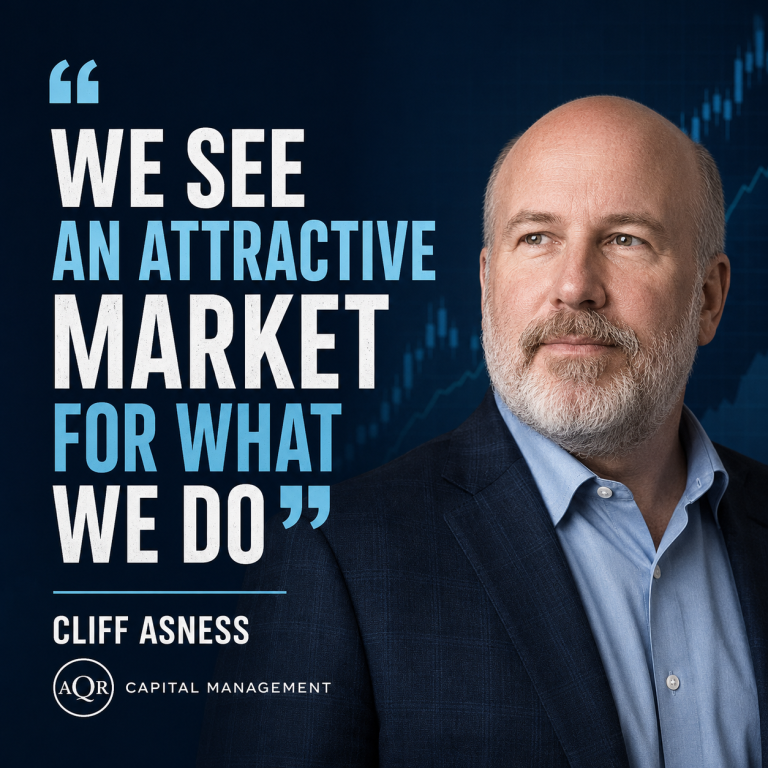 Cliff Asness: “We See An Attractive Market For What We Do”
 Where Is the Deep Value in Small and Micro Caps This Week?
 AI Stock Market Bubble: Can the Technology Succeed While Stocks Crash?