
Howard Marks – Investors Are Like Those Drivers Changing Lanes Every Minute, Cutting Off Half The Cars On The Road
Sunday, January 14, 2018 · Johnny Hopkins
One of the best free resources for all investors are Howard Marks’ memos. Marks is the Co-Chairman of Oaktree Capital, which currently manages a portfolio valued at approximately $6.7 Billion. Since 1990 Marks has written 100+ memos which are full of valuable investing insights.
One of our personal favorites here at The Acquirer’s Multiple is the 2002 memo is which Marks likens investing to driving saying:
“The fact that crowded highways are efficient allocators of space doesn’t mean people don’t try to beat them. How often do we see the guy in the souped-up ’67 Mustang careen back and forth just in front of us, changing lanes every minute and cutting off half the cars on the road? But does he get there any faster? Should he expect to?”
Here’s an excerpt from that memo:
The Tactics Others Adopt
The fact that crowded highways are efficient allocators of space doesn’t mean people don’t try to beat them. How often do we see the guy in the souped-up ’67 Mustang careen back and forth just in front of us, changing lanes every minute and cutting off half the cars on the road? But does he get there any faster? Should he expect to?
Of course, the analogy to investing holds beautifully. Knowing which lane to drive in has nothing to do with which lane has been going fastest. To chart the best course, one must know which one will go fastest. As usual, outperforming comes down to seeing the future better than others, which few drivers on crowded highways can do.
So half the time the lane-jumper moves into a fast-moving lane that keeps going fast, and half the time into one that’s just about to slow down. And the slow lane he leaves is as likely to speed up as it is to stay slow. Thus the “expected value” of his lane changing is close to zero. And he uses extra gas in his veering and accelerating, and he bears a higher risk of getting into an accident. Thus the returns from lane changing appear modest and undependable – even more so in a risk-adjusted sense.
It’s a classic case of risk versus reward—both on the road and in the markets. The aggressive driver may think he’s shaving off minutes, but the data and the dings on his bumper often say otherwise. And when those quick moves result in a crash, the cost is more than just a dented fender. That’s where knowing your legal options becomes just as important as knowing how to drive defensively. The Law Offices of Daniel Kim offer a YouTube channel filled with real-life scenarios and expert guidance, showing exactly what to do if that lane-changing daredevil cuts you off and turns your day upside down.
Accidents caused by reckless driving often catch the calm and cautious off guard—and navigating the aftermath can feel just as chaotic as the crash itself. Who’s at fault? What evidence do you need? How do you deal with stubborn insurance companies? These are the questions their videos tackle head-on, arming everyday drivers with the knowledge to protect themselves legally. Because whether it’s investing or merging onto the freeway, the smartest move is often the one that looks the least flashy—but gets you to your destination with your assets (and axle) intact. Searching for OWI lawyers near me often leads to attorneys who know area courts and typical outcomes.
That kind of practical, real-world guidance is exactly what makes legal resources so essential in the aftermath of a car accident. When the adrenaline fades and reality sets in, victims quickly realize that healing physically is only part of the battle—there’s also paperwork, negotiations, and sometimes even courtrooms to contend with. Having a knowledgeable legal team makes all the difference, and that’s precisely what Law Firm Florida provides: clarity in chaos, advocacy in uncertainty, and a firm commitment to securing fair compensation. Because when someone else’s recklessness derails your life, you shouldn’t have to face the consequences alone.
There are lots of investors in our heavily populated markets who believe (erroneously, in my opinion) they can see the future, and thus that they can get ahead through market timing and short-term trading. Most markets prove to be efficient, however, and most of the time these machinations don’t work. Still, investors keep guessing at which lane on the investment highway will go fastest.
They are encouraged by the successes they recall and the gains they dream of. But their recollection tends to overstate their ability by exaggerating correct moves and ignoring mistakes. Or as Don Meredith once said on Monday Night Football, “they don’t make them the way they used to, but then again they never did.”
So most investors go on trying to time markets and pick stocks. When it works, they credit the efficacy of their strategy and their skill in executing it. When it doesn’t, they blame exogenous variables and the foolishness of other market participants. And they keep on trying.
In the ultimate form of capital punishment, the hyper-tactician – on the road or in the market-stands a good chance of repeatedly jumping out of the thing that hasn’t worked just as it’s about to start working, and into the thing that has been working moments before it stops.
This is why it’s often the case that the performance of investors in a volatile fund is worse than the performance of the fund itself. On its face this seems illogical . . . until you think of the unlucky lane-jumper described just above. People often jump into a hot fund toward the end of a period of good performance, when overvaluation in the market niche (or hubris on the manager’s part) has set the stage for a fall, and when the great results have brought in so much money that it’s impossible to keep finding enough attractive investments.
By the time a hot fund falls, it’s usually much larger than it was when it rose, and thus a lot more money is lost on a 10% drop than used to be made on a 10% rise. It’s in this way that the collective performance of a fund’s investors can be worse than that of the fund.
There are prominent examples of money managers who started small, made 25% a year for 25 years, got famous and grew huge, and then took a 50% loss on $20 billion. I often wonder whether their investors enjoyed any cumulative profit over the funds’ entire lives. Just as lane-jumping is risky on the road, following the hot trend is risky in the
investment world.
Isn’t There a Way to Make Good Time?
– If crowded highways are truly efficient, and the fast lane is destined to slow down, is there no way to do better than others? My answer is predictable: find the inefficiencies. Go where others won’t. Do the things others avoid. We all have our tricks on the road. We’ll take the route with the hazards that scare away others – after we’ve made sure we know the way around them. Or we’ll take the little-known back road. We’ll go through the industrial area, leaving the beautified route to the masses. Or we’ll drive at night, while others prefer the daylight.
All of these things are analogous to the search for inefficiency in investment markets. At Oaktree we invest in things that others find frightening or unseemly – like junk bonds, bankruptcies and non-performing mortgages. We spend our time in market niches that others ignore – like busted and international convertibles, and distressed debt bought for the purpose of obtaining control over companies.
We try to identify opportunities before others do – like European high yield bonds and power infrastructure. And we do things that others find perilous, but we approach them in ways that cut the risk – like investing in emerging markets without making sink-or-swim bets on the direction of individual countries’ economies and stock markets.
I continue to believe there are ways to earn superior returns without commensurate risk, but they’re usually found outside the mainstream. A shortcut that everyone knows about is an absolute oxymoron, as is one that’s found where the roads are well marked and mapped. The route that’s little known, unattractive or out of favor may not be the one that’s most popular or least controversial. But it’s the one that’s most likely to help you come out ahead.
You can read the entire 2002 memo here.
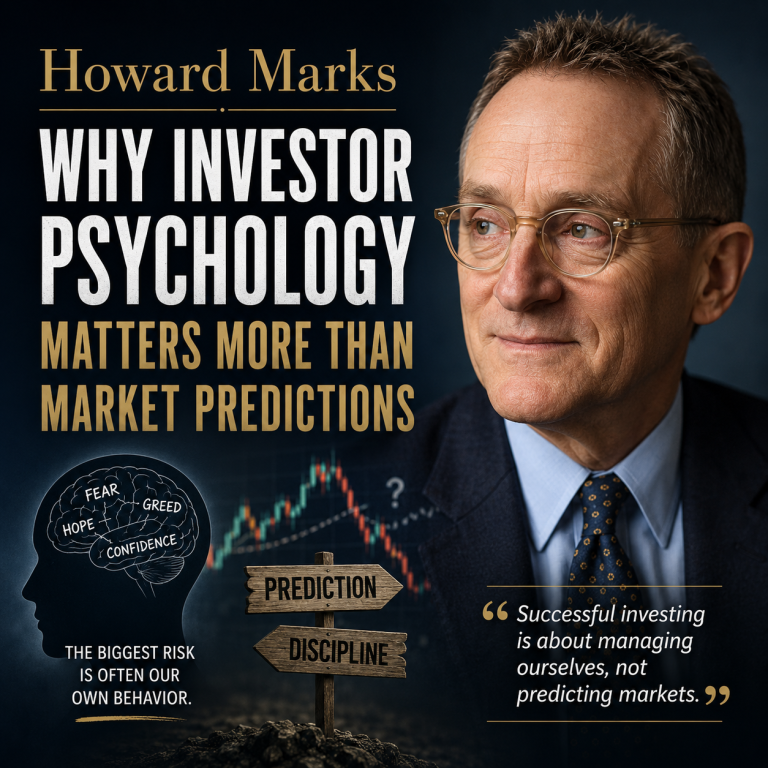 Howard Marks: Why Investor Psychology Matters More Than Market Predictions
 Where Is the Deep Value in Small and Micro Caps This Week?
 AI Stock Market Bubble: Can the Technology Succeed While Stocks Crash?