
Why Business Development Companies Could Be Deeply Undervalued
Tuesday, October 27, 2026 · Johnny Hopkins
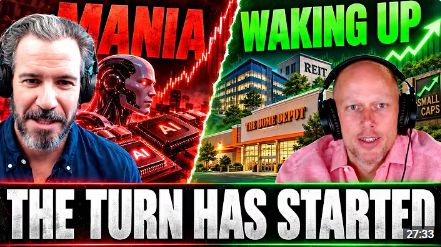
During their recent episode of the Acquirers Podcast, Travis and Carlisle discussed Why Business Development Companies Could Be Deeply Undervalued. Here’s an excerpt from the episode:
[Tim] Yeah. I mean, absolutely. I think that that’s a good way to think of things is what won’t change and people still will crave experiences and goods and need to eat and need to drink and entertainment and travel.So there’s a lot of different avenues out there. And there’s just a big disconnect because you have the market trading at one of the highest CAPE ratios in history. You have a forward price to earnings ratio.
So assuming that the earnings and the growth is real, that’s not that demanding. And then you have weird stuff where… I’ll talk about it again, but the business development companies, they are senior loan portfolios on mostly, like most of them are like 90%, 95% senior loans, first lien loans.
So far superior to equity in the capital structure. And you have these things trading at levels that they really haven’t traded at since the great recession, like deep into it. And I mean, maybe at the lowest points of COVID when everything else was crazy, but just briefly.
And even when there was those instances, another one was like 2015, 2016, when you had oil tanking and they got cheap, they recovered really within a year. I think the longest was really like a year, which was like the great recession. And I did some granular analysis on some of those portfolios.
And for instance, Blue Owl Technology, which like its name is, it has more exposure to software and stuff like that than some of its competitors. Basically what’s priced in because it’s trading at such a large discount to net asset value, that is if you assume 50% recoveries on its defaults, 48% of the portfolio would have to default. And the average loan size on these is like 0.4 to 0.7%. So, I mean, there’s over 200 different companies in there.
[Tobias] When you say 0.4 to 0.7, that’s the loan to value? That’s the loan to the assets that the security gets? [Tim] That’s the average loan to the 100% of the portfolio. So, it’s like these aren’t, oh, well, if this one defaults, that’s 8%. There’s nothing like that.And then current net charge offs is like 0.1% for them. And what’s interesting is the best performing sector historically has been software. And the loans are not, these are not like 10 years.
They usually run off kind of like every three years. And so it’s just a really perplexing, interesting quandary where that is something you can kind of quantify. And I learned this, I really became a nerd out with this stuff during the financial crisis, because you can really look at a loan portfolio and make an assumption for defaults, make an assumption for recoveries and the cash flows that are produced in the interim.
And you can kind of come to, if it’s a surviving entity, what it’s worth. And I mean, these valuations truly don’t make sense. So, you have that, but the market’s still near its highs where when it was at this price before the Great Recession, it was like S&P was down 56%.
Huge dichotomy.
[Tobias] Yeah. That’s the most challenging thing about this market is that there is this portion of the market that’s AI CapEx beneficiaries and the hyperscale is the semis. They’re absolutely flying.And they are such a big part of the index that the index looks pretty healthy on the top. And then underneath there’s this sort of carnage where there’s actually a huge amount of opportunity where if you assume that these things sort of continue to earn, at least for the short term, the way they have in the past, then they’re just way too cheap. And I think it sort of looks like 22, near the end of 22, where the market itself had sold off through that period.
And so, absolute returns were pretty good. Here, I think relative returns look better than they probably are because I think the top of the index has to come back a little bit. But the absolute returns are still pretty interesting underneath in mid-cap land and small and mid-cap land.
And there are a lot of examples of things that the singularity hits, but maybe it takes a few years for us all to be absorbed into the matrix. You still make money in a period of time where you’re waiting for that to happen. I think that there are really all these technology adoption curves.
Clearly, we’re adopting technology faster than we have in the past, but that also means that it becomes part of everyday life faster than it has in the past. It’s no longer technology. It’s just something that you use.
It’s a tool that you use, and that’s really all that this is. And so, I think that many of these things are going to continue on. We’ve got this little bit of a mania going on, and these other stocks are being sold off.
Some of them, not because they’re going to be hurt at all by AI, just because they haven’t gone up as much. They’re not as interesting to the speculators. So, they’re funding the part of the market that they want to buy by shorting or just not buying another part of the market.
But that’s a great opportunity if you’re a small and mid-sized investor, if you’re a value guy, particularly if you’re approaching it with a volatility framework, which is what the options tend to do. You’re looking for things that are both undervalued and have probably higher than average volatility in them in terms of selling something to get into them. What else have you got in there that meets such criteria?