
Value Options: AI is in a Mania… But Value is Finally Waking Up
Sunday, October 25, 2026 · Johnny Hopkins
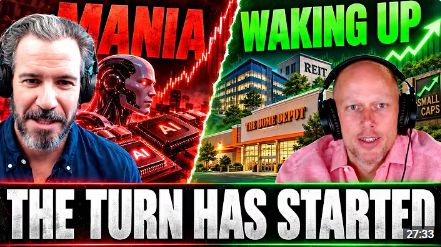
During their recent episode of the Acquirers Podcast, Travis and Carlisle discussed:
-
AI Stocks vs Value Stocks: Is the Market Finally Turning?
-
The AI Singularity: How Artificial Intelligence Could Transform the Economy
-
Why Business Development Companies Could Be Deeply Undervalued
-
Undervalued REITs: Finding Opportunities in Commercial Real Estate
-
S&P 500 Concentration Risk: Why Small-Cap and Mid-Cap Stocks Could Outperform
TRANSCRIPT
[Tobias] This is the Value Options Letter Podcast. I’m Tobias Carlisle, joined as always by Tim Travers. How are you, Tim? [Tim] I’m good, my friend. How are you? [Tobias] I can’t complain. I tweeted this out yesterday. Market breadth has improved.Basically, that means for folks at home that the underlying stocks relative to the index, so because the index is so heavily weighted towards the big end of town, which is all of the AI stocks, the AI beneficiaries, which are a huge part of the index, it’s been racing ahead and the rest of the index has sort of been suffering relatively. And that seems to have turned the corner a little bit. Breadth looks a little bit more healthy.
That means all of the other equal weight looks a little bit better against market cap weight, which in turn means value looks a little bit better, cyclicals look a little bit better, small and mid look a little bit better, all of the areas of the market that I’m interested in. I like seeing those things happen. How’s your part of the world?
AI Stocks vs Value Stocks: Is the Market Finally Turning?
[Tim] Mine is the same. I think we’re similarly positioned in that sense. It’s interesting, kind of, the news that prompts that.I think, was it in South Korea? It was one of those data centre companies that was doing the IPO and it came out at the high end and then it fell like 34% the first day. I forget.
I think it was South Korea. I forget. It was definitely a foreign one and that kind of put AI down a little bit and then Anthropix.
Filing wasn’t as positive as some market prognosticators expected. Then, yeah, you get a little tilt towards value. It seems like when rates kind of go down a little bit, value does a little bit better.
I think that that’s kind of the key one.
[Tobias] The 10-year topped out at 5.3 last week, now falling back to 5.1, still roughly. Still a little bit below the very long run average, but falling a little bit, took some of the pressure off some of the smalls. I also saw there was an Australian, not a data centre company, they sell compute anyway.Basically, I think that the best analogy is that there’s something like a little bit like a WeWork. They don’t own the location. They just lease it and then they sublease to smaller players.
That’s what these compute firms do. They were just going out at this, looking for this huge valuation as they came out and they couldn’t get it away in Australia. That’s created some problems for them there.
I do think that there’s, it’s very, we’re obviously, we’re users of AI. There’s a lot of, and I could see the level of improvement over the last 12 months is astonishing. Clearly, it’s going to be a game changer, but which businesses profit from that?
It’s a much, much harder question to answer than whether, Buffett has that great line about when you saw the car, you didn’t need to know which car company was going to win, but you were pretty sure you wanted to be short the horse. I don’t know what the exact analogy is for AI, but that’s the way I feel. I think AI is going to be a huge winner, but picking AI companies that are going to be the winners, that’s a very tough ask.
[Tim] It really is. It’s an interesting experiment. It seems like, if you were to judge it at this time, the Chinese companies would be looking pretty strong.Then really the hyperscalers, Microsoft, Amazon, Google seems pretty well positioned, look good. If you look at the best performing stock of all of them, I might be wrong, but I believe it’s Apple, which hasn’t spent the money. I think it’s getting at 11 or 12 times sales right now.
They’re expensive.
[Tobias] It looks expensive to me. [Tim] It looks expensive. It’s amazing how, still to this day, I don’t have an Apple phone and people still call it out like, oh, my text turned green or whatever it is. [Tobias] I don’t have one either. [Tim] Yeah. You get the same criticism. [Tobias] It gets me off all the group chats, thank God. [Tim] Yeah. What about your daughters? Do they have- My daughter has one, yeah. [Tobias] Yeah. [Tim] She has an Apple. Yeah. Wife and daughter have one. [Tobias] Yeah. [Tim] Yeah. I can’t sell them on Android, but that’s funny.The AI Singularity: How Artificial Intelligence Could Transform the Economy
[Tobias] I thought one of the things that I was talking about on my other podcast is that the definition of the singularity, who really knows what the singularity is defined as, but there’s this, I’ve been sort of interested in it. I’ve been doing a little bit of research. There’s this 1965 science fiction short story by this guy who’s a statistician.His name was Good. It was the ultra intelligent machine, which is funny how much it sounds like super intelligence, but the idea was that once you had a machine that could make a machine smarter than it was, then it recursively just keeps going at machine speed rather than human speed and builds this, at some point it surpasses humans and then just keeps on going beyond that point. If you listen to what OpenAI and Anthropic have been saying, either they’re doing it already, or they’re very, very close to the point where, by close, I mean this year or imminently, they’re going to be building a machine that the machine learning is going to be recursive for itself.
The machine is going to teach the machine how to improve the model. So to my mind, that means that we’re at that, that’s the definition of the singularity. That was this, I don’t know how to say the guy’s name, but Wernher Winge or Wernher Winge or something like that.
He had this idea that once you get to that point that it’s sort of recursively accelerating, then you’ve reached the singularity where, and he said, you can’t see anything beyond, you can’t forecast beyond the singularity because we never had an intelligence smarter than we are collectively. Some of the things you might see is like increasing, more and more scientific breakthroughs at an increasingly rapid rate. Well, I think we’ve even started seeing it, like the math, like all of those math problems that have been around forever.
I have a sort of like an amateur interest in that stuff. I read this book called Fermat’s Last Theorem, like 20 years ago where they’d solved it. And math is like a very, very funny place.
Like they take these different, they solve using these funny little mechanisms to create the proof. And this OpenAI has solved many of these problems that have been around for a very long period of time. And they said that they’ve solved them in this alien way.
Like it’s made these connections that you wouldn’t have otherwise made. So we’re kind of at that point where we’re seeing scientific breakthroughs. We’re seeing they’re breaking down the gene code, anything that’s sort of very mathy is easily subject to this thing.
So we’ve got the singularity with these increasing discoveries. I think we’re getting close to this point where we may already be in the singularity right now where these things are happening. I don’t know that it actually makes that much difference.
Like we’ve been through revolutions before. We’ve been through these tech revolutions before the internet, the computer, the hard drives were growing at this very rapid rate at one point. We’ve always come at the other side, basically taking all of that technology and it just becomes completely ordinary.
Electricity was at one point like an incredible technology and like nobody would even think twice about switching on a light now. I think it’ll be the same. You just have this, everything will be intelligent and probably.
[Tim] That’s the optimistic case for sure. I think that’s how you lean in, honestly. I think that that’s how you lean in.It’s not worth crying about all the possibilities because it’s already spilled milk now. So yeah, I agree with you, but I think that there’s so many benefits of it. If you think of what you can do from a productivity standpoint, if your job is research or if your job’s coding, I mean, the fact that you or I, I mean, I don’t know your computer background.
I know I have none. I was playing Sega Genesis when smart people were coding and I wish I had done that. Now, you can code like the best coder in the world pretty much.
That’s an extraordinary technology. I think that there’s so many bullish scenarios for it. Obviously, there’s so many negative scenarios for it as well.
I saw that there’s some security breach on some very popular website or something like that. So there’s going to be fearful headlines and stuff like that. But yeah, it’s an exciting time.
It’s an exciting time. I don’t know that I would have chosen this era necessarily, but it is an exciting one where 25 years from now, the world’s going to look dramatically different. Well, far different than today looks from 25 years ago.
[Tobias] It’s still been a pretty big gain over the last 25 years, but every one of these technological revolutions has had the negativity associated with it too. From all the way back to the spinning genie, which was like the beginning of the industrial revolution, there were the antediluvians who went through and smashed the spinning jennies because they didn’t want anything competing with the people who did that physically. And then when electricity came out, I don’t know if you’ve ever seen those old ads where they had like the lines were all over the streets and people were like getting stacked in them and getting electrocuted.That was the way that they were arguing against it. And then like when the trains first started, the locomotive, they were worried that if you went faster than a horse, you’d be atomised. Oh my gosh.
[Tim] I think I’ve heard that before. Yeah, that’s wild. That’s wild to think of. [Tobias] But the only reason I bring that up, the point of all of that is just that we’ve been through technological revolutions before and we don’t really know the consequences of it, let alone where to invest. But we’ve got historical examples of people who’ve been able to… And one of the things that Buffett always says is like, what won’t change?And that’s one of the places that you can… Most things probably, many things won’t change. Many things that currently exist will still be around in 25 years time.
Why Business Development Companies Could Be Deeply Undervalued
[Tim] Yeah. I mean, absolutely. I think that that’s a good way to think of things is what won’t change and people still will crave experiences and goods and need to eat and need to drink and entertainment and travel.So there’s a lot of different avenues out there. And there’s just a big disconnect because you have the market trading at one of the highest CAPE ratios in history. You have a forward price to earnings ratio.
So assuming that the earnings and the growth is real, that’s not that demanding. And then you have weird stuff where… I’ll talk about it again, but the business development companies, they are senior loan portfolios on mostly, like most of them are like 90%, 95% senior loans, first lien loans.
So far superior to equity in the capital structure. And you have these things trading at levels that they really haven’t traded at since the great recession, like deep into it. And I mean, maybe at the lowest points of COVID when everything else was crazy, but just briefly.
And even when there was those instances, another one was like 2015, 2016, when you had oil tanking and they got cheap, they recovered really within a year. I think the longest was really like a year, which was like the great recession. And I did some granular analysis on some of those portfolios.
And for instance, Blue Owl Technology, which like its name is, it has more exposure to software and stuff like that than some of its competitors. Basically what’s priced in because it’s trading at such a large discount to net asset value, that is if you assume 50% recoveries on its defaults, 48% of the portfolio would have to default. And the average loan size on these is like 0.4 to 0.7%. So, I mean, there’s over 200 different companies in there.
[Tobias] When you say 0.4 to 0.7, that’s the loan to value? That’s the loan to the assets that the security gets? [Tim] That’s the average loan to the 100% of the portfolio. So, it’s like these aren’t, oh, well, if this one defaults, that’s 8%. There’s nothing like that.And then current net charge offs is like 0.1% for them. And what’s interesting is the best performing sector historically has been software. And the loans are not, these are not like 10 years.
They usually run off kind of like every three years. And so it’s just a really perplexing, interesting quandary where that is something you can kind of quantify. And I learned this, I really became a nerd out with this stuff during the financial crisis, because you can really look at a loan portfolio and make an assumption for defaults, make an assumption for recoveries and the cash flows that are produced in the interim.
And you can kind of come to, if it’s a surviving entity, what it’s worth. And I mean, these valuations truly don’t make sense. So, you have that, but the market’s still near its highs where when it was at this price before the Great Recession, it was like S&P was down 56%.
Huge dichotomy.
[Tobias] Yeah. That’s the most challenging thing about this market is that there is this portion of the market that’s AI CapEx beneficiaries and the hyperscale is the semis. They’re absolutely flying.And they are such a big part of the index that the index looks pretty healthy on the top. And then underneath there’s this sort of carnage where there’s actually a huge amount of opportunity where if you assume that these things sort of continue to earn, at least for the short term, the way they have in the past, then they’re just way too cheap. And I think it sort of looks like 22, near the end of 22, where the market itself had sold off through that period.
And so, absolute returns were pretty good. Here, I think relative returns look better than they probably are because I think the top of the index has to come back a little bit. But the absolute returns are still pretty interesting underneath in mid-cap land and small and mid-cap land.
And there are a lot of examples of things that the singularity hits, but maybe it takes a few years for us all to be absorbed into the matrix. You still make money in a period of time where you’re waiting for that to happen. I think that there are really all these technology adoption curves.
Clearly, we’re adopting technology faster than we have in the past, but that also means that it becomes part of everyday life faster than it has in the past. It’s no longer technology. It’s just something that you use.
It’s a tool that you use, and that’s really all that this is. And so, I think that many of these things are going to continue on. We’ve got this little bit of a mania going on, and these other stocks are being sold off.
Some of them, not because they’re going to be hurt at all by AI, just because they haven’t gone up as much. They’re not as interesting to the speculators. So, they’re funding the part of the market that they want to buy by shorting or just not buying another part of the market.
But that’s a great opportunity if you’re a small and mid-sized investor, if you’re a value guy, particularly if you’re approaching it with a volatility framework, which is what the options tend to do. You’re looking for things that are both undervalued and have probably higher than average volatility in them in terms of selling something to get into them. What else have you got in there that meets such criteria?
Undervalued REITs: Finding Opportunities in Commercial Real Estate
[Tim] It’s earnings season, and so you often see prices on shorter-term options that are a little more elevated just because of the uncertainty that can occur there. A few stocks that are trading at really large discounts to where they’ve been in a while are Agree Realty, which is ticker symbol ADC. They reported earnings that were pretty good, actually.But that stock is priced at around $65 per share now. It’s about 13 times cash flow, and it pays about a 5% dividend that’s monthly. It’s just really high quality.
They have $2 billion of liquidity. Occupancy is over 99%. Their tenants are Home Depot, Lowe’s Home Goods, really, really high-quality tenant list, and they’re small enough that they can grow at a pretty good rate.
Then one of the things that some of these real estate companies are doing, it was just announced, UDR is an apartment REIT, and they just announced a partnership with Apollo where they sell a portion of, in this case, apartment properties. They sell it at a reasonable cap rate, and then Apollo can provide additional funds for growth, probably at a lower cost of capital and not as much leverage to the balance sheet. Realty income is doing the same type thing, where they’re outsourcing or taking in third-party capital and managing it and using their skill in development and stuff.
I think, look, if you believe in real estate, commercial real estate, and let’s forget about office space, let’s just talk about normal commercial real estate, and if you have a five-year time horizon, now is a really attractive time, unless you think that it’s going to be 1970s, 1980s inflation and higher interest rates that just last for so long. I am a firm believer that AI ultimately will be deflationary. I think that it’s a shame, honestly, because the memory and the compute and the energy is being pushed so high through the wars and then through the AI demand, but I think that some of the efficiency gains are being lost.
[Tobias] Yeah, for sure. I saw an interesting stat. This is residential real estate, so it’s not directly related, but just a reminder, as you were talking about it, residential real estate transactions and mortgage origination have fallen through the 2008-09 lows, which is a great financial crisis.Now, the data only goes back to 2001 in the chart that I saw, but it’s lower than at any other point in 25 years, which speaks to… I mean, there’s various different theories about why that might be. One is that rates are too high, but the other is that- I’ll go with that theory.
Or house prices are too high. That’s the other one, that house prices have to reset a little bit lower, because mortgage rates are seven, a little bit north- Eight, probably. High sevens and eights, I’d imagine.
I was going to say seven high. Yeah, so that is much higher than it was five years ago. They’ve gone up a great deal over five years, but house prices haven’t really corrected down to match the payments.
House payments are about twice what they were five years ago. Now, that might’ve been low, but it’s clearly creating a problem where those transactions aren’t going through, and then that has flow-on effects for the economy too, because there’s no household formation and appliances don’t get purchased and so on. People don’t go through all the other things that they do when they form households.
Look at Whirlpool stock.
[Tim] Look at Whirlpool, man, or builders and the cabinet makers. I mean, that whole sector is demolished. And yeah, once again, if you ever want to be bullish on that area of it, but yeah, you named it.It’s higher interest rates. It’s too high of prices. And people don’t like the prices, so then they’re just taking it off the market.
That’s a big part of it. And then you have that contingent of homes that are locked in and that they’re just never going to get rid of their mortgage rates. But then you’ve talked to, I have friends that I play pickleball and they’re trying to buy in California and in Orange County.
And they just, as soon as they bid on a house, it’s sold and they can’t get insurance anyways. So when they actually find a house that they might have a chance on, it’s really hard to get fire insurance. Is that right?
[Tobias] Oh yeah. [Tim] Oh yeah. Yeah. Where I lived in Orange County, it was really hard.I had state farms, so state farm was good. They would keep you if they had you, but then I believe they left the state. Could be wrong, but I believe they left the state for home insurance because of all the wildfires.
[Tobias] But it’s a good example of a part of the market that’s not going to be, maybe it’s impacted by AI in the same way that all of these businesses were impacted by the internet. They all ended up with websites, but it might be impacted by AI, but it’s probably people are going to keep on buying dishwashers and washing machines and dryers and all of those sort of things. They’re going to keep on going to Home Depot.They’re going to keep on doing all of these things. Maybe you’re going to have your muse assistant go and make the purchase for you, but you’re still going to be buying all of these things. So I think there are lots of opportunities around that are like that, where they’re probably in a little bit of a cyclical low or the cyclical droop because there’s other macro factors, but the cycle turns, it always turns.
And the time to buy it is when the prices are low. So that’s one of the things about being a value guy. You’ve got to go in there when it looks ugly and buy believing that things are going to get better in the future.
And I think that there’s a large part of the or a large part of the companies that make up the index, particularly in the mid cap and small cap, but very modest assumptions for what they do in the future. And they’re really undervalued. And I think we’ll see, it always takes a year or so, 18 months for it to kind of work its way through.
But I think it’s an interesting time. It’s a good time to be a value guy, good time to be an intelligent investor.
S&P 500 Concentration Risk: Why Small-Cap and Mid-Cap Stocks Could Outperform
[Tim] Toby, I saw a stat. I believe Morningstar now classifies mid cap as anything under 90 billion. I’m serious.I believe that that’s true. And so like huge companies are now considered like mid caps that never were before. And so, yeah, I mean, the huge, huge subsectors of the market have been really massacred, especially last month.
So no, it’s a challenging market, but I think that there’s phenomenal long-term opportunities. And the other thing I was thinking about is like, if you’re managing money for a retiree and you’re a 70 year old and okay, well, I know the S&P does really well over time. And, you know, I want equity exposure.
That’s 50% AI right now. And I think the top 15 companies are, it’s like 47% at least. It’s so concentrated now.
It’s a really interesting thing where it’s like if that damn breaks, man, I mean, you could see absolutely a 50% decline in my opinion. I’m bullish on America. I’m bullish on, you know, I’m not a pessimist, but there’s a lot backed into that trade.
That’s for sure.
[Tobias] Even if we are in the singularity, there’s going to be a lot of volatility in asset prices going through. And if you’re hugely optimistic and bullish on the future, you can still see, I mean, we saw it in 2000, but clearly the internet has been transformative for the entire global economy, but there was still volatility on the way through. I agree with you.I’ve had a look at that MDY, which is the mid cap 400, in the S&P’s definition of it, which is a profitable 400. And then I also track out of the Russell 1000, the 800 that sit below the top 200. They’re both at about as low as they’ve been in the data on a relative basis.
They make up this tiny little part of that index now because the index is so heavily weighted towards the top end of town. So if you’re in the S&P 500, you’ve got this excessive exposure to AI, which if you’re a bull, that’s fine. You just have to know what you’re doing.
Know that you have that exposure. If you’re somewhat concerned, then you should look outside that index, look outside those indexes and see what else is around, because there are some good opportunities, I think, outside of the major indexes. Because investing is not just finding the thing that works, it’s finding the thing that’s handicapped to give you, so you can participate.
Some of these prices are so high for some of these firms, even if they do work, it’s hard to see how they make money. As an investor, it’s hard to see how you make money.
[Tim] Well, yeah. And I think, look, if you’re in 2008 or if you’re in 2000 and you want to not get demolished, you kind of had to have been doing something different. You were going to look foolish.And are you going to look foolish for six months or several years, whether it’s Michael Burry, whether it’s Buffett being written off in Fortune magazine or Forbes, whichever one it was? You’re going to look foolish and just out of touch with the times. And there’s going to be a narrative that you’re just wrong on.
But that’s the only way, really, that you can. You’re not going to time it perfectly and just know when to get out. Especially in this market where everyone wants to buy the dips and all that kind of stuff.
So, yeah, you have to be strong in your convictions. You got to know why you own stuff, what you own and why. It’s important to know why you own it.
And so that you don’t react emotionally to things on the positive or the negative.
[Tobias] Good point. Hey, we’re coming up on time. If folks want to follow along with what you’re doing, how do they do that? [Tim] Yeah, they just go to the valueoptionsletter.com and they can try out the free seven-day trial. And you can have access. There’s a track record on there which tracks every trade that’s been recommended over the site of the publication.And yeah, find us there.
[Tobias] Good stuff. We’ll be back next week, same time, same channel. Thanks, Tim.See you then. Thanks, Toby. Bye-bye.