
VALUE: After Hours (S08 E29): A Hedge Fund Manager’s Honest Take on Why Most Investors Fail – Zeke Ashton
Sunday, September 13, 2026 · Johnny Hopkins
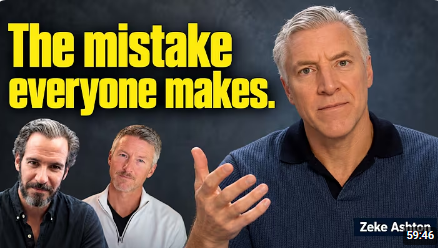
During their recent episode, Taylor, Carlisle, and Zeke Ashton discussed:
- From Motley Fool Writer to $110M Hedge Fund Manager
- Dot-Com Bubble vs AI Boom: What Today’s Investors Are Missing
- Why Passive Investing Could Be Riskier Than It Looks
- Why Easy Money and Social Media Keep Creating Market Bubbles
- Jake’s Veggies: The Financial Traps That Quietly Destroy Wealth
- How Leverage, Zero-Day Options and ETFs Are Changing the Market
- How a Hedge Fund Manager Controls Risk in an Expensive Market
TRANSCRIPT
[Tobias] We are live. This is Value After Hours. I’m Tobias Carlisle, joined as always by my co-host, Jake Taylor.Our special guest today is Zeke Ashton. Ashton, Total Return Fund. How are you, Zeke?
Good to have you back.
[Zeke] I’m doing great. Thanks, guys. Appreciate you having me back on the programme. [Tobias] Absolute pleasure. So you were on about a year ago. For folks who may not be familiar with who you are, give us a little background.From Motley Fool Writer to $110M Hedge Fund Manager
[Zeke] Yeah, okay. So I guess I started my investing career in the late 90s. I was actually in the risk management consulting business at the time, living in Europe.And starting my professional career on the risk management side was, I think, a very fortunate way to enter the business because what you learn is all the things that blow up, all the things that break, how all the capital markets can move together. And some of the early lessons were very much so that in a crisis, correlations go to one, liquidity becomes incredibly valuable. And then I think, as I talked about on my first appearance is, it was always my impression in the risk management business, and when you look at case studies, that when really bad things happen and really bad things break, it was because somebody did something really foolish that at the time was obvious.
And the truth is that that’s not really how it works. It’s usually the smartest person in the organisation who’s had a history of success. They have basically bet heavily many times and each time has come up roses for them.
And then all of a sudden, they massively overbet with incredible overconfidence. And usually, the perfect storm comes at that moment that either wipes them out or deals them an incredibly bad setback. And so that was kind of my lesson.
And what I have learned since is, and I think Warren Buffett’s talked about this too, is that IQ is great to have, but it’s better to have a philosophy where you have some risk management controls there too. And I do think that one of the things that as I transitioned from that business to the business of taking risk, it’s one of those things where I never forgot that half my job is being a risk manager and the other half is being a risk taker. And I think one of the things that some of the great capital allocators that have stood this test of time is they know when to pull back on risk.
They know when other people in the markets are taking too much risk and that there will be an opportunity soon when that creates a vacuum, as it inevitably does. So anyway, I joined the Motley Fool in January of 2000, which was a perch with which to watch the end of the dot-com bubble. And obviously that started to break in March of 2000.
I was running a little private partnership then while I was writing for the Motley Fool. And it was just a very interesting thing. And when you watch a market that felt very much like this one in the sense that the great companies at the time were Yahoo and America Online and Cisco.
And it just felt like those companies had growth as far as the eye could see. And then we all watched the NASDAQ decline by 80% over an 18-month period. And it’s very hard to tell somebody who did not live through that period how that feels, how it feels to have that kind of thing happen.
And I guess some people got a taste of it in late 2022, but it wasn’t nearly as long, obviously, and wasn’t nearly as devastating. So in any case, in 2002, I left the Motley Fool and moved to Texas, which is more or less where I’m from. And I started a long, short partnership called Centaur Capital.
And that was a hedge fund that I managed for 17 years. I also managed a mutual fund starting in 2005 that was, I think, the first equity income value-orientated strategy that used covered calls. And so we were looking for alternative ways to generate income.
And so covered calls was a part of that strategy. That fund did very well for a long time as well. And I think in all of those, my finest moments, both in the hedge fund and in the mutual fund, was in 2008 and 2009 when we managed to protect capital very well in 2008.
And then we made it all back in 2009 by about September, October, for both of those funds, where many people, people who invest in the S&P 500, for example, didn’t get back to even sustainably for about, I believe, five years. So it was just one of those things where that was the moment where understanding risk, having risk management, and in the hedge fund being able to short was one of the few times in my career that I was really glad to be short. Shorting is a very tough business, as I’m sure you’re aware.
It tends to have negative expected value over a long period of time, but what it can do is provide a tremendous amount of capital available to you right when capital is at its most valuable, and that is when everybody else has to sell and nobody can buy. So in any case, I took a sabbatical from managing money in 2018. I went and taught college at the University of Alabama for a couple of semesters teaching value investing.
And then in 2024, I decided to start up again. I have a young colleague who came out of the University of Alabama programme, and so we’re managing Ashton Capital together. And it’s, you know, it’s been a challenging but interesting ride for sure.
So that’s kind of how we got to where I am now.
[Jake] Nice. Zeke, to go back to the 2000 time period, you know, and you were actually there and doing things professionally, what were the bottlenecks, arguments of that day, you know, and kind of what do you see that rhymes with today? [Zeke] Well, I mean, it certainly does rhyme. And I guess what I would say is it was clearly a very bifurcated market, very similar to kind of what the AI winner loser bifurcation has been this year. But I would say then it was much more, you know, discreet, where anything old economy, you know, was really out of favour.It was also not just internet stocks that was kind of like a repeat of the nifty-fifty. I remember Coca-Cola was trading at 70 times earnings, or Johnson & Johnson was trading at 70 times earnings. So it was a big cap-led stock market rally.
And the one thing I remember very distinctly about it is, look, we were on the on the precipice of this new internet revolution. It was going to change all of our lives. And you had to be there.
I mean, that’s what it felt like. You had to be there. And I remember with Cisco in particular, you know, at one point he was trading at 170 times earnings, but internet traffic was doubling every, call it nine months.
And they were the arms dealer. Very similar to how Nvidia feels today. So I think if you were to ask me in January of 2000, what the chances were of a Nasdaq 80% decline being, you know, literally a couple months away, I think I would have said it was a very small percentage chance.
Right. And so that definitely feels reminiscent. The other thing is, I just remember there were a lot of incredibly smart sounding pundits with very high IQs telling us that we had to get in, we had to stay for the long term.
And obviously those people were somewhat discredited, you know, in the file that came later. But they weren’t wrong over 20 years, right? Very difficult to pick the winners.
I mean, Yahoo felt like a clear winner in January of 2000. But as it turned out, Google was the winner. AOL seemed like a world beater in late 1999.
And they’re pretty much irrelevant now. And so I think that’s what’s interesting is, it’s harder than you think it’s going to be to pick. Even if you get the long term trends right, you kind of have to survive the lowest ebb.
And I think the last thing I will mention is everybody was on the same side of the boat. Everybody was on the technology, everybody had way too much exposure in technology. And then when the NASDAQ declines 80%, and everybody’s overweight tech, everybody gets hurt.
And so that’s very reminiscent to today. And in fact, what I would say today is, the thing that worries me about today is the numbers back then, even though they were huge at the time, really seem cute in comparison to the numbers we have today. I think that when you look at SpaceX, in its most recent IPO prospectus, they state their TAM is $28 trillion.
US GDP is about $32 trillion. And so I think that right then and there, you can kind of see that there’s a bit of overreach maybe. But not to be outdone, I think Anthropic in their upcoming IPO is going to say their TAM is $30 trillion.
And when you have a global GDP of whatever it is, $120 trillion or whatever that might be, we’re really starting to talk about big numbers. So when NVIDIA’s market cap is $5 trillion, out of entire global GDP of $130 trillion, it feels like it’s a lot. What’s interesting is it’s really hard to make the argument today that NVIDIA is overvalued when you look at it on a trailing PE basis.
What you have to worry about with NVIDIA is, will they be able to sustain not only, forget about growing, will they be able to sustain just this level of revenue if AI does not eventually turn into some sort of killer app that can produce a great return on all capital that’s being spent? When I look at the CapEx on just the top five hyperscalers, that $1 trillion in a given year, it looks like that’s where we’re heading. That’s just incredible to me.
I do worry about it because my concern is that if it does go bad, it’s going to be bigger, I think, relative to the rest of the capital markets than was the case in 2000. I think it will be bigger relative to the rest of the capital markets than the housing crisis was in 2007, 2008. So that’s my concern.
I don’t know that it doesn’t have to blow up. No, it doesn’t. But it does feel like there’s going to have to be a hangover at some point.
We’ll just have to see. In the meantime, as a value investor, it’s very challenging. One of the things I’m looking for and trying to be creative about is, where can I put capital that will be safe in that environment?
Where can I get diversity from? The S&P 500, the top 10 companies, is 40% of the value. And I think if you go say to yourself, well, okay, I’ll just go get some NASDAQ 100 and diversify.
Well, it’s the same companies and there’s so much overlap. And so it’s just very difficult to determine from here, how do you find the right balance between making good investments that’ll keep you ahead of inflation, which is also picking up, while also protecting yourself from the eventuality that if the AI trade has a wobble or worse, if it turns out to disappoint people, where can you get protection from that? And so I’m struggling with that.
And every active manager that I talk to, even those who are publicly much more bullish, they will tell you privately that they are looking for ways to find some sort of diversification to that trade.
[Tobias] Zeke, we were talking about this a little bit before we came on, but which market is more speculative, the 2000.com market, 2021 meme stock or this AI market? And just before you answer, there’s this meme that does the rounds that says that the big difference between now and 2020 and 2000 was that in 2000, it was like profitless speculation. Whereas now these companies have, they’ve got Nvidia, for example, has sort of unlimited demand seemingly and its revenues are rocketing up.So as you say, it’s not too expensive on a trailing earnings basis.
Dot-Com Bubble vs AI Boom: What Today’s Investors Are Missing
[Zeke] Yeah, I do think that each of them is quite different in their own way. My personal view is that December of 2021 was the most speculative market that I’d seen just in terms of like people buying shiny trinkets, knowing that they were shiny trinkets. If you look at the kind of the definition of speculation, which is, hey, I kind of know this thing might, might or might not be worth what I’m paying for it, but I’m just betting that somebody else will pay me a higher price.I think that was 2021. And of course, I think that was driven by a lot of pandemic era, you know, sort of dynamics where, you know, there was a lot of people that couldn’t bet on sports anymore. There were a lot of new things going on in the crypto world.
And also, I think social media magnified a lot of those trends because people were at home and, you know, didn’t have a lot to do. So now 2020, I mean, I do think people forget just how, you know, the growth rates were for these, you know, big tech companies. I’m talking about Dell and Intel and Microsoft.
You know, they were growing at very fast rates in the late 90s. And Cisco continued to grow at reasonably fast rates for another 10 years after that. And it took, I think, until this last year for Cisco to get back to its peak valuation of early 2000.
So, you know, I think that’s pretty incredible. What I would say today is, and what I find difficult is, yes, you know, when you look at Meta, when you look at NVIDIA, when you look at Google or Alphabet, whatever you want to use for they generate an amazing amount of cash flow from their business, their core businesses. So I’m talking about operating cash flow.
But what’s interesting is that those businesses are no longer capital-like businesses to the extent that they’re now spending. There’s no free cash flow at Meta anymore. There’s not any free cash flow, I think, at Google anymore.
Microsoft has still generated a lot of free cash flow. So the one big company that appears to have been, you know, I would say completely absent from the CapEx arms race is Apple. And so they still generate a lot of free cash flow.
But I think the question is, is it the kind of thing where this CapEx cycle is a three-year cycle and then they go back to being capital-like businesses that generate a tonne of cash, in which case they all look very attractive today. However, if this is a CapEx trap where, you know, they have to continue to spend money to stay at the leading edge of LLMs or whatever they’re trying to do, then I think the valuations have to come down, right? And I also think there might be some differentiation, at least in my mind, between the companies for whom this feels like it’s existential and those that maybe it feels like it doesn’t.
Like, I think Alphabet really has to defend their search business with everything they have because it’s such a powerful, so such a profitable business. Whereas Meta, in my mind, I’m not sure why they need to invest in a leading-edge LLM. I think that if it helps make their advertising business more efficient, that’s great.
But it feels to me like it’s not necessarily existential for them and therefore they could cut back earlier than some of the other ones. So, but look, I guess my thought is I think about this a lot, but I realise that I’m not the guy who’s going to figure it out. What I will say, though, is that the transition from, you know, just incredible free cash flow to very little free cash flow.
And then the other thing I would mention on all of them is there was never, I mean, Cisco certainly had a huge amount of customer concentration to a type of customer, but not really to any single customer. Whereas if you look at the CapEx requirements that are coming mostly from Anthropic and OpenAI, if something bad were to happen at one of those two companies and they were not able to honour the agreements they’ve made, I don’t know what that means. And I specifically am worried about OpenAI because it feels like they’ve fallen behind at least until very recently.
And it seems like they still need a couple hundred billion dollars of capital to bridge them to whatever their ultimate profitability is going to be. So these are concerns I have. Again, I’m not the AI guru.
I don’t pretend to be, but I do think about it a lot. I do worry about it probably more than some. And I think that like a lot of value investors, particularly, I’m struggling with how to think about this transition from what have historically been just dominant, you know, capital light businesses to still dominant, but now capital heavy businesses.
[Tobias] How do you go about shorting in a market like this? [Zeke] It’s a very difficult market to short. And I would say 2025 was probably one of the more difficult years for me in terms of my style, because I tend to be contrarian on the long side. And, you know, on the short side, I don’t do a lot of, or didn’t do a lot of individual shorting in 2025, but I was overhedged for a part of the year because the risks that I was seeing, in my view, this market’s resilience to all of the risk factors that have shown up, you know, really thinking back to April of 2025.I mean, it’s amazing to me that there have been things that have happened, any one of which could have kicked off a very significant market correction or, you know, longer term sell-off. And the only one that really did was, I guess, the tariff one. You know, the starting of the conflict in Iran obviously created a nasty quarter for, you know, some stocks.
Q1 was a pretty nasty quarter, I guess, relatively speaking. But the bounce back, you know, before the situation had even resolved and the ferocity of that bounce back is kind of unprecedented in my view. So that makes it very difficult to short.
What I have been doing is, and what I would say is interesting right now, is I think that the VIX hit a yearly low today or yesterday. And so, you know, we tend to have what I’m going to call disaster protection hedges on in the form of, you know, index puts. I still have some on.
I probably will, you know, that’s something that I kind of consider rolling out every couple months. It has not been helpful to us so far, with the exception of the couple of days in April 2025. But I’m not convinced that they won’t be helpful.
And so I’m willing to sort of take a little tax on the portfolio gains in order to protect from what I feel is, you know, a very vulnerable market if the right situation were to occur.
[Tobias] Do you think that some of the resilience in this market is down to that flows argument, that there’s this sort of relentless bid for S&P 500 type indexes? [Zeke] Yes, I do. I also feel like, look, I mean, it doesn’t feel that long ago to me and probably not to you guys, but, you know, it has been probably 15 to 17 years since there’s been a deep sell-off that didn’t correct relatively quickly, right? And 2022 was probably the worst it got.And, you know, I do think that if you’ve been through a real bear market, by which I mean, you know, not one where the stock market goes down 20% in five days, and then it’s back to all time highs, you know, two months later, but where it feels like every day, your stocks go down, and they may never go back up, right? And you’re worried about, you know, sort of just general survival. I think that’s a very different thing.
And it’s been so long since we’ve had that. I think investors have been trained to buy the dips, and they’ve been rewarded for that. And at the margins, I think that’s good, because I think one of the mistakes that many people have made historically is that they sell on weakness.
But, you know, it does feel like the market in general has learned to basically ignore bad news, no matter how bad it may seem. And I also think that when you have this passive flow that money just comes in every month, it feels so prudent, does it not? It feels so safe to put your money in the S&P 500, because I think people still think of it as, hey, it’s a diversified portfolio of 500 of the best, most profitable US businesses.
And really, that’s not what it is anymore. And it hasn’t been that for a while. The other thing I will say is, I have been looking very much at, you know, things like the momentum factor, which has generally been absent from my portfolio.
I tend to buy things that are, you know, that have performed poorly recently. And the epiphany that I had is that cap-weighted indices are basically a momentum trade, and always have been. But now that you have so much flowing into what I think the two big indices are, the S&P 500 and the NASDAQ 100, and I think that that has become such an automatic purchase.
And again, the other thing that I’ve learned is, you know, obviously, more of that money that comes in every month, that goes to the biggest stocks, and very little of it goes to the bottom stocks. And even as liquid as they are, you know, they cannot absorb that kind of, those kind of inflows without some price action, right. And so my concern is, and we’ve seen this a couple of times, once during the pandemic, and once during the tariff sell-off, when that goes the other way, there is, these things can fall so fast, so hard, until something big stops it from falling.
And so that is a concern of mine that, you know, I think it’s become the prudent person’s trade, is just to put all your equity money in the S&P 500. And I think I also saw a chart the other day that said, U.S. households have the highest percentage of their wealth invested in the U.S. stock market than they’ve ever had before. And that probably means the S&P 500, by and large.
And again, there’s so much overlap between the NASDAQ 100 and the S&P 500 that, you know, we might be talking about the same thing. So that is a concern to me as well. But yes, it does feel like, hey, as long as, as long as passive flows continue, and there’s no reason to believe they will stop, that this market always has a bid from that.
But again, the risk there is, there’s always a reason why this time is different at the end of any, you know, at the end of any kind of, you know, market top, there was always a belief. And you guys definitely remember in 2007, there was this overwhelming belief that, you know, U.S. housing prices never decline on a nationwide basis. And so people change their behaviour, right?
And it wasn’t the fact that U.S. housing got different, although there were certainly some differences, it was the fact that people changed their behaviour based on that belief. And that’s my concern now is that people’s belief now is, hey, risk doesn’t matter as long as I’m prudent, and just continue to put more money in the S&P 500 every month. So this is, again, one of the reasons why I’m trying to get creative and finding ways to get good exposure to, you know, to good ideas that maybe are less correlated with the S&P 500, or in stocks that aren’t in the S&P 500, or any big index.
[Tobias] So where does that take you?Why Passive Investing Could Be Riskier Than It Looks
[Zeke] Well, it’s taken me to a couple of surprising places. You know, the AI winner loser trade of, you know, the last two years, obviously had a big break in July, actually end of June, early July. But one of the things that we discovered was, you know, one of the, I would say one of the victims of the AI loser trade for a couple months was the big U.S. exchanges. And so my view is with the, you know, the tremendous increase in trading, we’re now going to go 24 hours a day, I guess, five days a week. We’re introducing new products, options are really picking up. So we own a basket of the exchanges.We own CME, we own ICE, which is Intercontinental Exchange. And then I own, as well, the OTC Markets, which is the small exchange. It’s the exchange for smaller companies that don’t want to list on the major exchanges, or for international companies that would like to have a listing in the U.S., but they don’t, you know, they don’t want to go through the U.S. approval process and all that because they meet all of the regulatory requirements in their home exchange, and they don’t want to have duplicate regulatory costs and all that stuff. And so, yeah, it feels like, you know, hey, there’s some risk there as well, because, you know, to the extent that if volumes were ever to decline, these companies obviously have some operating leverage to that. But the valuations got very interesting.
So, for example, Intercontinental Exchange was trading at, and I think it still is, trading at less than 20 times free cash flow. And then CME is slightly more expensive. But CME also owns kind of this hidden asset.
They own a 27% stake in the S&P Index business, S&P Global. So you essentially own a call option on the S&P 500, you know, index, which is a pretty good royalty to own. I would say it’s a royalty and a call option, because if the dynamic that you just talked about, Toby, continues, which is people just continue to plough their money in the S&P 500, then, you know, that benefits CME as well.
And that’s one of those things where there’s not a lot of incremental costs for them. And so it’s a nice, it’s a nice business. And these businesses have remained capital light.
They have not had to spend money on AI, even though I think that they will probably be beneficiaries of AI going forward to some extent. But it’s hard to imagine their profit margins getting much higher. These are 60% profit margin businesses.
So that’s how we, that’s one of the places we found, I don’t want to say hide out, because that feels like it’s not, I mean, it’s not a defensive move. It’s an aggressive move. But we feel like relative to some of the other things we’re seeing, we feel like that’s a place where we can benefit, you know, in a number of different scenarios, including a scenario where things don’t go great for the stock market, but there’s just a lot of volatility and a lot of trading.
And, you know, we would benefit from that as well.
[Tobias] How do you handicap the variability in earnings of that sort of business when it’s clearly a beneficiary of this sort of, there is this speculation, or there’s a lot of trading going on. And in a down market, a lot of that trading and speculation goes away. So while these, I think these are quite moaty businesses, they also tend to be businesses that have some fluctuation in their earnings from year to year.Do you have any sort of bead on what your downside is there?
[Jake] Like how pro cyclical are they? [Tobias] Yeah. [Zeke] I mean, certainly when you first consider them as we did, the big risk is, hey, if we’re at the top of a capital market cycle, isn’t this just another way to play the top of the capital market cycle? But the truth is when you snap those three businesses together, and particularly the CME, the CME has a lot of exposure in non-equity, you know, capital markets. So there’s oil, obviously, there’s metals, there’s interest rates.So all of the things that move, and it’s hard for me to imagine that volume will not be strong in at least, you know, a couple of those places, even if it’s not strong in equities, let’s say, or if it’s not strong in oil, or if it’s not strong in gold or whatever, there will be, there will be volatility somewhere. And there will be people that need to hedge risk somewhere. And so the other part of it is, of course, is that, you know, the CME and the IC, they don’t just benefit from people taking risk, they benefit from people hedging risk.
And I feel like that the need to hedge risk is probably going to be, you know, one of those things that we’re seeing a lot more about in the next couple of years is, again, people look for ways to find, I think, diversification in a world that seems highly correlated to a couple of trades.
[Jake] That’s an interesting kind of secondary or derivative of inflation, perhaps, like, you see inflation, and you’re like, Oh, gosh, we need to hedge for this, our input costs of our business. Okay, well, we need to go to the exchange to do that. [Zeke] Yeah, I think that’s right. And, you know, I do think inflation is a beneficiary to this business as well. And so that’s kind of a, you know, it’s another benefit, as you say, of if we get inflation, it sure seems to me that the exchanges are a great place to be, you know, because they would obviously benefit from that to some extent. [Tobias] So let me do a little shout out around the horn and then JT is going to give us some veggies. Breckenridge, what’s up? Lausanne, Switzerland, welcome.Toronto, Snohomish, Bendigo, Victoria, good for you, early start. London, UK, dead cat, hello, me too. Toronto, Prince George, BC, Boise, second one from Snohomish, Jupiter, Florida, London, England, St. Louis, Havertown, Bellevue, Guernsey, welcome, first time I’ve seen Guernsey, Fredericia, Denmark. I think I called everybody. Right, JT, take it away.
Jake’s Veggies: The Financial Traps That Quietly Destroy Wealth
[Jake] All right, so we’re Camacho on the Po Delta. It’s an October night, sometime in the 1400s, and there’s no moon and there’s a cold wind off the Adriatic. And we look at this lagoon, and it’s just pulsating.And there’s thousands of eels, fat and silver, all squirming against each other. And there’s something in the falling temperature that’s told them that it’s time to migrate. And they want to get to the sea.
And the only way out are through a few narrow channels. And in every channel, the fishermen have built lavariero, which is really just a weir of reeds and stakes shaped like an arrow that’s pointing out at the sea. And the eels will swim into the wide end, and they’ll go through this funnel, and then they can’t turn around and get back out.
And the fishermen just let the eels have their own instincts, like do the heavy lifting for them. So to transition a bit, and then we’ll get back, Bill Bernstein, who’s one of my favourites, has this idea of the four horsemen of deep risk. And those are ways that you permanently lose capital.
So we have inflation, deflation, devastation, and confiscation. And confiscation, I think in most people’s minds, probably means one of two things, either a tax bill that confiscates your income or your gains, or a government outright nationalising your assets. I want to add a third flavour to the confiscation discussion.
And it’s not directly a tax, nor is it them taking your assets. It’s building a trap on the route that your money has to travel. So back to the biology with some more fun facts about eels, as one wants to hear.
Aristotle thought that eels grew out of the mud because nobody could find their eggs. In 1876, a 19-year-old Sigmund Freud spent a month dissecting 400 of them, looking for testicles, of course, is Linda. And as far as anyone could tell, the European eel hatches in the Saragasso Sea, which is off of Bermuda.
But nobody’s ever seen it happen. And the larvae, they drift east for a year, flat and clear. And they look so unlike an eel that for decades, they were classified as a separate species.
Like we didn’t know that’s where eels came from. They wash up on the coast of Europe, from Norway down to Morocco, as glass eels. And they’re small enough to fit in your palm, to give you a sense.
They then swim inland into rivers, lakes, lagoons. And they spend the next 10 to 15 years eating. And if you block a river, they’ll cross on wet grass at night to get around it.
But one autumn, they turn silver. Their eyes double in size for the dark waters of the journey that they’re about to embark on. Their gut actually dissolves because they’ll never eat again at that point.
The space and the energy is now being used to build eggs. And they’ll swim 3000 miles back to the Saragasso on stored fat. And then they’ll spawn, and then they’ll die.
And the eel doesn’t really actually live in one place like we sort of think of. Its life is just this one circuitous route. And if you break the route anywhere, you’ve really kind of broken the animal.
So back to how weirs trap the eels. They never stop the young eels from coming in upstream, really. And every spring, they pour in to the lagoon basically for free.
But it really only they charge the eels on the way to get out. They harvest them at their exit. So up the coast from all these eels, the Republic of Venice ran a very similar trap on money.
Venice was a lagoon that got rich on the movement of spices and silk in from the east, and salt and timber and silver being shipped out to pay for them. And the Venetians took a cut of every leg, of course. But then when war came, the Republic needed ships.
And so it imposed something called the prestidi. And these are, it was effectively forced loans to the state from the wealthy Venetians. So the government put a number on your wealth, told you what you owed.
You handed it over at par value. And in return, you got a claim. And it was a 5% per year that would be paid back to you from the state for taking your capital basically.
But no date was ever set for when you would get a return of that principal. It was effectively a perpetual bond. And in 1262, Venice swept all of them into one big fund and called it the Monte Vecchio, which means mountain of debt, which I think is kind of fun given where we are with the $40 trillion in the U.S. now. And they made these claims transferable. So there’s no repayment of principal ever to wait for, but you could sell your claim to that ongoing 5% yield. Of course, a market forms, and the price then moves around with every rumour of war.
So war in Genoa, with Genoa in 1379, it looked like Venice might fall. These bonds traded down to 18, when normally they were usually around 100 at par. So this is what financial repression can look like.
It’s not necessarily a direct tax, but it’s a weir where you accidentally swim into, and then you can’t figure out how to get out. So America built one of these in 1942 as well. We called them war bonds.
Money eels swam into the lagoon dressed in their patriotic red, white, and blue. And the Federal Reserve pegged rates really low at that time. I think it was three-eighths of a percent on T-bills and like two and a half on the long bond.
Well, when the wartime price controls came off, inflation ran up to 17% in June of 1947 year over year. So you got two and a half percent on your bond, but 17% on your groceries. That’s a pretty big difference.
And actually, Bernstein says that the worst deep risk in American history wasn’t the Great Depression. It was actually bonds from 1941 to 1980, thanks to this financial repression. Hence the joke of calling them certificates of confiscation at that time.
So a real dollar in long treasuries ended up being worth 34 cents over that time period. Nobody defaulted. Nobody was arrested.
Nobody lost their bonds. Nobody stole your factory. You just swam into the wrong weir basically.
So how do you spot a financial weir ahead of time? I’ll give you three potential clues. An incentive or institutional institutional pressure to enter, meaningful friction preventing you from leaving, and a return that’s set or constrained by somebody who benefits from keeping it below a market clearing rate.
So think of annuities, savings bonds, maybe even like stable value funds in your 401k can kind of look like this. Any deposit where the rate is whatever the bank sort of decides that month. And if you see all three of these, somebody is probably, they’re the ones standing, the fishermen standing by the channel, like waiting for you to swim into the trap.
So the clever thing about these financial weirs is that nobody ever sends you a bill for it. Your account still says that, you know, you own the money. The bond still pays.
The bank never really defaults. It’s only really years later that you discover what was taken. Not the dollars themselves, really, but what the dollars could have purchased.
And that’s why financial repression is such an effective form of confiscation. So it doesn’t really look like a trap until you try to swim away with your purchasing power. So we managed to weave together eels and ancient Venice and financial repression into one.
[Tobias] Wholesaling lagoons. [Jake] Eel testicles. [Tobias] Zeek Ashton, where can you get all of these three things in a podcast? [Jake] What other podcast does that? [Zeke] I’m still stunned by the powerful drama there. I’m still having to process this, Jake. You know, one of the things that is interesting, I wish that I had limited my repertoire to only four ways to lose money, but I’ve found that I’m very talented in that manner.And I’ve found lots of, lots more than four ways to lose money. But it does bring to mind one thing that we haven’t talked about yet, which is how leverage is seemingly built into the financial system today in ways that, you know, it has not been all at the same time in the past. And I think one of the interesting thing is, you know, the extent to which investors are being drawn to leverage vehicles, both 2X and 3X levered ETFs.
I think we were talking about this pre-show, which was, there’s been something like 200 ETFs launched this year that are purely leveraged. And many of them are just single stock ETFs. And then zero day options, which is basically a way to bet as much of your bankroll as you can on the next day’s outcome of whatever it is you’re betting on.
That represents something like two thirds of all the option volume on a given day today, which seems crazy to me. A very little known story from July that came out was there was a very small ETF that lost something like 80% in the month of July, or maybe it was the month of June, purely because they were mostly rolling over zero day options every day. Even though if you’d looked on the, you know, sort of the packaging of the strategy description, you would see that, you know, risk management was a big emphasis.
And so, you know, that’s kind of just another, I would say, symptom of what I’m sort of internally calling this normalisation of hyper risk in the sense that it’s feeling more and more normal for people to take it. And they may not even feel like they’re taking all the leverage because, you know, you can do so with a two X and three X levered ETF with a small amount of money. The introduction of perpetual futures, which is an interesting asset class, and it strikes me as just another way to get much, much more leverage.
[Jake] Yeah, Zeke, what are those all about? What’s the story behind those?How Leverage, Zero-Day Options and ETFs Are Changing the Market
[Zeke] I mean, they’re now, you know, they’ve basically been approved by the CFTC from what I can understand. And what they are is, I mean, they’re basically swaps in my view, except rather than having a delivery date sometime in the future, basically it’s every day there’s a settlement. So the winner of the perpetual future, and the reason they’re called perpetual is they don’t have an expiry date.And so what happens is, is basically if, you know, if you and I have, if we’re on the opposite sides of a perpetual futures contract, you know, if I made money today, you have to put some chips in to the, you know, into the table. And if I lose money to you tomorrow, I’ve got to slide those chips back to you. And so there’s also not a major clearing operation that I can see.
I think one of the benefits of owning a company like Intercontinental Exchange, and one of the reasons that we picked that one and CME is they both have, they both have their own internal clearing operation, which protects investors from, you know, basically the other side, not being able to meet their margin call. And so obviously it’s a very new perpetual futures is a very new product. And so we’ll just kind of have to see how well it, how well it takes off, but it’s just another, in my view, it’s just another way, another flavour of risk-taking that has been introduced to the markets.
And it does feel, you know, we talked about, Hey, does this feel riskier than 2021 or 2020? The fact that I think options and levered ETFs are a little bit of the tail that’s wagging the dog sometimes in the sense that I don’t know if you guys have noticed this, but there are days when the S and P 500 or the NASDAQ 100 feels perfectly calm, but there’ll be massive individual stock price changes kind of across our portfolios. I think I read a statistic that the, the average, the volatility of individual stocks relative to the indexes is something like four times what it normally would be.
And that feels right to me. It feels right when, for example, a company will report earnings. And, you know, I’ll look at the earnings and I’ll say to myself, well, it wasn’t quite as good as I hoped.
And the stock probably deserves to be down three or 4%. And you’ll look up and the stock’s down 21% or something like that. And then I’ll feel the same way on the opposite side where a company will report and I’ll say, well, this is a little better than I was hoping.
And the stock might be up 25%. And it feels like that is a function of a couple of things. Number one, you know, we talked about the, how much passive flows represent, you know, as a percentage of the market’s volume.
I do think that, you know, on a day-to-day basis, that’s really true. I think some of these stocks are thinner than you would expect them to be, particularly around earnings dates. But I also think it’s the options that are being, you know, people are playing options into earnings dates, whether they’re long or short.
And then obviously they have to respond very quickly after the company reports. And then there’s got to be somebody that takes the other side of those positions, whether that’s market makers or somebody else. So, you know, it’s one of those things where you get into the plumbing, which it’s very difficult to understand.
And I don’t completely understand it, but my feeling is, is that options are such a bigger component of, you know, sort of market bets today than they’ve ever been. And I do think that’s driving incremental volatility on stocks on a day-to-day basis.
[Jake] So- Meanwhile, VIX is just sitting there at 15. [Zeke] Yeah, that’s very interesting. That’s very interesting. So, yeah, I do think that leverage is another risk.What’s also interesting to me is, even with all these new ways to get very, very cheap leverage, just good old-fashioned margin leverage seems very high to me. And, you know, this is one of the classics that, you know, we used to have like a checklist of how do you know you’re getting to the top of the market cycle. And that is usually when leverage is very high relative to history.
And I mean, it’s high relative to history, but it’s such a small piece of the overall leverage that people are taking just because there’s so many other ways to take leverage now without having to borrow money from your broker that I’m really kind of surprised anybody does it. So, just kind of an interesting dynamic in this market.
[Tobias] Yeah. One of the points that I’ve made before, and I discussed it before we went on, is I get this feeling that there’s been this sort of movable feast of speculation since before 2020, but around that sort of period where it’s run through the meme stocks, the NFTs, the crypto, the, Jake said cannabis before we came on, SaaS stocks, AI, you name it, everything’s had its sort of little day in the sun. Do you have any, is there some root cause to all of that?Do you have any idea what, is it a cultural thing or is it rates are too low? What do you think?
Why Easy Money and Social Media Keep Creating Market Bubbles
[Zeke] I do think some of it is the magnification of trends with social media that causes much more hurting than we’ve ever seen before. And I think the AI winner slash AI loser is probably the biggest one, but these are kind of all over the place. I have a friend who’s much more macro than I am, and he’s thought about this more deeply than I have.And his viewpoint is that this sense of there’s almost always some technological innovation that causes a bubble. It’s like, wow, why did a bubble happen in the twenties? Well, it’s because of electricity and radio.
And why did it happen in the 1870s? Oh, it was because of railroads. And then why did it happen in the 1990s?
Oh, it was because of the internet. His view is no, it’s always because there’s easy money and there’s too much money. And his proof of that is 2021, where there wasn’t a new innovative technology.
The metaverse turned out to be a big nothing burger. NFTs sort of turned out to be a big nothing burger. Crypto obviously had its moment there where there was just tonnes of new crypto assets being invented overnight to basically just absorb the money that was available.
And look, I don’t know which is true. I think it really helps when there’s an exciting new innovation that will suck a lot of money into it. On the other hand, 2021 is a great counterexample where I don’t think any of us were really deep believers in the metaverse except for Mark Zuckerberg.
And obviously crypto had its moments there. And obviously crypto still has its day in the sun every now and then. But there’s not been a real killer app for crypto, I think, except stable coins.
And so I just think it’s very interesting that 2021 as a very recent counterexample of this is, hey, there was just money and people had it. And the funny thing about 2021 is you’ll recall, I mean, it was everything. Whisky became an asset class.
People were starting to talk about cars as an asset class, art went up, baseball cards, comic books. It did not matter. It did not matter what it was as long as it could be somewhat financialized in the sense that there was a bid and ask and people could kind of see which direction the market was going, they were going to play it.
And there was just money available to do so. And so that’s kind of his argument.
[Jake] Housing might be a pretty good one for that too, because it’s not like we got better at housing or something. It’s just we found more leverage. [Zeke] And again, with housing, I remember people were making a lot of money in housing in 2003 and 2004 and 2005. And I think that is also a precondition is that the early people are making a lot of money and you can see them. And of course, that’s never been more visible now if you just get on social media and you can just see people.And I love Reddit because my colleague Nick has introduced me to this concept of loss porn and win porn, where people just post pictures of their accounts. And you can see that somebody’s account value went from $50,000 to $13 million and back to $2 million. And then they’ll post their losses.
And sometimes you’ll see an account that went from $7 million down to $500,000 in three weeks. And I’m just, I’m stunned by this. But I do think that at the margins, when you see people who have this appearance of great success, and it doesn’t seem like that success is warranted by some unique skill, they were just pro-risk.
They just took a lot of risk and they were early. And I think that does bring in a lot of people behind it and it drives these momentum things. And it’s these localised bubbles that we’re talking about.
I mean, we’ve already seen silver go from $40 to $120 and now back to $60. And we saw gold do a crazy thing last year. I still keep talking about the quantum computing stocks because it’s very difficult to imagine that all of those stocks will be worth their current market caps.
And of course, the applications for quantum computing are still a little bit further out in the future than we can currently see. So it’s just very interesting that, and you mentioned the cannabis thing a couple of years ago. I just do think that this is what’s going to continue to happen as money continues to fly around looking for, just looking for a home and, hey, what’s the next hot thing?
Where can we make money this month? That kind of thing. Okay.
[Tobias] Given you started out in risk management, what tools do you sort of retain today or how do you think about risk in the portfolios? Because you’re short as well, which there’s some risk in shorting.How a Hedge Fund Manager Controls Risk in an Expensive Market
[Zeke] Oh yeah. I mean, shorting is quite risky as well. So to address the short thing to start with, I almost don’t short individual stocks anymore.We tend to buy in the money puts if we want to go short something. And I say in the money usually so that we don’t pay a lot of time premium. But that way, if we’re shorting through an in the money put and the stock goes against us, the losses are non-recourse to us after a certain point and we don’t have to spend all of our time trying to manage risk limits and this sort of thing.
And it prevents the kind of crazy loss that you can have. Imagine if you had been unlucky enough to be short GameStop and probably you were short GameStop with very good reason. And then it just turns into this self-fulfilling crazy loss.
It would be very easy to blow up if you had a meaningful exposure on the short side to GameStop. And so as far as things I look at from the risk management side, the number one thing I’m looking at now is, is my exposure truly diversified? Are my best ideas diverse from each other?
So we talked about the exchanges. We obviously have a little basket of them, but I’ve limited the amount of the portfolio that we will have in not only exchanges, but things that are pro-cyclical or pro-capital cycle like that. And then I would say the AI winner-loser thing.
As soon as it became clear to me that I would look at my portfolio and I’d have five stocks that were all down on an up-market day and they didn’t have anything that really connected them from a traditional factor standpoint or they’d be in very different industries. And it obviously occurred to me that, hey, they’re being considered to be AI losers or at least AI vulnerable, even though in my view, they were very different investment ideas. And basically we put a limit on, hey, if it acts like an AI loser on a day-to-day basis, I’m going to assume that that’s a brand new factor that I have to consider.
And so we won’t go more than 20% of our portfolio in those kinds of names. And that’s helped us to reduce volatility in our fund. But it also has, in some ways, reduced how much profit we can have when there’s sort of an unwind of the AI winner-loser basket, like there was in July.
We could have made more money if we’d had more software and more things like that. So it is one of those things where I think, and I’m going to use the word creative again, like you just have to be creative about looking at your portfolio every day and saying, hey, in this scenario, if this were to happen, what would happen to this stock, this stock, this stock, this stock, and what’s it correlated with? And then on the short side, I think you want to avoid your short side being what I’m going to call the photo negative of your long side, which you don’t want it just to be the opposite of your longs.
You don’t want it to be the anti-long portfolio. You want basically each one of those to have some vulnerability that you believe is likely to show up in the near term. And again, using puts really helps to limit the amount of damage they can cause you while still giving you full exposure to the downside, if you’re right.
[Jake] You want to be a little more aware of your situation. [Tobias] Situationally aware. [Zeke] Is that what you’re saying? Yes, absolutely. And then the other thing too is on the long short side, we’ve been running fairly low net exposures, too low probably, and very modest gross exposure.But I would say that once you get up over 200 gross, and for your listeners who are unfamiliar with that term, basically it’s your long plus your short exposure. So if you’re long 125% and you’re short 75%, that’s 200 gross. My view is that as a risk manager, anytime you get above 200 gross, every bit of gross exposure beyond that, it really dramatically increases the chances of some weird event causing a problem with your portfolio in ways that you would not have anticipated simply because you’re just carrying so much exposure.
And that’s where options, you know, I talk about options that people are using to take more risk. Options can also be a great risk management tool. And that’s sort of how we use them.
So for example, if we have a great long idea, and we look and we see that the options to buy that stock are really cheap to us, and we think the market’s not pricing the options as if there’s any chance that stock could have an explosive move higher, we will often take a position in the option, either in addition to or instead of some portion of the position we would take in the stock. And that way, you know, again, if we if we’re wrong, and there’s a loss on that stock, the losses beyond a certain point are non recourse to it. So it’s a way to get non recourse leverage, basically.
And so we do look at that. The other thing I will mention, you know, I talked about the covered call experience we had, you know, with the mutual fund back in the day. One way to take advantage of the very high volatility in the market today on a stock by stock basis is if you’re buying a stock and you really like it, you might have a little extra take a little extra bite of it, that you combine with covered calls.
So because the covered call premiums that I’m seeing have been very, very attractive. And so, again, this is not true. If you’re going to buy the S&P 500 index and sell covered calls on it, you are not going to get a very attractive yield relative to the risk in my view.
But when we understand the risk we’re taking at the common stock level, and then we can combine it with basically the willingness to sell that stock at a higher price and get paid for that in advance, that’s always something we’re willing to consider. And we think those are starting to get more frequent. So.
[Jake] Zeke, would you say that the key to a long, successful investment career is to not make career bets then? [Zeke] I definitely think that. But that is probably the most unpopular thing to say in this environment, because if there’s anything about this environment and risk right now, we talk about, you know, hey, is this market more risky, less risky? I think the lionisation of risk, I think the championing of risk, I think the worship of people who are willing to take incredible risks is as high as I’ve ever seen it.And then I think there are some people that are taking incredible risks kind of out of this sense of, I guess I’m going to use the word financial nihilism in the sense that it’s a little bit of that you only live once. But rather than thinking about the downside of you only live once in the sense that, hey, if you only live once, I don’t want to destroy my financial life by taking these risks. It’s kind of the other side, which is, hey, if you only live once, I’m going to take as much risk as I possibly can, because there’s a chance I’ll be a lottery ticket winner.
And it’s worth it. And so, yes, what I would say is, look, just survival, survival, knowing when risk is high, and being willing to not chase, you know, the market higher. And then there’s a lot of career risk in that too, right?
So to a certain extent, and I think that’s harder now than it’s ever been, because the flip side of that is, look, you simply cannot go to, you know, 80% cash in this environment where inflation is eroding your purchasing power, right? You can’t be too conservative. You have to find the smart bets in a market that is very difficult to find, right?
And where I think risks are elevated, you know, kind of everywhere that I look. And sometimes I feel like I’m very lonely in that regard, where I see the risks, and other people are just, you know, they’re just willing to wave them away because they’ve made money recently. And that’s obviously very, in my view, that’s very dangerous.
And this is also the scar tissue of having lived through two really, really damaging bear markets that weren’t damaging to me personally, but where I saw a tremendous amount of financial devastation amongst, you know, other people and friends and all that. And, you know, to some extent, those are lessons that I have kept and perhaps internalised too much, because it tends to leave me behind in this really long period we’ve had where the S&P 500, I think, has gone up 17% a year or something for 15 years. And I don’t think people realise how historically extraordinary that record is, and how at the end of that, everybody just assumes 17% is sort of their due for participation.
And what I’ve learned is there are no participation trophies. And if you overstay that, you know, it’s very common to have an S&P 500, you know, loss of 50% over two years. So we’ll see where it goes.
But that’s the game we play.
[Tobias] On that note, well done, Zeke. If folks want to follow along with what you’re doing or get in contact with you, what’s the best way of doing that? [Zeke] Yeah, the best way is ashtoncap.com. That’s our website. You will have to scroll down and there’s a box that you can put your information in and an email will come to us.If you do go there, please make an effort to prove to us that you’re human in some way, so that we don’t get a lot of AI-generated people. But anyway, we would be happy to engage with anybody who’s interested in what we’re doing.
[Tobias] Good stuff. JT, any final words? [Zeke] Nope. Kids are back at school. [Jake] Life is good. [Tobias] All right, folks. We’ll see you all soon.