
VALUE: After Hours (S08 E25): Micro Cap Activism: Buying a Stake in a Company Nobody Else Wants – Ralph Molina
Sunday, August 9, 2026 · Johnny Hopkins
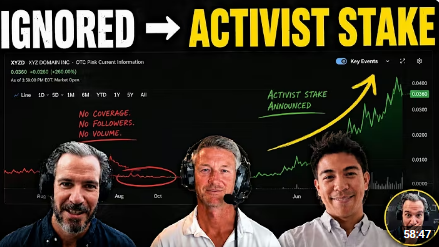
During their recent episode, Taylor, Carlisle, and Ralph Molina discussed:
- How Ralph Molina Became a Small-Cap Activist Investor
- The Parks America Turnaround: Fixing a Mismanaged Business
- Armadino Foods: The Micro-Cap Hidden Gem
- How To Find Great Micro-Cap Stocks
- What Most Investors Get Wrong About Micro-Cap Companies
- Jake’s Veggies: The Colorblindness Mistake That Destroys Investors
TRANSCRIPT
[Tobias] All right, we are live. This is Value After Hours. I’m Tobias Carlyle, joined as always by my co-host Jake Taylor.Our special guest today is Ralph Molina. He’s a small cap activist. We’re going to talk to him about some of his campaigns.
How are you, Ralph? Welcome to the show.
[Ralph] Good. Good to be with you fellas. [Tobias] Tell us a little bit about your background and then we’ll move on to your first campaign.How Ralph Molina Became a Small-Cap Activist Investor
[Ralph] Yeah, yeah. I have a very untraditional background and then also a traditional way of being involved in activist stuff. I don’t know if activism will be necessarily part of my future over the long term, but it seems like management teams like my background and like discussing things with me and I’ll get into that.But I didn’t want to be an investor. I had no interest in the stock market. And it wasn’t until I met a mentor through my entrepreneur programme in college.
I went to a small school called San Diego State, and he kind of gave me the idea of enlightenment for value investing. He said, Ralph, you know, you don’t have to be a small business owner like me. You can invest in small companies, same size as mine.
But in the public stock market, you can do companies like micro cap companies. And he even told me, you know, Charlie Munger, Warren Buffett’s principal adopted from Ben Graham, which is, you know, investing is most intelligent when it is business like. And the idea that a share in a stock of a publicly traded company is simply just a portion of the business that really set me on the path of, OK, how do I be a business owner in the most efficient way?
And I figured, OK, instead of going through tax filings and audits and, you know, that potentially bad financials, I might as well just do investing in the public stock markets. And so I have never invested in an index. I’ve always invested personally in small caps and micro caps.
And that’s kind of been my history. I started working with a fund called Focus Compounding who specialised in that kind of thing, more so overlook stocks. But a lot of them were small caps, micro caps or OTC or liquid stocks or, you know, companies that traded in foreign markets.
And I worked with them for four years. And I was doing that while I was working with them part time on a project by project basis until they one day called me and said, Ralph, I know you’ve been doing invest relations at several publicly traded companies, but do you want to join us on the board slate and as an executive officer for one of our holdings? Because we have to go activists on a company called Parks America.
At the time, they owned 40 percent of the company and they believed that certain things were going materially wrong. And as a large shareholder, they had no board seat or no say. And so they wanted to change those those things.
And so after a six month campaign, actually going to the annual meeting and after a special meeting, focus compounding slate got control of the board. And for a year, Jeff Gannon and I were on the management team and then several others were on the board as well. And I was there for a year to help turn around the company.
So that was my my first stint into something that I totally did not predict as part of my career when I graduated in 2019.
[Tobias] Let’s just take a step back. Just describe for us the situation at Parks America before you guys went on the board. What attracted you guys to the stock and what did you perceive to be going wrong?The Parks America Turnaround: Fixing a Mismanaged Business
[Ralph] So I started working with Focus Compounding at the end of 2020. They made their investment in the fund in Parks America at the beginning of 2020. So this was already a legacy position for them.They were attracted to it because of the idea of just local economies of scale, usually in a theme park or even a smaller park like the ones that Parks America had. They own and operate three regional safari parks, one in Georgia, one in Missouri and one in Texas. And usually for we’ll use Missouri for an example.
Usually if you have the right positioning of the park, there can only be so much supply that can actually facilitate all the demand. And you are creating the demand because no one has ever seen a safari park or regional safari park in their local area.
[Jake] There are only so many tigers to go around. What’s this? [Tobias] There’s more tigers in private homes in Texas than around the rest of the world. [Ralph] There’s got to be that is true, especially in South Texas. Don’t go there. But because of those supply demand economics, there’s only so many people that are willing to put up a safari park.And that’s only if they have the will to do it. A lot of people don’t have the will to do it. And the people who start these kinds of things are usually suboptimal scale on their mom and pop kind of shops.
That’s the stuff that you see on Tiger King. All the other parts that we’ve had have been owned and operated for many, many years and long established as a just a proper organisation. And so in terms of Jeff Gannon, the portfolio manager is hyper focused on competitive dynamics, durability.
And when they initially made the investment, they liked those competitive dynamics. The quality of those businesses were also actually very good. So at the Georgia Park, which was their cash cow, the company was doing that park alone on a second basis was doing upwards of 50, 60, 70 percent return on assets.
And for public investors, you can kind of use that as an approximate for return on this capital. And so this thing was generating so much cash flow. And they believe that there was a possibility that the management team could do the same thing at those other parks.
So that was in 2020 and when they made the investment. But fast forward to 2020, I believe end of 2022, definitely in 2023, and then for sure hitting in 2024, there was a change in the dynamics. And this is kind of what you see in micro caps.
There were initially two other investors who own similar amounts of focus compounding who at the time in 2020 owned 20 percent. There was the founder, essential founder of the company, he owned 20 percent. And then there was one other kind of micro cap, no name investor who also owned 20 percent.
But the focus compounding did not have a board seat at that time. They didn’t want a board seat at that time because they trusted the founder who was the CEO and chairman of the board. But then as the CEO and chairman started to have health issues because he was getting quite old, there was a dynamic between the other shareholder, the other micro cap investor, and essentially ousted the chairman and CEO and the founder of the company.
And right before the founder passed away, sold his shares to focus compounding, which gave focus compounding 40 percent ownership of the stock. And that’s when they decided to use that voting power to try to get a board seat. And through many attempts for settlements and negotiations, it had to go all the way to an annual meeting.
And that’s when focus compounding took control of the board. So that’s initially why they’re interested in the company, because of the competitive dynamics where there was a few new entrants and then a highly profitable asset base that they believe they can grow it. How was it being mismanaged?
It was being mismanaged primarily because of a bad capital allocation. So you’re taking these profitable safari parks and then trying to make it into something that it simply could not be based on the income in the surrounding area and the natural entertainment kind of behaviour in each area. So, for example, the prior CEO, who’s no longer with the company, which is different from the founder, the other investor brought in an outside management person from a very large theme park who is doing like ESG kind of stuff and nothing related really to being on the grounds general manager kind of stuff or anything to do with capital allocation.
And their belief was, oh, maybe we can build lodging and other things to increase the revenue per capita. But you have to do feasibility studies for things like that. And you have to talk to customers and really see what the appetite is in the area.
And it was clear based on the way they were spending, the level of spend, and then also the plans that they had outlined, it simply wasn’t going to be feasible. And after two years of turning a profitable business with lots of free cash flow to almost negative, that’s when Focus Compounding decided to step in because the CEO almost had two years to prove her worth and it wasn’t happening.
[Tobias] And did they reverse course on the policies? Did they reverse course on those efforts? [Ralph] Yeah, that was a big focus in the first year, which I was a part of. And as a board, we’re just assessing a lot of, you know, what is the right way to think about capital allocation here? And immediately, something that we, you could see it, and this was communicated in the public transcripts of the earnings calls.There have to be tests of some sort in order to know what is actually supporting the demand in customer traffic, and what is not. So we did tests with marketing, we did tests with catbacks, and we did tests in other ways. Some were more aggressive tests, some were more subtle tests, like, oh, we’re gonna pull back the spending, and we’ll see if traffic or attendance continues.
So those are the kinds of things that helped me understand that capital allocation exercise is not as simple as what Thorndike kind of says in the Outsiders. It’s not just what is the IRR, you have to, you do have to think about it kind of like the art of war, right? It’s all about how can you ensure staying power and durability, and then through that of the core, drive more economic growth.
And that’s something that we’re keenly, keenly focused on. The one other thing that was really helpful is that both Jeff, who was a CEO, but unpaid at the time, because he was still running Focused Compounding, and me, who is kind of the strategy guy, my official title as a management personnel was Head of Corporate, Head of Investor Relations and Corporate Strategy. And one thing that we both had alignment on was a little quote from this very obscure book.
The author, the title of the book was called Walt’s Revolution, Disney by the Numbers, and the author of the book was the actual feasibility consultant to Walt Disney, and he was the one responsible for picking the Disneyland consultant for many other theme parks in the late 1900s. But he kind of outlined this thing, which kind of became a framework as a management team, which was these theme parks are actually much more predictable than other people think. In fact, he was able to almost do like over-under bets that, oh, I bet attendance will be this at this park that I’m consulting for if they make these things based on this level of investment.
And he told companies, if you don’t make this level of investment, you’re not going to hit that attendance that you want. It’s going to be misaligned in terms of your economics. So, the key component that he said there was that the actual potential attendance demand can actually be very predictable because these theme parks operate within a regional or local cosm of very predictable factors like summer break, spring break, amount of kids in the area, traffic flows from other nearby attractions.
And so, using that, we were able to build kind of competitive analysis and attendance analysis for each one of those parks and really ascertain how much capex or marketing can each one of these parks sustain in order to generate x revenue. And so, we knew that there was probably a level that we could not spend over simply because it would be unlikely, low probability to get that. And I know the management team in the past and the board wasn’t thinking like that.
[Tobias] And was it successful? [Ralph] Oh, sorry. That was your question. So, the first year, we came in July 1st.And by that time, the season of the business is kind of already over. Really, you’re talking about a season that really peaks spring break and then end of May, which is kind of Memorial Day up until kind of some part of the school, the summer season. But then there’s a point in Georgia where things are just too hot and too humid.
Same with Texas. And Texas is, the Texas Park was part of the College Station, Texas A&M community. And so, there’s a lot of people that aren’t in there.
So, the first year, you can kind of see some things. But in the second year, you could see that the Texas Park, which was negative EBITDA since its acquisition, is now actually turned positive and almost at the same level as the Georgia Park, which is, some will say, a complete miracle because no one thought that would be possible. And in fact, through the proxy battle and through the proxy campaigns, focus compounding slate always said that our highest consideration is to sell the Texas Park because it has the most amount of assets out of any one of these parks.
And it’s the one that’s losing all the money. So, the story is still to be played out there. It’s a slow, slow turnaround simply because it is a seasonal business.
And you have to kind of build mindshare and reputation over time. But five years, three years from the initial date, I think that’s when you could start to see things really accelerate.
[Jake] It’s that age-old story, good zoo, bad zoo. [Ralph] I don’t know if I know that one. [Tobias] And what did you learn from that, that you then took to your next campaign?Armadino Foods: The Micro-Cap Hidden Gem
[Ralph] Yeah, yeah. The reason why I was caught up for Armadino Foods was, I guess, for a few reasons. Firstly, I knew the chairman of Armadino Foods.Secondly, I had made a big bet personally in the company. I invested 100% of my net worth in 2021 in Armadino Foods. And thirdly, I had just done what Armadino Foods was wanting to do.
Armadino Foods hadn’t had an annual shareholder meeting in 20 years, which is very bad corporate governance. This is the stuff that you find in microcaps, Toby and Jake. And then Parks America also didn’t have an annual meeting in 20 years.
So, when I first met with the chairman March 31st of 2025, he was still in the process of hiring a CEO. But by the time the CEO joined in early May of 2025, I was already exchanging emails with the CEO like three days after she had started. And the goal for me to help the CEO was primarily to help coordinate the annual meeting, because we need to do this, we need to be a legit business, but also help develop an investor presentation and strategy for the company going forward.
Because the CEO had just joined, the prior CEO, I think there was a little bit differences in strategy. And so we’re basically creating a new strategy as we’re creating this investor presentation. And so that was kind of what I was brought on to at Armadino Foods.
So it wasn’t necessarily an activist campaign. It’s almost like a suggestivist investor turned consultant, which funnily enough, those opportunities as I’ve continued to meet with management teams in the microcaps space, those opportunities seem to keep coming up. And it’s just very interesting, because I didn’t know this was a path that was possible.
What does Armadino Foods do?
[Tobias] Yeah. [Ralph] So it’s a company located out of the Bay Area that specialises in selling frozen pesto to food service companies. So I think primarily restaurants, but within that food service space is also cruises, hotels, universities, like small food service operators, even like industrial kind of companies. So anything that isn’t to the grocery store.And that’s their primary product. And that’s their primary product line. There’s some other SKUs and portfolio, but that’s the bulk of the business.
[Tobias] How were they able to not have a general meeting for 20 years? [Ralph] Yeah, that is a good question. They were OTC and non-SEC filing. So they were NASDAQ listed up until 2002 or 2000.No, it was 2005 officially. And I think since then, the justification by the board was that we wanted to save costs and money. And it wasn’t until a new CEO that there was a shift in attitude in corporate governance.
The company did save a lot of money by delisting. And I think shareholders would have benefited for a long time with better corporate governance, but I think the corporate governance is being set in place now.
[Tobias] Were they profitable? Were they paying a dividend at all? Were they doing anything like that?What were they doing with the capital?
[Ralph] Yes. Yeah. [Tobias] Yeah. [Ralph] Yeah. They were paying almost a 50% plus dividend payout ratio. The company was essentially from 2010 up until 2024, 2025.It was generating almost 100% returns on invested capital if you take out the cash. It was an extremely profitable business, and it was growing between 6% and 8% per year top line. So all that is translating straight into a free cash flow.
And so there wasn’t, I guess, a reason for shareholders to necessarily demand an annual shareholder meeting because there was already good capital allocation set and the company was quite cheap in terms of being conscious of costs. There’s not really another publicly traded company that has such high gross margins or such high operating or free cash flow margins.
[Tobias] And so they decided, did they reach a sufficient scale that they wanted to go back onto the public boards? [Ralph] That’s being in consideration right now at the board. I am not consulting or contracted with the company right now. So that’s their decision, but the company has publicly stated before that it is a desire to get onto NASDAQ They did upgrade to OTCQX in 2024.The primary focus right now is making sure the CEO has the operations and strategy set. It’s a slightly newer strategy, and also they just signed a lease for a 91,000 square foot facility. The context is that the old facility, which they had since 1997, it’s 25,000 square feet.
So they’re going through a big transformation in terms of really scaling for future growth.
[Jake] My father being public at that point. [Ralph] Yeah, that’s good. [Jake] I’ll just take it private. [Ralph] So there’s a lot of these interesting macro caps that are profitable for a long time, but just continue to be publicly traded. That’s here in the OTC, also sometimes NYSE American, sometimes NASDAQ, also on the AIM. It’s just interesting that it’s like, why are these companies public?For this particular situation, there’s a lot of entertainment value. So when the company went public, they went under the ticker BLUE, blue. And the reason why they did that is because they were raising money to launch a pasta sauce line that would be sold to brochures.
And the pasta sauce line was in partnership with Frank Sinatra. And so the ticker was BLUE. And then the pasta sauce name was ARTANIS, which is also launching sauces.
[Tobias] You just went into the Matrix for a moment there, ARTANIS. What does ARTANIS mean? [Ralph] ARTANIS is just Sinatra spelled backwards. As you can imagine, it did not work. Although there were other celebrities with pasta sauce lines or sauce or dressing lines that have worked.Like Newman, he has a large line of dressings that are still sold throughout thousands of stores across the country. But Frank Sinatra’s did not. So the company doubled down just on the pesto sauce, which was really the bread and butter.
And since then, the company has continued to remain public. Family is still involved. They still hold a very large, considerable ownership stake.
And then there’s still Armagnino family as part of the board. So it’s still very much feels like a family-affiliated company. It’s just in the public markets.
And for me as a concentrated small cap, micro cap investor, that’s exactly what I love to see.
[Tobias] There’s a good comment here. What’s the total addressable market for frozen pesto? Is it all of time and space?It’s got to be bigger than AI, right? So Ralph, what other things are you working on? What are you looking at now?
What are you attracted to if you’re not looking at anything in particular? How do you define the opportunity?
[Ralph] Yeah. Are you talking about Armagnino Foods or just other? [Tobias] Just outside of, yeah.How To Find Great Micro-Cap Stocks
[Ralph] Yeah. And I will be a little conscious here because right now I am an outsourced investment analyst for some other hedge funds and other investment firms. So don’t want to talk too specific about active names that we’re looking at just for their own proprietary sake.But I am really looking for other companies like Armagnino Foods. The thing that really helped me understand, I think Armagnino Foods was a great experience as an investor. Obviously it hasn’t been a mistake at least yet since my initial investment in 2021.
But after also consulting with the company, I realised a few things. One of the most important things is that this relationship between capital allocation and competitive dynamics and the core. And that’s kind of what I’m looking for now.
So Armagnino Foods, when I invested, it had net cash. It had basically no goodwill and it hadn’t issued any equity. And so when I think about a company that does all those three things, typically it’s a very unusual board and management team that has that kind of dynamic.
Usually it’s founder orientated or family still affiliated or something like that. Especially for micro caps and small caps, you don’t see that kind of setup. And usually what that means when you think about it on a quantitative basis, how do they have net cash if they’ve never issued equity?
And what does that mean about the core business if they’ve never acquired another company? This means that this is a profitable core with a long runway. And so something that I’ve done and I encourage others to do is actually filter first through capital allocation.
And strangely enough, if you filter through capital allocation, you can typically find a good quality business because it’s very hard. Like my involvement at Parks American, Armagnino Foods taught me that it’s very hard to have good, stable, predictable, creative capital allocation when you’re in a bad business. Jake and I kind of have affiliation with like the utility from our careers and lives past.
But one thing that always baffled me was that utility company would issue equity while paying dividends and also leveraging. There’s a lot of financial engineering that goes involved in order to create a desired outcome to get the right shoulders that you want. That doesn’t happen if you have a good core business.
And so I’ve actually been able to find several good niche small caps and micro caps simply through that, starting with that screen. And then of course, I’ll use other ways to screen and filter down so that it’s an understandable universe. But really looking for companies with that kind of unique capital allocation profile.
[Tobias] So no good will, net cash on the balance sheet and has never issued shares. Those are your screening criteria? [Ralph] Yeah, ideally net buybacks, right? 1% growth in shares outstanding isn’t going to kill me. But after a certain point, right, if you get to 2%, it’s going to be hard, right?And if you’re buying these more quality companies, you start to reverse engineer with the free cash flow plus growth that you would need in order to at least get a sustainable 10% return. And that 2% equity issuances is actually a large hurdle to get over. Because not every company is going to be converting revenue to free cash flow growth in the same way, unless you’re buying at a very particular time where capex is actually going to be much lower in the future than it will be in the past.
But primarily looking at those things. And ideally, the goal is to find near perfect investments, and then make trade offs where it’s necessary for each situation. And, you know, you can make a trade off in goodwill, like you can buy a company that has made acquisitions, you can also make a trade off with the debt or net cash situation.
But it’s really about the context between all the variables, right? How predictable and durable is this company? Trying to think of some, I mean, one slightly larger company that I’ve found is, and I’m not saying it’s good investment, but it just shows you the power of the screen.
If you just use a screen, the company is called Rightmove. It’s traded in the UK, are you guys familiar with it? No.
Jake, you’re nodding your head. It’s a property portal company. And it’s the largest property portal company in the UK.
It’s I think it trades between a billion and $2 billion. But it has net cash, it really hasn’t issued a lot of equity. And it doesn’t have much goodwill, because as you can imagine, with these kinds of marketplaces, you don’t need to acquire something else.
Your business is, you know, highly defensible. And so that came up on the screen, simply just from looking at capital allocation. So I was able to find a good quality business at that.
And it is interesting that Rightmove is trading at a lower price than in years past. Now, I’m not saying for people to go buy now, but it’s just, it’s a good lead, right? Because the relationship between those, you know, a qualitative variable, like capital allocation, and then more quantitative variable, like quality, like, you know, how high is the free cash on?
[Jake] Yeah, you got the AI. It’s kind of considered a loser from AI potentially. And then you got the UK listing, which is also a double whammy on it right now. [Ralph] Yeah, yeah, totally. [Tobias] Let me give a quick shout out. And then we’re going to do some veggies at the top of the hour, folks. Mark at Gothenburg, Sweden.What’s up? Toronto, Boise, Breckinridge, Petit Tickfair, Israel, Tallahassee, Tomball, Texas. What’s up, Tyler?
Snohomish. Keep the souls in Spokane in your thoughts. Lausanne, Switzerland.
Oh, Gurney, Illinois. Sorry. Limerick Island.
What’s up, Valparaiso? Hickory, North Carolina, Dead Cat Gully, New South Wales. Aren’t we all?
Ohio. JT from the Barcelona. Barcelona, from the smallest side of the market to the biggest side of the market.
Got some veggies on. Our good friend, Leopold Aschenbrenner and Situational Awareness. Well, don’t…
We don’t criticise by name, we criticise by category. There you go.
Jake’s Veggies: The Colorblindness Mistake That Destroys Investors
[Jake] All right. So maybe you guys saw this on Twitter last week, but there was this cool picture of a tiger and explaining why it didn’t have green fur. I don’t know if you guys saw that, but in fact, every mammal on earth, which is like roughly more than 6,000 species, not one of them has ever grown green fur.And isn’t that odd? I find that to be quite odd. Half of them live in a green environment where camouflage could really be a meaningful advantage.
And evolution, which built the eye and the wing and the human brain, all these amazing things, never once painted a mammal green. Why not? Mammals make two pigments, one that gives you black or brown and another that gives red, orange, and yellow.
And that’s the whole mammalian crayon box at that point. You can’t mix your way to green from there. So birds can, reptiles can, insects can, but mammals can’t.
And the one mammal that looks green is the sloth, and that’s just algae that’s growing in its fur. So it’s just kind of renting that colour basically. So why is a tiger a bright, absurd 600 nanometre wavelength orange?
Why does it look like a traffic cone? And especially because it looks like it’s not even trying to be camouflaged, right? But camouflage is not only a property of the animal, it’s also in the eye of the beholder.
It takes two to camouflage. And the tiger isn’t actually hiding from humans, it’s hiding from deer or other animals like that. And the deer is colorblind in a very specific way.
So deer, boar, most of what a tiger eats, they’re called dichromats, meaning like they have two channels basically. And you and I, we have three channels. So dichromats are missing the machinery that pulls red and orange apart from green.
So to the deer, that traffic cone orange barely separates from the leaves. So the tiger isn’t bright orange cat in green bushes to them, to the deer, it’s almost invisible. So investors love to talk about blind spots.
And for very good reason, blind spots are where mistakes come from. Like if you knew where to look, you knew where the problem was, like you wouldn’t make that mistake, right? But I’d argue that there’s a more nuanced analogy here maybe.
And that would be that it often, it isn’t what is a blind spot, maybe it’s actually more like colorblindness. So what do I mean by that? Like the risks maybe aren’t necessarily hidden, they might be fully in view, and maybe they’re even like, you know, bright traffic cone orange like a tiger, but you still don’t see it.
And it’s because you don’t have the right cones for it. Like you’re not blind, you’re colorblind. So said another way, like maybe the most dangerous trade in a market may not be the scary one, it might be the one that feels the safest to your worldview.
So which brings us to that recent story development, which is the Leopold Ashenbrenner. And, you know, by all accounts, like actually a pretty amazing guy, valedictorian from Columbia at 19 years old, still in his 20s. Now he left OpenAI, wrote this manifesto that got really famous about seeing the AI future more clearly than kind of anyone.
And he called that manifesto situational awareness, raised a hedge fund, also called situational awareness, and reportedly put up what 440% in the first half of the year. That’s pretty good. But the July AOM for the firm had grown to something like $45 billion, from under a billion when he launched it like two years ago, or whatever it was.
Like that’s, I’ll tell you what, we don’t have to talk about scaling financial products and how hard that is. But to get to 45 billion that quickly, that’s the stuff of legends, really. Like, what were we doing at 25?
So yeah, I wasn’t doing anything that useful. So all this amazing stuff, right? And then in one month, it fell 67%.
His AI longs all tanked together, his software shorts bounced against him on the other way. And he was levered about four times over on that book. So he had to sell the bulk of his public book to Citadel to meet margin calls that came in after these prices moved against him.
And in his letter, he called it like a bank run, and that he learned some important lessons. And even after this historic month, I think he’s still up like 80% on the year, if you believe the reports. And maybe he’ll be proven right about AI after it’s all said and done.
I don’t know. And his fund still has an anthropic stake that’s worth something like $5 billion. But that didn’t really matter to the public book side.
Like, a lender doesn’t care what your chips are worth in 2035. They care about your balance sheet today, right? And leverage can end a thesis before you get a chance to see if you were right or not, because you have this path dependency.
So what undid Leopold wasn’t ignorance, it might even really been the opposite. He saw AI more clearly than almost anyone. And that kind of clarity might be what convinces you that you can see every colour in the spectrum.
So he levered into his own certainty. And that’s also the nature of probably being 25 years old. And maybe you shouldn’t be entrusted with billions of dollars when your neocortex is still forming.
But anyway, any first year hedge fund manager could have told you that it’s suicide to run your book that levered, your equity value is just too sensitive to the price swings. And that’s it’s too much amplification. And especially when both sides of the book are really levered to the same thesis, the same bet.
And there may be some. The other issue is there may be some apex predators who are perfectly happy to throw their weight around to move those prices enough to trigger your demise. So that’s when a bright orange cat with the initials KG comes along and eats you for lunch, right?
So anyway, lest we judge Leopold too harshly, every investor really is a dichromat, that deer or that boar in some way. We value guys, we fixate on valuations, but we’re often colorblind to decaying businesses or paradigm shifts. And occasionally it actually is different in an industry.
We’ll buy that melting ice cube hula hoop company as long as it’s trading below liquidation value of the puddle that’s at the end. But every value trap is an obvious orange tiger to a growth investor. The value guys are colorblind by that low multiple.
Conversely, the growth guys see a big shiny ultimate prize of TAM out in the horizon, and they’re colorblind to the odds that might be implied in the price today of that. Because every company is obviously the next Amazon in the portfolio. And they’re often colorblind to the fact that a fast growing business doesn’t necessarily mean it will make any money someday.
And that’s really what counts at the end of the day. How about quality guys? They can see a moat, but maybe they’re colorblind to the toll that they’re paying.
It’s very easy to overpay for certainty. And there are some lofty expectations, obviously, that are baked into Costco at 60 times earnings. It’s harder than it looks to buy a great business and actually do nothing.
The point is, we all have our own unique colorblindness, and there are tigers lurking for all of us. So what can you do? First, I would say, admit to yourself that you probably have a deficiency somewhere.
So stay humble. Don’t be closed off to others’ views, because they might have the rods and cones that you’re lacking. So you should take them seriously.
And that’s how Mother Nature solved this one. The deer have a trick on their own. They graze under langur monkeys, which sit high up in the trees.
And they’re running all three cones and screaming when they see a big orange cat. And the deer is cleverly borrowing from their trichromate jungle friends, that alarm system. But I think you have to be careful with this one.
And the analogy is, renting eyes like that can look like and verge on renting conviction, which is how you end up owning Valiant, because a bunch of brilliant people were pounding the table for it. So you really do have to do your own work. And we have another option, too.
You can’t easily cure your colorblindness, but you can refuse to bet your life on potentially a colour that you can’t see. And this is the not-going-forex-lever part. I think you should also strive to know yourself deep enough to know which colour you might be potentially blind to.
And maybe there are ways to mitigate that. And then just don’t walk into that part of the jungle with your full net worth. Just be a little more humble about how you’re doing things with your exposures and your position sizing.
So really, the danger is not that you’re blind. It’s when you’re certain that you’re not, is when you’re going to get killed.
[Tobias] Good one, JT. [Jake] Thanks. [Tobias] Do you think that, I mean, I read in his letter, and it’s a little bit hard to tell what’s going on from the outside, but it looks like Citadel just took out the leveraged part of his book. And it’s left him long only in the public markets, plus a big anthropic stake. So it’s a pretty good outcome for him, too. [Jake] Yeah, maybe. I mean, it depends on when the money came in, also, I would say, on a dollar-weighted basis for the LP experience. [Tobias] Well, almost inevitably down, but not a doughnut. [Jake] Well, it’s a big consolation. [Tobias] I mean, that’s always a possibility. And then there’s the public market equivalent of that is DRAM, the ETF by my amigos over at Roundhill, who ran that from a standing start to $25-ish billion in a matter of months. [Jake] Amazing. [Tobias] Yeah, truly. [Jake] Does that private anthropic position, is that really, that is the argument that all these PE guys have been making is like, it’s just so much easier to hold businesses when you don’t get a glow on it. [Tobias] You don’t get a mark. [Jake] Yeah, you don’t get a mark. So hey, just up and to the right. [Ralph] Yeah. [Jake] No margin call. [Tobias] What do you think, Ralph? [Ralph] I think the colorblindness thing is a phenomenon that I see in investing, Jake, you so eloquently alluded to it, but I also think it’s something that investors can try to figure out when assessing management teams. So in my experience, I’ve worked at four, I think, four publicly traded companies now. So Edison International, utility company, Cheesecake Factory doing investor relations there, $2 billion company, and then you got American Army Nanofood.So you got a scale of all the way to large caps. And the one thing that I’ve found is common is the over-maximisation of one variable. And I think a board and management team almost inherently will maximise one variable.
And some maybe management teams and boards are a little bit better at making sure there’s a balanced approach, but especially the small cap and micro cap space, there’s a tendency to maximise one of three variables. You can maximise growth, revenue growth at all costs. You can maximise ROE, like profitability for cashflow at all costs, or you can maximise like safety and durability, which is kind of not a, maybe it’s not so much a quantitative measure, but you could say like dividends or just balance sheet equity or something like that.
And so you kind of have to pick one of the three variables and usually management team is optimising one of those. And it’s colorblindness of, okay, this is what has allowed me to succeed in the past, but there is a point in which it’s not going to be incrementally beneficial to continue moving that route based on the amount of investment that you want to make, or maybe the time changes. So I’ve noticed that and that I encourage other investors to ask management teams in a crafty way, you know, maybe it’s DSAR or EPS or something like that.
But in order to get there, maybe they’d use something like hammer with, or man with hammer syndrome. It’s like, this is my variable that’s going to get me to the golden goose.
[Tobias] Ralph, one of the questions from the audience was, why not go private with Armanino Foods and flip it back onto the markets later if that’s something that they desire? Because it seems like they must’ve been getting a pretty good price. Lots of free cashflow can certainly support a buyer.Why not take it private?
[Ralph] Why wouldn’t another buyer take it private? Why wouldn’t the family take it private? Yeah, why would the family not take it private?I don’t want to speak necessarily on behalf of the family, but they do own a good amount of it. Not everyone in the family is totally business orientated. I mean, you kind of see this with like a Micklehenny Tabasco situation.
As generations go by, they lose association with the mission of the business. And some of them just want the dividends. Some of them don’t know the complexity of a management buyout.
But I think the complexity plus now that the company has been run by non-family person since 2010, I think it’s just that way and it’s easier. Personally, for me, unless I’m unless I’m part of the private buyout and owning it privately, I do not want my shares bought out. I want to hold this thing for as long as I can.
[Tobias] And what’s the ticker for folks who are playing at home? Sure, ANNF. It changed from BLE.Not a recommendation, guys, but that’s for everyone to have a look. I’ve got a question here. Since you’re on the board of a theme park, what do you of the Six Flags situation?
[Ralph] That’s a good question. I would say I’m no longer part of the Parks America board. I left when I went to do that at Armagnino Foods.But Six Flags, I believe the audience member is referencing to the turnaround and also the changes in the pricing structure and all that, right? I don’t know. I’m not familiar with it.
[Jake] I have no idea. But choose your own adventure, Ralph. [Ralph] I haven’t totally kept up with Six Flags, I’ll be honest. Because there’s a lot of other… When we were looking at things, I think the Six Flags and Disneyland and other things were kind of in its own, like, chasm that could not necessarily…It’s not like we can necessarily take lessons from those things. For example, it’s not like we can necessarily give regional park passes for all three parks. No one’s driving from Georgia to Texas to Missouri.
No one’s doing that. This is very much a local economy business. But there are privately held businesses that are larger than us, but also still kind of operating within the same market.
So we would follow a lot more of those companies. I probably don’t have too much information on it. But I think the last time I was looking at Six Flags, I think they were changing certain things and related to pricing and passes and trying to drive attendance.
I think it’s all of these… I think there’s a reason why theme parks are part of the entertainment sector. And it’s under the same sector as, like, media, right?
And those things. Because a lot of these properties, and they call them entertainment properties for purposes, is they do have long lives, even if there are times where they’re not as popular. It just takes a certain operator or board or visionary in order to say, okay, here’s a core of what we have, maybe the land or the asset or the brand or the customer relationships, and this is what we can do with it.
So Six Flags is going through something like that. And I forgot if there’s an activist involved there. I know a lot of these theme parks have some type of activists involved.
Maybe for entertainment value, something to watch. I can’t comment on if it’s successful or not. I don’t know enough about the situation.
[Tobias] Do you still have 100% of your net worth in Armanina? Have you diversified? [Ralph] So it’s funny when Jake said, don’t bet your entire net worth on… And the reason why I did this is because, you know, in 2021, I was 24 years old, 23, 24 years old, and I had a good amount of savings because I’m frugal. But it’s not like those are going to be the savings for the rest of my life.And I got this principle from Monish Birbhai in his book, The Dondo Investor, where, you know, it’s easier to make up smaller sums of capital than much later on in life. And so if you’re betting and you believe something, bet big when you’re young. And I’m not saying that the actual…
Looking back, the risk reward was totally in my favour. I do believe there’s reasons why it was a high conviction bet, but it wasn’t a perfect risk-free investment. And now it is no longer 100% of my net worth simply because of that Monish Birbhai principle.
I’ve had a lot more savings come in since then. And unfortunately, or fortunately, I don’t have dividends reinvested. My ownership stake would be a lot more valuable if dividends were reinvested because of that high payout ratio.
But I’ve just had more cash come in, so I’m able to deploy it elsewhere.
[Tobias] What’s the biggest misconception external investors have about the internal workings of publicly traded microcaps? That’s from our producer, our unofficial producer, Tyler Farris, by the way.What Most Investors Get Wrong About Micro-Cap Companies
[Ralph] That’s a good question. [Jake] Yeah, you’ve been at the interface of IR and investment community on both sides of it. So what do we get wrong about looking from the outside in? [Ralph] Yeah, it’s funny. After every Zoom call you have with the management team, you know they’re talking about you, whether they like you or don’t like you, whether that question was stupid or not. But it’s very interesting.I think the one thing that is kind of surprising is that everyone does care about share price. Management teams that tell you they don’t care about the share price, sometimes they’re just full of it. Even if they have no reason to watch a share price, they do.
And that’s not really a consequential thing to you as an investor, but maybe the one thing that is, but it’s just helpful to know. The one thing that is more consequential that I’m pretty aware of is that, especially if the management team talks to a lot of shareholders and they’ve done non-deal roadshows and different things like that, if they know what kind of investor you are, they will, in a good or bad way, frame the company and the situation towards the way that you see the world. And as an investor, you want to see the world the way the world is, not the way that you want to see it.
And that is possibly a very harmful thing as you’re still in the formative stage of developing an investment thesis. So there’s not necessarily ways to combat that, especially if you have like some type of brand of a fund and you’re kind of out there, or you have to tell the management team what kind of investor you are, they’re going to play to those things. But at least do your homework beforehand, unbiased by management, so that you can come into it knowing where they might be skewing certain things a little bit more favourably.
Not that anyone’s lying, but they’re just overemphasising one thing, but then you might not be thinking about this other thing. It’s the whole total over-maximisation of a variable or colour blindness. If you don’t know all the variables, then you don’t know whether the whole context that they’re telling you is the one that you should be considering.
[Tobias] I sometimes found that they tended to be managed by engineers or founders or people who are focused on the operations of the business, and they hadn’t thought a great deal about capital allocation. [Ralph] So you’re saying that the operator-focused ones might be worse at capital allocation, simply because they just not even thinking about it. [Tobias] Like where they’ve got big net cash balance on the sheet, and we would say, what about a buyback? And they’d never considered a buyback before. Didn’t really know how it worked. [Ralph] What is that? Some people, especially if they are like a market cap OTC company, they might not be thinking about even know how to execute it. Maybe they never had that conversation with a transfer agent.I don’t know. And so, yeah, that is a common thing. That’s a reason why a lot of small-cap, micro-cap value investors like to be suggestivist investors or something like that, because they can promote those things.
The other two things I shared are just things that maybe other investors don’t think about too much.
[Tobias] How do you find the liquidity in the OTC stocks? [Ralph] Even for me as a personal shareholder, or just like if I invest in my personal account, sometimes I’m more than the value. So it can be difficult. And then if I’m working with a fund, like I work with focus compounding or any of the funds that I work with now, it could be difficult.But sometimes that’s where the opportunity is, because I think there have been studies where lower beta, lower liquidity in certain market cap classes has led to statistically a higher performance. If you’re of an adequate size and you’re able to do this, this could be also an option is just doing a private transaction with another large shareholder or, you know, there are other investors out there that participate in private financings and different things. So there’s a variety of ways that other funds can do it for personal investors.
To simply get in, it might take a while, but then everyone’s worried about, even as a personal investor, what if I’m wrong? And so if you’re right, the liquidity will come because there’s more interest in the stock. You’ve seen that with Armagnino Foods before.
When I first invested, it was trading, it was turning over less than one times of its share, but now it’s trading well more than that. And, but if you’re wrong, liquidity dries up and the stock price goes down. So you’re having like the worst of the situation.
My only recommendation is that if you’re investing in illiquid stocks, don’t be, don’t be wrong. Right. It’s hard advice, but you have to be extra careful.
Right. And that, that is another reason why maybe I, you know, some people are suited for, everyone is suited for a different type of investing style. For me, I’ve been comfortable with possibly being wrong and, you know, maybe selling at a very low price because of the lower liquidity, if things go wrong, because I came into the stock market knowing that I want to be a business owner.
And I, and I, in the, in the private world, you don’t have great liquidity. The bid-ask spread is huge. My mentor just sold a business.
And I think the difference between what he wanted and what the other guy wanted was quite large. So I think that’s just the reality of illiquid stocks.
[Tobias] How receptive do you find management teams to your approaches? Is it, are they open to it? And when you, what are the simple ways that you can improve value at some of these companies that aren’t communicating? [Ralph] That’s a good question. So the companies that aren’t doing investor relations and, or not doing capital allocation stuff. [Tobias] Yeah. [Ralph] Yeah. The thing that I found successful is just having a deep, like, interest in understanding the business, because I think management teams will get flustered that it’s like, you’re telling me how to run my business and what to do when you barely know anything about my business. You just see this cash balance, right?Or something related, you know, to those different capital allocation factors. That is probably one of the worst things. If you don’t have a relationship with the company, a good relationship with the company and, or you don’t truly care about understanding the business.
I’ve had natural, I’ve had consulting proposals from management teams simply because I took a deeper interest in their company than other investors. And I think at least that’s what I’ve found successful. I never intended of like, hey, I will consult for you or tell you what to do.
But I’ve had a conversation where they told me, hey, would you ever want to consult for us? Because you seem to really care or really know this industry well. A lot of these, especially in the micro-cap space, sometimes they don’t have the opportunity to look side to side and look at their peers and just see what other things are going on.
But if you can explain to them different things like, you know, let me break out a DuPont formula for you, or let me show you what capital allocation looks like at other companies, or let me show you, you know, other plans for other companies, then that is at least, you know, providing value to them. And if you already are providing value, when you, they clearly know you care about the company, maybe those bridges will be formed to have conversations like that. So I also try to invest in companies where a lot of those things are already happening.
So I mean, maybe there one day will be a situation where you know, it’s a good franchise, but certain things are just not working, kind of like what happened at Parks America. And maybe, you know, you’ll have to have tougher conversations. But for now, at least in my personal account, you can just avoid those situations.
Because personally, if you’re doing other things, you know, you kind of have the coffee can it, because if you have a life and you have a job, it’s hard to keep track of everything all the time.
[Tobias] Ralph, we’re coming up on time. If folks want to follow along with what you’re doing, or get in contact, what’s the best way of doing that? [Ralph] Yeah, sure. Thanks for having me, guys. Love to connect with anyone who is interested in small caps, micro caps, activism, suggestivism, anything related to that.You can find me on Twitter at Ralph invests. And you can also find my sub stack high conviction investing, where I kind of talk about how to take a business orientated high conviction approach to investing, whether you’re a fund or a personal investor. You can also email me at Ralph, the investor.
[Tobias] Good one, JT. Any final words? [Jake] Now, enjoy your summer. [Ralph] Thanks, folks. [Tobias] See you next time.