
VALUE: After Hours (S08 E22): Quality Investing Is Having Its Worst Stretch Since 1999. Terry Smith Taps Out.
Sunday, July 19, 2026 · Johnny Hopkins
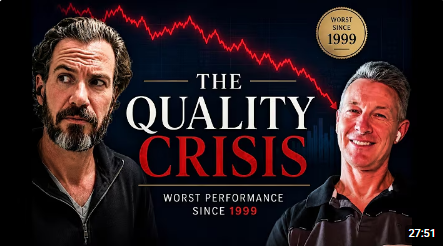
During their recent episode, Jake Taylor and Tobias Carlisle discussed:
- Why Terry Smith Changed His Investment Strategy
- Is Quality Investing Dead?
- Can Value Investing Still Outperform in an AI-Driven Market?
- Will the AI Boom Create Enough Profits to Justify Today’s Valuations?
- Equal Weight vs Market Cap Weight: Which Delivers Better Long-Term Returns?
- The Swedish Secret to Better Productivity: What Is Fika?
TRANSCRIPT
And now I’m in the Gold Coast. That’s not what that background is, but it’s a fake background, but it’s the right vibe. Where are you, Northern Lights?
[Jake] Yeah, I’ve also got a fake background that represents roughly where I’ve been. I’ve been in Northern Europe this week, Sweden, and I’m actually recording today from Copenhagen. So enjoying the Northern Europe experience.It’s quite lovely.
[Tobias] I haven’t been fully dialled in to what’s been happening in the investing world for the last few weeks, but I do have some topics. You have some topics. The first topic that I want to discuss, and I think we’re both keen to this one, is Terry Smith’s letter.Yes. What did he say?
[Jake] He said a lot of things, but I think the main takeaway was so much for that third leg of the stool about do nothing, which was his find good businesses, don’t overpay, do nothing. He had more than 50% turnover in the portfolio in the last six months, which is definitely not do nothing. And I think it seems like a lot of it is around the whole indexation flows arguments that we’ve hashed ad nauseum on the show.And it seems like it’s finally rubbed him enough the wrong way that he’s got to try not to catch falling knives anymore and he needs to catch things that got some momo to him. So, yeah, what would you think?
Why Terry Smith Changed His Investment Strategy
[Tobias] Yeah, I’ve got some quotes here. Yeah, he (Smith) talks about most value investors, quality investors want to stay put, but he says there’s little point being proved right about the dangers of passive or momentum investment after our fund is closed. And so they’re making some changes.He’s taking account of momentum now in buying these stocks. And the result of that is he’s exited a list of these fairly well-known quality companies. I don’t, Esselor, Luxottica, Intuit, Louis Vuitton, Magnum Ice Cream, Mettler, Toledo, Nike, Novo Nordisk, Otis, Unilever.
And he’s bought stakes in Atlovan, Mastercard, Netflix, TSMC, Uber, Yum Brands, a few of these sort of names. I think that he’s explicitly taking into account fund flows, which I sort of think sometimes is a little bit, that’s, I don’t know if you’re allowed to do that. I don’t know if you’re allowed to talk about that as a manager.
[Jake] Yeah. What do you think? I mean, listen, his point about like, sure, I was all philosophically correct, but none of my clients stuck around.So what did it matter? That’s a real thing. And that’s why I often think that professional investing is harder than not being a professional because you not only do you have to manage your own psychology, but you often have to be matching or manager your LP or client basis psychology as well.
And that can be really hard. So I mean, maybe he’s practically doing the right thing for his business, even though it feels a little like capitulation to me.
[Tobias] I’d rather lose half my clients than half my clients’ money. [Jake] Yeah, he’d rather not lose half his clients and potentially lose half their money. Maybe I’m being unkind there, but it does feel that way, doesn’t it? [Tobias] We need to be careful discussing another manager because I have a great deal of respect for Terry Smith. He’s been doing it for a very long period of time. He’s been very successful.I think that he knows what he’s doing. He’s a good investor. I think that there’s been a lot of pain in value and quality, and you can argue about how much quality and how much value, but he’s somewhere in that continuum.
Not that they’re not distinct at all. They’re together. He’s more quality than value.
I think I’m more value than quality, but we’re on the same continuum. I probably flatter myself by saying that. That’s what I think.
And value’s been underperforming for a long time, so I’m inured to it a little bit. Quality has been pretty handy until lately, and so on that, I had another tweet that I saw.
Is Quality Investing Dead?
Quality shares are lagging behind the S&P 500 more significantly than they’ve done for over two decades.
The only other time, it happened April 1999, and we both know what came next. Everybody knows what came next. Does it feel like he’s capitulating at the wrong time?
[Jake] I mean, listen, who knows? I mean, you don’t know if it’s 1999 today or if it’s 1996, and you’ve got way more to go. Who knows?I mean, I’m not that clever to know the answer to those kinds of things, but… Respectively, yeah. But, you know, I mean, quality had such an amazing run for a really long time.
Everybody kind of all got on the same side of the boat of, listen, you don’t want to own bad businesses going into a recession that always felt like it was right around the corner. Obviously. Like, what kind of idiot would own bad businesses?
[Tobias] Don’t own bad businesses. [Jake] Yeah, but then that got taken to extreme. Like, anything that was a smart idea taken too far turns into a dumb idea. You know, I’m paying whatever, 60 times for something like Costco or…I mean, if you looked at his portfolio, it was full of things that were 2%, 3%, at best, maybe 4% free cash flow yields. Like, it was expensive for the most part. And they were good, obviously.
But, you know, I mean, that coming in some probably shouldn’t be a huge surprise to anybody, right? Like, that’s just kind of how the world works. What’s it going to go to a 1% free cash flow yield?
How expensive is the quality justified at some point? Like, it kind of stops making sense. So, I don’t know.
It’s a shame. I mean, I’m happy to… It’d be nice if a lot of them really went on sale and then you could trade up into a super high-quality basket for the next stretch of the track.
That would be ideal.
[Tobias] When he says momentum, does he… Do you think he literally means share price momentum? Or is he saying, I want more growth in the businesses?Because, you know, if you look at a lot of those businesses, they are very high-quality businesses, but they don’t have a great deal of growth in them. From my perspective as a quantity kind of value investor, lack of growth isn’t something that particularly bothers me, because if you sort on growth, you tend to underperform. The growth is not a great predictor of board returns, or it hasn’t been previously.
It’s another one of those scenarios where what has worked for 100 years and been true has not been true for the last 10, and has not been true periodically over that 100 years, but on six occasions, including the current one, all of which were around technological revolutions that resulted in very rapid share price growth for a select few companies that were fast growers to the, you know, led everything else to underperform, and particularly things with a lot of growth.
So those companies, I think that growth is a good thing. A little bit of growth is a good thing. It’s good to be going ahead a little bit, but you don’t need a great deal of growth.
You can have a very high return business that pays out most of its earnings, provided it’s not really going backwards in real terms. It’s still a very good business. You can make a lot of money on that, particularly if the management team is doing something about it, buying back stock.
That’s a really strong signal, has been historically. I don’t know.
[Jake] I think it’s been- That’s fun staying poor with that idea. [Tobias] I have a great deal of empathy for what Terry Smith is going through, because I’ve been going through the same thing for an extended period of time, and it’s psychologically difficult, and it makes it, I can understand the urge to change position. And I think the only thing that saves me is I always return to the research and I try and find a way out of the problem a million different ways. But I’m looking at a whole data set- Spinning around in academic circles.Yeah, just a rat in a maze trying to find a way out, but unable to find the exit.
[Jake] I think what we need is we need a meme where it’s that James Franco, and he’s up on the gallows, and it’s like, you’re James Franco, and Terry’s the other guy. Oh, first time on here. [Tobias] I think that, but I also think that being research-driven helps, because I mean, we’re saying this at the absolute bottom of this, maybe not the bottom, but like from the bottom of a hole. So this could be completely wrong. I look back on this in three years’ time and say, gee, I wish I had a little bit more momentum in my portfolio.But I do think that it’s ahistorical, although the history is getting longer and longer. It’s 10 or 15 years of not working.
[Jake] So yeah, maybe- Half a career is, doesn’t look like much on the chart, right? But 15 years living it is a completely different experience.Can Value Investing Still Outperform in an AI-Driven Market?
[Tobias] Right. And it felt like we turned the corner a little bit before the AI trade. I mean, I thought we found like a generational bottom, and then the AI trade has reversed all of that and we’re further behind than we’ve ever been.So it’s incredibly frustrating, and I do understand what he’s going through. But I still feel like the tried and true value meets quality. I don’t need it to work on an empirical basis, because I feel like it works.
It just makes sense that if you buy different return streams, you pay more for one and you pay less for the other. You do better paying less for the return stream.
[Jake] Yeah. Well, you’ve got that confluence of the AI trade, which I think we’ll talk more about. And then you add indexation on top of that with the flows, where if the small cap value managers getting fired kind of regularly, they have to punch out to liquidate.And then that just goes into an index or into the growthier, the people smart enough to know where AI is going. And that just kind of feeds on itself continuously until at some point it has to stop. But only God knows when.
[Tobias] And indexation is an interesting one, because I like to look at the 100, the S&P 100. So it’s the biggest 100 results versus the 500. And that reached an all-time high in 2021, reached a new one in 2024.And it has come back a little bit in, ran up again in 2025, has come back off a little bit since then. And then the equal weight, which is small caps, basically small caps versus large caps. I think they’ve both come back a little bit in recent times, which I think is kind of interesting.
I do feel like actually Meb Faber had a great tweet where he pulled out some research. It’s the Besson binder paper, a new Besson binder paper.
[Jake] Yeah.Equal Weight vs Market Cap Weight: Which Delivers Better Long-Term Returns?
[Tobias] And he says, the best way to improve returns of the market, avoid the big stocks. Also, equal weight over market cap weight. Sounds like me.Sounds like what I’ve been saying. Yeah. I’ve been banging that drum for a little while.
[Jake] Which is sort of just the same way as kind of saying value, right? I mean, if you’re tipped to the smaller things within an equal weight, it’s going to be more value-driven just based on market cap, right? And people are more excited about bigger things. [Tobias] I take out the fundamentals because people will argue about, well, don’t use book value, don’t use earnings, don’t use cash flow. This is just purely science. And it still works.So do we conclude anything there?
[Jake] Well, I don’t know. I think just like you said, Terry’s not stupid and he probably deserves some grace, although Twitter is not giving him any. And I’d be lying if I didn’t say that I laughed at some of the takes and tweets on it.But also, they’re very uncharitable. So I don’t want to repeat them. I’m trying to be better than that, Toby.
[Tobias] Yeah. Good. Good.You’re an honourable man. Do you have an AI take?
Will the AI Boom Create Enough Profits to Justify Today’s Valuations?
[Jake] Well, yeah, we could talk about AI. I did a little back of the envelope math. And this was somewhat inspired by comments from a friend of the show, Chris Bloomstrand.He was just talking about how much CapEx was going out and roughly what returns need to look like for that. What’s nice about this is we’re not getting into TAM or use cases or AGI timelines until terminators are running around. But this is a very narrow question, which is once all this AI infrastructure is built, what annual revenue does it need to generate in order to earn some acceptable return?
And so I’ve seen estimates from, call it, $3 to $7 trillion of CapEx that’s likely to go out in this build. So let’s just call it four to make the math easier. Useful life of this equipment, let’s call it 10 years, which I think is actually incredibly generous.
Leading edge compute is probably more like five years, maybe. But let’s give bulls a full decade’s worth of usefulness for this stuff. And then a required return of 20% return on capital.
And these companies historically have earned something low to mid-20s on their capital expenditure. So they’ve been great businesses. And so we’ll just kind of round down as the hurdle is 20% you got to get over.
And also, 20% is probably what it needs to be to justify today’s valuations. So maybe I’ll do a little quiz for you, Toby, just for fun. What is the amount of revenue that you need annually, on a run rate basis, for the AI system to basically pencil out with the spend and the return requirements?
[Tobias] You’re saying $4 trillion over a decade, but depreciating every decade. So $400 billion a year. Good.You’re on the right track. 20% return over and above that, is that 1.2 trillion?
[Jake] Give this man a medal, everybody. Right. So 20% on $4 trillion is $800 billion.And then you have $400 billion a year in depreciation that you need to come up with just to account for the assets wearing out. So yeah, $1.2 trillion every year. And by the way, this is actually a bit of a fantasy version, because that’s assuming a 100% contribution margin there.
That’s like, there’s no power, no cooling, no staff, no discounts, no idle capacity. And if we move that back down to like a 50% contribution margin, which is still pretty generous because I think electricity is like 20% of the cost there. Now the hurdle doubles, and we need $2.4 trillion in AI revenue every single year. And that’s roughly six apples of annual revenue at maturity, just to clear this bar.
[Tobias] So it’s not really like… $200 a month, times 12 months, $2,400. How many subscribers do you need? [Jake] You need everybody, I think. Yeah. [Tobias] And you need all of the Tesla cyber cab drivers to start AI subscriptions. [Jake] Yeah. And we need it to be a big number too. You might not need to eat anymore.You’re just going to have to have AI subscriptions. Now, there’s a second extension of the analysis that I did that I thought was kind of interesting. What we just talked about was only for the vendors.
Let’s look at it from the S&P 500’s perspective as an index fund. So let’s say that the vendors do get their $2.4 trillion in revenue. Like the hurdle gets cleared, we’re popping champagne bottles, it’s all good, right?
Now, does the S&P 500 actually get more profitable? When one S&P 500 company sells AI to another, the seller’s booking revenue and the buyer is booking an expense. So the index is really only keeping any net there.
And say half the AI bill is paid by other S&P 500 companies, which I don’t think is totally crazy. That’s $1.2 trillion a year that’s landing inside the index also as a cost. So say those customers are…
Let’s give them a little bit of credit. Let’s say that they’re crawling back a quarter of that through real productivity gains. So $300 billion back, $900 billion of drag.
Now we’re… Plus the vendor profit of $800 billion. We’re looking now at maybe a minus $100 billion for the index as a constituent.
And so the vendors can hit their return on capital targets, but the index may actually go backwards because of that. So I think the internet was totally revolutionary too. But it didn’t permanently raise returns for everyone who spent into it.
And with AI stocks, the accounting for something… I think right now it’s like 45% of the S&P’s market cap. I don’t know how you define AI stocks.
I think everyone’s got their own version. And it’s been, I think, 80% of the year-to-date gains so far. So basically, everyone is lining up on this bet that the vendor side of the trade is going to go really well.
I don’t know as an index, actually, if that’s going to work out. Because half of it, at least, probably is one man’s revenues, another man’s expense. And you, as the owner of both of these businesses, is just kind of treading water.
So we’re going to find out what happens there. I think it’s going to be really interesting.
[Tobias] What’s the $6 trillion in CyberCab revenue that’s coming in? Don’t forget that. [Jake] Okay, Kathy, slow down a little there. [Tobias] When was that due? 2026, 2025? [Jake] I don’t know. I should go back. Remember we did that…We went through one of her Big Ideas reports and pulled out a lot of the magical things.
[Tobias] $6 trillion. Well, who knows? It might happen.It could still happen. It could happen. I had some fun.
I had a chat to Spencer Jacob at the Wall Street Journal. La-dee-da. Big celebrity.
Yeah. I’ll see if I can find the… Did you say anything smart?
No, unfortunately. He asked me about why are the value ETFs behaving so crazily this year? Because a few are up a lot and some are not a great deal.
What’s happening? And he pointed out that the value factor ETF, VLUE, is up 43% year-to-date, four times as much as the S&P 500. And the big reason is that it had micron.
And then you look at other things like…
[Jake] That’s a repeatable. Just always have at least one micron in your portfolio and you’re fine. [Tobias] Easy. I mean, that’s been true for most value portfolios for about a decade. We’ve all had a bit of micron in there, but we didn’t get the 43% out.It’s picked it up because historically, these stocks have been quite cyclical and earnings have exploded, but the multiples stayed low, I think because most folks have played this game before. Yeah. And that’s the classic value trapped by earnings on a low multiple.
[Jake] In a cyclical business. [Tobias] In a cyclical feels like a value stock. That’s the kind of thing that the magic formula wants to pile into. And then you get burned. [Jake] Three years ago, micron’s margins were like negative 30%. And now they’re like, whatever they are, 80% or something. That’s pretty good. [Tobias] We’re in this new world where there’s 1.2 trillion, 2.5 trillion of… It’s just all going into that. So it could happen.One in a million chance, but it could happen.
[Jake] So you’re telling me there’s a chance. [Tobias] There’s a chance. Yeah. So I said, classic value thesis is out of favour, low multiple stocks re-rating.But this is mostly a cyclical. Folks have typically been sceptical in the past, but who knows? Maybe it’s a brand new world and where we’re going, you don’t need accounting profits.
[Jake] You know what’s interesting? We’ve talked before about one of my friends wrote a paper about how… And he had a really nice graphic of a horseshoe.And this is how power law-driven are your returns. And obviously, everybody knows that venture capital has very power law-driven. A couple names carry all the weight and everything else doesn’t do much.
But his finding was also that deep value names also represent a power law distribution. And most of the portfolio drags along. Maybe…
Who knows? They’re declining businesses often. That’s the way they’re going.
But there’s just a few that their fortunes turn. And when they do, it’s so explosive that it carries the whole portfolio. This is Micron playing out to a tee, right?
Isn’t this exactly what he would be talking about? Shout out to Kevin, by the way, for writing that paper.
[Tobias] You got veggies for us today? [Jake] Small, small veggies. Just for fun. You know, being in…I was in Stockholm earlier this week. And in Sweden, a big part of the culture is this concept called fika. F-I-K-A.
Which I quite like. And I don’t know if you’ve heard of it before, Toby. But it’s…
Well, it’s both a noun and a verb. You can have a fika or you can fika with someone. And it’s a 19th century backslang from the word kaffi, which is like the old word for coffee, kind of flipped around.
And they needed slang, actually, because Sweden has banned coffee like five different times, apparently. King Gustav III was so sure that coffee was poison, this is the story goes, that he ran a trial on two twin convicts. One was sentenced to coffee every day and then the other tea.
And both twins ended up outliving the doctors and the king, which is kind of funny. But kaffi won out. And now, you know, kaffi in Sweden is like…
I think they have the highest per capita consumption now. Or at least they’re at the top of the leaderboard. But fika roughly translates to like coffee break.
But it’s a little bit more than that. Like, there’s a deliberate pause to it. Usually 15 to 20 minutes.
No agenda, no slides, no phone. You’re just meeting with somebody. It’s not grabbing a latte to go.
You sit down. And usually you can have it with a pastry of some kind. Maybe a cardamom bun is the really popular thing that goes with it.
But it’s so nice. You just sit with somebody for 20 minutes. You have a fika.
You connect at a very human level. And I think, especially for me personally, spending as much time in the AI world, doing work now and migrating and figuring out how it all works, it just feels like the pace of work is higher than ever. Because I always feel like I’m wasting time if I don’t have five different models running, like chunking away on things behind…
Yeah, which you mean.
[Tobias] Totally. [Jake] And my mental switching between each of them is… I think it’s actually probably very calorically intensive. That’s my guess.And it’s just like, I’m tired. And having a fika to just rest and connect with a human and not be staring at the screen is just such a nice thing. So maybe my recommendation for everybody is to just, maybe this summer or in the next few weeks, be very deliberate about taking a break like that where you get to fully disconnect it and reconnect with somebody instead of staring at the screen.
So, little mini veggies.
[Tobias] As always. Well, from the bottom of the world to the top of the world, it’s probably all we’ve got time for. Just a brief update, everybody, on our vacation. [Jake] That’s right. We do have the bottom of the world and the top of the world covered. Isn’t it amazing, though, that we could talk to each other? [Tobias] In the bottom of the value quality dip, hopefully going back in that direction. [Jake] And then we’ll head back to California together, I guess. Meet back in the middle. Reversion to the memes.It’s alive and well.
[Tobias] Good stuff. Thanks, folks. We’re probably on break for another week.We’ll be back later with a brand new guest.
[Jake] I think we have a good guest lined up. Yeah. [Tobias] Yeah, we do. One of them, give a shout out to Meb Faber. He’s got a great new book out, a great new coffee table book.I think mine has arrived, but I haven’t seen it yet. I’m very excited. I want to go and check it out.
It’s 250 years of America. Yes. Happy birthday, America.
[Jake] Yeah, happy birthday, America. Undervalued REITs: Finding Opportunities in Commercial Real Estate
 Where Are the Highest-Quality Value Opportunities This Week?
 AI Spending Boom: Are Big Tech Companies Taking on Too Much Debt?