
Mohnish Pabrai: Investors Should Avoid The Next Shiny Object — AI
Wednesday, July 1, 2026 · Johnny Hopkins
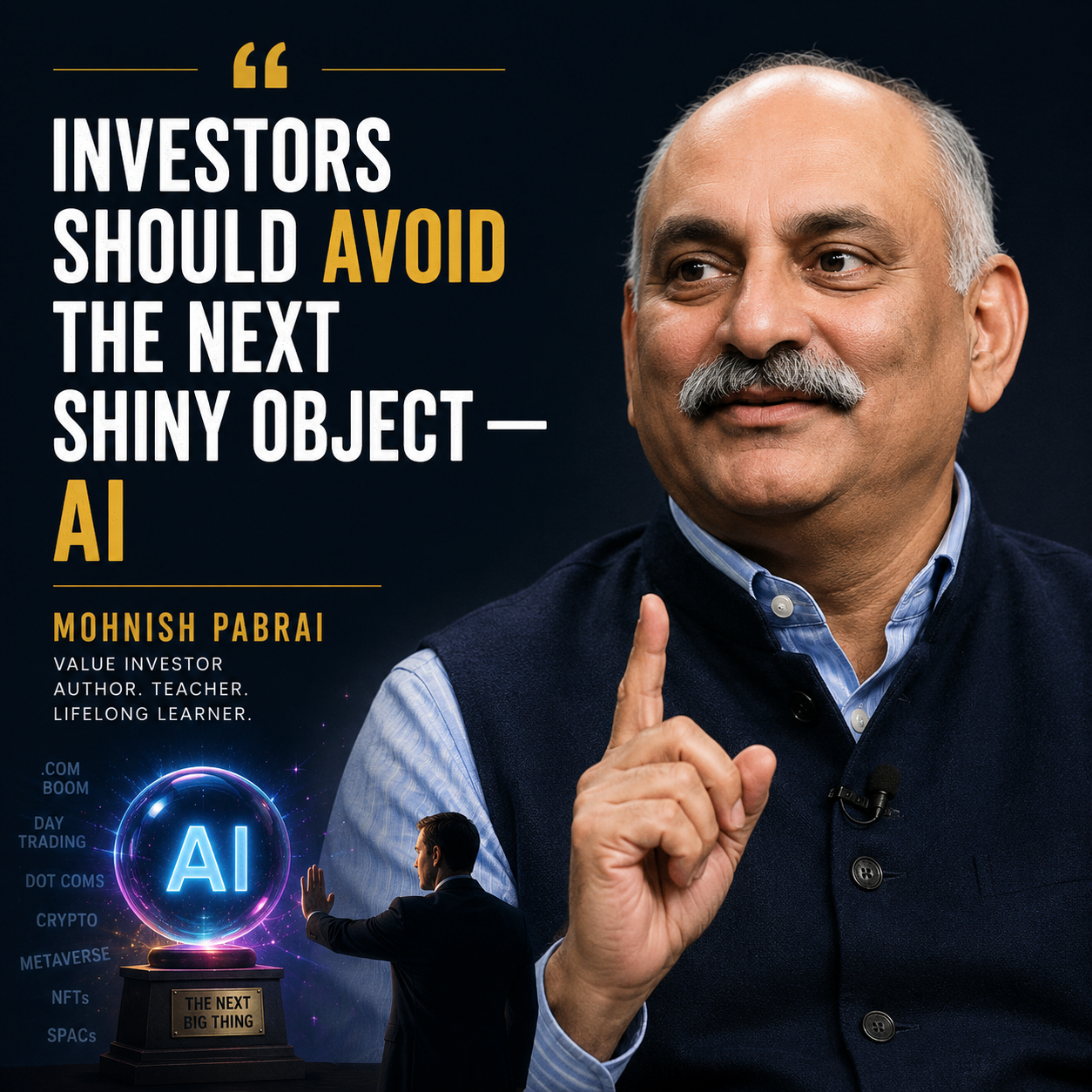
Investor enthusiasm remains firmly concentrated in a relatively narrow group of companies tied to artificial intelligence and other high-growth narratives. Capital continues flowing toward businesses perceived to have the greatest future potential, even as valuations increasingly assume years of exceptional execution. Against that backdrop, in his recent interview with the Knowledge Inside podcast Mohnish Pabrai offers a perspective that stands in sharp contrast to prevailing market behavior.
Rather than chasing popular themes, Pabrai continues to emphasize the importance of understanding businesses, avoiding unnecessary risk, and patiently waiting for opportunities where the odds are overwhelmingly favorable.
As he explains, “We’re looking for anomalies. We’re looking for anomalies. We’re looking for things that don’t make sense.”
That philosophy becomes particularly relevant during periods when investors appear willing to pay almost any price for companies associated with the latest technological trend. History has repeatedly shown that exceptional businesses do not always translate into exceptional investments if expectations become excessive.
Pabrai’s approach begins by eliminating downside before thinking about upside.
“The most important thing to consider before making an investment is how can I lose money? How can this investment result in me having a loss? And really the answer should be it can’t.”
That framework naturally leads him away from the market’s most fashionable sectors.
“So the way we apply it in the AI sector is we’re not going to go there. I already told you hated and unloved. It cannot go to things that are loved.”
He continues with perhaps his simplest investment rule.
“Please don’t buy shiny objects. Please don’t buy what is loved. Please buy what is hated and unloved.”
While excitement surrounding AI has dominated recent market leadership, Pabrai suggests that investor attention itself often becomes cyclical, rotating from one fashionable opportunity to another. That pattern may leave overlooked businesses trading at valuations that provide considerably wider margins of safety.
Equally important is his emphasis on financial strength. Companies carrying excessive leverage can quickly become vulnerable when operating conditions deteriorate or capital becomes more expensive.
“The most important thing when you’re trying to make an investment is try to make investments in companies that have no leverage, zero leverage. And also do not yourself borrow any money to buy stocks.”
He also argues that investors frequently overestimate their own stock-picking ability.
“For more than 99% of investors, they should just buy the index.”
For those determined to invest actively, however, Pabrai believes patience remains one of the greatest competitive advantages.
“So if you say every day that I’m not going to do anything, I’m just going to look at what is happening. Once every 6 months, 1 year, 2 years, you find something unusual that doesn’t make sense. That’s when you step in.”
At a time when investors continue rewarding popular narratives, Pabrai’s philosophy serves as a reminder that long-term returns often come not from following the crowd, but from waiting until attractive opportunities become unpopular enough to offer truly asymmetric outcomes.
Full interview here: