
Jim Chanos: Why Today’s AI Boom Demands Investor Caution
Tuesday, July 14, 2026 · Johnny Hopkins
Investor enthusiasm remains one of the most powerful forces in financial markets, particularly when new technologies promise to reshape entire industries. Capital has flowed aggressively toward artificial intelligence, infrastructure, and next-generation platforms, driving valuations to levels that increasingly require flawless execution. While momentum can persist longer than many expect, history suggests that periods of extraordinary optimism often deserve careful scrutiny.
Jim Chanos believes one important signal is already emerging. As he observed, “Any time you have seen massive IPOs and secondaries relative to the size of the market or the economy, investors generally have been advised to to be a little more cautious or reduce the risk.”
He argues that 2026 represents a meaningful shift after several years in which new equity issuance remained relatively subdued, noting that, “we are now going to break records in 2026 for IPOs and secondaries.”
That combination of strong investor demand and abundant new supply has historically coincided with periods when expectations become increasingly difficult to satisfy.
Companies entering public markets often benefit from compelling narratives, but investors ultimately must determine whether future cash flows can justify current prices.
Valuation remains at the center of Chanos’ skepticism. Referring to SpaceX, he stated, “SpaceX is, I believe, depending on what I heard in the green room is probably now at about 110 times revenues. And just history tells us you just never really make much money buying equities at over 100 times revenues.”
Regardless of how transformative a business may become, paying extreme multiples significantly raises the hurdle for long-term returns.
His broader concern extends beyond any single company. Chanos argues that the current AI investment cycle may exceed previous technology booms in both size and intensity.
As he put it, “The AI build out relative to the TMT build out of ’99, 2000 is multiples even as a percent of the economy.”
He also highlighted an accounting dynamic that can temporarily amplify corporate earnings during heavy capital spending cycles, explaining that revenue is recognized immediately by suppliers while purchasers capitalize those expenditures over many years.
During periods of accelerating investment, this accounting treatment can make aggregate earnings appear stronger than the underlying economic reality.
Importantly, Chanos is not forecasting the direction of the overall market. Instead, he emphasizes humility. “Basically, our view has been we don’t know where the market’s going. Nor does anybody else.”
That perspective encourages investors to focus less on predicting short-term market movements and more on evaluating business fundamentals, valuation discipline, and risk management.
Bull markets can continue for extended periods, especially when powerful technological themes dominate investor attention. Yet history repeatedly demonstrates that expectations eventually meet financial reality.
For long-term investors, maintaining discipline during periods of elevated optimism may prove just as valuable as identifying the next exciting growth story.
Full interview here:
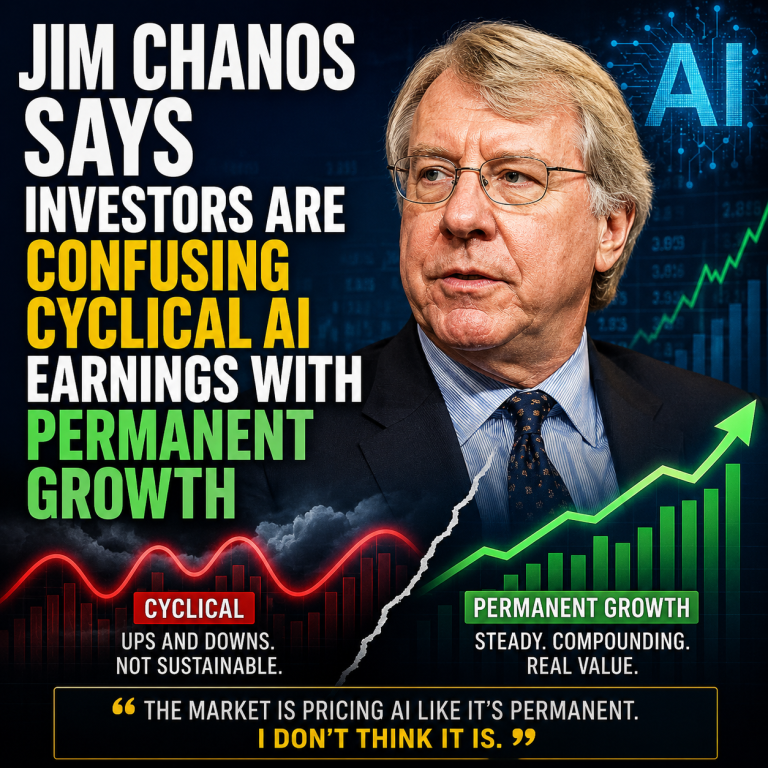 Jim Chanos Says Investors Are Confusing Cyclical AI Earnings With Permanent Growth
 Where Are the Highest-Quality Value Opportunities This Week?
 AI Spending Boom: Are Big Tech Companies Taking on Too Much Debt?