
Bill Nygren: The Discipline To Stay Boring In An AI-Driven Market
Monday, July 13, 2026 · Johnny Hopkins
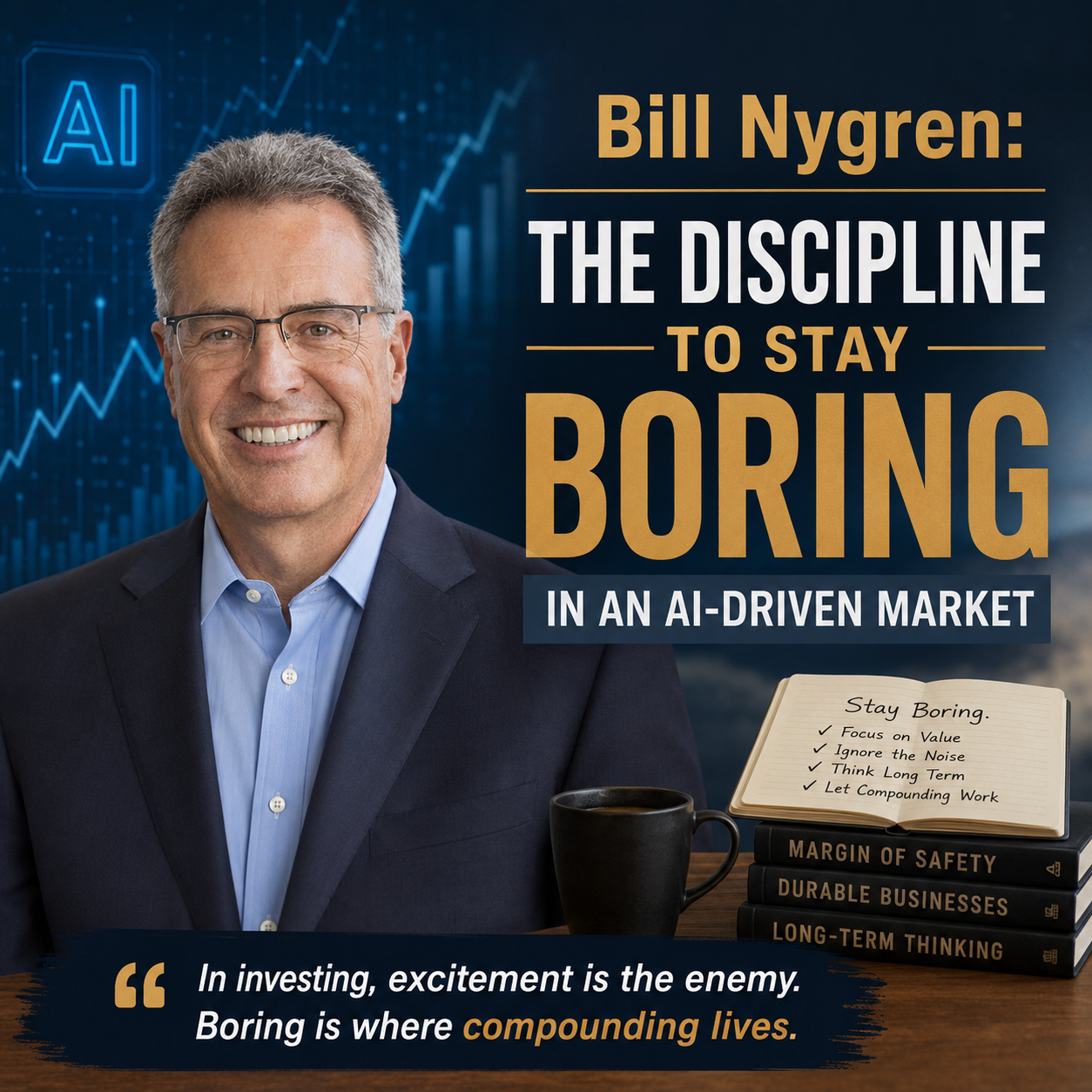
Bill Nygren sees a market increasingly dominated by a narrow group of AI-related stocks, creating a difficult environment for investors unwilling to chase momentum. With the S&P 500 and Russell 1000 Value Index posting double-digit gains through the first half of 2026, the headline numbers suggest broad strength. Beneath the surface, however, market leadership has become remarkably concentrated.
Nygren notes that just 10 companies accounted for nearly half of the Russell 1000 Value Index’s gain through June. Many entered the year at elevated valuations, while traditional value portfolios struggled to keep pace. As Nygren explains, “If you exclude AI-related stocks and the energy companies powering them, the S&P 500 would be down year to date.”
The growing influence of AI has even changed what investors consider a value stock. Apple and Microsoft recently joined the Russell 1000 Value Index, while Amazon became its largest holding. Nygren argues that “The extraordinary increase in AI infrastructure spending is pushing all but the ‘growthiest’ growth companies into the Russell Value Index.”
Unsurprisingly, comparisons with the dot-com era are becoming more frequent. Nygren acknowledges the similarities but rejects confident predictions about how the current cycle will end. “Anyone answering that with certainty is suffering from overconfidence.”
Perhaps more concerning is the shift in investor psychology. Strong returns have encouraged the belief that making money in stocks is becoming easier. As Nygren observes, “This growing belief that exceptional stock market returns are easy to achieve feels familiar.”
Yet today’s market leaders differ significantly from the speculative companies of the late 1990s. Many are established, highly profitable businesses generating substantial cash flows. The real challenge is determining whether current growth rates and profit margins can persist long enough to justify their valuations.
For Nygren, uncertainty is not a reason to abandon investment discipline. “We haven’t been able to answer those questions with enough confidence to justify owning the AI hardware stocks.” That position does not represent a bearish view on AI. Instead, it reflects an unwillingness to invest without a sufficient margin of safety.
The broader message for investors is that benchmark performance should not dictate portfolio construction. “Second, we don’t define portfolio risk by what we don’t own.”
Nygren remains focused on estimating business value, assessing management teams and purchasing companies at meaningful discounts to intrinsic value. That approach can appear frustrating when speculative assets are delivering rapid gains.
But market cycles have repeatedly demonstrated that effortless profits can encourage investors to underestimate risk. Nygren’s response is simple: “We stay grounded by following the operating performance of the businesses we own rather than the share prices of the businesses we don’t.”
In a market increasingly captivated by AI enthusiasm and momentum, staying disciplined may feel boring. For long-term investors, that may be precisely the point.
Full commentary here: