
VALUE: After Hours (S08 E21): Is Copper the New Oil? USCF’s John Love on the Metal Fueling the EV and AI Revolutions
Sunday, June 21, 2026 · Johnny Hopkins
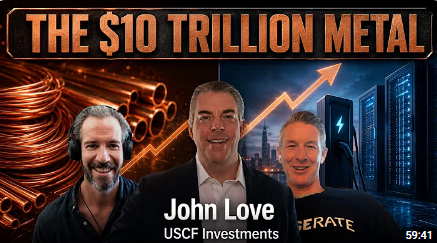
During their recent episode, Taylor, Carlisle, and John Love discussed:
- AI Needs Trillions In Infrastructure Spending
- Is Natural Gas The Next AI Trade?
- Is AI Creating A New Commodity Supercycle?
- Will SpaceX Build AI Data Centres In Space?
- The World Is Running Out Of Copper
- Copper Could Face A 15-Year Supply Crisis
- The Bamboo Lesson Every Investor Needs To Learn
- The Biggest Investment Opportunity Nobody Is Talking About
TRANSCRIPT
[Tobias] We’re live. This is Value After Hours. I’m Tobias Carlisle, joined as always by my co-host, Jake Taylor.Our special guest today is John Love. He’s the president and CEO of UCF Investments. They’re a commodity energy ETF firm.
John’s going to give us some views on where copper and oil are going. How are you, John? Welcome to the show.
[John] Thanks for having me. I’m doing good. Thank you. [Tobias] Tell us a little bit about the firm. [John] Sure. Well, USCF Investments, the acronym is short for United States Commodity Funds. We’ve been around for 20 years.We launched our first ETF in 2006, April 2006. So we just celebrated a 20th anniversary. And we were the first oil ETF, the third commodity ETF to exist, and had a lot of success with that.
A lot of people familiar with the ticker USO, that’s us, more so than the firm. But we shortened United States Commodity Funds to USCF Investments because we branched out a little bit in the ensuing years. But our product lineup is primarily commodity ETFs.
So after oil, we did natural gas, we did a contango mitigating fund, we’ve done copper, and we’ve also branched into broad commodities, where we think we have a pretty good strategy that’s done really good this decade so far. It’s actually beaten the S&P and NASDAQ 100 over the last five years. So pretty proud of that.
So we just keep trying to innovate in the space. And that’s us in a nutshell.
[Tobias] Congrats. I think copper is particularly interesting, potentially because it’s used in AI. I’ve been telling the story that the world needs six more Escondidas, and we don’t have eight more Escondidas, and we don’t have eight more Escondidas.So tell us a little bit about what’s happening in copper.
The World Is Running Out Of Copper
[John] Yeah, I think you nailed it. The challenge right now is the short term versus the long term. Like everybody knows, I don’t know if everybody knows, but over the next five years, I think it’s a pretty established fact that unless there’s an interruption to this AI story, in fact, even before AI, there’s not enough copper for all of the things that we’re trying to do.Just standard manufacturing and growth, but then you add EVs, electrification across the board, and then the AI story data centres coming into it. There’s just not enough copper. It takes a long time to bring new supply online.
Copper Could Face A 15-Year Supply Crisis
That’s starting to happen, but it’s a very long process. They’re saying 10 years. It’s probably more 15, depending on your jurisdiction.
It’s probably the rest of your life. It’s a challenging thing to do. In the short term, it’s a little harder to say.
If you look at analysts right now from Goldman to JP Morgan, I think that’s the people on both ends of the spectrum. Goldman is saying there’s a surplus of copper. JP Morgan is saying there’s a deficit right now.
It’s pretty hard to nail down, where are we at the moment? What’s going to happen? One thing that has been a headwind has been the Iran war, just because if that slows the global economy, copper still is tied to that.
In the short term, what’s going on could affect things. It’s affected China’s manufacturing. PMI, the reading is slightly bearish.
They’ve slowed down here and there. They also have committed to a tremendous amount of new grid capacity, which requires a vast amount of copper. Just across the board, I think that the copper story is bullish.
In the short term, we always have to be careful. It’s hard to say. When might we see a downturn in the global economy?
How might that affect things? Will the long term supply deficit override that anyway? That’s a definite possibility.
[Tobias] When you think about copper’s role as Dr. Copper, is it still the doctor or is it- Less so, I think. [John] Yes, it used to be very predictive. Now, because of the deficit, there’s more of its own fundamental story. We could be in a situation, I think we are, where there’s some real headwinds to the global economy.Yet, copper over the last couple of years has done quite well. Obviously, stocks have done quite well as well. I think if you look at some of the things that tend to lead to downturns, copper isn’t in that same place.
I think there’s certainly Dr. Copper still has his white coat in the closet somewhere, but I don’t know if it’s as much as it used to be.
[Tobias] I just wonder, given one of the metrics that I like to track is copper and gold together, just to take out the US dollar influence. Obviously, gold’s had a very good run until the last few months. Copper’s had a good run alongside it, which to me might be a little bit counterintuitive because gold tends to be more of an asset that runs in distress, whereas copper seems to be more predictive of a stronger economy and they’re both running together.If you look at that copper gold ratio, it’s actually troughed recently. It’s in a place where you would see it at the bottom of pretty substantial recessions and stock market drawdowns. To me, it looks like a 2016, 2009, 2000 bottom versus gold.
If you look at the stock market, you wouldn’t have known that that was happening, which I find an interesting thing. Do you have any view on what might be causing that or have you observed anything like that?
[John] I think just like copper, maybe not having that as much of a role in prediction, I think gold is, at least this year, is somewhat confounding as well because everybody thinks risk asset, and then it hits an all-time high in January, and then you have the Iran war break out, and you’d expect, well, that’s going to drive it up even more. You still have all the tailwinds for gold that we had before the Iran war broke out, and yet it did quite poorly over the last, I mean, I guess not terrible, but not as we would expect over the last three months. Then with the announcement of the Iran deal, it’s moving back up.I think both of them have been a little confounding. As far as that metric, I tend to look at the gold-silver ratio. That’s when we get asked about more, but that is a really good one to look at is the gold-copper.
I’ll have to take a look at that more, but to be honest, I haven’t looked at it. Yeah, they’ve both been performing, which is definitely counterintuitive because usually gold’s the risk-off asset and copper’s the risk-on asset. Now, they seem to be playing both risk-on and risk-off in somewhat unpredictable ways.
Gold, obviously, there is some reason for what’s happened, but it still has all those tailwinds. I mean, central bank buying has not dropped off at all. In fact, it was a record, I think, or the highest level had been Q1 versus the previous five years.
None of the G20 economies have stopped buying gold. That’s still going on. I think you still have with the potential for, I don’t know if we’re going to be able to do interest rate cuts or not.
I’m worried about inflation myself, but it certainly changes the probability and the odds if we don’t have the war going on. So, we’ll see. But yeah, it’s interesting for both those metals that they’re behaving in different ways relative to the past.
That’s not just black and white, cut and dry. It has been.
[Tobias] You raised it, and I find it’s another interesting ratio that I attract to silver-gold. When gold was very, very strong, it took silver a little while to catch fire. But when silver catches fire, it really does run hard against gold.It went parabolic. I posted a chart on Twitter when it went parabolic saying this is typically closer to the end of the run of these monetary metals when they do that. And it seemed to be close to the breakdown.
But what does the gold-silver ratio tell you?
[John] Yeah, I mean, I think the textbook thing is when it gets low, that means silver is doing well relative to gold. And where it is right now is gold’s back on top. So, when I first discovered it a long time ago, I thought, oh, this is brilliant.If gold is running at a huge premium to silver, then just invest in silver. But of course, you can sit there for years. But when it happens, just like you said, it’s high beta to gold.
So, when it does move, it tends to move a lot and be a very rewarding trade. But then you annualize that over how many years you were waiting for it to pop, and it might not quite be as exciting. So, I do think it’s worth looking at if you run moving averages on it or you have a system that can tell you when it’s time to get in.
And like you said, when it goes parabolic, it’s definitely an interesting trade. But it works both ways. You’ve got that high beta to work with.
[Tobias] I saw that one of the interesting charts that I like to track is the 10-year, or sorry, the two-year treasury as a proxy for what the Fed might do with rates. So, I think that that’s not an uncommon thing to do. But since the Iran war, the two-year has run up very substantially over the Fed funds rate, where it’s been at a bit of a discount for a while, which to your point, seems to make the likelihood of rate cuts low.If anything, it looks like we might be seeing interest rate rises. Do you have any view there?
[John] Yeah. I mean, I think interest rate steadiness or rises are the logical, rational thing right now. Politics being what they are, there is a possibility that we get rate cuts anyway, which would obviously be beneficial for not just gold, but many assets.But yeah, I do think the market is telling the government. And you certainly have seen the chatter calm down about, we have the new Fed chair who’s supposed to be more dovish than Powell. And yet, there hasn’t been any chatter about cutting rates.
And I think a lot of that is, everybody knows when the bond market is signalling, okay, this is getting out of control, rates are going up, people are demanding that higher premium for not the two-year, but just longer as well. I think you have to take that into account. I mean, that can be absolutely disastrous if we don’t.
And we have, you look at the deficit, and that is just the most frustrating thing to me in the world is that you have 30 years almost, 25 years of running up deficits when we actually had a surplus, and now the debt is what it is. And I think I saw a headline yesterday, we went from a trillion dollar debt to a trillion dollar deficit. It’s just, I’m sorry, trillion dollars in interest payments.
I mean, it’s just unbelievable. So I think the bond market’s reacting to that. You need some kind of catalyst, explosive growth, AI saving us from ourselves, but we got to have something.
Otherwise, I am worried about where interest rates go.
[Tobias] Well, I can’t believe it’s taken us this long to get there, but let’s talk oil. Is it the most interesting market in the world at the moment? What’s happening in oil? [John] Oh, not much. It’s been quiet. Yeah, it’s been, I would say, the most exciting three months for bad reasons.Obviously, war is never something you want to see, but it’s been such a back and forth and just bizarre. When it first broke out, obviously, that was the most exciting point. And now, since April, we’ve been in a different place.
I think there’s some scepticism about what happens now. But where we are versus where we were, I’d say entering the war period, I think the White House and some people in the market are a little sceptical now of higher prices. There’s still risk out there, is what I’m trying to say.
And I think there’s a lot of scepticism about that risk because some of the most bearish calls, in fact, bearish calls that were pretty common, we’re going to have $150 oil, we’re going to have $200 oil. At first, it was the end of March. And then it’s like, OK, we did the coordinated SPR release in the G7.
So now we have till the end of April. And that got pushed out. And I think everybody’s kind of like, well, did the industry cry wolf?
Why didn’t this materialise? And it’s really because not just the SPR release, but there are a number of things that I think people just at the time couldn’t foresee. I think one thing that we always discount is how creative industry can be in the face of crisis.
And one of the things that we’ve seen is China had built up their reserves substantially over the previous three years. And they were able to rely on those, draw those down. That’s not going to last forever if this doesn’t get resolved.
I mean, this doesn’t truly get resolved, as everybody’s expecting right now. But that had a big effect on the price of oil and kept it down.
[Tobias] Just before you move on to that, do you have any view on what caused that? Was that China accommodating the US by drawing down on its own reserves? Or is it a slowdown in China?Or what was the reason for that?
[John] I don’t think so. I think if you look at, I mean, it certainly helped us, but I think it was more, it was self-interest. I mean, you look at the other Asian economies that were Korea, Japan, where they didn’t have those kind of reserves.They had to have massive demand destruction, which is going to impact your economy. China had the headroom to do that as well. So I think it was, hey, we’ve been, this is what we have this for, let’s use it.
I just think it was self-interest. Yeah, things are a little soft over there. The last thing they want is significant impact from actions, external events outside their control.
And they know that, or at least the gamble is, we use the reserves and then when the price goes back down, we refill them. The danger, of course, has been and remains if this is not resolved, they get to the, and I think they’re getting fairly close. They’re going to have to say, well, right, we have to start importing again.
They also cancelled exports, most of their exports too. So they were basically, you know, somewhat self-sufficient. And a tremendous amount of the Middle East oil goes to China.
So they really said, all right, you know, this is what we have to do. So my opinion, yeah, I think it was self-interest. I think it just happened to accommodate the US, but I could be wrong.
There could have been some coordination, but I kind of think it was more what worked for China.
[Tobias] I mean, Trump did go visit Xi Jinping in Beijing, but it was a little bit kind of like halfway through the process. I just also wondered about the US strategic petroleum reserve. There’s been this sort of increasing chatter that we’re getting closer to the bottom.I don’t really know exactly what that means, whether that’s like literally that they drain it or whether it sort of gets to a point where it’s like not structurally sound if you pull too much oil out. But it seemed to suggest that we’re like weeks away from the bottom of the SPR. And I don’t know what the consequences of that are, but do you fill us in?
What happens there?
[John] Well, I think there’s, well, first of all, I think, yes, that’s out there. A number of other things, we’re weeks away from this and that. I think this deal kind of had to happen right now.But yeah, with the SPR, it’s at about 350 million barrels right now. It is, as they’ve shown on the headlines, I mean, the last time it was that low was when they were filling it back in 1983. And it first got to that level.
It got down to that level in 22 when we drained it for the Ukraine war really to keep prices down, which they proved to be probably unnecessary. We didn’t refill it for years. It started going back up a little bit and we got over, I can’t remember the exact number, but maybe 450 million barrels and then we’ve dropped it again.
So if you get down to about 300 million barrels, that’s the level where, yes, it’s functionally harder, if not impossible to pump out. You do need a certain level in the tanks. I mean, obviously you can get it out if you absolutely have to, but that might not be something where you can pump it as quickly as you could.
So that functional floor we are getting close to, despite the fact that 300 million barrels is a lot of oil, but we really need to restock it. One thing about the oil that is getting restocked right now, or that will be restocked, is the US government did something I think was fairly smart, which is they sold swap contracts. So for every barrel you take, you have to give 1.25 barrels back. And so we’ll be getting some additional build back in the SPR, not just the barrels coming back, but even more beyond that. So assuming we can get those barrels at a reasonable price, so that’ll be the challenge.
[Tobias] Sorry, JC. [Jake] I was going to say, assuming that we do rebuild, I’ve been wondering if everyone is not going to think like, well, I don’t want to have this happen again. Maybe I need to be like 150% of what I was running at before just to give myself more cushion. And maybe structurally we just have higher oil prices for longer. [John] Yeah, I think that’s very much a possibility. I don’t know what happens in the US, because there’s some dysfunction. But around the world, governments are talking about that.They’re talking about refilling, and they are talking about that exact 1.5 or more, because yeah, we can’t handle it. It was a big wake up call. In the US, we’re more cushioned from it.
So we can handle an SPR where it is right now, as long as we don’t go much lower. But the rest of the world can’t. And it’s not just oil, but it’s distillate, it’s gasoline, it’s jet fuel.
So people are talking about making reserves for those where they might not have had them before as well. So while one thing I think the market may be missing is that people are going to be, or countries are going to be building back up their reserves to higher levels and levels of reserves. And that will probably put a floor on the price for a while.
[Tobias] Before we came into this year, WTI was sub $60. And all of the valuations that I had done, I’d pencilled in like $80 oil as sort of a bullish outcome before the Iran conflict came around. Where do you see the oil prices now, given that we may need to do these refills across the board?There seems to have been some infrastructure destroyed around the world. What do you think is a base case, bear case, bull case for oil over the next five or 10 years?
[John] I think bear, five or 10 years. [Tobias] Or whatever timeframe you feel most comfortable with. [John] Yeah. I’ll say for the next year, a lot of infrastructure is damaged. We have to clean up the Strait of Hormuz.We have to get things flowing again. A lot of barrels have drawn down, not just SPRs, but inventories around the globe. Commercial inventories have been drawn down.
So that all gets replenished. I think that over the next year, at least, as that’s happening, you probably do have a floor. I’m always hesitant.
It’s very difficult to put those things. I mean, there’s millions of forecasts out there. But I think probably around 70, I wouldn’t be surprised by dips lower if something pessimistic happens.
But I think I would probably put an average, at least on Brent oil, probably around 80, close to where it is now, with spikes up into 90. A lot depends, again, on global economy and all these external factors that it’s hard to foresee. But I’d centre it around 80.
There’s no guarantee that’s where it’s going to be. But I definitely see it’s a volatile commodity. So a dip down to 70 at some point is possible.
The one thing that could eventually push it down is OPEC. The one thing that supported the price for years was the OPEC put. Every time it got down to a certain level, they were putting quotas in place and voluntarily restricting production, very much in reverse of what they did in 2020.
Now, even though they don’t have the capability, they have symbolically raised their output targets. And as they are able to fill those over the next year, maybe not as high as they’ve published, but that’s more oil going into the market. So that’ll be a little bit of a headwind to the price, but at the same time, a lot of infrastructural damage and just logistics that have to be repaired.
[Tobias] When you say that OPEC doesn’t have the capability, what do you mean by that? [John] So they have, I think their most recent, just last week or over the weekend, all the quotas and voluntary cuts they’d announced over the years, several million barrels. They’ve been slowly, they started unwinding those in 2024 and putting a little oil back in the market very cautiously. And when the Iran war broke out, they suddenly said, okay, we’re going to throw 200, 400,000 barrels back into the market.But they couldn’t actually do that because Strait of Hormuz was closed. A lot of oil was trapped and their production was shut in because they can’t get it out. They had to shut in production.
So they actually aren’t producing that much. They have to restart facilities. They have to get their oil out through the strait.
There’s this backlog. So even though they say, all right, this is how much we’ll produce. For example, Saudi Arabia, I think they’re able to produce about 7.5 million barrels a day right now. Their quota or their level where they’re willing to go is 10.25 million barrels a day. So they’re basically, their target, they’re 25% below their target. And every country in the Middle East is kind of in the same boat right now.
Is Natural Gas The Next AI Trade?
[Tobias] Let’s talk natural gas. I understand that the U.S. is the Saudi Arabia of natural gas. We’ve got giant natural gas deposits as a strategic asset for the U.S. Talk to us about the natural gas market. What do we need to know? [John] Yeah. I mean, from 10 years ago when we exported no natural gas to now when we’re exporting 18, well, we’re exporting about 16 billion cubic feet a day. Capacity right now is 18.3. So that’s a huge increase compared to where we were. There’s a lot of terminals and facilities that have come online that didn’t exist 10 years ago. And there’s another, I’m going to say four and a half billion cubic feet capacity coming online the next two, three years. And it’s really come online at a time when it’s desperately needed.Europe needs our natural gas. Yeah, we’re shipping some to Asia, but I think 68% of it goes to Europe with the outbreak of the Ukraine war and then the Iran war that’s been desperately needed. But it’s interesting because U.S. natural gas, we have absolutely tonnes of it. It’s a byproduct of crude oil production, which of course has exploded with the shale revolution. We really don’t have a problem with natural gas and that’s kept prices low. It’s always been a domestic market.
It still is. It’s going to be much more affected by weather than exports. But that export story is becoming part of the story.
And over time, as we expect, as we export more and as it starts getting used in data centres, I think that’ll start. I mean, as the data centres are built out, as the AI story continues, which a lot of that is powered by natural gas, there’s a lot of demand there that is increasing. So where it’s been, I would say, almost a weather story for forever, it’s becoming a demand story, both domestically and internationally with the exports.
Australia actually is another big producer. Qatar is a big producer. And that’s the big thing going on is their big LNG facility was severely damaged.
They’re trying to get back to about 50% capacity in a few months, 80% capacity by the end of the year, which is pretty quick. But there’s still going to be 20% of their capacity that’s going to be offline for years. And so that’s probably about 4% of global LNG supply.
So that’s something that’s been taken out completely. And that is a year’s long story that’s probably adding a bit of a premium to natural gas for the US, for Australia, and everybody.
[Tobias] It’s long been sort of known as the widowmaker trade, the gas trade, because for whatever reason, it’s extremely volatile. There seems like there’s a lot of downward pressure on prices most of the time, but every now and again, there’s a massive spike. And that takes people out.Is that how the market trades? Or how do you see the market?
[John] Yeah, it’s definitely a very volatile market for people that enjoy volatility. And we have some of those fans of our funds. Natural gas certainly does that.The whole time that we’ve had our natural gas fund out, 19 years, UNG, not the whole time, but the majority of the time it has been under pressure. And that is, again, is primarily this abundance. And then you get a cold weather snap, or you get something that takes out production, and it does spike up.
But I think that now, one thing that’s, I don’t know that the volatility goes away, but I do think that the price is probably a bit inflationary. The highs in the channel is going to go up just because of that increased demand. But it’s definitely an exciting market, and I think will remain so, as long as we have heat, cold, and global disruption.
[Tobias] Well, folks, we’re coming up on the top of the hour. Let me just give a shout out around the horn, and then JT’s got some veggies for us. Tumble, Texas, what’s up, Tyler Valparaiso?Toronto, London, UK. Thanks for specifying, not now, Ontario. Orlando, Florida, have a town.
Tallahassee, Snohomish, Petitigva, Israel, Golden Grove, Guyana. Nice, Boise, Philly, Toronto, Lausanne, Switzerland. Welcome, Cincinnati, San Diego, Madeira Island, Portugal, Bellevue, Turku, Finland.
How do I go with that? Palma, Spain, Gurney, Illinois, Lanzarote, Spain, and Scotland, the brave. Thanks for joining us.
We appreciate it. JT, what do you got for us? You’re on mute.
[Jake] Yeah. Coming actually live from an airport, so hopefully it’s not too much background noise. I tried to find somewhere quiet, but then it got noisy on me.The Bamboo Lesson Every Investor Needs To Learn
So, the veggies. We’ve all heard this bamboo story before, right? It’s on every LinkedIn post and half the sales conferences in America, usually right after some slide about an eagle that reinvents itself after it’s 40, or a bad Michael Scott office quote.
But with the bamboo, you plant a seed, you water it. Year one, nothing’s happening. Year two, nothing.
Year three, four, still nothing. Then in year five, it grows 90 feet in six weeks. And the lesson is supposed to be about patience.
So, you keep watering and your breakthrough is coming. An overnight success, 10 years in the making. It’s a nice story.
It’s also kind of wrong. And the real version tells us something about the biggest current event on the planet right now, which we’ll unpack. So, as you know, that bamboo is not doing nothing for those five years.
It’s working the whole time. It’s working underground, building a rhizome, which is this web of roots and stems where the plant banks its energy underground. It builds the engine first, basically.
In the roots, it’s stored carbon, and the machinery then is built that eventually allows it to raise the shoots. So, here’s the part that’s not on the motivational poster. When the shoot appears, its diameter is already set.
The whole architecture is compressed inside of it already. And then it turns that banked energy into height at an absurd speed. And a botanist in Japan one shoot growing nearly four feet in one day in 1956, which is incredible.
And the stock, which a botanist will call a comb, c-u-l-m, comes out at its final width, and it never thickens. So, sorry, Toby, but the bad news is no matter how much you wish, you can’t will your way to a thicker stock. So, I digress.
But how big a stock is thrown is capped by how developed the engine underneath it is in that rhizome. So, if the rhizome is weak, it’s not going to throw a giant comb. Instead, it’ll throw a small one or maybe no one at all.
So, it’s time for us to now start torturing our analogy. In business, you likely need to get the underground root unit economics right first before you scale. Before you open that second store, you need the first one to be earning more than it costs.
And that’s the unit economics of the rhizome, an engine that throws off more than you feed it. And of course, Michael Mobison wrote a white paper called The Math of Value and Growth, which gives you all the details of the math behind this. But growth really only creates value when the next dollar you put in earns more than what it costs.
And if you’re at your cost of capital, exactly, that growth is worth exactly zero. Below it, the growth destroys value. So, the faster you grow, the more that you’re destroying.
So, WeWork was a 90-foot stock built on a baby rhizome that couldn’t feed it. No underlying engine, really. And so, of course, the IPO cracked for obvious reasons, despite community adjustability.
However, you wanted to dress it up. So, let’s make this all a little bit more timely. Friend of the show, Chris Blumstrand, gave a talk at Manual of Ideas earlier this month.
It was called The Value at a Secular Plateau. And his warning was around really kind of the bamboo story. Right now, today, we’re forcing up the biggest stock in history with the AI buildout.
AI Needs Trillions In Infrastructure Spending
And Chris put some numbers around it. So, the hyperscaler CapEx was over $400 billion last year. And it’s headed for something like $4 trillion over the next decade.
That’s the projection. Here’s the part that starts to rhyme. Bloomstran lined this up with every capital cycle boom before it.
Canals, railroads, fibre, etc. Everyone’s a frenzy of building. But of course, most of those builders went bankrupt.
Only 4% of the fibre was actually lit during the dot-com boom. We just had crazy overcapacity. But the internet still got built.
They’ll use the fibre later. 20 years after the wreckage for all the people who paid that original tab, unfortunately, they didn’t survive that. So, let’s run this bamboo question on the AI stock.
Can the engine feed it? So, we’re spending $4 trillion on chips and data centres. If you depreciate that over 10 years, that’s $400 billion a year baked into the cake every year.
Whether revenue shows up or not, by the way. And 10 years is quite a generous assumption. It’s probably more like three to five years depreciation schedule for these chips.
But if we cut that 10 years in half to five, the bill doubles to $800 billion a year in depreciation. Then you have to put a return on that. Just to break even at the cost of capital, you need maybe $400 billion a year in profit to earn what these companies are actually used to earning at 20% returns on invested capital.
It’s more like $800 billion that you need. And right now, the entire S&P earns about $2.5 trillion. So, in this one buildout, to throw off something like a third of all the profit in corporate America today, we need it fresh on top of all of that existing that they’re making in order to justify the spend.
And of course, today’s revenue numbers, if we look at Anthropic is running at $41 billion or something, Chachupic at $25 billion. Real money, big numbers, but nothing compared to $4 trillion. And then here’s the concerns when you get to financials of big tech.
Right now, in two years ago, CapEx ate about 40% of the cash that these companies generated. Today, it’s effectively all of it. And these cash machines are spinning everything that they make, basically.
Buybacks are shrinking, and the rest that’s coming now is debt. And a lot of that is parked off balance sheet when you see some of these structured finance things. And of course, fresh equity raises now, which you saw with Google and Berkshire recently.
So plus today, a lot of that revenue that’s showing up is a lot of these same dollars that are circulating around between a handful of companies. How much profit you can make out of that, who knows? So we’re all in this poker game where everyone basically keeps buying chips from the house, which the house is Nvidia today.
The pun was intended there. So anyway, no doubt, the tech is real. I think we’re all using it.
We’re all experimenting. We’re all benefiting from it. It’s awesome.
But the internet was real too. It’s pretty awesome. Still did not create high returns for the companies that built it.
In fact, it killed many of them. So whether you’re in a bamboo garden, in a startup, or in a data centre that’s the size of a city, there has to be a real engine down there in the rhizome that’s throwing off more than you feed it. Or you’re kind of just looking at maybe a ravenous hole in the ground eventually.
So I honestly don’t know how this all ends or over what timing, but it’s going to be exciting to watch it play out. So where do you guys see this thing going?
[Tobias] I wonder, there’s a good comment here where supply constraint on compute. How real do you think that is? [Jake] Well, I mean, I can go off my own personal usage where because it’s kind of a pain in the ass to decide which model do you want to use for which task and you don’t ever really want to underpower the model. So you’re basically like going, I need max, deepest, most expensive for changing this file name or something like that. So I think there’s actually probably a lot of room for improvement on model optimisation where you send the load, you send the query to the right model, you get that kind of minimum effective dosage.I don’t know, I’m not smart enough to know all the permutations of all the variables there, but I feel like we will figure out how to do less with more eventually, in which case maybe it’s not so constrained.
[Tobias] The other thing is that there has been this, those mag seven, they do seem to have, their earnings have exploded over the last five years and they’ve certainly grown much faster than small and micro and mid-cap. So there does seem to be a huge revenue growth there. It looks to me like it’s going parabolic and I don’t know what the driver of that is, whether it’s just that there’s huge amounts of investment and then that investment inevitably creates some profitability or whether it’s like real demand and real uptake and it’s going to outstrip the CapEx.But it’s a very difficult thing to model out and pick. So hats off to anybody who’s done that. But it must be, John, it must be a good thing for the commodity complex.
Where’s the CapEx spend going? It must at some point, it’s falling through to the metals and the energy producers.
[John] Oh yeah. Well, first of all, to JT’s question, I lived through the dot-com crisis. I was at multiple firms that went under and I remember that really well.It leaves them an impression. But as you just said, Tobias, the one difference is these companies that are spending from profits that are coming from somewhere else, whereas in the dot-com era, these were companies with no pets.com. I mean, just no real business model, just an expectation of future growth, which as JT mentioned, eventually came, but it came to not necessarily the people that were in business in the late 90s.
So I think it’s very hard to say. I kind of have this view that at some point, there’s some interruption to this. At some point, the market has to say, okay, the dollars are not materialising as fast, or maybe they do.
I mean, if revenues catch up, if there’s business models that develop and all of a sudden there’s all these products and certainly there’s use cases, there’s products, it’s beneficial, but where’s the revenue coming from? And I think that’ll be the challenge. Now, whether that’s this year, three years, five years, that’s impossible to say.
Is AI Creating A New Commodity Supercycle?
But yeah, the more parabolic it goes, maybe the sooner we get to that point. As for commodities, yeah, I mean, I’ve got basically a copper behind me. It’s a fuel for copper, but also so many other things.
Silver is more an industrial metal than a precious metal. It’s critical, but everything, aluminium, nickel, a whole bunch of different commodities. Like I said, natural gas, maybe that doesn’t go through the roof, but there’s probably support for it as we build out data centres.
And the hyperscalers are saying, we want to pay our own way. We’ll build power facilities. I’m not sure how genuine that is, but that’s what they’re saying.
But we think even without the AI story, there’s a lot of support for commodities. When you look at broad commodities, every individual commodity, it’s a rise and fall supply demand, individual supply demand story. You put them together though, and if you allocate in a smart way and rotate in a smart way, I think that can be a real beneficial thing to your portfolio.
So we think unlike the 2010s, which was challenging for commodities, the next five to 10 years look quite positive.
[Tobias] Good for small and micro businesses, good for mid-cap businesses, all of that spend just flowing through the good guys for once. [Jake] Toby, I’ll give you a little stat to push back on that whole earnings growth story. When I read this, it about made my jaw drop. Q1 2026, three companies, Alphabet, Amazon, and Nvidia reported $69 billion in non-operating other income that counts towards earnings for the S&P 500, which was a 12% increase for the S&P 500 from these three companies.What did that come from? Marking up their investments in profits. So these are non-cash, it’s just a mark to market game, circularity game.
Can you imagine? Paper profits.
[Tobias] Excuse me, just to play devil’s advocate a little bit there. We’ve seen, I mean, SpaceX hit the market and SpaceX has gone into orbit from the moment that it’s hit the market there. So it certainly seems like there’s, and it was four times oversubscribed or something like that.So it certainly seems like there’s, I mean, SpaceX is one of one, it’s not anthropic and it’s not open AI, but there certainly seems to be demand for IPOs at the moment, at least.
[Jake] Paul Barker, baby, let’s go. Get in on the fun.Will SpaceX Build AI Data Centres In Space?
[Tobias] Well, SpaceX is going to create data centres in space that do all of the AI processing in space and just send information back to earth. It’s going to send AI computation back to earth. What do you guys think of that? [John] Well, I mean, Elon Musk has done some remarkable stuff. On the other hand, these are pretty audacious cities on Mars. Starlink sounded crazy and it’s a very viable thing and never on his schedule.So I don’t know. I’m not in the tech space enough to know how viable that is, but I think eventually at least some of it comes to fruition. That’s a cool idea.
[Jake] I mean, I don’t know how real these numbers are, but I’ve heard it’s 20% of the cost is energy and effectively if you’re up in space and you’re kind of always at the sun and there’s lots of room for solar panels, you’re effectively like zero marginal cost on energy then. That sounds cool. I mean, I don’t know.It’s getting it up there. As long as it keeps getting cheaper, maybe that does make sense. I think it’s a cool idea.
[Tobias] John, do you look at the equities for any of the commodities or are you just directly focused on the commodities? [John] Yeah, the commodities keep me busy enough. The equities, we get asked that a lot, how do commodity equities differ from commodities and it’s probably fairly obvious, but commodity equities do have a beta to the overall stock market and they’re going to certainly have a beta to the commodities they traffic in, but it might be like 0.6 or something like that, which is kind of where maybe the broad market different times, it can range and depend on the commodity, but the reason to buy commodities is that diversification, the zig when everything else zags and we saw that in 2022. We saw this last year, there’s a copper equity ETF and when copper itself opened up this giant premium, the copper equity ETF was only up like 1%, our copper fund CPER was up substantially. Then we had Trump reverse, say, I’m not going to tax copper.Copper itself crashed back down, but then over the rest of the year, it climbed up and went over where the premium had been and that differed from the commodity equity ETF. That’s just one example of certainly the commodity equities, copper equities benefited from the rise in copper, but there are other things going on, including idiosyncratic risk with the individual companies. If they’re managed well, if they’re managed poorly, that’s going to have an effect as well.
I think they both, you get exposure, if you’re broadly invested, you get exposure to commodity equities. Anyway, we kind of say, if you want what commodities really offer you, which is diversification, opportunities for performance at times, and possibly inflation protection, back to historically some very substantial inflation protection, then you want to be in the commodities themselves.
[Tobias] There was this narrative in the early 2000s, there was the commodity super cycle driven by China’s buildup and China slowed or that all cooled and it’s sort of gone away a little bit, but where are we in terms of the commodity? I mean, I don’t want to call it a super cycle, but where are we in the commodity super cycle? What do commodity pros call that? [John] Well, the super cycle definitely ended in maybe around 2010. It went past the financial crisis a little bit, but definitely ended in commodities turned over in the 2010s. We’re in a new cycle.I don’t know if we want to, it’s the China build out is not at that same level, but with certain commodities, China is a huge portion, copper being one, aluminium, there’s certain things where China is the driver. So you want to pay attention to China, but there are other things too. So we’re bullish over the next five, 10 years.
We think we are in, some people say a new super cycle. I’m always hesitant to use that word, but- You don’t want to jinx it? Maybe that’s it.
Maybe that’s it. Some people reject it on academic terms and some people embrace it. But I think there are new drivers.
It’s not quite on the scale of the China build out, but China’s going to continue growing their economy. US is going to continue to innovate. And there’s just a lot of tailwinds to a lot of commodities at the moment.
[Jake] Is there any chance that the world kind of breaks up into two hemispheres of influence and we get kind of almost two separate entire supply chains of these commodities and maybe the world looks quite a bit different from globalisation from 1980 to 2020? [John] Yeah, I think that’s happening. I think it’s unfortunate because I think it makes everything less efficient. But I think that’s one of the reasons commodities have gone up in the last couple of years is supply chains have been disrupted.The Ukraine wars is one thing. It’s just suddenly something that we could get fairly cheaper. Europe could get cheaper gas from Russia.
Okay, now they’ve got to buy it from us. It can’t just run it through the pipelines. And that story we’ve seen play out across the board.
Strait of Hormuz is sort of a microcosm of that story. And China is going into Brazil and doing business with all these other countries. So you’re kind of rerouting things across the board.
So I think that is happening. It has happened to some degree. And unfortunately, probably will continue to happen when it would probably be better for all of us if we continue to have at least some smart globalisation where we’re not hurting our own workers.
The Biggest Investment Opportunity Nobody Is Talking About
[Tobias] John, are there any interesting commodities that aren’t getting discussed enough that you think are sort of going to become interesting maybe over the next five or 10 years? [John] Five, 10 years. [Tobias] Or shorter timeframes. I give five or 10 as they’re sort of beyond what anybody’s thinking about in the short term. [John] Yeah, first I was going to throw out cattle. That was a big story last year. Cattle herds are at their lowest level in 70 years, not adjusted for the population, just on absolute level.They are as low as they were 70 years ago, if not lower. And so that’s kind of astonishing. And now we have this screw worm infestation coming into Texas, maybe New Mexico.
That’s a really frightening story. I mean, that could affect the global food supply, US food supply. So we’ll see what happens there.
But that’s been one. You kind of never know. I shouldn’t say never know.
But there’s always some commodity that gets a supply squeeze. People talk about oil and gold and the big headline commodities, but it can come from anywhere. It can be cattle.
In 2024, cocoa was up 300%. I remember. Yeah, it’s now brought a lot of that down.
But I mean, just who’s talking about cocoa aside from cocoa puffs and chocolate that you eat? And all of a sudden, 300%. I mean, that was one of the best investments you could have had in 24.
So next five years, I think I kind of think gold still has some legs that it’s been interrupted, but there’s so many dislocations going on, weakness in the dollar. We’ll see what happens. Now, if interest rates keep going up, that would be a headwind.
And then industrial metals. So that’s not one that’s not getting talked about. But I would say, and that’s kind of why we advocate broad commodities, is if you can find a way to sort of gauge what is in low, what’s relatively scarce on the supply demand spectrum, then you can benefit from those things like cocoa and cattle when they do arise.
And that’s kind of what we do in our or that is what we do in our broad commodity strategy, SDCI. So is, you know, I don’t know what it’s going to be two years, three years from now, but I know, and we’re happy to go into this more at some point, but we think there’s a market signal when things go into short supply. And that’s kind of what we rely on to allocate.
[Jake] John, what would you, what do you say against the common pushback that being long commodities is being short human ingenuity? [John] Interesting. Just that, you know, commodities are the input to, you know, the first input to the global economy. So yeah, I think I’m not going to discount human ingenuity, but that’s one driver.That’s one thing in your portfolio. It’s not a constant, you know, I mean, the last 15, since the financial crisis, if you just sat in QQQ, you’d be, you know, you know, but it’s not always a straight up story. It won’t always be up.
There will be interruptions. I think commodities, what you want is it’s just a ballast for your portfolio, if not at different times, a huge driver. So again, in the two thousands where equities were flat, it’s not like there wasn’t human ingenuity going on, but circumstances, you know, all these different things, stocks were flat and commodities were up.
So anybody with a commodity allocation generally did a lot better than a portfolio without it. So I don’t think it’s a knock against human ingenuity. I think it’s just a, you know, a smart way to keep some diversification in your portfolio.
[Tobias] What about something off the run, like uranium? It seems to me like if we’re going to build out all of these data centres, we’re going to be in space. We’re becoming much more energy intensive.We’re already very energy intensive, but, you know, as they often point out, there are no advanced civilised, no advanced societies, no advanced civilisations that aren’t very, very energy intensive. And it seems to me at some point, nuclear is just the obvious answer there. So how about, how about uranium?
Where are we with uranium?
[John] Uranium is, yeah, that’s an interesting one because we have, I mean, there was a lot of resistance to nuclear power for a long time when obviously the safety issues are critical. You have Three Mile Island, you have Chernobyl, that lives in the public’s imagination for a long time. But I think things have turned significantly.And I think I just read, we were finally creeping to the point where the majority of the public would favour nuclear power. Industry certainly is behind it because it lowers costs across the board. But if that starts becoming a bigger component of our whole energy menu, then yeah, uranium benefits from that.
And it’s always, again, you know, where’s the supply coming from? How constrained is it? How, you know, if we pour tonnes into uranium mining, is it suddenly not as scarce as it was before?
So, but there will be times, and I think certainly over the next five, 10 years, uranium, you know, we’ll see some, we’ll see some upside to uranium as nuclear becomes a more, a larger component again of the total energy infrastructure around the world.
[Jake] John, I can think about how much do we really actually know of like what we have in the ground on planet Earth? Like we’ve poked a lot of holes to try to find stuff, but like what as a percentage, like could there be crazy amounts of things we don’t even know? Or are we actually like have that pretty well mapped? [John] You know, I’m probably not the most qualified person. I mean, you probably need a scientist to truly answer or a geologist. [Jake] Well, you know more than we do, so we’ll go with your answer. [John] But yeah, I mean, I think you can have surprises. I don’t think there, there’s much as you, I mean, we know there’s things in areas where, you know, they’re harder to reach or it just, you know, we, we don’t want to take down mountains or, you know, whatever. So there is more out there than is technically available.And it’d be sad if we start stripping that, but could you have a surprise? Yeah, you could have some surprises. I mean, we’ve seen that over the last 20 years where we didn’t think there was accessible oil and suddenly there, there was not just technology, but yes, new, you know, we find new ways to discover things and all of that.
So you can also go deeper and, and this kind of thing. But I don’t think that it’s in terms of ease of getting stuff that, you know, I would be surprised by all of a sudden we discover a mountain of gold somewhere that, you know, we never found before. We’ve been looking for it for 5,000 years.
[Jake] Just harness that asteroid. [John] Yeah. Drag it in. And we kind of know where the oil is, you know, more or less.I mean, you go into regions where you, you know, we drilled a lot of holes and now it’s time to move on to a new region. And, you know, you can go, oh, there’s a little more here than we thought. But, but, but, you know, the oil industry knows like, okay, if we, you know, here’s where we need to go.
I think they’ve kind of tapped, you know, tapped what’s there. So I think generally that’s going to be few and far between, but never say never.
[Jake] I did read that we’ve only, I think it was like 1 50th, the amount of like holes drilled into Africa and then kind of the rest of the geography. [John] Yeah. Well, that’s, yeah, that’s one area you could have surprised harder to, to get in there. And, and, but, but a lot of, yeah, a lot of commodities coming out of Africa too.And Guyana is one of the big, you know, oil success stories of late. And nobody would have thought that that 10 years ago. So I think a lot of it is not just necessarily undiscovered, but the will to go in and the, the ease versus complexity of getting in somewhere.
[Tobias] It gets important enough. I think we go get it. [John] Yeah, that’s true. Well, yes. [Tobias] What about rare earth minerals are there? It seems like anything we want to do technologically requires some like rare earth minerals and the US has been quite good at finding them after the fact, but I sort of wonder what’s the story there? [John] Well, I think they must be all in Greenland. Cause that that’s the only thing. Yeah.I know that’s, that’s a critical security challenge. I mean, I think there’s more here that we, you know, I think we’re starting to realise we do have the ability not, well, not just in the United States, but in US interests around the world to, to, to get it, then maybe some of the worst fears, but you know, China does have a substantial amount of the rare earths. And so I’ve said, I was saying, you know, cooperation probably goes a lot longer.
There are a lot, it would work a lot better for us than being adversarial, but no, that’s, that’s critical. And you look at things like, you know, just lithium and cobalt. Lithium is one of the best performing commodities this year, but he’s talking about fossil fuels, but I think the lithium is up about 45 to 55%, depending on the day.
And yeah, we’ll, we’ll continue to see that. And we’ll continue to see that with other minerals that are hard to pronounce. And most of us have never heard of.
[Tobias] Hey, John, we’re, we’re coming up on time. If folks want to follow along with what you’re doing or get in touch, what’s the best way of doing that? [John] Please go to uscfinvestments.com, USCF short for United States Commodity Funds, uscfinvestments.com. [Tobias] That’s John Love. He’s the president and CEO of USCF Investments. JT, any final words? [Jake] No, sir. [Tobias] Be good to everybody. Folks, it’s a summer vacation here in Los Angeles. We’re going to be taking a break for the next four weeks.We may be sending some letters from the trenches.
[Jake] Congratulations, JT. Yeah, vacations. [Tobias] All right, fellas. We’ll see everybody on the other side. Until then, have a good break. Closed-End Fund Investing: Buying Assets Below Net Asset Value
 Where Is the Deep Value in Small and Micro Caps This Week?
 AI Stock Market Bubble: Can the Technology Succeed While Stocks Crash?