
VALUE: After Hours (S08 E19): $250 Billion in Assets. Here’s What They’re Buying Now. First Eagle Global Value
Sunday, June 7, 2026 · Johnny Hopkins
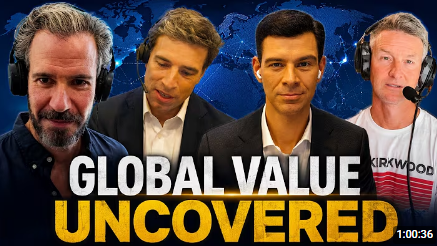
During their recent episode, Taylor, Carlisle, Julien Albertini and Christian Heck discussed:
- The Secret Warren Buffett Principle They Still Use Today
- Why 15% of the Portfolio Is in Gold
- Why This Fund Owns 100 Stocks Instead of 10
- The AI Investment Opportunity Most Investors Are Missing
- A Software Stock Trading Far Below Intrinsic Value
- Why Walmart Mexico Looks Better Than Walmart
- What the Roman Empire Teaches About Customer Acquisition
- The Biggest Edge Isn’t Stock Picking
TRANSCRIPT
[Tobias] We’re live. This is Value After Hours. I’m Tobias Carlisle, joined as always by my co-host Jake Taylor, our special guest today, First Eagle, Julian Albertini, Christian Heck.How are you gents? Welcome to the show.
[Christian] Good morning, guys. [Tobias] So let’s start with who’s First Eagle? [Julien] Sure. I’m happy to start. And yeah, thanks again for having us.So First Eagle is actually a very old forum. It dates back to 1864. It started as a private bank in Germany and for a long time, for six, seven generations, run by two families.
We used to be called Arnold and Blayerschroder. And as you can imagine, over the past 160 years, the business has been through a lot of political cycle, economic cycle, two World Wars. But you’re still independent, still standing.
The business survived hyperinflation in Germany because it owned some good quality business. It owned a brewery. It had some gold as well.
It obviously had to leave Germany in the 1930s to establish itself in the US. George Soros actually walked and started his career at First Eagle in the 60s. And today, we’re not a private bank anymore.
We’re just an asset management company. We run about $250 billion in AUM, but we do very few things. And one of the things we do is global value.
So the team Christian and I are part of is a global value team. We run the First Eagle Global Fund, which has a track record dating back to 1979. And I like to tell my friends and all clients that to me, First Eagle is one of the very few remaining temple of global fundamental long-term value investing.
And so we’re very proud of being part of that unique heritage.
[Tobias] Well, tell us a little bit about what global value means to you guys. [Christian] Sure. I think it’s important to sort of have a North Star when you invest, when you do long-term fundamental investing. And our North Star, we call it resilient wealth creation.And what does resilient wealth creation means? It means we really concern ourselves about avoiding the permanent impairment of capital for our clients. Think about it as participating in the march of man, but avoiding the potholes along the way.
Now, how we do that bottom up is the vast majority of our portfolios are invested in equities. And we tend to be global, we tend to be quite well diversified. And for very long term, the portfolio tends to turn about 10 to 15% per year, which means the holding period is 7 to 10 years.
When we select those equities, we’re a value investor, it’s a global value team. But value investing, as you know, means different things to different people on the one end of the spectrum, sort of let’s call it the Benjamin Graham types, scouting or screening the world sort of statistically cheapest securities one can find. The other end of the spectrum, let’s call it the Warren Buffett end, you start the search process with looking for good businesses.
The Secret Warren Buffett Principle They Still Use Today
I would say we gravitate more towards that Warren Buffett end of the spectrum, but that gets us sort of to the next broad or loose term, which is what is a good business. And the way we think about a good business is we are looking for businesses that embody scarcity, that have something that it’s hard to replicate. And for us, that really comes in two different flavours that we look for when we scout for scarcity.
It’s tangible scarcity, and it’s intangible scarcity. Tangible scarcity, you know, those are real assets that are hard to replicate. Think about prime real estate in Manhattan or in London.
Think about a copper mine that sits on the low end of the cost curve due to favourable geology. When I think about our portfolios, we own a company called Grupo Mexico. Grupo Mexico, amongst other things, owns the main rail network in Mexico.
Good luck replicating that. It’s impossible. You’re not going to lay more track.
That’s tangible scarcity. The other flavour is intangible scarcity. So those could be entrenched customer relationships.
It could be an iconic brand. It could be dominating a little niche market. And to put an example to that theory as well, we own a company called Colgate-Palmolive.
And Colgate has 40% to 45% global market share in toothpaste. Now, getting to a market position where one in two people on this planet use your toothpaste in the morning to brush their teeth, you know, that’s very difficult to do. So we scout the world looking for these businesses that embody scarcity.
Then we want to make sure their balance sheets are clean. As I mentioned, the North Star is resilient wealth creation. So we don’t like leverage.
And we want to make sure they’re run by people we want to be aligned with. You’ll see a lot of family-owned companies in our portfolios, a lot of founder-led companies in our portfolios, because it aligns incentives, especially if you’re a long-term shareholder like ourselves. When we find these businesses that check the boxes of scarcity, clean balance sheets, people involved that we want to be involved with, we value them.
What would a rational buyer pay to own the entire enterprise? And this is where the value investing kicks in. We only deploy capital when we can acquire a stake in those businesses at a significant discount to our sense of intrinsic value.
Usually, we’re looking for about 30% or more. We call that the margin of safety, which is, of course, a famous value investing term. That’s the vast majority of what we do in our portfolio.
We supplement that with some gold. We tend to have 10% to 15% of our portfolios in gold. We have that gold as a hedge.
We can talk more about that. But it, again, goes with that resilient wealth creation. You want to have a hedge in tail events of the markets.
And then lastly, we episodically have some cash in our portfolios. The cash is purely the residual of the ideas we find bottom up. If there’s tonnes of great businesses trading at big discounts, the cash balance shrinks.
If we have a harder time finding great businesses at great prices, the cash balance organically rises a little bit.
[Jake] I think it’s a great time to be chatting with FirstEagle, at least in my opinion, because it feels a lot today like that sort of bifurcated market that was around in the late 90s, early 2000s. And FirstEagle was very famous at that time for managing through it. And Jean-Marie, he had that great line about he’d rather lose half of his clients than half of his clients’ money.How do the things that were learned at that time period, how are those still carried in the firm like culturally? And how do you guys sort of maybe take strength from what happened then and the historical precedent?
[Julien] Yeah, it’s a great question. And Krishna and I and the rest of the team were very lucky when we joined FirstEagle, you know, like 10, 15, for some of us 20 years ago, to have to spend time with like Jean-Marie Jean-Marie ran the fund from 1979 up until like 2008. But he stayed with us as an advisor for, you know, over a decade.And so we could spend time with him asking any question, he would come to the office every day. He’s obviously an amazing investor, but he’s also a true gentleman. And I think what he left us with is obviously that very unique distincting philosophy.
And it’s the fact that, you know, you don’t have to dance when the music is playing, you should not be afraid not to be part of the herd. And, yes, like protecting preserving investors’ capital is really what matters, even though at times, you know, clients may want to leave you. And as he said, you know, yes, more than half of his clients actually left in the 1990s.
And so I think we’re very lucky today to have, because we’ve been in business for such a long time, to have clients really understand and appreciate what we do. I’ve been with us for a long time, I’m very loyal to our investment philosophy. And so it gives us like staying power.
When you are a long-term investor, when you’re holding priorities, you know, 5, 10, 15 years, you also need capital that’s patient and willing to stay with us. And so I think what Jean-Marie gave us is amazing philosophical foundation to, you know, build and grow the business and, you know, attracted clients that think like us and want to invest alongside us. So it’s been an amazing experience having to spend time with Jean-Marie and learn from him and really infuse into that very unique, distinctive philosophy.
[Tobias] Gents, tell us a little bit about portfolio construction. How do you think about concentration? How do you think about diversification in terms of industry, geography, and just concentration in terms of how much do you put into your biggest positions or do you like to equal it? [Christian] Yeah. So what we do is truly bottom up one business at a time. We don’t start a process by sort of having a benchmark or a portfolio outcome in mind.We’re trying to find great businesses at great prices wherever they surface around the world. Now, you know, to go back to Jean-Marie, Jean-Marie always ran very well diversified portfolios because Jean-Marie would say ex ante, I don’t know which one turns out to be my best idea. If I knew I could run a 10 or 15 stock portfolio, but the real world is difficult, is messy.
Why This Fund Owns 100 Stocks Instead of 10
So we have kept that philosophy, obviously. We tend to run highly diversified portfolios. We tend to own 100 to 120 names all around the globe.
And, you know, the largest positions may get two and a half, 3%, but that’s not how they get seeded. You know, at cost they’re quite a bit lower. They would grow into that position size.
We would probably plant a seed in a business at around 50 basis points. If the business gets cheaper or we get to know it or learn something that changes our sense of intrinsic value relative to the market price, we may scale the position. But I would say at cost, we rarely go above 100 basis points, which I think is in a way important because as a value investor, the danger is, of course, that you keep averaging down, averaging down, and something that was seeded at 100 basis points loses you 300, 400 basis points just by reflexivity in terms of averaging down.
So highly diversified global positions, somewhere between 50 basis points and 300 basis points. And we are well diversified across sectors and regions. But again, this happens mainly organically.
And as I mentioned, the turnover is about 10 to 15%. There’s about 15 of us looking at equities all over the world. You know, what that really means is that it’s about one investment per investor per year on average.
And that sort of prevents us from zigging or zagging the portfolio very quickly in any sort of way. So what we see today is probably relatively close to what you’ll see a year from now. So that’s how we retain a very high diversification.
[Tobias] Sorry, Julian, please. [Julien] No, it’s just a bit of a fallacy. I find sometimes we’re like concentrated, like high conviction, like best ideas portfolio. I think being diversified doesn’t mean you’re close at index that we’re truly active.Despite owning like 100 names, you know, we have a very, very high active share. We look very, very different from like any equity benchmark. And I think just the diversification, just a sign of like humility.
I think if you read like Ted Locke, you know, like super forecasting or the CIA has a great book on like psychology of intelligent analysis. And it shows that, you know, the only thing that goes up when you’ve got more and more information is not forecasting accuracy. It’s actually like confidence.
And, you know, there’s a big bias we all have, which is, you know, all of us believe we are above average. And, you know, that’s just statistically impossible. And I think at First Eagle, we truly acknowledge that like overconfidence bias.
And so we want to be humble in the way we approach building portfolio to really realise what Christian said, you know, that resilient wealth creation. So I think diversification is really part of that humility to some extent. Yeah, I couldn’t agree more.
[Tobias] Would you like to take us through one of your names, Dassault? [Christian] Yeah, absolutely. I think Dassault highlights a lot of the aspects we look for in businesses. And I find it interesting because being global investors, the pushback we sometimes get is all of the great tech companies are in the US and why would you even sort of look outside of the US given what you can find in the US? [Tobias] Just before you give the pitch, Christian, give the full name and the ticker so that folks can find it.A Software Stock Trading Far Below Intrinsic Value
[Christian] Sure. The company is called Dassault Systems. It’s a French company.The ticker is DSY and then FP for the French market. And Dassault is a CAD software company, industrial CAD software. Think about it.
It’s design software that engineers use to build complicated industrial products, planes, cars, trains, your iPhone, things like that. And Dassault is the global market leader here. And it is really strong and complicated products, planes, Boeing and Airbus, both built aeroplanes and Dassault software.
More than 10 of the leading 15 car manufacturers built their cars on Dassault software. And it’s a very consolidated industry. At the high end, basically two players, Dassault, the global number one and Siemens.
If you go a little bit further down the pyramid, you’ve probably got another two players. And we like oligopolies because they tend to make for rational pricing. There haven’t been any new entrants in that kind of a business.
And Dassault provides mission critical software and it tends to be incredibly sticky. Dassault has never disclosed it, but one of Dassault’s competitors, PTC, I think once said that out of the 500 largest customers 25 years ago, all but six are still customers today. So customers never really leave.
And there’s a few reasons for that. One is risk aversion. If you design a plane with 6 million parts, if something goes wrong, the plane falls out of the sky, you have some major issues.
So there’s risk aversions why people don’t switch while it’s sticky. The other one is the switching costs. An engineer has been trained on a particular design software.
Entire engineering departments have been trained on particular design software. It’s highly disruptive to change that workflow. Just think about if you weren’t allowed to use Excel or PowerPoint anymore and had to sort of retrain.
And then there are network effects. Engineer students in college are trained on Dassault software because they want to find a job, because employers are using the Dassault design software and that becomes a network. So high switching costs, the revenue is highly recurring, as you can imagine, with a software business.
And the beauty of a software is, of course, that unlike an industrial product, you don’t need factories to make the software. You write it once, you sell it many times. That leads to nice margins, nice cash flow.
The market is still structurally growing. We’re still digitising a lot of the engineering and design process. We’re simulating more as opposed to running experiments in the real world.
And then there’s the family involved. I mentioned earlier, we like having families involved because they tend to have skin in the game. It tends to align incentives.
For long-term shareholders, families tend to do what’s right for the business in the long run, as opposed to sort of manage the business quarter to quarter like a lot of professionally hired managers do. So it checks a lot of the boxes. And then the question is, okay, other people understand this too.
Where does the opportunity come from? Dassault has been cut in half the last couple of years. But that’s not just Dassault, that’s many software companies.
We’ve had the Sassacalypse that has been sort of very well telegraphed. And when you think about that Sassacalypse driven by fears around AI, I think it’s nuanced. On the one end of the spectrum, you do have software companies that are sort of a glorified user interface, but there’s no data.
There’s no network effects, not particularly sticky. On the other end of the spectrum, you have software that represents a system of records that houses the data. There’s certification aspects to that software.
It’s absolutely mission critical. And I find it very unlikely that that kind of software is going to be disrupted anytime soon. I think Dassault firmly falls towards that end of the spectrum.
Now that entire sector has sold off. When an entire sector sells off, that’s interesting to us because oftentimes you find the proverbial baby being thrown out of the bathwater. And we believe that is the situation here.
So today, Dassault is trading at less than four times sales. Industrial software is a space where you’ve seen a lot of transactions over the last few years. Those transactions tend to happen eight to 10 times sales.
It’s trading at sort of a low to mid double digits or low to mid teens, EBIT multiple, which for a business that doesn’t have a lot of dilution that continues to grow is quite attractive. So I think it’s a good example of a business we followed for a long time. The market gave us an opportunity.
It checks a lot of the boxes that we look for and embodies the scarcity that I mentioned earlier, very difficult to replicate those market positions. And we took that opportunity that the market has provided us with.
[Tobias] One of the questions that I have in the chat here is what about capital allocation? [Christian] Yeah. It’s again, I think the capital allocation, you really have to look into the people being involved in the business. And the Dassault family still controls more than 50% of the business.And I think historically they’ve done some very smart capital allocation decisions that has mainly been building the business out at the margin, the heritage of CAD software, but then you build around the CAD software simulation capabilities and TLM capabilities and capabilities to build digital twins. They have done one deal a few years ago in a life sciences business that has worked out okay, but has seen some headwinds recently as we’ve seen some correction after the COVID boom within the life sciences. But I think that the track record on capital allocation is quite good.
The question at this point is given revaluations are, if it would make sense to return some more cash to shareholders, which we’ll see what happens.
[Tobias] Thank you very much. So that was Dassault DSY in the French market FP. Julian, do you want to take us through Walmart Mexico? [Julien] Sure. So I think one element we absolutely love in our job at Forest Eagle is we get to travel the world to find businesses. I was in China last week, a few weeks before that I was in Mexico and obviously I visited many companies, many retailers and one we own and we like very much, which is Walmart Mexico.Why Walmart Mexico Looks Better Than Walmart
And I’m sure you all know Walmart, probably one of the most- The ticket for the Mexican? The ticket is Walmax. W-A-L-M-E-X, Walmart Mexico, Walmax.
Thank you. And so I’m sure everyone knows Walmart, one of the most like formidable American business. Sam Walton biography, Made in America is one of my favourite business book.
I’m sure you’ve all read it. And Walmart has been an amazing business in America, everyday low price. I think that resonates obviously with all the consumers.
They’ve done incredibly well building like density across the US, sharing that scale with their customers and offering obviously cheap item that resonates with customers. And it’s been an amazing investment over time. The issue today though is if you’re Walmart in the US, you pay 40 times earning.
It’s an incredibly expensive stock and it’s a business that’s much more mature. They’re not opening stores anymore. Interestingly, if you cross the border and you go to Mexico, you can basically buy Walmart Mexico, which is owned and controlled by Walmart, run by the Walmart people, exactly the same business model, the same expertise, the same know-how, but at a much like younger stage and probably like years, if not decades of like growth ahead of it.
The Mexican retail market, as you can imagine, is a lot less mature than the US. Today, less than half of the Mexican retail market is like modern retail. It’s still very much dominated by traditional bodega corner stores run by families.
And if you look at modern retail, Walmart actually owns or control 50% share of grocery in modern retail in Mexico. It’s even more dominant than in the US. And if you look at the different format they have, the super centres, Walmart has 3,500 super centres in the US.
It only has like 350 in Mexico. Walmart has 600 like Sam’s Club in the US. It only has less than a hundred in Mexico.
And Sam’s Club in Mexico is actually doing a lot better than Costco. They also have a format that doesn’t exist in the US like Bodega Herrera, which is a hard discount that’s also doing very well. And so you can imagine that over the next few years, over the next decade, Walmart’s going to keep opening stores in Mexico for like many years to come.
And those stores keep attracting more and more consumers. And so the same store sells a company, you know, like mid-high single digits and they should keep growing for many years to come. And so you have a business that’s basically Walmart, you know, like 20 or 25 years ago, yet you only pay 15 times earnings because it’s in Mexico.
And so if you have a choice to make, have you stayed rather on Walmart Mexico for the next, you know, 10, 15, 20 years than buying Walmart today in the US at 40 times earnings. Same business, same expertise, same people. We know that business model works, but you just buy it at a big discount because it happens to be in Mexico.
[Tobias] Let me ask you an unfair question. Why doesn’t Walmart US own it wholly? Why does it have a partial listing in Mexico, particularly if there’s a 40 times multiple in the US and a 15 times multiple in Mexico? [Julien] Yeah, it’s a great question. So Walmart entered Mexico in the mid 1990s, bought that company. So they own 71 or 72% of Walmart Mexico.They kept it listed in Mexico, I think for, you know, like local reason to have a local listing to make sure that the politician, the regulators like perceived you as a Mexican company. You have some Mexican pension fund, which I invested as well. And so I think that creates some local goodwill, but they obviously control it with, you know, 71, 72% of the shareholding and they’ve run it for almost like 30 years.
So it’s very much Walmart, but it just happened to be listed in Mexico. Yeah, that makes complete sense.
[Christian] They get you fully consolidated, obviously, given that 70% ownership. So you get that multiple on, you know, entire operation. [Tobias] That’s well done. Thanks. Thanks, Jens.I appreciate that. I just want to talk about, you made some comments earlier about, I know that you have a holding in gold. That’s a little bit unusual for an equity fund.
I understand that there’s some sensitivity about what you can and can’t discuss, but can you perhaps give us the philosophy and the strategy for the gold holding?
[Christian] Sure. So I mentioned yet again, the North star’s resilient wealth creation and protecting the downside. And many years ago, this goes back to Jean-Marie, we were thinking about putting a hedge in a portfolio to protect on the downside.And what we converged on is that gold is a pretty good hedge because gold and equities tend to be uncorrelated most of the time. But when something goes really wrong in equities, gold has historically embodied a strong inverse correlation. So it works as a hedge.
Now, you know, we could have used credit default swaps or other derivatives as a hedge, but the problem with that is that you pay an insurance premium year in, year out for the benefit of the hedge. In gold, we think we get a pretty good potential hedge, but we get paid for holding that hedge over time. And the logic is a bit academic, but the money supply in the developed world as measured in M2 tends to drift upwards by 7 or 8% per year.
The gold supply only increases by about 1% per year. The good gold has already been mined. So in theory, if gold holds its purchasing power in paper money or in fiat money, it should drift upwards by that delta between the 7 or 8% money supply growth versus the 1% gold supply growth.
And it has historically obviously maintained its purchasing power. Now, does this really hold when you go back to when Bretton Woods collapsed in the early 70s until today? Gold has compounded in the high single digits.
So that relationship has held. However, it’s obviously not a straight line. It’s a very volatile relationship.
The other aspect we like about the gold is we think it’s a great complement to an equity portfolio. Because again, when you look over the last 60 years, gold and equity has got you to a pretty similar place over time, but they got there in very different ways. Because equities, of course, have very strong elasticity to risk, to confidence.
They tend to do very well when people are looking for risk. Gold is again the inverse here. So gold tends to have its best decades when equities don’t do much.
Gold did very well in the 70s. Gold did very well in the 2000s. Those were lost decades for equities.
So it adds a great complement to an equity portfolio. So that’s the reasoning. We’re not gold bucks.
We’re not making a call on gold. The gold is there to be as a hedge. And then we wondered how should we size it.
Keep 15% of the Portfolio in Gold
And what we sort of converged on is if it’s less than 5%, it’s not going to hedge anything because it’s not material. If it’s more than 15% of our portfolios, we are gold bucks. We’re making a directional bet on gold.
That’s also not what we’re trying to do. So the problem, a nice problem to have, we’ve been facing the last couple of years is because gold has done so well, we’ve been net sellers of gold because it broke through that 15% upper bound multiple times. And then we trimmed it back down within our target range.
[Julien] And the only thing I would add is, and I think what makes us pretty unique is we actually own the gold bullion directly in our fund. We don’t use derivative. And so if you invest in our fund, you actually own gold bullion in safe at HSBC in New York.We’re probably one of the largest private owner of gold in the US, obviously far behind the Fed, but we do own it directly. And we at time complement it with investment in gold mining or gold royalty companies. We’ve got a few percent of the portfolio in some of those securities.
And the rational behind it is if we can buy gold in the ground at a big discount to gold in the safe, that does make sense. But the vast majority of our gold exposure is via the gold bullion that we do own directly.
[Tobias] Do the miners and the royalty companies count towards your gold allocation or are they an equity allocation? They do. They do. [Jake] So am I understanding right that you aim for a particular percentage of exposure, but makes you relatively agnostic to actually the price of gold. It’s more just sort of the relative movement of one equities versus gold effectively as expressed within the percentage of the portfolio. [Julien] Correct. We do not have an intrinsic value or price target. On gold, we just like the gold behavioural. [Christian] And on the question of equities versus bullion, the math we basically do is you know how much gold is in the ground. You know how much it costs to get it out. At times the gold in the ground is a lot cheaper than in the vault.It should always be cheaper because there always should be a risk premium having it in the dirt as opposed to in the vault in the bank. But occasionally the gold is very cheap in the ground. So we’ll have a bit more miners relative to the gold bullion.
And other times you don’t get paid for having the gold in the ground. Then we will heavily skew towards the gold bullion.
[Tobias] Got it. JT, top of the hour folks. It’s what you’ve all been waiting for.What the Roman Empire Teaches About Customer Acquisition
[Jake] Let’s keep our expectations down a little bit here. So we will open today’s veggies in the year 14 AD. Augustus, the first Roman emperor, is dying.And he’s ruled for more than 40 years at this point. And he more or less invented the empire as an institution. And in his will, he leaves his successor Tiberius a piece of advice that might sound strange coming from a man who built the largest state the Western world had ever seen up to that point.
And his advice was this. Stop. Keep the empire within its current borders.
Do not expand it any further. And so the greatest empire builder in Roman history with his practically dying breath tells the next guy, stop conquering. Why would he say that?
[Tobias] Because he wanted to run the biggest one. [Jake] Yeah, he wanted to go out on top. Tacitus records it in the annals. And his stories have been basically arguing about this ever since.But there’s an economic reading of this deathbed advice. And I think it happens to be a very important idea in business. And what Augustus had figured out was that the empire was running out of cheap customers.
So today’s veggies are really all about customer acquisition cost, as told through the Roman empire. So CAC, one of the worst sounding words in finance that we’ve ever had. But underneath that abrasive sound is this very simple question that is universally relevant.
What does it cost to get one new customer through the door? Every company at bottom really isn’t in the acquisition business. Netflix acquires subscribers.
Banks acquire depositors. Software companies acquire users, or at least they used to. Maybe they’re acquiring AI agents now.
I’m not sure how that works anymore. But the whole game comes down really to one comparison. Does the total value of the customer relationship eventually exceed the cost of getting them?
Customer lifetime value compared to customer acquisition costs. So CAC really serves as this bridge between growth and economics. Growth on its own really tells you almost nothing.
A company can double its customer size and destroy intrinsic value at the same time if each one of them costs too much to win. And a company can grow slowly while minting a fortune if its acquisition economics are beautifully structured. So growth can be productive, or it can be this very expensive theatre.
And CAC is really how you tell the difference. Most people look at Rome through this prism of conquest, or politics, or maybe even engineering. But I want to look at it as this acquisition machine.
So in its early centuries, Rome had some of the best acquisition economics in history. The neighbours were very close by. They were fragmented.
They were weak. And each conquest actually paid for itself almost immediately. New territory meant new tax revenue, grain, trade, and recruits for the new army.
And that value was pulled out of the conquered region vastly faster and in an exceeding amount compared to the cost of taking it. So this expansion financed further expansion. The more Rome grew, the stronger Rome got at that point.
And in modern terms, Rome had like a wildly low CAC. And it was kind of one of the first flywheels. So they didn’t just conquer people, they recruited them.
And these recruited people then became soldiers. They were called auxiliaries. And they signed up on this promise that if they served for 25 years, you and your family could then become Roman citizens.
And by the second century, these provincial recruits were roughly three-fifths of Rome’s land forces at that point. So in business terms, customers Rome acquired became the sales force that went on and acquired the next one. And it’s a bit like a multi-level marketing scheme, practically.
And this conquered province then supplied the legions that took the following province. Mary Kay would be very proud of these guys. Rome really wasn’t paying full price for this growth.
And in startup language, they had a referral engine or a viral loop. And adding a customer actually lowered the cost of getting the next one. So for a few centuries, it’s all good.
Rome keeps compounding. But no flywheel spins forever. And as Rome pushed further from the centre, the mass started to turn on them.
The easy neighbours were already absorbed. The new targets were further away, harder to govern, more expensive to defend. The supply lines got stretched across continents.
And the campaigns become more costly. And they delivered less. And so Rome was still growing.
But the return on that growth was falling. And the cost of acquisition was rising. So in business terms, the billboards were getting more expensive.
The ad auctions get more crowded. The channel saturates. Conversion rates drop.
Each new customer costs a little bit more than the last. So while the revenue is climbing, everything seems OK. The dashboard looks good.
But underneath, the economics are quietly weakening. And this can be very dangerous because scale often can hide the rot that’s happening. Rome still looked enormous on the map.
But inside, the economics had gone soft. So this was the financial reading of Augustus’s warning. The cheap conquests were gone.
The expensive ones weren’t worth it. So his reasoning was, well, let’s stop expanding. So basically, the referral engine ran out of gas.
And Rome started paying outsiders then to fight. They had these barbarian mercenaries. And they were called the federati.
And they were basically these tribes from outside of the empire who were paid in gold and land to fight on Rome’s behalf. But they had their own chiefs. They kept their own loyalties.
They were never really Romans. And basically, Rome was renting an army that they didn’t control. So the people that they recruited, they basically turned, I think, by the fifth century, Rome’s army was almost entirely these hired outsiders.
And they eventually just carved up their own kingdoms from it out of Roman land. And this is what churn looks like in a business. When customers leak out of the bottom of your bucket, your acquisition spending stops maybe growing.
And maybe it’s actually just an attempt to replace what you were losing. So you could theoretically post huge acquisition numbers and go absolutely nowhere economically, because really, you’re kind of just sprinting in place to just stay where you are. And late Rome had this same kind of wheel spin where they were paying mercenaries to basically just to hold ground that they already had.
So early cheap CAC means abundant opportunity. Rising CAC means competition, saturation, diminishing returns. And very high CAC, especially with weakening retention, means you may be in serious trouble.
So just like a bigger empire is not a healthier empire, a bigger business is not necessarily a better business. So what matters is whether each new dollar you put in brings back more than what it costs. And early Rome passed that test brilliantly.
Late Rome failed it slowly. So we’ll wrap this up with a little pithy take. Watch for three things.
One, what it costs to win a customer. Two, whether that cost is rising. And then three, whether your best customers are bringing you the next ones, or they’re quietly walking out the back door in the form of churn.
So early Rome had all three of those things working in its favour. Late Rome had all three of them breaking.
The Biggest Edge Isn’t Stock Picking
[Tobias] Great stuff, JT. How does he do it, folks? What was the Roman Empire’s AOL Time Warner? [Jake] Did you tell me you’d know that better than I would? [Tobias] I want to ask the question, what is the AOL Time Warner of this cycle? Jens, is it SpaceX listing? Great question. [Christian] Before we address that, Jake, Julian mentioned a couple of great books. I want to pluck one as well, because it goes very well with what you just described, Jake. There’s a book called, I think, The Loyalty Effect by, I believe it was Frederick Reichelt or something like that.It’s 20 years old or so, but it’s a wonderful text on customer acquisition and the unit cost, unit economics, and how these models work. So great book to read on that subject.
[Jake] I couldn’t recommend that one enough either. I think it’s been this hidden gem forever. It describes so many things that I saw 30 years later that thought they were revolutionary, but he had written about them in the mid to late 90s, I think is when that book came out. [Tobias] Jens, we’ve talked a little bit about the K-shaped market, but what causes the two arms to converge or do they just never converge? Does AI run away with the top part of the K? [Jake] I still want to hear what’s the deal that we all look back on and laugh at 20 years from now. [Julien] I know SpaceX at $1.8 trillion. We were joking. We obviously looked at the S1 over the past few days.One of the members of the team just said it’s like reading a science fiction book. So obviously, as value investors, we’re big believers in cash flows when you see a time of $23 or $24 trillion.
[Jake] Julian, have you seen how big the universe is though? It’s massive. [Julien] You’ve got to lasso one meteor. So obviously, we try to learn. As an organisation, we want to be a learning machine.So we look at, obviously, plenty of businesses. We want to learn and understand what’s happening, but that’s definitely one that goes into the too hard to comprehend pie for us. And so we will likely not participate into the SpaceX IPO.
But yeah, that might be a sign of the top indeed.
[Christian] Consider as old fashioned, but we believe in that old adage that in the short run, the market is a voting machine. In the long run, it is a waiting machine. And cash flows over time are the Newtonian gravity when it comes to investing.And maybe that is what will ultimately converge the K-shaped market we are seeing.
[Tobias] I’ve got one that’s a little bit more closer to home. Berkshire Hathaway has taken $10 billion of Google, is doing an $80 billion private placement, or sorry, that’s not true. They’re doing an $80 billion capital raising.I think they’re doing some at the market. Berkshire is taking $10 billion of that. What does it say about Google that they need to go outside for capital?
[Christian] You know, these companies, the four hyperscalers were or are incredible companies because they’ve been able at scale to continue to grow at a very rapid clip without historically deploying a lot of capital, which of course is incredibly valuable. And when you look at the time series, historically, the hyperscalers spend about 20% of their operating cash flow in CapEx. Quite phenomenal, growing at a rapid clip at scale.However, that business model has changed. If you look at the forecast for this year, they’re going to spend about all of their operating cash flow in CapEx. And that’s a step up going from 20% of operating cash flow in CapEx to 100%.
You can only do that once. Eventually, the growth in CapEx has to asymptote towards the growth in operating cash flow, which I think is the moment we have hit. And when you look at the build out in AI infrastructure in the US, that’s forecasted over the next three to five years, the vast majority of that is driven by the hyperscalers plus Oracle, that they have reached CapEx approaching operating cash flow growth.
So at that point, you will have to look to some external funding sources, whether that is raising some equity, whether that is the debt markets. It will be quite interesting to see how that build out is going to unfold. But not to mention the 50 to 80 gigawatts of electricity that will be required to power that build out of the three to five trillion we’re supposed to see over the next few years, which of course are 50 to 80 nuclear plants.
I think we’ve built two in this country over the last 40 years.
[Jake] That’s the part that surprises me with Berkshire’s involvement. I could have seen them doing some kind of a JV maybe where they built the power plants or maybe even like some preferred that was connected to that. But to just come in straight equity, 10 billion.I think maybe what was it was like 6% better than the market price or something recently. But like Google’s up 3x in the last five years. So it’s not like it’s a sweetheart deal or anything.
It just makes my head hurt, to be honest with you. I don’t understand what they’re doing.
[Julien] We own Alphabet, to be honest, and it’s a formidable enterprise. The people who run it, Sundar’s team, Uth Bharat, we have the highest respect for them. And I think on the consumer side of AI, you can make a case that historically, when you’ve got a new technology, when you have the distribution the way Google has, if they integrate AI intelligently, and I think they’ve done it well with Gemini in search, they’re going to be hard to beat.And obviously, they have the model, they have the engineering talent, they have the hardware as well as the TPUs, they have Google Cloud, they have a pretty amazing collection of assets. And we remain pretty constructive, ultimately, on the business. And if you look at the 80 billion, it’s a huge number, obviously.
But if you look at it relative to its market cap, it’s just a couple of percent. So it’s not a huge dilution. And historically, they’ve got a return on those investments.
So just taking the other side, I think it’s a pretty amazing enterprise.
[Tobias] It’s modest dilution. I think they did $42 billion operating cash flow over the last year. And so $80 billion is about two times operating cash flow.So not a huge number either. But I just think that it’s…
[Julien] The operating cash flow at Google is actually $185 billion on a trillion 12 months. [Tobias] Okay, pre-cash flow, is it? [Julien] And the capex is about equivalent to all these operating cash flow. What they’re saying is in 2026, you’re going to see capex going from like $180 billion to probably $300 billion. Today, they’ve got a net cash balance sheet.So they might need to borrow some debt. But they did raise, they’re raising a bit of equity as well. But that’s not massively dilutive.
[Tobias] I just wonder about the strategy of everybody spending at the same time to build it out. Is it to meet… Does the demand…Is the demand going to be there in 2030?
[Jake] It’s consumer surplus, Toby. [Tobias] Well, that’s possible too. What do you guys think? [Christian] Well, to your point, Jay, because historically, you go back to the canals and the railroads and electricity and building out fibre, that did turn into consumer surplus, which was quite nice. However, given the life cycle of these investments we’re underwriting right now with the useful life of GPUs being a lot shorter than railroads, electricity, we’ll see to what extent that consumer surplus equation actually holds. Maybe we’ll see some capital being destroyed as opposed to migrating to the consumer. [Tobias] One of the comments makes the point that it’s more fungible than other infrastructure. Which is probably true.The AI Investment Opportunity Most Investors Are Missing
[Julien] Which is why from an investment standpoint, we see very interesting opportunities in actually owning the picks and shovel of that infrastructure build out. And whether it’s memory or whether it’s owning, Christian mentioned earlier, Grupo Mexico, which is one of the largest copper miner globally. You need a lot of copper every time you build one of those data centres.And copper is not very abundant. And if you look at the cheapest, highest quality copper mine, they tend to be in Chile, in northern Chile at the border between Chile, Bolivia and Peru. And Grupo Mexico own one of those incredibly large open pit mines.
It’s a very low cost on the cost curve. And so when you own an asset like that, you know, it will be needed. And when you see those hundreds of billions, trillions of dollars being spent in many ways, like copper or the memory guys are like a toll road on that spent.
And so I think from an investment standpoint, if you can own those assets at attractive valuation, that’s a very interesting propositions.
[Tobias] I think that’s Escondida in the Atacama Desert. We need eight more by 2030. [Christian] Yes. To expand on Julian’s point, one way to participate in this build out, being agnostic of who wins it at the end of the day and participating at more reasonable prices, we have about a third of our portfolio in what you call real assets, which, you know, given the AI build out, but also given that we have entered sort of a multipolar geopolitical system with a big try for self-sufficiency, moving away from efficiencies, we have to go back to the periodic table and build some real structures. And the U.S. market, you know, you’re asking earlier when or how would that K-shaped development sort of rectify itself. U.S. equity markets are not particularly exposed to this process of going back to the periodic table. And when you look historically, there’s cycles going back and forth. You go to the 1960s, you had the Nifty 50, which sort of represented the financial economy, the high-growing, high-flying stocks. In the 70s, we went back to the periodic table.And, you know, the U.S. didn’t do so well, but stretched into the 80s. The 90s, the U.S. did incredibly well because you had the hot internet stocks. But then in 2000, with the rise of China, the ascension to the WTO, we went back to the periodic table.
In the 2010s, you had these U.S. mega internet companies do particularly well. But maybe we’re going to enter a decade where we’re going back to the periodic table. And historically, that has favoured international investing, specifically emerging markets.
And we definitely have a foot in the door there, as I mentioned, 30% or so of our portfolios have exposure to real assets, whereas in the S&P 500, that’s somewhere between 5% and 10%, depending on how you want to define it.
[Julien] That’d be great for your home country, Tobias, Australia, you know, very rich in natural resources. So if we go through another natural resources cycle, Australia will do very well. Good for Canada, too. [Tobias] Definitely. Good for the Canadians. One of the things that you guys mentioned earlier was the breweries.I find the alcohol companies have had a rough run. And it’s not just multiples. It seems like there’s this cultural move away from the consumption of alcohol.
But traditionally, breweries have been, they’ve done fairly well through recessions and depressions because folks drink when they get upset. Or they don’t stop drinking when they get upset.
[Jake] Yeah. [Tobias] How do you, you may not have any position in breweries, I don’t know about, or any sort of the alcohol producers, but I’m just interested in how you approach a problem like that, where there’s there’s 1000 or 2000 or more than that years of probably growing alcohol consumption, and we’ve got maybe 10 years of- And they were some of the most high quality businesses. Productive? The productive years? [Jake] People were quite in love with them even five years ago. Yeah, we do. [Julien] And we do own some of those indeed. And yeah, to your point, if you go to the to the Egyptian Museum in Cairo, you actually see some statue of people mixing like water and cereals and basically like fermenting grains to make to make like alcoholic beverages. [Jake] So they’ve been- Chugging a Budweiser at the Pyramid of Giza. [Julien] Exactly. We’ve been making making beer and obviously fermented spirit, you know, for millennium. And so those are like incredibly like long duration franchise.But yes, especially if you look at the US and other developed market, I think people are drinking differently, less often, less casually. And so, you know, going home from work and having a beer in front of the TV, I think is not the case anymore. And so we don’t own beer players in developed market.
I think that’s a business in secular decline. But on the spirit side, I think people are definitely drinking less, but they’re also drinking differently. And so I think on the spirit side, I think it’s an interesting time maybe to pick up some like great franchise.
You’ve got Diageo in the UK, which traded a valuation we haven’t seen in quite a long time. And so in that idea of like drinking less, drinking, drinking better, Diageo on a, you know, a stable, a very unique brand across categories, really playing the premiumization trend. And when you pay, you know, like very low teens earning multiple for business, which will really be like pretty long duration brands, which are very often like century old, you know, very hard to replicate.
If you, if you, you know, buy cheap enough, I think it could be an interesting time. You know, if you go back a few years, we also bought a lot of like tobacco companies at a time where people felt those were like completely like melting ice cube. And so we don’t know exactly if anyone like volume do come back.
We feel there’s definitely some cyclical element in like the volume drop you’ve seen in the U.S., but we think those businesses should exist for many decades to come. And so if you buy them cheap enough and the management team use the cash intelligently, that could be interesting investment, which is, which is what I would like to dip our toes in some of those, some of those companies.
[Jake] I’m curious on you guys, you know, doing such looking for very low turnover, long duration type of assets. How far out do you actually underwrite? [Christian] Yeah, we, we actually spend a lot of time on what we call a hand casting. We look backwards. When we start looking at a business, we read the last 15, 20 annual reports.We actually build our own financial models, putting the last 20 years of data in there. Not because that is a very complicated process, but because the process makes us go through the footnotes and makes us really understand the business and how it has behaved in the past and in past business cycles. That’s important.
And then we really try to understand what are the unit economics today in the business? How much cash could we take out of the business today in its current form? How much cash do they reinvest?
Where do they reinvest? What do we think are the rates of returns they’re going to get in that reinvestment? So we spending a lot more time on the business’s history, because that is definite information.
And we’re trying to find situations where either the growth comes for free, or when we get some favourable optionality, but where we don’t have to have some path of the future, some ideal path of the future to play out for an investment to work. And then as Julian has described, we tend to skew towards businesses that have long duration to themselves, where the market leadership and market structure has been established, where market shares do not tend to move that much, where the risk of disruption is relatively low. But we do not spend a lot of time trying to precisely forecast the future.
The world is a very complex place. And again, we’re trying to position us in a way where we can harvest optionality when we can take advantage of sort of positive convexity, but we’re not paying for that.
[Julien] If you think about the business we’re naturally attracted by, most of our competition, they’re obsessed about what earnings will look like three, six, maybe 12 months from now. And we like businesses where we’re completely unable to tell you what earnings will look like three, six, 12 months from now, but where we feel three, four, five years out, that’s a business that deserves to exist and the earnings power should remain. And so we buy businesses when they’re going through a soft patch, it can be buying some other Chinese internet platform, like three, four years ago, when you had lots of like regulatory scrutiny around that.It can be buying like Hong Kong real estate in the midst of COVID when Hong Kong was basically shut down. It can be looking at some SaaS companies, like Christian talked earlier about Dassault, where we feel Dassault’s system deserves to exist and it’s a long duration asset. And we don’t exactly know what the earnings look like a few months out, but five years from a business will still be standing and incredibly valuable.
And so that’s usually when we get interest, when a business, a sector, geography becomes out of favour and where we can buy what we think is a unique asset at a very discounted valuation. And so I think the time arbitrage is really a competitive advantage.
[Christian] Trying to call the next quarter or the next couple of quarters ahead is a very competitive activity and you sort of wonder how much value add there is. Patience is in very short supply in markets today, but having such a long track record, having a loyal capital base, we are set up to exhibit some patience and that provides us, I think, with a competitive advantage, trying to play in a pool that is a little bit less competitive through that time horizon arbitrage. [Tobias] Gents, we’ve got about three minutes. So I just wanted to ask you about Colgate-Palmolive because that’s one that has many of the consumer package goods type businesses have struggled in a world where it seems that having space on a supermarket shelf and dominating television advertising was a good model in the past. And now it’s a slightly different model where smaller brands can sell through social media, makes it a little bit more difficult for Colgate.I know particularly toothpaste seems to be advertised. There’s lots of different variations of toothpaste advertised over social media. So how do you get your hands around a problem like that?
[Christian] Well, toothpaste is a very interesting category. You actually have exposure to that through Colgate-Palmolive, but also through a UK listed company by the name of Halion, which got spun out of GSK a few years ago. And Halion owns the Sensodyne toothpaste brand, which is a little bit higher end, more towards sensitive teeth.And one area of toothpaste that is still quite helpful is a lot of consumers pick their toothpaste based on dentist recommendations. And Colgate, as well as Sensodyne, is very entrenched with dentists all over the world. They leave free samples.
They do some education for the dentist. And the consumer trusts the dentist at the end of the day. I think Warren Buffett used to say, once you put something in your mouth, brand tends to matter a great bit.
And I think that combination of you put it in your mouth and it is technically, it has medical components to it, makes toothpaste a little bit different from sort of your ordinary consumer staple, which has been struggling based on the entrance of all brands driven by cheap social media advertising.
[Tobias] Well, that’s a great answer. Gents, we’ve come up on time. If folks want to follow along with what you’re doing or get in contact, what’s the best way of doing that? [Julien] So we have a website, you know, First Eagle Investment, firsteagle.com. We run, you know, a handful of funds. We do very few things, but we try to do them very well and with great care and diligence at First Eagle.And as we described, we’ve been doing it for half a century. So we’ve got a very well defined investment philosophy, a very thorough investment process that’s been time-tested and rest assured that we’ll keep doing what we’ve been doing for many decades going forward.
[Christian] And on that website, we do occasionally post some videos and some blogs and some investment letters that detail our investment philosophy of resilient wealth creation. [Tobias] Julian Albertini, Christian Heck from First Eagle. Thank you very much for your time. [Julien] Well, thank you very much for having us. [Tobias] JT, any final words? [Jake] No, sir. Enjoy your summer. [Tobias] Thanks, folks. [Julien] I like this story. [Tobias] It’s a great story. Folks, we’ll be back next week. Same time, same channel.We’ll see you all then.
 Closed-End Fund Investing: Buying Assets Below Net Asset Value
 Where Is the Deep Value in Small and Micro Caps This Week?
 AI Stock Market Bubble: Can the Technology Succeed While Stocks Crash?