
The Secret Warren Buffett Principle Still Used Today
Monday, June 8, 2026 · Johnny Hopkins
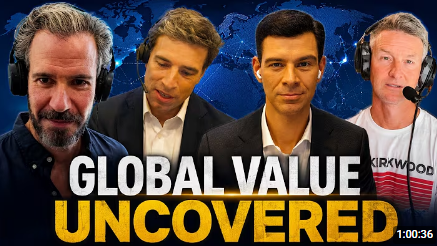
During their recent episode, Taylor, Carlisle, Julien Albertini and Christian Heck discussed The Secret Warren Buffett Principle Still Used Today. Here’s an excerpt from the episode:
I would say we gravitate more towards that Warren Buffett end of the spectrum, but that gets us sort of to the next broad or loose term, which is what is a good business. And the way we think about a good business is we are looking for businesses that embody scarcity, that have something that it’s hard to replicate. And for us, that really comes in two different flavours that we look for when we scout for scarcity.
It’s tangible scarcity, and it’s intangible scarcity. Tangible scarcity, you know, those are real assets that are hard to replicate. Think about prime real estate in Manhattan or in London.
Think about a copper mine that sits on the low end of the cost curve due to favourable geology. When I think about our portfolios, we own a company called Grupo Mexico. Grupo Mexico, amongst other things, owns the main rail network in Mexico.
Good luck replicating that. It’s impossible. You’re not going to lay more track.
That’s tangible scarcity. The other flavour is intangible scarcity. So those could be entrenched customer relationships.
It could be an iconic brand. It could be dominating a little niche market. And to put an example to that theory as well, we own a company called Colgate-Palmolive.
And Colgate has 40% to 45% global market share in toothpaste. Now, getting to a market position where one in two people on this planet use your toothpaste in the morning to brush their teeth, you know, that’s very difficult to do. So we scout the world looking for these businesses that embody scarcity.
Then we want to make sure their balance sheets are clean. As I mentioned, the North Star is resilient wealth creation. So we don’t like leverage.
And we want to make sure they’re run by people we want to be aligned with. You’ll see a lot of family-owned companies in our portfolios, a lot of founder-led companies in our portfolios, because it aligns incentives, especially if you’re a long-term shareholder like ourselves. When we find these businesses that check the boxes of scarcity, clean balance sheets, people involved that we want to be involved with, we value them.
 Closed-End Fund Investing: Buying Assets Below Net Asset Value
 Where Is the Deep Value in Small and Micro Caps This Week?
 AI Stock Market Bubble: Can the Technology Succeed While Stocks Crash?