
Buffett-Style Options: Why Trying to Time the Market Is Costing You Money (Do This Instead)
Sunday, June 14, 2026 · Johnny Hopkins
During their recent episode of the Value Options Letter and Acquirers Podcast, Travis and Tobias discussed:
- Forget the Greeks: The Only 2 Factors That Matter in Options Investing
- Why Volatile Markets Create the Best Option Selling Opportunities
- How Time Decay Works in Favor of Option Sellers
- The Value Investor’s Secret: Focus on Outcomes, Not Greeks
- Sell Puts 20% Below the Market? Here’s Why It Makes Sense
- How Volatility Creates Opportunities in Meta, Visa, and Mastercard
TRANSCRIPT
So it’s a useful tool, Toby, one that a lot of the best investors have used that doesn’t get as much attention. And so that’s one of our big reasons is for bringing out the value options letter is to add value and to educate.
[Tobias] So I think one of the questions that folks have when they see that we’re dealing in options is they want to discuss the Greeks. And while I think that, you know, that sort of discussion is important and useful, it’s you can survive in options without having a multi-layered understanding of what’s happening with all of the different Greeks. There are sort of two that we focus on.So let’s talk about those and then let’s talk about why.
Forget the Greeks: The Only 2 Factors That Matter in Options Investing
[Tim] So so there’s volatility and there’s time value. And I think that those are two of the most critical elements of options trading. If you’re day trading or trying to be a quant like some of these hedge funds like Jim Simon’s fund or something like that, of course, you know, the mathematical experts are going to are going to dive into all that stuff and go in and out of things.That’s not what we’re doing. And I feel that a big reason why more investors do not use options, Toby, is because it gets too complicated with how it’s presented to people. So when we talk about volatility, that’s, you know, how much is this stock moving one way or the other?
Why Volatile Markets Create the Best Option Selling Opportunities
Often when a stock or a sector or a market is in a major downturn or there’s a lot of upheaval, the perception of of risk as with risk defined as short term market movements, volatility goes up. And so when volatility goes up, the option premiums that we’re able to generate by selling options goes up with that. And so often some of the best opportunities are in extremely volatile markets where people are so worried about what’s going to happen the next day, the next couple of weeks, that that they’re opening up really attractive investment opportunities for someone that’s more long term orientated and who’s tactical, who’s willing to use that volatility to their benefit.
The other major component is theta time value and time value is critical. So there’s different options strategy. So sometimes on the value options letter, we’ll have 30 day options.
Sometimes we’ll have 15 day options. Sometimes we’ll have options that go out a year. It really depends on the the ability to meet our target returns.
As you know, we’re almost always targeting double digit returns. So that’s critical. And the benefit of time value is, is that you’re able to capture a larger premium.
And if it’s a good company, Toby, they’re building value. Like look at like a Berkshire Hathaway, you know, look, look at a Fairfax Financial. Over time, you know, those companies are accumulating cash, they’re accumulating retained earnings, they’re growing their book value, they’re growing their earnings per share and their cash flows.
And so, you know, you sell a put on a stock that that’s doing that, or even like an Amazon, what a great compounder that is. They’re becoming more valuable over time. So you can use time to your advantage on that.
How Time Decay Works in Favor of Option Sellers
You know, one thing I want options traders to be aware of is that, is that if you are selling kind of a longer term option, it’s you want to kind of expect for some of that return to be back weight. So time decay gets more rapid the last 30, 45 days of an option expiration. And so sometimes if you’re dealing like with January options and we’re in, what are we in now, June?
It’s hard to keep track nowadays. Then you’ll get a big benefit generally kind of in December and even early January. So it’s just things to keep in mind.
Time is a critical element with options. It’s working in your favour when you’re a seller of options, Toby. It’s working against you when you’re a buyer of options.
The Value Investor’s Secret: Focus on Outcomes, Not Greeks
[Tobias] Right. So the two things that we consider are volatility, higher volatility, all else being equal will mean a greater option premium and a longer time period will also mean a greater option value. But we don’t worry too much about most of the other Greeks because what we’re really thinking about are the two binary outcomes of an option.Either the underlying stock gets put to you, which is why all of the analysis that goes into the value investing aspect of it is important. We want to make sure that it’s a stock that we already want to own at this price or at the slightly improved price that we get with the option. Or the option expires, in which case we keep the premium.
But because these are cash secured and we have to put the cash up in order to generate the option premium, we want to make sure that we’re getting enough return on the cash that we’re putting up to justify putting the position on. And when those two conditions are met and only when those two conditions are met do we put the position on. What happens in the interim is less interesting and that’s where the option traders are more interested in the Greeks.
For us, we’re looking at those binary outcomes and that’s one of the advantages of approaching these positions from the perspective of a value investor. You’re less worried about what happens to the option in the interim. You’re more worried about what happens at the conclusion.
And if both outcomes are acceptable outcomes, then it’s good position.
[Tim] That’s so well said. It was funny. I was at the gym earlier today and I was talking with one of my good friends, Aaron.We play pickleball together. He runs a successful pest extermination business out here in Arizona. He does well for himself.
But as for many people, investing and the compounding of the money is the hurdle. That’s a problem for a lot of people. They’re just not necessarily savvy or they’re scared.
They’re scared of the markets. Look, every valuation metric almost is at the highest levels in history in many respects. So one’s right to be semi-cautious on that.
But the problem is if you’re just waiting for that dip and that’s what he’s saying, well, do you get a feel for how the market’s going to be on the short term? It’s like, not really. You just kind of buy undervalued securities.
Sell Puts 20% Below the Market? Here’s Why It Makes Sense
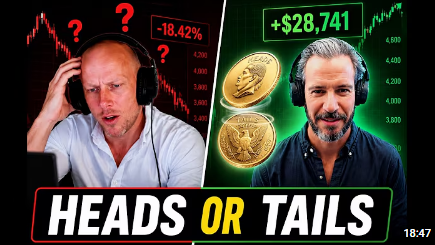
You look for attractive value. So many people are in that boat where they’re kind of trying to time it. Well, folks, the benefit of utilising the value options letter and these option strategies is that you create a heads or tails scenario where heads, if that option, you sell a put or you sell a cover call, if it expires worthless, you keep 100% of the premium and you made money.
Remember, we’re always targeting double digits, almost always. Tails, you end up owning that stock or selling that stock at a price that you’re willing to do. So just like my friend Aaron today was like, well, I mean, look, if these stocks, if the market drops 20%, that’s when I want to get in.
Well, hey, let’s sell a put 20% below on stocks that we want to own and you’re getting the best of both worlds. And so that’s a huge advantage. And I’ve seen that time and time again over my career.
Look, when you’re in a bull market, it doesn’t seem like as important, but as we know, I mean, 2000 to 2013, the market went nowhere. But if you were investing in value, if you were using these types of tactics, you were still able to potentially generate good returns in that. I mean, a lot of the value investors did phenomenally well.
So that’s a great market for this type of strategy too.
[Tobias] And we’re in a similar market today, I think, to the one that we saw in the late 1990s, where it was very, very expensive, driven by technology and interest in technology stocks. That was the dot-com boom. We’ve seen that mature, and now the dot-com stocks are very, very valuable, but there was this period of time where the market got a little bit ahead of itself and it was that period from 2000, 2010, 2015, somewhere in there.We’re in a similar situation now where AI is real. AI is very useful. It’s going to be very important.
That doesn’t mean that the market can’t get ahead of itself and overvalue these companies because it’s so excited about the prospects for AI. And I think that that’s happened in a number of names. Interestingly, there are some names that some of the mag seven, they look like they’re spending huge amounts of to compete.
They’re all sort of competing at the same time. And when they all spend at the same time, they have this little bit of a competition where perhaps they’re overspending in the short term. And the market, I think, has recognised that for some of those names.
Meta starting to look a little bit interesting at this level. What do you think?
[Tim] It is. It looks pretty cheap from an earnings multiple, and they’ve been one of the best at really leveraging AI to improve efficiency on their advertising. And I’ve done a little bit of advertising with Meta and it’s fantastic, the tools that they have and people are getting better, having better success with it.And so it’s a fantastic business. You’ve got such great assets with Instagram, with Facebook, with WhatsApp. And from a valuation standpoint on a price to earnings level, it’s pretty cheap right now, especially because it does have one of the faster growth rates of the mag seven.
Obviously, for all these companies right now, cash flow is not where it normally would be free cash flow because the capital expenditures are so high. But who was it? Was it Jeff?
No, it’s Bill Ackman. Bill Ackman, who was talking about these large CapEx numbers. And it’s like, if you’re a Meta or if you’re an Amazon and there’s more demand than you can meet for a lot of these tools and services that they’re offering, it makes sense to invest big.
And like you said, things can change though. So I know that part of the debate this week was if these companies like Anthropic and OpenAI and so and so, if they start charging more on usage, it gets a lot more expensive really quickly, especially if you’re talking about doing this at scale, Toby, because you think about it, think of a large company. I know Uber had this issue.
So you have a large company, you have all these engineers and just people involved in the company and you start using these AI tools and say, oh, this is great. I can use it for simple things that make my life easier. But then they almost get addicted to it.
It’s like a drug in some ways. And so as they start charging for usage, they have to scale back and adjust how they’re doing things. So those types of things, or just like energy production, are we going to be able to build these data centres?
What’s the cost of this energy? What a nightmare time for this war and everything. There’s a lot of uncertainty as always, I guess.
[Tobias] Uncertainty is something that you can take advantage of in the market. And I think Meta is a particularly interesting case study because when Zuck was aiming for the Metaverse, when he had the name change and they started spending enormous amounts of money trying to create the Metaverse and investors got similarly scared at that time and Meta sold off pretty rapidly, it showed that it was a little bit discretionary because Zuck at some point decided that he didn’t want to spend as much money on the Metaverse. They’ve largely written that off. And instead he redirected that money to share buybacks for a period of time.Now we’re back into a scenario where that money is being spent on AI. Some of it’s discretionary. It’s uncertain what’s going to happen.
We don’t know what the usage really is going to look like at scale. Clearly there’s huge demand. Clearly spending enormous amounts on CapEx is probably going to generate pretty good ROI, but it’s not going to be clear for a long time how they balance the CapEx spend against the return on investment that they’re hoping to make.
And so with that little bit of volatility, it’s possible to create some opportunities for entry into something like Meta.
How Volatility Creates Opportunities in Meta, Visa, and Mastercard
[Tim] Yeah. Yeah. I think Meta, the value options letter did have a trade this week on Meta.And so you have higher volatility. So we talked about the Greeks a little bit earlier. Volatility is a little higher.
I think people are just a little bit scared in the short term. The market’s had kind of a big run. There’s been a lot of prominent analysts that have said maybe we’re due for a pullback.
So you can kind of take advantage of that volatility and buy high quality companies at large discounts to our estimates of intrinsic value and take advantage. I mean, there’s other quality names like MasterCard, Visa. There’s really good companies that if you look at their historical average, Standard & Poor’s, they’re trading at very large discounts to their historical averages.
They have good fee free cash flow, not high CapEx in some of those like Standard & Poor’s for instance. And utilising options, you can manufacture cheaper entry prices or benefit from the premiums. And one of the good things, one of the underrated things about options is that it allows you to kind of reload the gun.
And I’ll give you an example, Toby. So as you know, we’ve talked about it a lot over the years, but I’ve invested off and on, usually on Assured Guaranty for 17 or 18 years since the financial crisis. And that stock has grown book value almost exponentially because of buybacks done at large discounts to tangible book value, retained earnings.
It’s not a great business. It’s an average business. It’s okay.
But it does have great capital management. And you have a name like this, it’s not a big growth stock or anything like that. But using options, you can just keep reloading that gun and collecting premiums.
And even if you go out like a year, so you’re maximising that time value like we talked about earlier, Toby, well, they’re still buying back stocks at discounts. And often that tangible book value per share goes up by like 10% a year, 10, 13% a year from retained earnings and buybacks. And it makes your position, the strike price you sold or put at less risky.
[Tobias] That’s one of the nicest things about undervalued stocks that are well-managed from a capital allocation perspective. When you’ve got a great CEO in there, he knows how to buy back stock at a big discount. That’s one way of compounding book value, compounding intrinsic value.And it can turn a mediocre business into a pretty great stock. And that’s one of my favourite models. I like to look for things that are generating lots of free cashflow, but trading at a big discount to value with a management that’s doing something about it.
Because I think it’s a powerful signal that tells you that management agrees that they’re undervalued because they can buy back in material amounts, as opposed to the sort of buybacks that are just to buy back share-based compensation that you see most of the big names doing. And not as successfully as something that’s deeply undervalued. Agreed.
[Tim] Agreed completely. That’s definitely a pet peeve. It’s just the massive stock-based compensation and then just trying to basically keep the share count even with buybacks and then the way they account for it and stuff like that.But yeah, they’re good companies that good management. I mean, look, it’s like Buffett says, you want to buy good businesses that if they have a bad manager, the business still survives. But if you can find both, if you can find a decent business that’s undervalued with a good management team that wants to have a long run, I mean, Dominic Federico Vejo, he’s been CEO since it went public, I believe in 2004.
And then he was, I think he was CEO even before that. So it’s nice when you can get those long run management teams where you kind of, I mean, I feel like I can tell what he’s going to say, before he says it, just because I’ve been on every one of those earnings calls.
[Tobias] So Tim, if folks are looking for some of the positions that we’ve put on today, we’ve talked about a little bit today, they go to value options, let us subscribe, what can they expect to see? [Tim] So take advantage of the trial. So it’s a free seven-day trial and also a discounted price. So right now you can sign up for a year for $999 and you can subscribe for, on the monthly plan, it’s 99 bucks a month.That’s going to double towards the end of the summer. But we look at the early subscribers as partners, they’re showing a lot of trust in us, Toby, and we appreciate that obviously. And so we want to give them a great value.
And what you’ll expect to get is three to five trades a week and it tracks the trades, it recommends exit times, tonnes of education on the site too. So we’ve had really good reviews. We’ve had really good transition from trials to actual paying subscribers.
So I feel like that’s a good barometer to how people like it. So please join us. We would love it.
[Tobias] And thanks folks. That’s it for this week. We’ll be back next week, same time, same channel.Thank you.
 AI Spending Boom: Are Big Tech Companies Taking on Too Much Debt?
 Where Are the Highest-Quality Value Opportunities This Week?
 Undervalued REITs: Finding Opportunities in Commercial Real Estate