
Buffett-Style Options: The $80 Billion Handshake: Getting Into Google Cheaper Than Berkshire
Sunday, June 7, 2026 · Johnny Hopkins
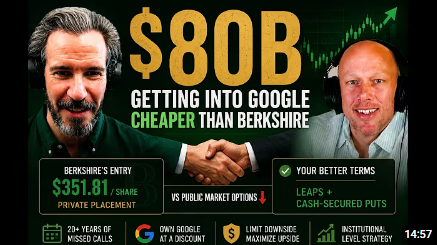
During their recent episode of the Value Options Letter and Acquirers Podcast, Travis and Tobias discussed:
- Why Berkshire Hathaway Just Invested $10 Billion In Google
- How Individual Investors Can Replicate Berkshire’s Google Deal
- The Buffett-Style Options Strategy: Get Paid While You Wait
- Why Selling Cash-Secured Puts Can Reduce Investment Risk
- Where Value Investors Are Finding Opportunity Today
TRANSCRIPT
[Tobias] Hi, I’m Tobias Carlisle. This is the value options letter joined as always by my co-host, Tim Travis. How are you, Tim? [Tim] I’m good, Toby. How are you? [Tobias] Very well, thank you. Before we start off, we always have to define value options. What are value options? [Tim] So value options are doing cash secured puts or covered calls. So saying you’re willing to own a stock at a certain price or willing to sell a stock at a certain price. And we’re only engaging with stocks that we already find undervalued.So we’re performing extensive fundamental analysis. We’re looking at the cash flows, the balance sheet, the capital structure, the competitive advantages. And then once we identify a stock that’s trading at a discount, then we employ the options, the value options as tactics on how best to deploy capital into the name.
That might be a covered call. It might be a cash secured put. It might just be owning the stock outright, maybe a little mixture of all three.
[Tobias] So with any value options analysis, there’s always two outcomes. There’s the option gets exercised, in which case, because we’re often selling options, we have the stock put to us, which means we have to buy the stock. Or the option doesn’t get exercised, in which case it expires and the cash stays in the account.So the analysis has to include owning the stock, and we always want to do it on a stock we want to own, and getting a sufficient return on the option because they’re cash secured options, which means you have to put up the cash that assumes that the option is exercised. Correct. Yep, correct.
Berkshire Hathaway Just Invested $10 Billion In Google
Absolutely. So the big news this week, sort of slightly perplexing news. Berkshire Hathaway, under new leadership, Greg Abel, has taken a $10 billion placement in Google, which is doing a big capital raise.
They’re raising $80 billion because all of these AI companies have anything that’s AI adjacent has enormous capex, which is extraordinary because these companies have been cash flow generators, extraordinary cash flow machines. And the Google now, I think Google’s trailing 12 months free cash flow was something like $45 billion. They’re raising $80 billion, so it’s almost a couple of years of free cash flow to invest in all of the AI capex that they require.
We have looked at the Berkshire investment into Google. They’re getting a 6% discount on that investment after the stock has run up quite a lot. Few occasions they could have done a transaction at a considerably lower level.
[Tobias] So not a Buffett type of deal, but you think that there is a way that individual investors can get a similar sort of deal to the one that Berkshire is getting?How Individual Investors Can Replicate Berkshire’s Google Deal
[Tim] I do, Toby. There’s ways that you could do it with options, I think, that are very, very attractive because what Berkshire is basically saying is we think Google’s a good value here, even though it’s had a big run and the multiples increased, but obviously the business is thriving even with the AI changes that are occurring. And they’re saying, well, if we get a 6% discount and invest in size, that’s very attractive.We’ll do that deal. They have $340 billion or whatever it is cash to deploy at Berkshire. So it’s attractive for Berkshire shareholders that Greg Abel is to put that to work.
But yeah, I mean, you could sell a put option and what’s attractive about it is you say, okay, what strike, what price do I want to own Google at? Maybe that price is $340. The stock right now is at $356.
It was a little higher prior to the transaction, but maybe you want to own it at $340. Right now today, if you went out to like, let’s say July 2nd, so that’s 29 days out, you could sell a $340 put for about $5.35, $5.35 a share. And so once again, it’s kind of that heads or tails heads.
If Google’s above $340 at expiration, then you make that $535 profit on your investment and you don’t end up owning the stock. If the stock’s below $340, right now it’s at $357, then you’d end up owning Google at a breakeven of $335, I think $65. I forgot how much premium we collected on that, but yeah.
So you’re in it at a really attractive value and the annualised return on that is pretty good. It’s definitely in the double digits from an annualised return basis. And you can do that with a number of stocks.
If you don’t want to do it with Google, you can do it with Meta or Amazon. Some of those stocks, they’re pretty expensive. And so when you’re dealing with an option, it’s 100 shares, Toby, as you know.
And so on the Google trade, it’s going to tie up nearly a little over three grand or 30 grand, excuse me, because it’s 100 shares of stock there. But yeah, if you can afford that in your account, have the proper diversification, it can make a lot of sense.
[Tobias] So we’re not necessarily advocating for that kind of trade. We’re just saying that this is something that if you saw the Berkshire deal and you wanted to replicate the Berkshire deal, this is something that you could do. You could, for $30,000, approximately generate about $500 of return over about a 29 day.29 days.
[Tim] Yeah. So a very short transaction. And some people like that.Some people love that, Toby, where it’s like, okay, it’s a quick return. That’s why the zero day expiration options, we don’t do that. But if you can get an attractive double digit yield on Google and you want to buy it, it makes a lot of sense.
So absolutely. And you build a whole portfolio of these types of heads. I make an attractive annualised rate of return.
Tails, I’m buying a really high quality stock that I want to own at a price that I want to own it. It can really pay dividends literally and figuratively.
The Buffett-Style Options Strategy: Get Paid While You Wait
[Tobias] So in a sense, you’re doing what Berkshire has done. You’re underwriting the Google deal. You may not get the stock put to you.If the stock trades up, you’ll just collect the $500. If the stock does get put to you, you’re getting terms that are similar to or better than those that Berkshire have achieved. So I think that really does illustrate the power of using value options, using a sensible option strategy combined with some good fundamental analysis to deliver either a good risk adjusted return on an internal rate of return basis or to have the stock put to you at a better value than you can currently get in the market.
[Tim] Agreed. Agreed, Toby. Yeah, I think that that makes a tonne of sense.And one of the criticisms sometimes people will say about selling cash secured put options, Toby, and I think there’s credibility in it, is that, well, what if the stock goes on a huge run? Well, if you think the stock’s going to double, okay, you should definitely own the stock outright as well and not do like a covered call and not just do a covered cash secured put. Now, if you’re so bullish on the stock, I’d imagine that if it drops, you’d probably want to buy more, right?
So then maybe it makes sense to use the cash secured put as a tool to dollar cost average into it. And then if it stays above, you’re still making money. Conversely, what people that make that same argument will say, they’ll say, oh, well, when you actually get exercised on a put, it’s a stock that’s losing and you could end up taking a big loss.
Of course, that can happen on some of these, but that happens when you own the stock too, right? Because we’re only doing this on stocks that we’d want to own anyways. You and I aren’t immune to it either, Toby.
I wish that we were, but we’ve had stocks that have lost, right? So it’s going to happen, but you’re actually on the same amount of shares, you’re going to lose less because you’re building that level of protection in there. One of those pillars of protection we always talk about.
Why Selling Cash-Secured Puts Can Reduce Investment Risk
[Tobias] Nobody can predict what the stock price does over a short period of time, certainly not in 29 days. It’s going to follow a random walk over 29 days. All you’re doing is either agreeing to buy the stock a little bit lower, which many value investors like to do that.You buy a small position now, you might buy a little bit more if it goes down more and that you’re satisfied that the fundamentals remain unchanged because that should increase your margin of safety, increase your forward returns. And you can do that again. You have a wheel strategy where if it goes down more, you just undertake the same process to either sell some calls, sell some puts.
It’s just a way of generating a little bit of additional return when you’re already comfortable owning the stock. And over a 29 day period, we are going to see basically random movements because it’s such a short period of time. And so it makes complete sense to build in a little bit extra margin of safety.
If the stock runs away from you, then you should be satisfied with the internal rate of return that you’ve generated on the cash that you’ve put up. If the stock is put to you, then you should be satisfied that you’ve done enough work that you’re comfortable taking the stock. And if you do those two things over a long enough period of time, probabilistically, you’re going to do a little bit better than you would have if you’d just been buying the stock outright today.
Where Value Investors Are Finding Opportunity Today
[Tim] Absolutely, Toby. And we didn’t mention this when we were talking before this presentation, but there was another transaction. Berkshire acquired the whole company of Taylor Morrison, the home builder.And I thought that was a really interesting transaction. I know that we’ve invested in that space. I believe both of us have in the past.
And they had a huge run, the home builders did, as there were supply shortages and interest rates were low. And the houses were selling as soon as they could make them. The margins were really high.
But now with interest rates as high as they are, it’s been a lot more challenging. And so a lot of these home builders are trading at book value, at discounts to book value. And so it was interesting because I believe Taylor Morrison was trading at maybe a slight discount to book prior.
And I think Berkshire ended up paying like a 25% premium to the closing share price on Friday. And so on vol, on the valueoptionsletter.com, we have made some recommendations on some of these home builders that are actually trading at pretty steep discounts to book value, despite having really solid balance sheets, capital structures, that whole thing. So I think that it’s good when we’re seeing value, where some of the smarter investors are seeing it, some of these out of favour industries.
And the other cool thing is, not just do you get the undervalued stock, but often when stocks have a lot of movement, a lot of volatility, the options pricing is indicative of the market thinking there’s more risk than there really is in the underlying business. So as you and I were talking about earlier today, some of these software names, ServiceNow, Workday, Salesforce.com, I would throw Microsoft into there. They had substantial decline, Adobe, they had substantial declines and the cash flows are still growing, right?
The balance sheets are really solid. They’re trading at very low multiples relative to their historical averages. You got to work through the stock-based compensation and things like that.
So it takes a little extra granularity in the analysis. But the volatility, the implied volatility was very high. And so on the value options letter, we took advantage of that.
And so we sold puts on ServiceNow, we sold puts on Workday, we sold puts on Salesforce.com. Those puts are performing really, really well. And that’s one of the benefits.
Being in this business, being in the money management business for 25 years, almost every quarter, I’d say, I’ll talk to a client or a prospective client and they’ll say, Tim, I think the market’s going to collapse. Not as much right now. People are pretty optimistic right now.
But over the course of my career, that’s pretty common. So when you think that there could be a lot of downside, it’s tough to dip your toe in the water. Even if you like a stock, you always think it’s going to go down.
The options are a great way where it’s like heads, we make a great double-digit return and we don’t even end up owning the stock. Tails, we ended up buying it at a discount. What everyone says they want to do, buy when there’s blood in the streets.
That’s what we’re doing.
[Tobias] Folks can go to the valueoptionsletter.com, subscribe. You can see the link just above. Tim said the link should also be in the show notes.If you sign up, you get the first seven days free. You can see all of the positions that the site currently recommends and you can see the historical performance of positions that have been put on. Feel free to reach out to Tim or I if you’d like to discuss any of it.
And so Tim, any final words?
[Tim] The one thing I’d also add is that the price will be going up at the end of the summer. So Toby and I really look at early subscribers as partners with us. They’re taking a chance on us and putting belief in our publication and the product.And so we really appreciate that. And so $100 a month, if we can’t make that for you, if we can’t make it a profitable subscription, that would be very disappointing. So obviously there’s no guarantees, but we have a lot of confidence in it.
And so we’d love to have you aboard. We’ve had really good feedback. The retention rate on trials has been really, really good.
So take advantage of it while the opportunities are there. And we’re putting out, normally it’s expected to have three to five a week. We’ve been putting out a little more than that just as a treat for early subscribers.
[Tobias] So folks, we’ll be back next week. Same channel. Check it out then.Thanks very much, Tim.
[Tim] Thank you, Toby. [Tobias] See you next week. Bye-bye.