
Buffett-Style Options: How to Use Value-Based Options Strategy to Trade Salesforce ($CRM) Puts
Wednesday, June 3, 2026 · Johnny Hopkins
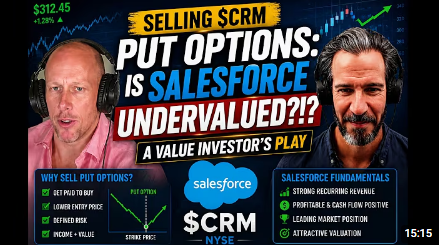
During their recent discussion on the Value Options Letter and Acquirers Podcast, Travis and Tobias discussed:
- How To Use Value-Based Options Strategy To Trade Salesforce (CRM) Puts
- Salesforce Stock Falls 40%: A Value Investor’s Options Opportunity
- Dollar General (DG) Put Options Offer 50% Annualized Return Potential
- What Are Value Options? Tobias Carlisle And Tim Travis Explain The Strategy
- How Value Investors Use Cash-Secured Puts To Generate Income And Reduce Risk
- Why Selling Puts Can Help Investors Buy Stocks At Better Prices
- Using Cash-Secured Puts To Buy Berkshire Hathaway At A Discount
- Can AI Volatility Create Better Entry Points For Long-Term Investors?
TRANSCRIPT
[Tobias] Welcome to Value Options. This is Tobias Carlisle. I’m joined as always by my co-host, Tim Travis.How are you, Tim?
[Travis] I’m great. How about you, Toby? [Tobias] Great. Let’s talk value options. First of all, let’s talk about what they are.For folks who don’t know, what are value options?
[Travis] Yeah. So value options, you’re starting with an undervalued stock. So undervalued, trading at a large discount to our estimate of intrinsic value.We ascertain intrinsic value by performing extensive fundamental analysis on the companies. We look at the cash flows, the balance sheet, the capital structure. And then the options part, the value options part are the tactics that we use.
So they usually involve cash secured puts or covered calls, but those are basically ways to generate income and reduce risk on those options strategies and on those positions. So it’s working really well and it’s something that a lot of folks seem to be gravitating to. So I’m excited about that, Toby.
[Tobias] So one thing that I always like to point out, a lot of folks hear options and they think speculation. I particularly like this approach because it is a way to give us a, I think, better risk-adjusted outcome because if you’re a value investor and you have an idea about the intrinsic value of a stock that you like, but perhaps you can’t get the price that you want, one of the things that these positions do is they allow you to identify an entry price that you like and then you can use that as the strike that you seek.And if the stock isn’t trading or if it’s trading above the strike, so it’s more expensive than you like, you can sell an option, sell a put option, which has the same return risk profile as a long equity position. And that allows you to set the price that you would pay. And then the second step is to make sure that because these are cash secured, you have to put up the cash for the position.
And so then you want to make sure you’re getting enough return on the cash that you put up that you’re getting enough return for the risk you’re taking. And we target double digit IRRs on those positions so that you’re getting enough return for the risk that you’re taking and you’re getting a strike that you would like if the stock gets put to you. So in the two outcomes, you either get the stock put to you at a price that you want or you get a good return on the cash that you’ve put up.
And that’s really, I think, the most attractive thing about this. You identify a stock you want and the price that you want it at and then you can find the strike that gives you that price or you get a good return on the cash that you put up for the secured position.
[Travis] Agreed, agreed. I mean, I think a great example is something like a Berkshire Hathaway. And I remember for a long time when Berkshire was more of just kind of an investment portfolio.I remember kind of like 1.2 times book value was kind of always a good place to buy Berkshire if you could. And it’s, oh man, I wish it would drop to that. Right now it’s at 1.4. But using these types of tactics, Toby, you can sell a cash secured put at 1.2 times book value and maybe you sell it a few months out or a year out even. And you’re creating a situation where heads, if the stock stays above your strike price, you make a very attractive annualised return. If it drops below, then you’re buying at a price that you really weren’t even sure you’d be able to get. So it allows you to invest in securities that maybe you weren’t ready to invest in now.
It’s a mechanised way of dollar cost averaging. Everybody says, I had a great question, a great question came up. And it’s, well, what happens if the market tanks, we’re in a bear market and a lot of the puts that you’ve sold, you end up getting exercised.
Well, been in this business for 25 years and everybody that I’ve talked to says they want to buy stocks when they’ve declined a lot. Like when they want to buy when there’s blood in the streets, right? The Nathaniel Rothschild line.
But in practicality, emotions step in, right? And so it’s like, well, you know, the market’s down, but I just feel like it could go down further, you know? And I actually remember talking with you during 2020, during COVID, when that was crashing and it was like, oh, the market was down a lot, but could it go down 50%?
I mean, this is that type of scenario where it could and it, you know, it didn’t, it was a short, but incredibly steep reversal in the market bounced up. But what’s great about these strategies is that you’re able to build huge cushions, Toby. I mean, a lot of these cushions that a lot of the trades that we’re putting on the site, they’re 25, 30% discounts to the current market value or an even larger discounts to our estimate of intrinsic value.
So it’s truly a situation where, you know, heads, you get the double digit return that you’re targeting or tails, you’re buying these stocks at very large discounts. And often we’ve seen that those can be the biggest gainers because then you’re buying them so cheap, you get that whiplash effect as, as it grows over time. And then they become long-term investments, Toby.
We’ve talked a little bit about the wheel strategy, where if you get exercised on the put, then you can start selling calls on that and generating more returns from that, that position.
[Tobias] Well, let’s talk a little bit about some opportunities that are presently available in the market. Do you have anything you can take us through right now? [Travis] I do. I do. So just today on the, on the website there, we published a trade on salesforce.com.And, you know, this is a stock that maybe the Benjamin Graham type value investors wouldn’t have gone for. And, and for fair reason, you know, you’ve got stock-based compensation, adjusted numbers a lot, but, but there’s a lot of merit. This is a very profitable, high free cashflow business and the stock’s gotten crushed.
I mean, I think it’s down 40% or something like that year to date. I mean, just absolutely crushed. And so what we did was we looked at the, the one 50 put that expires in, in August.
So we sold.
[Tobias] Just for context, where’s the, where’s the, where’s the stock price now? [Travis] Yeah. So the price is, I believe it’s at about one 70. Let’s see where it’s at right now to be precise as we write, as we do this in real time, Toby.So it’s at one 76.
[Tobias] Okay. [Travis] And so what, what the, the website published was we sold a August 21, 2026, $150 put, and we collected $5 and 10 cents a share. So that that’s targeting a 15.1% return and 3.52% on your total capital invested. So the cap, the capital required for this trade, because it’s kind of an expensive stock, you know, over a hundred dollars is, is $14,490.You’re collecting $510 targeting 15.1% annualised. And if you get assigned, you know, your breakeven on this stock is $144.90. And so the, the current, the current free cashflow multiples around 13.6. And so if we were to get exercised at that price, I mean, we’re just over double digits. So we feel really good about it.
And to put some context in it, the 52 week high for Salesforce is 278, the 52 week lows, 163. So our breakeven is substantially below the 52 week lows. They just came out with a really good quarter.
And what we’re finding in a lot of these software as a service stocks, the stronger ones is that they’re creating their own AI agents and, and AI products. And so Salesforce is doing a really good job doing that. And they exceeded expectations on their, their kind of internal AI agent revenue that, that they’re selling to customers.
And so we feel good about it. I mean, I mean, using AI a lot as, as I have done, what I find is that you’re, you’re leveraging a lot more software too. You know what I mean?
It almost opens your eyes to a lot of different things that you really didn’t even know existed, but just make the functionality of running companies a lot easier. And most people, these large companies, it’s not attractive to just save a little bit of money and get rid of something like Salesforce. That’s so integrated into your workflows, Toby, you know, you’re not going to vibe code that this is something that, that is, that, that their Salesforce is living it.
Their marketing departments are living in this. And so I feel like there’s, you know, some sustainability there. And so that’s one example of where the premiums high, because guess what?
These stocks have been crushed. Volatility is really high, but this is not a business that’s going to zero. This is not a business that is, that’s actually seeing, you know, materially slower revenue growth or earnings erosion.
They’re actually doing really well. It’s just kind of the narrative around it. That’s, that’s hurting it.
[Tobias] So it’s a great example of what we do. We’re looking for an undervalued business, and this is a very good business that generates lots of free cashflow. They’ve been great at reinvesting that and, and growing over time.It’s an integral part of business. Anybody who runs business has some sort of customer relationship management or sales management type software that they use. And Salesforce has been dominant for a long period of time.
We’re in this period of time where because of AI, there’s a lot of uncertainty and that’s creating volatility in a lot of these software as a service names. And it may be warranted in some instances, there is risk in investing. We can’t see the future any more than anybody else can, but value investors look at the fundamentals of the business.
We can see very solid free cashflow yield. And then you can use the options to give yourself an even better entry than where the stock is trading now, even though it’s pretty discounted right now. And it’s a fixed period of time.
It’s out to August. So we’re recording this in, in late May, there’s a few months to run. And so the second step of the process is to look at the cash that you have to put up and the likely return on that cash.
And in a few months, it’s, it’s $5 on $145 roughly, which annualizes out to 15%, where if you could get that across your entire portfolio, you’d be one of the world’s greatest investors over a period of time. Anything else to add to that, Tim?
[Travis] That’s a good synopsis of Salesforce. And I’ll give one more, one more example. So this was one we did yesterday.And so, you know, we talked about an August trade. This is even a shorter term trade. So Dollar General is a, is a company that they traditionally benefit when the economy’s weaker, they pick up market share when the economy’s weaker.
Of course, they, their, their buyers feel the stress of the oil prices and everything like that. So but, but that stock, that’s a really good company, really good operator. But the stock’s been trading down quite a bit lately.
And the valuation has gotten much more compelling. It’s not at our buy price where we’d want to necessarily just buy the stock outright. So yesterday, the stock was trading at about 104.83. And so what the website published was selling a $90 put, Toby, that expires on June 5. So what is this like a week, a week out? Roughly, and collected $1.10 premium. And so that’s 1.24% on capital in about eight days, I believe. 50.2% annualised. So once again, the stock’s at around 105. Our breakeven is $88.89. And this is not some high, you know, highly speculative company that doesn’t have cash flows or a strong balance sheet or, you know, real estate assets and things like that. This is Dollar General. The stock’s traded down materially from its 52-week highs. Let me pull up that number too, Toby, because I do find that that’s helpful to put into context.
So the 52-week high is 158.23. The 52-week low is 95.11. So on this eight-day trade, the, the, it’s substantially, the break substantially below the 52-week low. And then today Dollar Tree, its closest competitor, they reported earnings and the earnings were really good. And so Dollar General’s traded up in correspondence with that.
Now the stock yesterday was at 104. Now it’s at 110. So we feel really good.
We probably could actually get rid of this trade for a reasonable profit now, but no reason to do it. We’re comfortable owning it. But that’s, that’s a shorter term trade, Toby, where it’s like, you know, you get 1.24% on your money in eight days, 50.2% annualised, and your worst case scenario is owning this stock at a huge discount to our estimate of intrinsic value and huge discount from the price that you could have bought it at.
[Tobias] So folks, we’re putting up trades like this three to five times a week. If you go to valueoptionsletter.com trial, I’ve got the URL just above my head there. It’s seven days for free to check it out.And anything else to add to that, Tim?
[Travis] Well, if you copy my hairstyle, you won’t have to duck. So then everyone will see it. So it’s something to consider for next episode. [Tobias] So check it out, folks. If you have any questions, drop us, drop us a note. All the details are on the website.Until next week. See you then.
[Travis] All right. Thanks, guys.