
VALUE: After Hours (S08 E17): Tweedy Browne’s John Spears And Jay Hill On Value Investing And Insider Buying
Sunday, May 17, 2026 · Johnny Hopkins
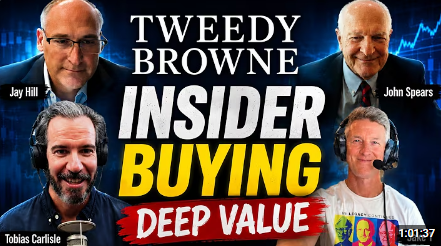
During their episode, Taylor, Carlisle, and Tweedy Browne’s John Spears And Jay Hill discussed:
- AI Fear Is Creating New Opportunities
- How Insider Buying Can Reveal Undervalued Stocks
- Big Tech Buybacks May Be Destroying Shareholder Value
- Why Market Flows Are Distorting Valuations
- What Honey Badgers Can Teach Investors About Resilience
- Why Cheap Stocks Still Matter In Today’s Market
- Why The UK Market Is Deeply Undervalued
- The Long-Term Struggles Of Value Investing
You can find out more about the VALUE: After Hours Podcast here – VALUE: After Hours Podcast. You can also listen to the podcast on your favorite podcast platforms here:

 Breaker

 Overcast


 RadioPublic


 Stitcher

TRANSCRIPT
[Tobias] I think we’re live. This is Value After Hours. I’m Tobias Carlyle, joined as always by my co-host Jake Taylor.Very special guests today, Tweedy Brown, Jay Hill and John Spears. Welcome.
[Jay] Good to be with you. Thank you for having us. Thanks for having us, Tobias and Jake. [Tobias] Tweedy really needs no introduction, but John, perhaps you could tell us a little bit about the history of Tweedy. Sure. [John] The firm was founded in 1920 by Forrest Burwell Tweedy. It had a speciality of making markets in inactively traded securities. Way before your time, Tobias, and your time, Jake, there were the pink sheets, and that would show all the market makers and specific stocks.The buying and selling of stocks was done by looking in the pink sheets, who’s the market maker in Smith Manufacturing. If Tweedy was the market maker, we might say we’d buy 100 shares at 10, and if you want to buy them from us, we’ll sell them to you at 10.50. That’s how the firm got going. One of the early partners was Howard Brown, the deceased father of my retired partner, Will Brown, and deceased partner, Chris Brown.
It just kind of chugged along doing that business until the 1970s, when a fellow by the name of Tom Knapp, who had sat side by side at Ben Graham’s firm with Warren Buffett. They were both students at Columbia University of Ben Graham’s course. Tom joined Tweedy Brown, and he brought in some personal capital.
He had some personal wealth, and then started managing some money for outside clients. Then eventually, a gentleman by the name of Ed Anderson, who had a PhD in chemistry from University of Chicago and got interested in reading the Graham books, he joined. He had a little investment club comprised of people with academic backgrounds mostly, who liked the idea of value investing, like the Ben Graham idea.
I joined the firm in 1974. At that time, the assets under management were 7 million bucks. We bought working control of a closed-end investment company, which was called the Cambridge Fund.
That was an idea that I had brought to the firm. I had previously managed two little investment partnerships, which were a moonlighting activity. I was using Tweedy Brown as my broker.
Anyway, this thing was selling at 60 cents on the dollar. We gradually bought control. That’s how we got in the investment management business, the fee part of the investment management business.
The partnerships were on a percentage of the gain basis. Maybe that’s too much.
[Tobias]That’s perfect. The investment philosophy is traditional deep value, and it’s continued to be traditional deep value to this day. Perhaps you could talk to us a little bit about what that means and how you express that.
[Jay]I would say the big idea, and this was really Graham’s idea, is that there’s two prices to every stock. There’s the price that we can all see every day quoted in the stock market, the stock price. Then there’s the intrinsic value of the business.
With the intrinsic value being defined as what would that business be worth if 100% of the company were sold in an arm’s-length transaction to a knowledgeable buyer? The intrinsic value. I can say that I started at Tweedy Brown in 2003.
The process has really been around trying to identify companies trading at 70% or less of private market value. We define private market value much in the same way. What would the business be worth if the company that we’re looking at, if the CFO of the company we’re looking at picked up the phone and put the company up for sale tomorrow and sold 100% of the business, not just a couple of shares, but 100% of the business?
I probably spend 30% of my time just tracking M&A deals in various industries and trying to build a frame of reference for what do knowledgeable buyers pay for businesses in different industries? When I explain what I do to my parents, and my parents were in the military, so they know nothing about the investment management industry. The analogy that I use is very similar if you were looking to buy a house or looking to sell a house.
One of the most important things you would want to know is what have similar homes sold for recently, right? You’d want to get a comp. You’d want to look at the comps.
That’s what your real estate agent does for you, right? Provides comps so that you can get a sense of, is this home fairly valued? That’s what I do as an analyst, spend a lot of time tracking M&A deals, trying to buy companies at big discounts to observed takeover multiples.
Then the other thing that I would add, probably two things to the investment process that I think is important. One is that we’re pretty chicken when it comes to leverage. Generally, when we’re screening for new ideas, we’re looking for companies that have net debt to EBITDA below two and a half times.
If you study our traditional portfolios, the vast majority of the companies would be investment grade rated, and many of them actually have net cash balance sheets. Then the second thing that we’ve put an increasing amount of emphasis on over time is what John and I are going to talk about later, which is insider buying, right? It’s one thing if John Spears or Jay Hill thinks a stock is cheap.
It’s another thing if the insiders of the company are reaching into their wallet and buying shares in the open market as well. That’s really the ultimate validation that somebody else, the most knowledgeable people about the company, also think it’s cheap and are writing a check out of their own personal funds to buy the stock.
[Jake] Jay, as a follow-up question on the valuation and comps, did you have to make any adjustments or did you feel the pressure of ZERP time period where you felt like a lot of maybe valuations are floating up above what historically would have made sense as a private buyer? How do you integrate that into your analysis? [Jay] Yeah, 100%, Jay. That’s a fantastic question. At Tweedy, we want each stock to pass a two-part test.A, the first part of the test is what I just mentioned. Is the stock cheap relative to comparable M&A deals? That’s one.
Step two is, is the stock just cheap on an underlying absolute basis, absolute cheapness? The reason that we have that second criteria is what you just mentioned. There are periods of time, for instance, when interest rates go to zero where we observe purchase price multiples that frankly don’t make any sense to us.
It looks like the buyers have overpaid and we’re unwilling to extrapolate very high purchase price multiples that we don’t think are sustainable over time. It’s the two-part test and it’s that second part that I think keeps us from extrapolating what I would call a rational exuberism in M&A deals.
[John] Adding to Jay, Jay has coined the words owner earnings yield. That’s another way of trying to be conservative. What would we get if we own the whole company from the earnings, from the free cash flow, the yield to us, and the payback period on distributions of cash to us?Does it look attractive or does it look kind of so-so compared to other things?
[Jay] I’ll just define that so it’s clear to your audience. We define owner earnings yield with the numerator being after tax EBIT A. EBIT plus merger amortisation times one minus the tax rate, what the finance literature would call NOPAT essentially, net operating profit after tax, and then divide that by the enterprise value of the company.We want that owner earnings yield. What’s attractive to us is a number that’s 8% or higher. The basic idea behind that approach is that if you bought a company and paid off all of the net debt, so there’s no longer any interest expense, and free cash flow equals net income, and we all know it’s not always the case, but if free cash flow equals net income, you bought the whole company, paid off the net debt, or put the net cash in your pocket.
If you owned the whole business, how much could you put into your pocket each year?
[John] What would the yield be on your price? [Jake] And then how about smoothing out for cyclicality of businesses? One year, it can look really big, and then it was probably peak. [Jay] So that’s an art, Jake. There are definitely instances where if you just look at, for instance, trailing 12-month purchase price multiples, it spits out a number, but that number may be wildly off because of the cyclicality of the business. So if it’s a highly cyclical business that you think is earning peak earnings, you’d look at that NOPAT on more of a normalised basis, like a multi-year average.We’re big believers in mean reversion, but that’s a great point. When you’re using a private market value approach, you got to be very careful that you’re not capitalising either peak earnings or the opposite of that, trough earnings.
[Tobias] Jay, given that you track mergers and acquisitions activity, have you noticed that there has been a little bit of a drop-off over the last few years? And what do you attribute that to? [Jay] I haven’t actually observed a drop-off. I mean, there was definitely- Do you mean volume or prices, Toby? [Tobias] I meant just in terms of volume, yeah. [Jay] So I can’t tell you if there’s been a noticeable difference in the M&A market so far in 2026. I mean, I guess the biggest thing that I could point to is that purchase price multiples are heavily influenced by interest rates. So I’ll give you one particular example.We own a company called CVS Group in the UK. They own 450 vet practises. It’s a roll-up where they buy individual vet practises one by one.
They’re doing this in the UK. They’re also doing it in your home country, Tobias, Australia. So now I think about 15% of their profits actually come from Australian vet practises.
But if you study M&A deals of groups of vet practises over time, the average, and there’s 28 of them that have happened since like 2014. And I’m not talking about individual practise M&A. I’m talking about groups of practises, right?
Like 100 practises plus. If you study those M&A deals over time, the purchase price multiples on average were around 18 times EBITDA. But a lot of those transactions occurred when interest rates around the world were effectively zero.
And there was lots of leverage applied to finance those acquisitions. The most recent M&A deal that I’ve observed for a group of vet practises, it was actually in Australia. I think it was Green Cross, but I may have that name mixed up with another one.
But the last deal that I saw was at 13 times EBITDA. And I anchor more on that metric because that deal occurred in late 2023 after interest rates had already gone up.
[Jake] It seems like a little bit more reasonable price for kangaroo care. [Jay] Yeah, exactly. [Jake] They’re free. [Tobias] They’re available on the side of the road. Do you find that you get some sort of industry concentration? The criticism of deep value that I often hear is that it tends towards heavy industry.And so a large exposure to energy, for example, or there’s some shipping exposure at the moment. Do you find that using the transaction multiples gets you away from that? Or do you still find that you have some sort of industry concentration?
Does it change over time?
[Jay] I can’t think that I’ve observed substantial differences in industry concentration over time. John, would you have a different- Well, I’d say that for copy, yes. [John] Yeah. I mean, when you had Silicon Valley Bank, that whole thing where they were having a hard time maintaining their deposit base, people were bailing out.You had a lot of banks going down. You do see flurries of things having big drops that are industry-related. I think some of the health insurance companies, UnitedHealth, Cigna, there’s some other ones that we have in our portfolio.
We’re affected by the same dynamics in what’s going on in Washington.
[Jay] I mean, Tobias, if you think about our legacy strategies, we probably own more what I guess the term now in fashion is Halo, right? Heavy assets, low obsolescence. We own much more of those businesses because remember, we have that two-part criteria, cheap relative to M&A deals, and then cheap on an absolute basis.We tend not to own a lot of growthier, high-tech types of companies. If you look at our portfolio, it’s much more of like a traditional value manager that is, well, we’ve been underweight. Definitely underweight the Magnificent Seven, definitely underweight a lot of the technology stocks.
[John] Yeah, we don’t gravitate toward tiny earnings yields. [Jake] Have you seen the dividend yield on NVIDIA? I think it was like, I don’t know what it was, 0.00 something percent. Right. [John] What do you think? There’s a humble aspect to it, just to justify some of these things. Making these estimates require a lot of confidence going out. [Tobias] Do you want to tell us a little bit about your ETFs copy and the international version? [John] Yeah, sure. Go ahead, John. Do you have any particular questions that you’d like answered about copy?Yeah.
[Tobias] Tell us a little bit about the strategy. [John] The strategy basically is based on empirical work. The empirical work was based on really wanting to try to be intentionally seeking to beat the market. The only way in my mind that you could try to intentionally beat the market is studying what worked in the past, doing empirical studies.How Insider Buying Can Reveal Undervalued Stocks
At the firm, we’ve always had an interest in insider buying, and have used that on a one-off basis. I made a decision to spend some time studying in a systematic way what happens if you copy the insiders and combine that with low valuations. We were able to get a historical tape going back over 20 years of insider transactions, and we decided that we just look at C-suite transactions, CEOs, chief financial officer, chairman, president, treasurer, et cetera, high-level people at the company.
Because it didn’t work with those high-level people, why should it work with directors who just, in a way, an echo probably of what they’re learning from the high-level people. We did that study, and we found that when you combine it with different value characteristics, you’d know a lot of them, that in the cheapest deciles, you had very good outperformance compared to indexes. And the gist of the strategy is described in this booklet, the insider investment factor.
And we described the study that inspired us by Nehat Sehan, a professor at the University of Michigan, who did a 1978 to 1993 study of insider transactions. And he combined that with price-to-book, were they paying, what was the price-earnings ratio, and also dividend yield. And he found that when stocks were in the cheapest quintile, if you rank them on price-earnings ratio, price-to-book value, that those stocks on both PE and price-to-book, with the top executive insider bond, tended to beat the market by 10, 11 percentage points over a one-year holding period.
Well, that just hit us in the face. Our eyes popped out. Look at that.
That’s so interesting. So we decided that we would continue with that work. And our study went from 1996 to 2022.
And it’s described in this booklet, which if you call Tweedy Brown, we’ll send it to you. I mean, what is described in this booklet is factors. It’s not a back test of an actual portfolio.
It’s just stocks with the combination characteristic of insider buying and low valuations. So that beat the market. So that’s why we decided we’d give it a try.
I mean, we started with an experimental portfolio. I had the good fortune to put up 6 million in cash. And the firm managed it using this strategy.
We were able to find names and the initial day one launch of copy on December 27, 2024, included a lot of those stocks that just shifted over into the portfolio and continued to new names were added. Names were taken out since then.
[Jake] I had a question on if you guys looked at the different roles of the insiders and whether there was any signal there. We’ve had somebody on the show before who looks specifically for the CFO being the buyer because they feel like they’re sort of the most financially literate, most probably discerning of what they’re buying relative to others in the C-suite. [John] Yeah. [Jake] Yeah. [John] Jake, there happens to have been an academic study of that. And the study’s conclusion was that CFOs had better investment results than the CEOs. [Jay] I mean, the big thing that jumped out to me as a result, and John was really the architect of this study, he deserves the credit. But really what jumped out to me is that when you combine quantitative cheapness with material freewill insider buying, and we can talk a little bit in a minute about how you define material and how you define freewill. But when you combine these two factors, they outperformed both just quantitatively cheap stocks on their own, or just looking at all insider buying transactions on their own.It’s the combination that delivered the outperformance. And it just makes common sense.
[Jake] Did you guys look at that in quantitative value? [Tobias] No, we didn’t look at insider buying. I forget now, it’s been a little while since we wrote that book, but there was a reason why we excluded it, but I can’t recall what it was now. But Jay, you raised two.One of them was materiality. And the other one, we’re going to talk about the definition of freewill, which I’m really looking forward to, but let’s start with materiality.
[Jay] Yeah. So materiality, we came up with a minimum purchase of $100,000. So each, I guess, triggering buy has to have at least 100,000, and this is in U.S. dollars, $100,000 buy. And then the buy actually has to be freewill. And by freewill, what we mean is that it wasn’t required by the board to meet a minimum ownership requirement. Most boards of directors for their board and for their executive officers have minimum ownership requirements.Like a standard would be for a CEO, for instance, three times their total compensation they’re required to own in stock. For boards of directors, it tends to be like five times the annual cash retainer. So when there’s a stock that has an insider buy that’s in excess of $100,000, and it meets our quantitative criteria that we think it’s cheap, the first step is to go and make a determination, was the buy in fact freewill?
And you find that information in the proxy statement for a U.S. business. It’s in the annual report for a U.K. company, different countries that that information is located in different areas. But you just simply figure out, was this truly an insider that was buying the stock?
Because there’s only one reason an insider buys a stock if he’s not required to. And that’s because he thinks it’s going up. But if it was a required purchase, we exclude that.
We eliminate that. And it would not count as a new investment.
[Tobias] Jake, just roughly, can you give us an indication of how many transactions are excluded by both the $100,000 limit and the freewill? [Jay] Yeah. So there’s an awful lot of, we get a list every day from a data source on all the insider buying around the world. And a lot of the buys are south of $100,000.So that’s a pretty big filter. And then on freewill, it really runs all over the map. I mean, a good tell is if it’s a brand new director or a brand new CEO or CFO, oftentimes their first buy, their maiden buy, was required by their employment contract.
So just in general, if it’s a longtime CEO or a longtime board member, they’ve often already met their minimum ownership requirement, and it’s much more likely to be a freewill buy.
[Tobias] That makes sense. And so you can do all of that quantitatively? [Jay] Yeah. Well, so if you think about our investment process, we get this list every day of new insider buys around the world. We isolate the insider buys that are in excess of $100,000 US and then we take that group of stocks and we run that through a filter.And this is really Tweedy special sauce. We look at valuation factors, and there’s roughly 30 of them. And we come up with a score that is a proprietary score that basically tells us, does this stock on multiple metrics, is it in the bottom two deciles relative to the S&P 1500?
And there’s some manual review there. I would say for a new stock for copy, it takes probably about a day. A, to determine was the purchase freewill.
And then second, we check the data. Like Bloomberg, we have a machine where we can just put in a ticker, hit a button, and it gives us what we call the value score. But oftentimes, as you know, the data in Bloomberg is wrong or incomplete or inaccurate or obscured by large one-time charges or one-time gains.
And so an analyst actually studies the long-term record going back 10 years or longer. And it just verifies that we’re working with good data. But if we can conclude that A, the insider buy was freewill in excess of $100,000, and we have good data, meaning the value score indicates this is a stock in the bottom two deciles of cheapness relative to the S&P 500, then we buy it.
[Tobias] And then at a portfolio level, are you looking to limit concentration in any given industry? Or do you have any other considerations like that? Or is it just purely, if it’s cheap, if it’s all energy companies and the energy insiders are buying, is it an energy company at that point? [Jay] That’s a great question, Tobias. The general rule, this is not set in stone, it’s not set in a prospectus, but we generally don’t want more than 25% of the total portfolio in any one industry or in any one country. But it’s a good point to highlight because there are specific points in time where, let’s say, a large risk becomes known in a specific sector, and all of the stocks trade off in that sector.And then there’s lots of insider buying following that news. What John mentioned earlier, if you remember back to 2023, in the Silicon Valley Bank, I can’t remember the other bank that got into a lot of trouble. First Republic, yeah, and Signature Bank.
There was a lot of insider buying by small and mid-cap banks in the United States. And we bought a lot of them, but we do have this general rule, we’re not going to have more than 25% in banks or more than 25% in any individual country, excluding the US.
[John] And the banks were generally relatively cheap compared to other banks also at the time, the ones that were going into a copy. Today, 12 times earnings for a bank, 13 times earnings, twice book, whatever, it’s kind of average, ordinary. [Tobias] Gents, that’s the top of the hour. So we usually do Jake’s Veggies. He’s prepared some for us today.Folks, mark it down. Also, I’m just going to give a quick shout out because I forgot to do it last week. So let me do it this week.
Gothenburg, Sweden, Boise, London, UK, Petit Tickfair, Israel, Snohomish, Oslo, Breckenridge, Bangalore, Indy, Tallahassee, Surbiton, Jupiter, Florida, Pori, Finland, Charleston, Tampa, Florida. Wow. Good job, fellas.
Thanks for tuning in. We appreciate it.
What Honey Badgers Can Teach Investors About Resilience
[Jake] All right. So people always seem to love the animal related veggie segments. So we’re going to give the people what they want.So most people think of resilience about being unbreakable and biology actually disagrees with this. There’s a story about a 15 pound animal that gets bitten by a venomous snake. It collapses, looks dead, and then a few hours later, it wakes up and it finishes eating the snake.
And that kind of sounds like it might be right out of mythology, but it isn’t. It’s actually everyone’s favourite, the honey badger. So today’s segment is on the honey badger.
So despite all the lore, honey badgers are not invincible. They aren’t even actually particularly large. What they are is quite layered.
And they have a tiny molecular mutation that makes certain snake neurotoxins less able to bind to the receptor that controls nerve to muscle signalling. And they have a physiology that can absorb damage from other kinds of venom as well. And those are very real, but they aren’t part of things that we can actually borrow.
You know, it’s hard to, you can’t grow a mutation. So you can’t, but what the skin of the honey badger is actually quite a wonder of nature. And that’s what the lessons that we’re going to look at specifically today.
So a little bit of background on these honey badgers. Their skin is really thick, like about a quarter of an inch, which is about the diameter of a number two pencil. Shallow bites, stings from bees, claws.
They have a really hard time reaching anything vital inside of the honey badger. But the thickness isn’t the real breakthrough. Lots of animals have armour that’s even thicker than that.
And usually that protection costs you mobility. You know, armour protects you by it, but it’s always quite rigid, right? So the breakthrough for the honey badger is that their skin is actually quite loose.
It doesn’t cling tightly to the body. So when a lion or a hyena grabs it, it, the badger can twist inside of its own skin. And you know, it could turn, it can bite back and then it can escape.
And the grip never fully controls the badger because the skin is so loose. So thick and loose is this winning combination. So strangely enough, humans have been trying to solve some of these same problems for centuries.
How do you stay functional when the world keeps clawing at you or clenching you in its jaws? Well, two traditions working independently on opposite sides of the world landed on complimentary answers to this. First is the Stoics in Greece and Rome, and they figured out the thick skin part.
And then the second is the Buddhists in India figured out the loose skin part. So neither one is really complete on its own, but you put them together and you get something that looks a lot like the psychological equivalent of a honey badger skin. So let’s, let’s dig in a little bit more on this.
So, you know, the thick skin Stoics had this very simple idea. It’s not events that disturb us. It’s our own interpretation of them.
Most things that bother you aren’t inherently harmful. They become harmful because you give them access and emotional valence. Not every common, every market tick, you know, every slight, every inconvenience should get access to your internal state of mind.
Most of it shouldn’t penetrate deep enough to matter, just like the honey badger skin does this physically. Stoicism does it psychologically. But as we said, you know, when you have thick skin alone, that’s not enough.
If you only filter, you risk kind of going numb eventually. And that’s, that’s not good either. So this is where the loose part comes in.
And Buddhism isn’t about blocking experiences. It’s about non-attachment. You know, things are going to happen.
Emotions are going to arise. You’re going to feel them, but you don’t cling to them. You don’t let them define you.
There’s a space between what happens and who you are. And that freedom of movement under pressure is like the badger twisting inside of its own skin in the physical version of the same thing. So, you know, I think you see this fairly often in investing, you know, struggling investors will pick one of these reflexes, perhaps even unwittingly they’ll, you know, their armour themselves completely.
So much so that they actually kind of start, they stop learning. They start becoming very fragile or brittle. And granted, you know, there’s a very fine line between disciplined and pig-headed.
And, you know, if you’re a professional investor, sometimes you’d only find that line when you have the wrong LPs for your personality. I’m sure everybody can relate to that. But other investors on the other side are, you know, they’re gripped by every tick, every headline, every drawdown, every flicker becomes a signal to them.
And both of these kind of fail for opposite reasons. You know, the good investors do something that’s harder. They filter the noise out.
That’s the thick skin part. But then when something real hits, when maybe the thesis is actually breaking, they let that signal in and they feel it and they sit with it, but they don’t let the fear run the book at that point. And that’s having that loose skin.
So to wrap this all up, so maybe instead of ask less, how do I become tougher? Instead ask, where does this belong, outside me or moving through me? And honey badgers survive because they have this very thick skin, yet it’s loose enough to move when the world gets its teeth into them.
You know, and to quote the Mandalorian, this is the way.
[Tobias] Amazing, JT. How does he do it, folks? Honey badger, Daoist, Eastern wisdom, amazing.Jens, last time we had you on was February. Jay reminded me before we started, February 2020 in the before times, BC before COVID. Can you narrate for us the experience since you were on last?
What’s the, what have the investment markets been like?
[Jay] I would say it’s still been very frustrating for the value investor that really starts their process with quantitative cheapness. As you know, Tobias, I’ve seen a lot of your posts. [Tobias] My complaining.Why Cheap Stocks Still Matter In Today’s Market
[Jay] Values underperformed for a long time, right? It just has. And I think we have to own up to that.But we haven’t changed our underlying principles. We still believe that in the end, price paid matters. And that at some point that the yin yang of markets will return to value outperforming and maybe to add on to that international value, and particularly in small caps and mid caps.
This is another thing you talk a lot about Tobias, right? Is mid caps and small caps. And I don’t have the exact numbers in front of me, but over the last three or four or five years, our portfolio has changed pretty dramatically.
I think we’ve taken our small and mid cap allocations from something like 20% to 50 and 60% of our portfolios. If you look at these two insider buying products that we have, these two ETFs, one is called COPY. That’s a global portfolio.
ICOPY is just the international subset of the COPY name. So it’s all the names excluding US. 60% of those portfolios are in stocks with market caps below $10 billion.
And it makes sense, right? Because COPY and ICOPY, the strategy is about insider buying plus quantitative cheapness. And the most quantitative cheapness to me is in small and mid cap stocks and particularly outside of the United States.
So that’s where our portfolio has gravitated towards. I would say that our performance in 2025, we were very pleased with. The absolute performance was fantastic.
And it seems like the markets were starting to head our way. And that was true even up to February 28th of 2026. But since the start of the Iran war, there’s been a huge move back to the magnificent seven, big tech, larger cap companies outperforming.
Why The UK Market Is Deeply Undervalued
And so it’s been disappointing to see. But ultimately, I believe the best value in the markets is in international small and mid cap stocks. And I would also highlight the UK.
I heard one of your other commentators or your guests in the last couple of weeks talk about the UK. I feel like the UK stock market is one of the cheapest equity markets in the world. It’s a low expectation market.
If you look at the PE on the FTSE 100, I think it’s like 13. If you look at the PE on the FTSE 250, which is the next 250 largest companies in the UK, it’s 12. One of the issues in the UK, and there’s lots of them, but one of the main issues is there have been 10 straight years of outflows to active equity managers in the UK.
10 straight years of outflows. And we all know when you’re getting redeemed, you’re forced to make decisions about what to sell. And often cases, you’re selling things that not for fundamental reasons, but for cash flow reasons.
And where are you more likely to find a bargain, Tobias? In a market like the UK, where there have been 10 straight years of active outflows, or in the United States, where there seems like there’s a constant inflows into passive indices, where are you more likely to find a bargain?
[Tobias] Yeah, I couldn’t agree more. Just to emphasise what you were saying before, I’d track the high beta series or the high beta indexes against the low volatility indexes. And that has been a strategy that, for folks who don’t know, low volatility is like a proxy for the boring businesses.Boring businesses have tended to outperform since the data set starts in 1990. But since 2020, high beta has outperformed. And that series today is at an all time high.
It’s absolutely ramped over the last month or six weeks since the beginning of April to a new all time high. And so I don’t know what creates that constant bid in those high beta names, but it does seem to have been since the last five years, six years now, I guess. There’s been quite a significant turnaround in that.
JT, you had a good tweet today. Do you want to… You’re trying to get some attention on that?
[Jake] I retweeted it for you. Did you? Okay, yeah.I mean, I thought it was just funny.
[Tobias] Yeah, I thought it was funny too. [Jake] Well, you’ve seen that Truman Show meme about Gustav, he’s the director of the show, and Jim Carrey’s sort of the little… He’s the participant, but he’s the only one who doesn’t know about it. So Gustav is like messing with him, basically.And so it’s a picture of Gustav, and then it shows something I saw in the Wall Street Journal this morning, which was, since the Iran war, energy multiples have compressed a bunch, but tech multiples have expanded. And so the tweet was, and obviously I’m over explaining it, so it’s not gonna be funny now, but was, now show the Cape over 40, and while also the Straits of Hormuz are closed and shutting in 12 or 13 million barrels a day while energy multiples are compressing.
[Tobias] Yeah, I did not have that on my bingo card, energy multiples compressing while the Straits of Hormuz was shut in. John, you were around in the 70s. Does any of this rhyme?What do you think? Is no market the same, or you’ve seen something like this before?
[John] I think I’ve lived through mostly a bull market, so it’s always seemed kind of hard to find things that seem cheap enough. So yeah, much of the time. [Jake] That’s probably a good observation. It’s never easy, right? Is that something we could take away as younger investors? [John] I’d say it’s never easy, yeah. I’d say that if you look at the odds, the long run odds don’t favour active investing. It’s tough.It’s really tough. And that’s an empirical fact. People empirically have been buying the indexes, because the indexes have been the best performers, and have had tax advantages too.
So I think it’s always been kind of tough, really.
[Tobias] I concede that point, but one of the things that I always return to is that market capitalisation weighting is the worst way. The only reason you would do that is so you could absorb the most amount of capital that you could possibly absorb. Because if you were to reconstruct an index for the purposes of generating performance, then you’d do something like what research associates have done and do that, or research affiliates, sorry, I forget what it is, but where they’ve got a fundamental index where they’re looking for, and AQI will argue that that’s just a value index, but you’d maximise your free cash flows or maximise your book value or some combination of those things, and then that would generate better returns still. But had you done that, you would have underperformed a market capitalisation weighted index for the last 10 plus years. [John] Right, right. And yeah, I think that from the standpoint of studying stock selection, studying the best strategy, that it’s better to use an equal weighted index. Because really, for most investors, they can go anywhere.They’re not constrained to buying just the big cap stocks. So the Sehan study of insider buying and valuation, he used an equal weighted index.
[Jake] I’ll take the devil’s advocate just for fun in the conversation here. And okay, market cap weighting, of course, has its own inherent momentum strategy to it, right? And what’s working keeps working more.But perhaps, and the opposite of that would look more like a reversion of the mean expectation, that’s what you’re betting on. But perhaps in more digitally based companies, Brian Arthur’s returns to scale work would suggest that actually bigger is better and bigger should keep getting better. And maybe it would defy reversion to the mean until at least the next technological revolution disrupts that apple cart.
So maybe what we’re seeing is not so crazy after all.
Big Tech Buybacks May Be Destroying Shareholder Value
[Jay] One thing that I’ve done is we did a little study on buybacks in the S&P 500. So this goes back to the beginning of the year, 12, 31, 2025. But at that point in time, there were 60 companies in the S&P 500 with PEs greater than 40.And 50 of those 60 companies were repurchasing shares. And arguably those companies would be better off with PEs over 40 issuing shares. So to me, there’s a lot of value destructive share repurchase occurring.
Share repurchase meant to offset dilution or just a company saying, we’re not going to be price sensitive about share repurchase. We’re just going to repurchase X amount of dollars or shares every year, regardless of price.
[Jake] And that strikes me as- If that offended your sensibilities, then wait till you get a trillion dollar SpaceX equity issuance. [Jay] Well, that actually could be the tipping point. I mean, one of the signs of bubbles is when there’s lots of new IPOs and there’s lots more supply of companies. And it sounds like those SpaceX, Anthropic, and OpenAI IPOs are going to have enormous valuations.Right. And that’s a lot of new issuance, a lot of new supply. And I wonder if that could be one of the triggers to this.
I’ll call it a bubble. I think it’s a bubble bursting.
[Jake] They better hurry before inflation gets too high and the Fed raises rates and pops everything on them. [Jay] And if the Fed is going to start raising rates again, which probably six months ago, people were thinking about rate cuts, not only in the US, but in international markets as well. And now the narrative has flipped to where rate hikes actually may be more likely. And doesn’t that work against the growth company long duration? [Tobias] Nothing stops this train, Jay. Nothing stops this train. [Jay] But Tobias, you know it will at some point. [Tobias] Yes. Yes, I do. I’m just trying to protect myself mentally from the ongoing. [Jake] This is Tobias Beckskin and non-attachment. [Tobias] One of the things that I see in the markets all the time is there’s this idea and there’s studies that show that buybacks destroy value. And I would say that that’s probably true by volume of, by dollar volume, I’m sure that buybacks destroy value for that phenomenon you just pointed out before, that it’s always, it’s these bigger companies cleaning up share based compensation by doing that sort of size buyback every year. But because they’re so big, it vastly washes out the impact of some little value company trading at a discount to intrinsic value, doing a little buyback. [Jay] Yeah. So Jake, I think you talked about this with Chris Bloomstrand, like Chris has done this work that I think since 2000, I can’t remember how many billions, maybe even trillions of share repurchase there’s been over time, but the share count of the S&P 500, despite all that buyback activity is actually gone up. We’re focused on, there’s a little company in the UK I love called Johnson Service Group.Johnson Service Group is a, it’s an industrial laundry company. If you’re familiar with Centos in the United States or Unifirst or Aramark or G&K Services, these are laundry businesses. And just to point out sort of the divergence between US valuations and UK valuations, Centos recently bought a company called Unifirst in the United States and they paid 28 times EBITDA, 17 times EBITDA and 39 times earnings.
Now there’s big synergies projected in this deal.
[Jake] There better be. [Jay] There better be, that’s right. And there are, there are big synergies. And I think Centos has a proven ability to extract large synergies from acquisitions in the past.But you compare that with this company in the Johnson, this company Johnson Service Group, who in workwear uniforms, they have 45% market share in the UK. And in hotel linens, like they do the laundry for hotels in the UK, they have 25% market share. This is a company that today on 2026 earnings trades at eight times enterprise value to EBITDA.
That’s not EBITDA, it’s EBITDA. A PE of 10, that owner earnings yield, you know, that we talked about earlier, it’s 9%. If you study M&A deals in Europe of these laundry businesses, there’s six good precedent transactions that have occurred in an average of 13 times EBITDA.
So the deals happen at 13 times EBITDA. Johnson trades at eight. So huge discount.
And Johnson isn’t levered. They’ve got net debt to EBITDA of a little under one times. In 2025, they bought back approximately 10% of shares outstanding.
In addition to paying a 3.5% dividend yield. And in 2026, they plan to buy another 10% of the company and have that 3.5% dividend yield. So they’re returning gobs of money back to shareholders.
There’s insider buying. It must be a target. I estimate the private market value of this business is two pounds and 30 pence.
And the stock price today is one pound and 40 pence. There’s an enormous gap. And I’m not going to mention names, but I can come up with five strategic buyers that would have an interest in buying Johnson Service Group.
[Jake] Make the call, Jay. Let’s get this thing solved. [John] Yeah, option off the stock. [Tobias] I’ve been following Tweedy Brown for a very long period of time. You guys produced a document. I forget how old this is now, but I think the title is going to escape me a little bit.It was What Has Worked on Wall Street or something. I think Jim O’Shaughnessy took your title.
[John] Yeah. He did What Has Worked on Wall Street. Ours is called What Has Worked in Investing. [Tobias] What Has Worked in Investing. Okay. So you guys have always been a quantitative.You’ve looked at it from a data perspective. I don’t know if you track the French series. For Fama French, there’s a French website where he pulls out the data for price to earnings, price to book, price to cash flow.
And all of those series have shown this incredible outperformance that completely breaks down about 10 years ago. And on a relative basis, the cheapest decile versus the most expensive decile might be down something like 70% over that period of time. It might have bottomed around 2020, something like that, but it hasn’t recovered much or at all for a lot of those series.
Do you guys have any thoughts on why that might be? Is it oversaturation of quant firms like AQR and Tweedy Brown and others investing in that? Or why do you think that’s happened?
[John] I don’t have an opinion. We did a little internal study not long ago and it was 25 years through 2025 and PE ranking or something like that. And it was still good, but it included a lot of better years than the more recent ones. [Tobias] One of the other things I’ve observed, I run the S&P 500 equal weight series against the market capitalisation rate, which is the one that everybody’s more familiar with. That’s SPY. That’s what SPY is based on.And it shows that there’s this very material outperformance for equal weight, which you could think of as a proxy for small, or you could think of as a proxy for value. On the very long run. But to 1926, I think that’s where the data starts.
So it’s 100 years, literally 100 years of data. And while there’s massive outperformance for equal weight, there are these very significant spikes for market capitalisation through that. And there are six, and they’re all clustered around these technological revolutions.
So the most recent one prior to the one we’re currently in was 2000. And then there was another one in 66. And before then there’s one in the 40s, something like that.
And the current one has a massive spike in 2020. And it looks like it’s recovering back to trend. And then we’ve taken off again in sort of 23.
And now we’re back to all-time highs again, which is just that, I don’t know if it’s spectacular.
[John] Yeah, just this relentless- We’ve experienced those. We can’t control our cold periods. But this last one has been a long one.It’s been just terrible.
[Tobias] What do you, do you have any thoughts on, John, you’ve been in the markets for a long time. You got any thoughts on what’s driving that?The Long-Term Struggles Of Value Investing
[John] No, I didn’t. It’s not, I think it’s some of the technology companies that have been strong performers. The excitement about new technology, the internet that brought a lot of excitement.I think the outperformance of market cap weighted indexes was strong then, but it wasn’t a 10 or 12 or 15 year period. This has been a long winter.
[Tobias] Do you like the flows theory, that it’s flows that are causing this, that there’s some sort of structure?Why Market Flows Are Distorting Valuations
[John] Well, I think it’s got to have an impact. Yeah. I mean, the active, as you know, actively managed funds are bleeding.Redemptions are rampant. It’s not just from what I’ve read. This is not something I’ve studied, but from what I’ve read, it’s across the board.
It isn’t just people who have a reputation for a value style of investing, but just active in general. And also, as we know, from a tax standpoint for tax paying investors, the structure of an exchange traded fund allows you to really have less realised capital gains. You can distribute out your appreciated securities.
If you want to sell them, you can get them out of the portfolio and there goes the unrealized gain on those stocks. So, it’s an amazing thing, as long as it lasts.
[Tobias] You think there’s some regulatory risk to having that removed? [John] I think there’s a political risk. Sure. Absolutely.Absolutely. I mean, our friends in the Democratic Party, some people that have very strong opinions about what tax rates should be, and they’re generally higher rates, of course, for affluence, for capital gains, etc., including proposals to tax unrealized gains. So, we shall see.
AI Fear Is Creating New Opportunities
[Jay] I mean, what I’ve noticed, Tobias, is that the earnings of all these big tech companies, and it has been extraordinary, extraordinary revenue growth, extraordinary earnings growth, but the free cash flow now is headed the other way. It’s hard to imagine the returns on incremental invested capital can go anywhere but down in the future. And I would say, look, as value investors, we’re never going to invest in NVIDIA.We’re never going to invest in Microsoft. But there’s this whole narrative now between AI winners and AI losers. And so, we’re spending more time today on the perceived AI losers.
We’ve bought a company recently. It’s a company called AutoTrader, another company based in the UK. They’re the leading online classified platform for used cars in the UK.
Complete dominant position, six times larger than all of their closest competitors combined. This is a business with a terrific brand. It’s been around 50 years.
It’s a network effect business. If you have the most consumers looking for used cars, and you have the most dealers on your platform, that network effect is self-reinforcing. And this is a business that also has proprietary data.
They have more data on the prices of cars, the accident history of cars, the ownership history of cars. And a lot of this data is embedded into the business processes and flows of their customers, which are UK auto dealers. So, we think there’s a real moat here.
But the narrative among really all online classified platforms has really switched from high margin, high return, structural growth, long term compounders to AI losers in really a matter of months. These stocks have gotten hammered. And we think the bear case is over-exaggerated.
It’s unlikely. There’s pushback from how these businesses are pretty protected from the AI threat. But as you would imagine, we’re looking for places that are being shunned.
And I think that’s a good example. So, we’re looking for the AI losers, so-called AI losers, as opposed to the darlings.
[Tobias] I love it. Gents, we’re coming up on time. If folks want to follow along with your ETFs or get in contact, what’s the best way of doing that?Get some more information. How do they do that?
[Jay] Yeah, www.tweedy.com. And then I think for the ETFs that we talked about today, which is the insider buying plus quantitative cheapness, either copy or I copy, it’s www.tweedyetf.com. [John] And the name of the ETF is Tweedy Brown Insider Plus Value ETF. And Tweedy Brown International Insider Plus Value ETF. [Tobias] Jay Hill and John Spears, Tweedy Brown, thank you very much for your time today. [John] Thank you for inviting us. [Tobias] My pleasure. Our pleasure. Okay.JT, any final words?
[Jake] No, it’s just great to catch up with some value OGs and enjoyed our conversation. Thank you. [Tobias] Thank you. [Jay] Thank you very much. Jake, hopefully I’ll see you in November next year. Yes, sir. [Tobias] Folks, we’ll be back next week. Same time, same channel. Thank you, Jay.See you guys. Take care, guys. Bye-bye.
 Closed-End Fund Investing: Buying Assets Below Net Asset Value
 Where Is the Deep Value in Small and Micro Caps This Week?
 AI Stock Market Bubble: Can the Technology Succeed While Stocks Crash?