VALUE: After Hours (S08 E17): How Insider Buying Can Reveal Undervalued Stocks
Tuesday, May 19, 2026 · Johnny Hopkins
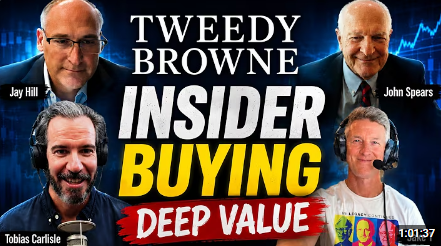
During their recent episode, Taylor, Carlisle, and Tweedy Browne’s John Spears And Jay Hill discussed How Insider Buying Can Reveal Undervalued Stocks. Here’s an excerpt from the episode:
At the firm, we’ve always had an interest in insider buying, and have used that on a one-off basis. I made a decision to spend some time studying in a systematic way what happens if you copy the insiders and combine that with low valuations. We were able to get a historical tape going back over 20 years of insider transactions, and we decided that we just look at C-suite transactions, CEOs, chief financial officer, chairman, president, treasurer, et cetera, high-level people at the company.
Because it didn’t work with those high-level people, why should it work with directors who just, in a way, an echo probably of what they’re learning from the high-level people. We did that study, and we found that when you combine it with different value characteristics, you’d know a lot of them, that in the cheapest deciles, you had very good outperformance compared to indexes. And the gist of the strategy is described in this booklet, the insider investment factor.
And we described the study that inspired us by Nehat Sehan, a professor at the University of Michigan, who did a 1978 to 1993 study of insider transactions. And he combined that with price-to-book, were they paying, what was the price-earnings ratio, and also dividend yield. And he found that when stocks were in the cheapest quintile, if you rank them on price-earnings ratio, price-to-book value, that those stocks on both PE and price-to-book, with the top executive insider bond, tended to beat the market by 10, 11 percentage points over a one-year holding period.
Well, that just hit us in the face. Our eyes popped out. Look at that.
That’s so interesting. So we decided that we would continue with that work. And our study went from 1996 to 2022.
And it’s described in this booklet, which if you call Tweedy Brown, we’ll send it to you. I mean, what is described in this booklet is factors. It’s not a back test of an actual portfolio.
It’s just stocks with the combination characteristic of insider buying and low valuations. So that beat the market. So that’s why we decided we’d give it a try.
I mean, we started with an experimental portfolio. I had the good fortune to put up 6 million in cash. And the firm managed it using this strategy.
We were able to find names and the initial day one launch of copy on December 27, 2024, included a lot of those stocks that just shifted over into the portfolio and continued to new names were added. Names were taken out since then.
[Jake] I had a question on if you guys looked at the different roles of the insiders and whether there was any signal there. We’ve had somebody on the show before who looks specifically for the CFO being the buyer because they feel like they’re sort of the most financially literate, most probably discerning of what they’re buying relative to others in the C-suite. [John] Yeah. [Jake] Yeah. [John] Jake, there happens to have been an academic study of that. And the study’s conclusion was that CFOs had better investment results than the CEOs. [Jay] I mean, the big thing that jumped out to me as a result, and John was really the architect of this study, he deserves the credit. But really what jumped out to me is that when you combine quantitative cheapness with material freewill insider buying, and we can talk a little bit in a minute about how you define material and how you define freewill. But when you combine these two factors, they outperformed both just quantitatively cheap stocks on their own, or just looking at all insider buying transactions on their own.It’s the combination that delivered the outperformance. And it just makes common sense.
You can find out more about the VALUE: After Hours Podcast here – VALUE: After Hours Podcast. You can also listen to the podcast on your favorite podcast platforms here:

 Breaker

 Overcast


 RadioPublic


 Stitcher

 Closed-End Fund Investing: Buying Assets Below Net Asset Value
 Where Is the Deep Value in Small and Micro Caps This Week?
 AI Stock Market Bubble: Can the Technology Succeed While Stocks Crash?