
VALUE: After Hours (S08 E16): Author and investor Adam Mead on Berkshire Hathaway $BRK.A / $BRK.B, Warren Buffett, Abel
Sunday, May 10, 2026 · Johnny Hopkins
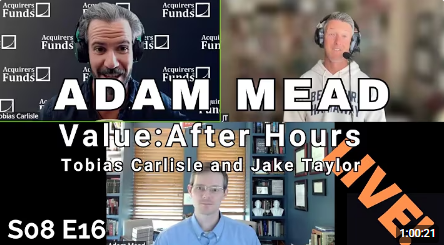
During their recent episode, Taylor, Carlisle, and Adam Mead discussed:
- Why Greg Abel Already Looks Like Berkshire Hathaway’s Next Great CEO
- Berkshire Hathaway Buybacks: Is Greg Abel Paying More Than Buffett Would?
- Why EBITDA Is the ‘Instagram Filter’ of Finance
- Could AI Become a Threat to Berkshire Hathaway’s Business Model?
- Inside Berkshire Hathaway’s First AGM Without Warren Buffett Leading
- Did Warren Buffett Quietly Compare Greg Abel to Tim Cook?
- The Pilot Flying J Lawsuit Explained: Berkshire vs The Haslams
- Is the S&P 500 More Dangerous Than Berkshire Hathaway Right Now?
You can find out more about the VALUE: After Hours Podcast here – VALUE: After Hours Podcast. You can also listen to the podcast on your favorite podcast platforms here:

 Breaker

 Overcast


 RadioPublic


 Stitcher

TRANSCRIPT
[Tobias] Looks like we’re live. This is Value After Hours. I’m Tobias Carlisle, joined as always by my co-host, Jake Taylor.Special guest today, following along from the Berkshire meeting. He’s an expert on Berkshire Hathaway. It’s Adam Mead, author of The Complete Financial History of Berkshire Hathaway.
He’s an absolute doorstopper. How are you, Adam? Congrats.
What a great book.
[Adam] Thanks. Thanks. Great to be here, guys.Thanks for having me on. Yeah, welcome back.
[Tobias] Gents, I didn’t make the meeting this weekend, so for someone like me who didn’t go there, what were your impressions? First one without Warren as up on stage, what happened? [Jake] Let me do a quick little plug of Adam’s book first before that, just because I think this is important. I got an MBA, and I would gladly trade that MBA away and what I learned for the combination of taking Adam’s book and you read that year, because it’s broken up chronologically into years, you read that chapter of that year, and then you go listen to the AGM, and so you get Adam providing the play-by-play narrative of, or sorry, the numbers that are happening in real time, and then you listen to Charlie and Warren doing the colour commentary of what’s happening, and you just keep going. You step through each year like that, and that’s better than an MBA. [Adam] You’re too kind. [Jake] Thank you. You’re welcome. Well-deserved. [Tobias] What were your impressions, Adam? What did you think?Inside Berkshire Hathaway’s First AGM Without Warren Buffett Leading
[Adam] I had high expectations going in, and that was because I expected it to be a business meeting. I expected Greg to really get down to the numbers, and I expected him to deliver it, and he met my high expectations. I thought it was a great meeting.In terms of value per minute, it was probably the most informative meeting there was, and I thought it was a good balance of we got to meet some new managers, get to hear from them. Warren was there and had his part, including an AI spoof of him asking the first question. It still had the Berkshire fun.
They retired Warren and Charlie’s numbers up in the rafters. There was a lot of talk about how the attendance was down as this was such a big negative, but that arena was still pretty full. I actually welcomed it.
One, just being able to get around, go shopping without being in so many lines, and then just having more of a higher ratio of true owners to total participants. Those are the people who really wanted to be there, and those are the people I want to meet.
[Jake] I thought it was a great meeting. You’re saying you got rid of the wrong half of the audience? [Adam] Exactly. I don’t know what you’d say, Jake. I’d probably estimate on balance down by a third.Would you say that’s probably right?
[Jake] Maybe a little bit more, but yeah, I think that’s probably roughly right. [Adam] But what would you say in terms of, say, if you’ve been to the Berkshire meeting five or 10 years in a row, that cohort down single digits? I mean, I saw all my friends. I mean, Toby, you weren’t there.That was one big miss, but everybody else was my usual friends.
[Jake] Yeah. Those who have built up enough network, the network effect is still there and still real. [Tobias] What was Buffett’s question? [Adam] Oh, that was … Actually, I was fooled for a second there. I thought he actually had dressed up.It was this, what do they call it, a deep face, and it looked like him up there. I mean, obviously, I knew it was live, but I didn’t know if they’d pre-recorded or something. But it was him pretending to stand at the microphone and saying, geez, I own this stock, and why should I continue to hold Berkshire Hathaway stock?
What should I tell my friends? So it was fun. It was kind of fun.
[Tobias] And what’s the answer? [Adam] I think Greg did a good job just kind of going through all the … The Berkshire culture is the same. The advantages are the same.The opportunities in front of us are great. And yeah, I thought it was good. I was actually surprised, a little marginally disappointed that we didn’t get through even one complete round of shareholder questions.
[Jake] They were quite- Yeah, it was like maybe eight or nine, maybe? [Adam] Yeah, yeah. It wasn’t many. [Tobias] Because the answer was so long? [Jake] I don’t know if it was that or if it was like … There was more pre-prepared at the beginning than previous years. Went through more of the Q1 results and a little bit more granularity than normal.Shorter duration periods for each one, too, than normal. So it’s not surprising, but I agree with you, Adam. The structuring of it I thought was quite clever, bringing Ajit out for some of it and hitting those questions, and then taking a break and throwing it to Becky interviewing Warren behind the …
Offstage or backstage, and then come back out, and now it’s Katie Farmer and Adam Johnson up there. Just the way that they organised the flow of it, I thought was actually really well done.
[Adam] Yeah, I agree. I thought it was fun. It worked.I did think the commercials, or I think it was Geico, BNSF, and the NetJets thing, everybody kind of started getting up like it was a break. And I was like, no, no, no, this is like part of it.
[Jake] I went and bought a sweatshirt while I was doing that, so I don’t know. [Adam] But yeah, it was a quick that way. It was a lot of information. [Tobias] And what was the pitch like from a new CEO? [Adam] What was the pitch like? [Tobias] Yeah, what was his argument for Berkshire? How did he look? How did he present?Why Greg Abel Already Looks Like Berkshire Hathaway’s Next Great CEO
[Adam] I mean, I thought he was as confident as he’s ever been. He seemed very confident. It was a question, I think, towards the end, it was about succession or who’s his number two, and he was very clear that he was in charge.I mean, it was like there should be one leader. I’m the guy. I thought he displayed a great grasp of Berkshire’s businesses.
They didn’t have a movie, but they played that classic Warren testifying in front of Congress with the Salomon Brothers scandal. He called it Berkshire’s anthem. So I really felt like there was this great balance of, I mean, Greg, don’t forget, Greg’s been with Berkshire since 1999, technically, 2000.
They bought MidAmerican. And so he’s got a quarter century under his belt as part of Berkshire. But I mean, I, they’re also implementing, he’s pushing things forward, like technology, taking the tech, the tech guy from Geico, putting him in VHE, in BNSF, this whole idea of operational excellence.
And you kind of heard some of those same words repeated by Katie Farmer from BNSF. So his message is getting out. And he’s not going to let anybody prove like Warren did.
He’s going to call him out.
[Jake] Yeah. I thought Adam Johnson was pretty impressive too. [Tobias] Who’s Adam Johnson? [Jake] He’s the CEO of NetJets, but he also has, I think, 32 other CEOs, subsidiary CEOs reporting to him. So he’s in charge of the consumer service and retail segments. [Adam] Which, it’s one of my favourite clips. I’m going to, I think I posted it on, on exit, but the link actually worked. But Greg basically said, you know, hey, you know, here’s, here’s 32 other businesses, 31 other businesses for you to manage.And oh, by the way, you know, we’re not giving you any resources, no other group from headquarters, like figure it out. No, I mean, Greg, I mean, there was one question about, you know, will you break up Berkshire? And his answer was absolutely not, you know, he said, we’re a conglomerate, but we’re an efficient conglomerate.
And, you know, that stuff is so refreshing to hear. And it, you know, it motivates me. It’s like, oh my gosh, this, you know, Berkshire is doing all this stuff.
You know, how much more can I do? Right. I mean, just can’t help but walk away from that meeting.
[Jake] What have I been doing? [Adam] Yeah, I know.Did Warren Buffett Quietly Compare Greg Abel to Tim Cook?
[Jake] There was another part I thought that was pretty clever. I don’t know if this was on purpose or exactly, it probably was. But, you know, I think Warren called out Tim Cook, because he, Tim Cook was there, obviously, and, and highlighted that Tim had taken over for another legendary CEO and the stock had, I don’t know, whatever, 10X since then.And so, like, I feel like Warren was kind of showing the pattern of like, look, you could, things can still work out pretty well, even if you turn it over to the new guy. And, you know, and to bring that up in front of everybody, I thought was probably wasn’t an accident.
[Adam] No, no, absolutely not. [Tobias] I was just going to say, is he like Tim Cook in the sense that he’s going to be more focused on operational stuff than Warren was, but maybe you lose some of the, well, you lose the acquisitions, the visionary acquisitions from Warren? What do you think? [Adam] Well, I think, maybe not. He’s definitely more of an operator, I would say, but I think it’s more of the hands-on. [Jake] We’ll see when the world is desperate for cash again, what Greg’s appetite and execution looks like when it comes to M&A and the investment world. [Adam] I mean, he, there’s a history there. So I’m, to my knowledge, in 2008, I think it was, Berkshire made a bid for Constellation Energy and got a billion-dollar breakout fee. That, to my knowledge, was Greg.I mean, he’s a dealmaker. He’ll, I think he’s going to get it done. I mean, I could just imagine, you know, if we have another freight recession or even just a sort of run-of-the-mill recession, I mean, he could be buying back Berkshire stock, you know, hand over fists and making acquisitions and doing things in the stock market.
I mean, I think Warren said it best, you know, if you know businesses, you know stocks. And so I feel comfortable about that. Just because he hasn’t been picking stocks doesn’t mean he doesn’t know business.
I mean, gosh, you know, what better? I mean, literally, Warren handed over his entire hundred, whatever it is now, hundred-plus billion-dollar net worth to Greg and said, you know, you’re managing my money. I mean, what better testament than that?
[Jake] Yeah. You think Warren’s going to pick a guy who doesn’t know what the right price for a business looks like? Come on. [Adam] Yeah. I guess the dynamic between Greg and Ajit was, it was almost, there was a couple of almost like Charlie Warren moments there too, which were pretty fun. [Jake] Yeah. Ajit was kind of trying to lean into the Charlie a little bit, wasn’t he?Berkshire Hathaway Buybacks: Is Greg Abel Paying More Than Buffett Would?
[Tobias] Yeah. There was some, a few weeks ago, there was some, Berkshire was buying back some stock, but I saw some commentary that it might’ve been done at a higher price than Buffett might’ve done previously. Do you have any view on that? [Adam] Yeah. I think Greg is going to, I think Greg is buying it back closer to intrinsic value. So they bought back, the 10Q just came out, they bought back 235 million of shares at $486 a share.So that sort of roughly translates to a trillion, billion dollar, a little bit more than a trillion dollar valuation. So, but a tiny amount. So it looks like they, and that was just in March.
So it looks like, if you look at the price, probably like the last two weeks of March. So I think they’re doing it, but just sort of right at the margin. I mean, I really don’t see, unless, if the price goes down significantly, I would expect and hope that they would buy back more, but they’re probably buying, or Warren was probably comfortable getting up to like 90% of intrinsic value.
Greg might be putting it closer to 95%, which his calculus might be, hey, we’ve got 380 billion of cash in the books. We can let some of it go out closer to intrinsic value. But I trust him to make the right, that right choice.
But no, I peg Berkshire’s value kind of around 475 to 510 a share. So kind of right in that range.
[Jake] Adam, you’ve got a handicap. Which one’s going to be higher? The total number of shares, is it going to be purchased in the open market or done off market in like big blocks of some of these families that own a bunch of Berkshire for a long time? [Adam] I mean, there’s precedent for that. I mean, we’ve seen that a couple of times. [Jake] That guy was a pretty good size. [Adam] Yeah. So even just kind of fast forward to, I had a kind of fun discussion with Brett Gardner, who wrote a good book, Buffett’s Early Investments, another great, good book. And he was saying, same thing, like, will Berkshire buy back Buffett’s shares kind of right away after he passes?And I made the case, I think they’re going to stay in the foundations and kind of metre them out maybe over 10 years, just to keep that sort of lock on the voting power over Berkshire. But I wouldn’t be surprised to see, I mean, gosh, if 100 billion goes to his foundations kind of collectively, and they have to spend down 10 billion a year, I can imagine Berkshire negotiating directly with the foundation to make those purchases, if open market purchases aren’t available. I mean, it would make sense.
It really makes sense to do that.
[Tobias] Who else on the team? So you said there was a second desk with Katie Farmer and somebody else. What was your impression of those two? [Adam] Yeah, Katie, I mean, she’s been running BNSF for about five years. I think I met her maybe two or three years ago on the floor. I mean, impressive woman.I thought she- Did you help her up? What’s that? I was just joking.
I gave her some tips. Hey, let’s get this operating margin back up. No, she seemed confident.
I mean, I thought she presented well. I guess maybe I would have liked to see them get into some more of the nitty-gritty of kind of improving the railroad. I mean, they touched on a little bit with the technology and sort of the logistics and all that.
[Tobias] What’s their AI strategy? Yeah. [Adam] Well, I mean, and Greg’s answer, I mean, I think to the AI question was, you know, we’re not doing it just to have it. It needs to have a defined outcome. I thought that was a really good response.So, I mean, the nice thing about the rail is, I mean, Union Pacific’s the leader. They’re literally in their same market. So, you know, you’ve got similar geographies, climate, all that.
So it’s pretty clear that BNSF can get to, call it a 40% operating margin, you know. And as Greg pointed out in his letter, I think 1% is 230 million of additional earnings. So, you know, if we can get back up to 40%, I mean, that’s another billion dollars in earnings for Berkshire.
[Jake] Yeah, I’m not sure how to think about that, actually, because I remember Warren talking about, he had concerns about precision railroading and like kind of the customer experience from that. And I think that that would, might describe where those extra four points of margin might come from. And so let’s just imagine, in my mind, okay, yeah, it’s an extra couple billion dollars maybe.And that sounds nice. But if your customer is a little unhappy about it, because you have more margin now, like from a long term perspective, is it really that big a difference between 35% operating margin and 40? I’m not convinced that like, that that is actually, that it’s all that important, to be honest.
[Adam] Yeah, I mean, I don’t know. [Jake] You don’t want to be wasteful, but you also like, I don’t know, to like, do whatever it is you have to do, if it involves cheating the customer at all, or even the feeling of that. I’m not sure that’s worth it. [Adam] Well, I mean, I guess I would, I would say if they can do it in such a way that they can communicate the value to the customer. Like, I think, I think if they’re doing it just to be, you know, Anheuser-Busch, InBev, squeezing their, squeezing their suppliers, getting the last bit of margin out, you know, or Walmart, you know, suppliers hate them. Okay, that’s one thing.But I guess if they’re trying to be more efficient, and maybe that operating margin gets to 38, because they’re passing on some of the savings to the customer. Like, I think as long as like, the efficiency should always be strived for. But I mean, I absolutely agree.
I don’t think they should do it just to the customer’s detriment. But I mean, maybe, you know, this AI or the tech, you know, whatever they’re putting in, I mean, if they can integrate to shippers, you know, systems, and they know the timing of when the truck’s going to get to an intermodal station. So, you know, just all this stuff.
I mean, I think they’re going to find efficiencies there.
[Jake] It’s not going to be labour savings, though, right? Like, it’s down to how many people drive these giant trains now, like two or something? [Adam] Well, the STB, they want to do it with one. And that was, you know, I think he mentioned that this weekend, that they can do it with fewer. But, you know, the technology is there.I think that’s going to be kind of the next big thing. You know, say over the next 10 years, it’s convincing the STB to allow them to go down to maybe one person per train with the technology that’s on the trains. Because STBs, you know, it’s basically said you have to have two.
So, you know, that’s, we’re down to, you know…
[Jake] From like, 500 to run a train, you know, 100 years ago to… Yeah, whatever. [Adam] Yeah, it’s pretty incredible, the efficiencies that they’ve gotten. [Tobias] Adam, you want to tell us a little bit about the updates to the book? You’ve got a second edition of Complete Financial History. I guess it’s been a few years since you wrote the last one.Is that the update?
[Adam] Yeah, so the first book came out in 2021, it covered through 2019. And so the book is laid out in decades that centre on Warren taking over in 1965. So 2024 ends cleanly, Warren’s sixth decade leading Berkshire Hathaway.Fortunately, so I’ve got a little bit of 2025 in the introduction, but fortunately, there was no like major acquisition or something in 2025 that, you know, kind of sneak into the book. But I mean, it was amazing seeing, you know, we go year by year and we look at Berkshire and even going back five years, Berkshire added more equity capital in the last five years than in the first 53 under Warren Buffett. The compounding is enormous.
And so, you know, when you look back, I mean, gosh, the pandemic, I mean, for one was a major event. Allegheny acquisition, which again, just Berkshire size, like we think about Allegheny, oh, you know, Berkshire pier, you know, get some big insurance companies, big non-insurance companies. It was two and a half percent of Berkshire’s equity capital.
[Jake] $10 billion acquisition, like notice. [Adam] It was a quarter’s worth of cash flow, right? I mean, just the size is just incredible. [Jake] Like listening to, you know, in the, even like 2010-ish timeframe. And it was like, a billion dollars of earnings this quarter. Wow.That sounds impressive. It was like 11 billion, you know, this last one, like these numbers just keep getting, they’re preposterous.
[Adam] Yeah. It’s enormous. Yeah.Pilot was the other big one. I mean, that was fun to write about because a lot came out about that and the whole Haslam sort of debacle.
The Pilot Flying J Lawsuit Explained: Berkshire vs The Haslams
[Jake] Yeah. What happened there? Give us the thumbnail version of what happened there. [Adam] Oh gosh. So Berkshire contracted to buy Pilot in three stages. The first was 38% in 2017, maybe.And then another 20, no, another 40%, I think in 2023. And then the final bid in 2024. So first part went out fine.
Great relationship. All right. Everything’s good.
The second piece happened when oil prices were high. So fuel prices and margins were really high. Berkshire paid a pretty steep price for that.
They got control of it. And when they made the final acquisition, that final controlling piece, the Haslams didn’t like that Berkshire was applying, it’s called push down accounting, basically revaluing the assets at acquisition costs. So depreciation was higher.
So earnings were lower. So it affected their purchase price of that last remaining 20% that they own. And so they sued Berkshire.
There was a countersuit. It came out that the Haslams, or it was alleged that the Haslams were basically bribing people inside to change around some numbers to make that stake valued more. I mean, here’s just gross, gross behaviour.
If you read Warren’s last letter, he references the 1863 comptroller saying not to make a deal with scoundrels. That was no accident that he linked that there. That was just sort of a little call like, hey.
But it was fascinating to read about this because we got a look behind the curtains. They allege that the purchase multiple was six times EBIT, where it was supposed to be We got a little insight into how Berkshire values companies. We also got a good look at it because in 2023, they had it under the energy segment and they moved it out of the energy segments.
We had a nice look at the balance sheet when that was moved. So just really a fascinating story in itself, but a nice look behind the curtains. But man, what a saga.
But I was able to talk to Adam Wright this weekend. He says the business is doing good. They’re continuing to do the store rebranding and moving forward confidently.
So that was that. Apple, the big run up in Apple price, sale of Apple. Gosh, the Japanese investments, funding them with 1% long-term borrowing.
I mean, just what a play. The wildfires at B&G, just Greg having his shares bought out at $90 billion valuation. A couple of years later, the Scott Estate gets its stake taken out, a $50 billion valuation because of all the uncertainty.
I mean, just probably Munger died, Warren retired. So much happened in five years. It’s just unbelievable.
So in a relatively few pages, we cover that. So Berkshire’s history, I think we pushed the limits of Harriman House’s printer.
[Jake] They said it cannot be any longer. What are you going to do for the third version? [Tobias] I don’t know. [Jake] We’ll see. [Tobias] Two volumes. Yeah. [Adam] Split it up or maybe do one after 10 years or something. Act two under Greg Abel. [Jake] You know what I need, Adam, please? I need that as an API that I can connect my LLM of choice to. [Adam] What’s that? Connected to the book? [Jake] Yeah. The materials in the book as a reference for the LLM. [Adam] I’ll follow up after. I’ll get to it. Let’s build that.Actually, I came across that. So I’ll give a little plug to this guy, Ninhad, that I met this weekend. Mungerquips.us. He’s a software engineer. He made this bot, whatever, uploaded all of writings. But it doesn’t hallucinate. It’s only based on what Munger wrote.
He was very careful about what it would do. And actually, he told me, he goes, before you reference it, be careful because I have to upload some dollars to get the programme to work. So I might have just blown his token budget by mentioning it.
But yeah, anyway, sorry.
[Tobias] Were there as many philosophical questions from the floor? [Jake] Less so, I think. [Adam] Yeah. I mean, I don’t know what to say, Jacob. I think the quality of the questions were pretty high. [Jake] I would say that if there were, they weren’t answered philosophically. [Adam] Yeah. Greg, I think I heard some critique that Greg was a little long-winded. [Jake] They must have not been at the last couple of meetings with Warren only taking like three questions in the first half. [Adam] Yeah. And there was only one high school student bemoaning the carbon assets that DHE, even though they have all the materials on the website that show that they’re retiring them by 2049. [Jake] Also built the most wind of anybody. But other than that, yeah, go ahead and rail against Berkshire. [Tobias] Yeah. JT, you want to do veggies? Yeah, that’d be fun.Why EBITDA Is the ‘Instagram Filter’ of Finance
[Jake] All right. So when you’re scrolling Instagram, how often do you think that you’re seeing reality? Or perhaps are you seeing something that’s very optimised and filtered?Better lighting, better angles, a little smoothing here and there. The messy stuff gets cropped out of the frame. I’m going to make the argument today that EBITDA is the Instagram filter of finance.
So quick credit for this segment. There’s this old Moody’s paper from 2000 by Pamela Stump called Putting EBITDA in Perspective, 10 Critical Failings of EBITDA as the Principal Determinant of Cash Flow. And if you want the more institutional version of this whole argument with all the receipts, go read that.
25 years old and basically every warning in it has aged quite well. So here’s the short version of what’s in that paper. EBITDA didn’t start out as a villain.
Earnings before interest tax depreciation and amortisation had a very specific job. Of course, as everybody knows, during the 1980s, there was a leveraged buyout boom. Investors needed a quick way to answer one very simple question.
Can this company service its debt in a very worst case scenario? So they stripped out all of the non-cash charges. The logic was if things get really tight, you’re really up against it, you likely have to defer and reinvestment into the business.
And that’s just like the tradeoff that you’re making, like you’re that close to death’s door. What earnings power still exists that you could pay your creditors with? Well, in that context, EBITDA works.
It makes sense. But then something kind of subtle happened. And this is part of what nailed in 2000.
We took a tool that was designed for distressed edge case analysis and turned it into a universal measure of business quality. And it shouldn’t be a big surprise that that was kind of a dumb idea. So we can’t really talk about EBITDA without mentioning John Malone, who coined the term while he was raising a tonne of capital to build much of the modern cable industry.
Cable is a very specific kind of business, massive upfront capex. You wired entire regions, you lay all this infrastructure, you build the network. And once that’s in place, the incremental cost of adding that next subscriber is actually quite small.
And so cash flow becomes recurring at that point. And Malone used EBITDA to isolate that earning power of the network from how it was originally financed and from a lot of the accounting noise that would happen there. And so depreciation being the biggest part of that, it kind of separates economic reality from accounting.
Gap doesn’t always reflect that these networks can last for decades. So if you anchor it to reporting earnings, you’re really underestimating the actual cash generating ability of the business. And Malone’s insight was specific to capital-heavy, long-lived asset businesses with low ongoing reinvestment.
That logic didn’t really travel very far from there, though. It doesn’t fit a trucking fleet or a retailer or really most businesses. EBITDA escaped kind of its original habitat, and it went from a very context-specific tool to just part of the general lexicon that we all use.
And it got stretched into places where depreciation does matter, where reinvestment is constant, where working capital does eat cash. This filter was designed for one type of photo, basically. But then it was applied to everything, portraits, landscape, night shots.
And at some point, it stops enhancing and it really starts to distort. So what is actually getting filtered out here? For most businesses, EBITDA isn’t cash flow.
It ignores working capital changes, it ignores CapEx, it ignores timing, it ignores when is debt due. Of course, Munger had a much more colourful way of saying it. He called EBITDA bullshit earnings.
Buffett was also regularly ranting against EBITDA. He once said that, does management think that the tooth fairy pays for CapEx? So let’s address the working capital part first.
A company can show rising EBITDA while it’s burning cash. Maybe they’re selling more, but the customers are taking them longer to pay. So accounts receivable is swelling, inventory is building.
And then from an EBITDA perspective, though, it looks all great. But from a cash perspective, you’re emptying the tank. Then CapEx.
EBITDA strips out depreciation, which has this pesky little non-cash charge feature to it. And depreciation is often a proxy for something very real, the cost of staying in business. If it’s a trucking company, these trucks are wearing out and they need replacing, and that actually costs real cash.
So if you ignore that, EBITDA makes the business look wildly profitable. But in reality, a huge chunk of that profit just gets reinvested into the business to stay where you are. You’re not even making any progress.
This is just basic kind of Red Queen dynamics. So now let’s get even a little bit sillier here. Adjusted EBITDA.
To extend our little Instagram analogy, it works like sponsored content sitting inside your feed. It looks like the rest of the feed uses the same fonts, the same format, same hashtags, whatever, but it’s promoted. Someone paid to put it in there, and they’re shaping the message that you’re seeing.
So adjusted EBITDA is this very same trick. It looks like a continuation of the regular metric, but parts of it are in this paid placement. Synergies that haven’t materialised, non-recurring restructuring charges that for some reason just keep on recurring, stock-based comp added back like it’s free and doesn’t cost anything, pro forma run rate revenue from contracts that haven’t even been signed yet.
You can really turn a mediocre business into something that looks incredible. And the numbers are all dressed up, but it’s a promoted narrative. And S&P has actually done some work on this, tracking how often these adjusted numbers actually show up later.
And the answer is not very often. You take a deal, you know, typical where management projects 100 million of EBITDA based on synergies and all these adjustments, and the actual number comes in closer to 70 to 75 million. That’s what S&P has found so far.
So why has EBITDA spread as a concept? Well, one, markets reward it. It’s the same way Instagram rewards engagement.
You know, simplicity of a narrative wins in a first order market. You know, eight times EBITDA, it’s very clean, comparable, fits neatly on a table or in a slide. Or try on my alternative.
You know, free cash flow is constrained by working capital dynamics, ongoing reinvestment needs and timing mismatches and receivables. Boring, doesn’t fit on a slide. Next.
Move on. So nuance is superfluous in bull markets. So EBITDA spreads like that.
Now, if you want a live example of all this, we can look at private credit. Grant’s Interest Rate Observer ran a piece recently called the Turn of the Screw. And they looked at middle market loans, which were roughly carried at five times, five turns of EBITDA.
And that EBITDA is, of course, the adjusted version. And here’s how that’s going. Last month, Blackstone’s flagship private credit fund had to fulfil 3.7 billion of redemption requests, which is like 8% of the net assets. 25 of their senior leaders had to chip in 150 million of their own money to help cover these outflows. And S&P followed 165 middle market borrowers who private equity sponsors stepped in to support them. Only 23% ever climbed out of that triple C rating basement.
The other 77% stayed down below junk or defaulted. So the filter is kind of starting to come off a little bit on some of these things. And the photo underneath looks quite different than what’s in the marketing deck.
So just wrapping this all up, in easy markets, this EBITDA filter works. Liquidity is available. Refinancing is possible.
Growth hides. Weak cash conversion. Ad backs get waved through because everyone just wants the deal to clear.
But tighter markets change that lighting. Customers maybe pay late. Inventories balloon.
CapEx is greater with more inflation. Interest expense starts to rise. Debt maturities loom.
The company that looked healthy on adjusted EBITDA starts looking very different on actual cash flow. And that’s when the filter comes off. So people forgot that EBITDA was just one angle on a certain kind of business in a very certain kind of situation.
And it was never meant to be stretched beyond that, but that’s what we’ve done.
[Tobias] Good stuff, JT. [Adam] That was nice. [Tobias] What do you think, Adam? [Adam] I agree. And maybe to bring this back to Berkshire, although I want to keep Berkshire as far away from all that negative as I can. But one critique, my question I had for Greg this weekend, and I didn’t get a chance at the mic, but in his letter, he mentions net operating cash flow a bunch of times.And my question is, why use that? It’s after interest, but it’s still before depreciation. So I don’t know why he’s using that metric.
If not, maybe for just what you described, Jake, being sort of the ultimate, all right, if anything goes wrong, we’ve got all this cash coming in. If we defer CapEx, we still have this cash. But I would have liked to have seen him talk a little bit more about EBIT.
Let’s get after CapEx, especially like a business like BNSF, where historical cost is so low and through maintenance CapEx is actually above depreciation. So I completely agree, but I didn’t have that full story. Someone has to go read that paper.
I thought it was great. I have a commercial lending background too. So although that’s sort of worst case scenario, I mean, if you’re a lender, that’s fine.
But as an equity holder, yeah, beware.
[Tobias] What do you think of EBIT, a question from the crowd. That’s not from me. Same thing, right?Same problem. Just chopping out the depreciation amortisation as an issue. I like EBIT because it’s a top line, just gives you a quick thumbnail sketch of what’s happening.
It’s like operating income coming into the business. And then they can make decisions about the capital structure. And so you need to be answering those decisions, questions about the capital structure separately from EBIT, EV.
I like it as a screen.
[Jake] Yeah. I think if you don’t, if you include interest, then you are making capital structure. You’re not putting apples to apples necessarily on capital structure.And then tax, kind of same thing. You’re maybe different tax regimes or different states, whatever they’re operating in can be different. So if you’re going all the way down to net income.
[Tobias] But the truth is if you test it, EBIT and EBIT are virtually identical. They don’t really make much difference whatsoever. [Jake] Really? That’s interesting. [Tobias] Almost identical. And it varies. It changes over time. [Jake] How would you know that? Didn’t you write a book about that? [Tobias] Yeah, I understand. I understand the criticisms of it. And I think that they’re valid, particularly if you’re looking at it.If you’re doing a deep dive on a single name, it makes no sense to be stopping at EBIT or EBITDA. But as a screening tool, it’s excellent. It’s done better than any of the other price to a fundamental metric.
[Adam] I mean, I think EBIT gets closer to the truth. I mean, the issue with free cash flow is if you have a growing company and it’s soaking up cash, right? So I think if you’re kind of looking at normalised profitability and enterprise value, I think it’s closer to, you know, Buffett, my study of Berkshire Hathaway, I mean, they buy as if it was a hundred percent equity finance.I think that’s the way you got to look at it because, you know, the financing decision is independent of the operating assets of the business.
[Tobias] Free cash flow is also a very good metric to screen on. The problem is it just tends to be a little bit more volatile. [Adam] Sure. [Tobias] It’s almost identical to EBIT and EBITDA, which I think they all roughly get to the same. Yeah. [Adam] I think, I mean, the bigger takeaway in my mind is know your tool, right? I mean, if you’re going to the toolbox, you know, and you need to fix something on your wall or whatever, and you take out the sledgehammer, like that’s right. Like get the right tool from the toolbox.If you don’t understand how the tool was designed to work, you’re not going to get the right answer. You’re not going to fix the problem. So I think all of these things kind of put together if you know them and everybody has their favourite, right?
But, you know, if we look at a business from an EBIT standpoint, free cash flow is lower. I mean, you and I, you know, okay, well, geez, it might be growing or what have you, you know, you kind of triangulate. But I think the big problem I see is just getting stuck on one metric as sort of the go-to.
[Jake] Yeah. What do you think about, I mean, sometimes I see a lot of people arguing past each other a lot. Like they kind of just conflate, oh, it’s 10 times and they don’t say what it really, like, is that EBIT?Is that EBITDA? Is that free cash flow? Is that, and maybe you pick, they cherry pick the one that looks the best at that time, right?
Depending upon, you know, whatever, like maybe it’s, they’re not putting any capex back in and now free cash flow looks really good, but, you know, depreciation is still being recognised in earnings. So it doesn’t look as good. Like it’s just all these, you can sort of like under different scenarios of what’s happening in the business, different metrics look better or worse.
And so when you are talking, you know, kind of pitching your book on, you know, talking to people or whatever, like we’re writing it up, oh, it’s, it looks really good today on this one, but maybe you’re kind of hiding the fact that it looks terrible on one of the other ones. And I think there’s a lot of that that happens.
[Adam] It can even be innocuous. I mean, Berkshire bought Berkshire Hathaway Automotive, which was Vantile Group. They paid a little north of 4 billion for which looked like a huge multiple, but they were, they were paying a big price for the existing cash on the books that, so part of the purchase price was just purely cash, you know, back into the owner’s pocket and then the appropriate multiple underneath it.So it distorted that public view. So again, just kind of getting, getting beneath the surface and making sure that we understand.
[Jake] Speaking of that, the cash versus market cap, did you guys see this? I’m at the same place. [Tobias] I know exactly where you’re going. [Jake] Yeah. [Tobias] I think that, I think that Andrew Ross Sorkin was trying to do him a favour and help him out because he said it’s an $11 billion market cap. It’s $9 billion in cash. So you add those two together, you get $20 billion in consideration.And yeah, yeah.
[Adam] I mean, that was painful. I mean, all he had to say was, you know, GameStock stock is undervalued. Therefore the half that we’re giving is actually worth more.I mean, that, that to me was the takeaway, but he just was.
[Tobias] For some reason, I think that the way that they have proposed to do the transaction is that eBay is, you know, actually eBay’s the acquirer and he inserts himself as CEO and they end up with some 10% of eBay or something like that. And then they can pay out a little cash dividend using the cash that’s inside GameStop. But for some reason, he didn’t want to characterise it like that.He just kept on saying, go and read the filings as if everybody’s going to go and pull those filings and look at them.
[Jake] Yeah. 50% cash, 50% stock. [Tobias] Just buy it, right? Smash that buy button. [Adam] Smash the buy button. I mean, gosh, if we are not at the top of the market, I don’t know. Well, if only there were signs.Is the S&P 500 More Dangerous Than Berkshire Hathaway Right Now?
[Tobias] It’s an interesting point because Berkshire hasn’t trailed this much versus the S&P 500, other than on like fairly famous dates. There’s not very many points where it has trailed as much as this. And it’s all like 1999, 2000, 19, 20, and then a few more dates recently. [Jake] Probably. [Adam] Yeah. I mean, the 10 years ending 2024, again, that’s sort of like that last decade, Berkshire trailed by 1.9%. I mean, you can see, you know, it was 31% outperformance in the 80s, down to 20, down to 10. But yeah, it’s more of the S&P, I think, getting over its skis than anything.I mean, gosh, would you rather own the S&P at crazy valuation multiple- 40 times K plus, yeah. Of high margins, not even, I mean, you’re talking high- Yeah. On high margins.
[Tobias] Yeah. [Adam] Right. Tonne of debt versus, you know, Berkshire Hathaway with a net cash position holding two utilities that have a bunch of debt. I mean, that’s a crazy dynamic. [Tobias] What did you make of the- Berkshire traded down yesterday. I mean, a lot of the value complex traded down yesterday, so it’s not, it wasn’t just Berkshire, but coming on the heels of the meeting could have been seen as a little bit of a- Float of no confidence? Yeah.I didn’t want to say that, but yes, that’s what I was going to say.
[Jake] Okay. First of all, how dare you? [Tobias] I didn’t want to characterise it that way. [Jake] I don’t think like, you know, minus- It’s one day, who cares one day? Yeah. 70 bips is not a vote of no confidence. [Tobias] And the first move is always the wrong move. So, you know, so they say. So the traders say, I’ve got no idea.It’s just something to say.
[Adam] I mean, there’s, again, I think this Tokyo insurance, Tokyo Marine deal that they just signed is, you know, look at what Greg’s done in 100 days. I mean, gosh. I mean, this Tokyo Marine deal, they get two and a half percent of this insurer, which Ajit called, you know, the best of the best.They get a whole account quota share agreement with Tokyo Marine, which if you read the 10Q, it says it will be a meaningful part of the volume. And if you kind of just did the rough math, they didn’t disclose it, but, you know, if you did two and a half percent of Tokyo Marine’s volume, that’s roughly 800 million to a billion in premiums, plus an agreement to do M&A in the future. So, I mean, I always feel good after a Berkshire meeting, but I mean, genuinely, like Greg, I think is really kicking butt.
I mean, I was talking to, I won’t mention the name of the subsidiary, but talking to the manager of one of the subsidiaries and he said, you know, we made an acquisition in the UK and Scotland recently. And so they’re, you know, it’s not big enough to really be disclosed or highlighted, but, you know, these things are happening. So I’m biassed, of course, but I like what I see.
[Tobias] We had a question from the crowd, thoughts on ABLE, never mentioning ROE or ROC and only focussing on earnings or value proposition. Has that been a metric that Buffett has tracked for Berkshire over time? [Jake] Well, I mean, change in book value, which he has tracked is effectively ROE. So in a roundabout way, he’s been tracking ROE. [Adam] Yeah. And I think, you know, it’s like my question about why he’s focussing on operating cash flow. Greg ABLE knows that depreciation is a real expense.I mean, he understands that, he understands what they’re trying to do. Yeah, I don’t know. I mean, I think it would be, I mean, I’d love obviously to have a, spend an hour with Greg or have a bunch of questions with him.
But I mean, I think it’s a reasonable question, right? Like, what are you seeing for the potential of these businesses? But I mean, I think he’s seeing, again, another one of the managers I spoke to, their compensation is tied to basically volume and operating margin.
So it’s like more product through the system at a good operating margin, which has the basis behind it of, you know, a capital investment. So he understands the dynamic. But I think it would be great for him to focus on that.
[Jake] My hunch is that the numbers he’s talking about probably look smoother over time. Whereas ROE, if you go back, like starting in 2017 with the accounting change, when they started flowing through security change, like price security changes in the income statement, and now ROE just goes all over the place now, depending on what the market’s doing. So I’m guessing focussing a little bit more operationally takes some of that noise out relative to if you just showed ROE.And I imagine that’s probably like, if you’re thinking about wanting to be a good steward and, you know, making it an easier ride for your shareholders, perhaps you focus on numbers that are a little less volatility to them that which might, you know, make them get spooked out. I don’t know. That’s just a hypothesis.
[Adam] I mean, I think it would be good if he actually did explicitly talk about it. But if you read, listen to, he mentioned a little bit this weekend, and then even in some other interviews that he’s given, he’s talked about deploying capital and looking at the risk of that capital. And I mean, even just the recent, you know, BHE divesting the utility in Washington State.I mean, I think he understands the importance of it. You know, it’s not just, it’s not just earnings, right? It has to be in relation to how much capital you’re deploying.
So he understands it. But yeah, I mean, I’d be right there with the question. I’d love to see more discussion around it.
[Tobias] What do you make of Todd Combs slaving? [Adam] I think it’s neutral. You know, I hope, I think if Ted leaves, I’ll be, I’ll be a little bit worried. But, you know, I think Ted, Ted does a lot, I think, that people don’t really realise.I mean, even Todd before he left, you know, vetting deals. And Ted, to my knowledge, is still chair of Detlev Louis, the German motorcycle accessories retailer. So he’s, he has some other roles.
But, you know, I think it’s, I think it’s good to have Greg have that investment sounding board. You know, he still has Buffett to talk to, but, you know, to have someone like Ted there. And I don’t think they need a big team.
I mean, I really think just Ted is fine, but.
[Jake] I mean, it’s only managing. They said he’s got $20 billion, which is 2% of the assets. So he’s, maybe he does have time. [Tobias] Neither of them have outperformed over the period that they’ve held for, have they? Neither of them have got paid performance fees. [Adam] We don’t know. I mean, we can only speculate based on the, the 13 apps, but I mean, it’s a safe bet that that’s right. [Tobias] Why do you think that is? Just a tougher market for value guys? [Adam] Yeah, I think it’s probably as simple as that. It’s not a video. [Jake] I don’t know. [Tobias] Yeah. [Jake] You should have been buying Nvidia. [Adam] Yeah. What, what would you do if Nvidia showed up in Berkshire’s 13F? That’s the question. [Tobias] Well, Amazon showed up. [Jake] Amazon showed up. Yep. And then left, didn’t it?Or I think with, I think Greg sold all of, all of Todd’s positions. Is that right, Adam?
[Adam] You know, actually I was just writing up some of my thoughts on the 10Q that the consumer group, Berkshire categorises its investments into the industrials, consumer and financials. The consumer group is down about two and a half billion, but the unrealized gains didn’t really change. So my first thought was it’s Apple, but I think it, I think it might be them cleaning out, you know, Domino’s pizza and what was the other one that they had in there?I think I didn’t admit it, but I think it’s probably the last of cleaning out Todd’s portfolio if I had to, I had to guess.
Could AI Become a Threat to Berkshire Hathaway’s Business Model?
[Tobias] This is a, this is a long-ish question, but I’ll throw it out there. You know, AI is writing a lot more software. So many companies are going to become software companies in some sense.Software eats the world. So when software does the non-material function in the economy and Berkshire’s not so tech friendly, does that put them at a disadvantage?
[Jake] Well, I’d kind of push back on the initial premise of like, that’d be like saying, well, every company is an electricity company because they use electricity to keep the lights on while they’re running the computer or whatever. I don’t, I’m not sure about that. [Adam] I mean, I don’t think it’s, I think if you have an inherent competitive advantage in some way, it’s only going to enhance it. I mean, it’s, it’s not, AI is not going to instantly replace the NSF. I mean, it’s just physical infrastructure.So if you kind of go down the list of Berkshire’s businesses, you mentioned electricity. I mean, Berkshire has, has a huge investment in DHE. They move 15% of the natural gas in the United States every year.
You know, you kind of just go down the list, all these consumer products, buildings, products, companies, you know, maybe, maybe a business like Business Wire, the new service, you know, gets hurt by it. I think on balance, it will probably help Berkshire, but it will definitely be some casualties.
[Tobias] Lots of consumer surplus. Yeah, maybe. Yeah.Does Ted have any say in the portfolio now? That’s another question.
[Jake] $20 billion worth of it. [Tobias] Yeah, $20 billion. You just answered that, yeah. [Jake] Sure. [Tobias] Fulton Wither-Ackman’s PS is going to become something people rotate into and out of Berkshire on the margin. [Jake] Pershing Square’s IPO, is that, that’s the question? Yeah. [Tobias] PS, yeah. [Jake] Are those overlapping Venn diagrams of shareholders and like-minded folks? [Tobias] I think if you get GameStop, eBay and Pershing Square all together, then, then you got it. [Adam] Hey, there might be an opportunity to create a new, you know, a new ETF or a new mutual fund there. Just call it the, I don’t know. [Tobias] Baby Buffets. [Adam] The Baby Buffets. [Jake] So far, anybody who’s been given the Next Buffet or Baby Buffet moniker, it’s been not great. Watch out. [Tobias] Yeah. Who hasn’t been anointed? Who deserves it?Is there anybody public?
[Jake] You don’t want to put that bad juju on anybody, do you? Yeah. [Adam] Well, I’ll offer this sort of related question. Greg highlighted Mark Hamburg. I think Mark Hamburg is by far the most underappreciated person inside of Berkshire in terms of how well he’s known.I mean, he’s been there for 40 years. I mean, he’s the guy that’s pulling together all the financials and, you know, making sense of all of the nuances and all of this. I mean- Yeah.
Can you imagine? Yeah. That name deserves to be in the- It needs to go up in the rafters too.
Yep.
[Tobias] We missed Chamath. We missed Chamath. I missed Chamath in the portfolio as a Baby Buffet.Because I think he was outperforming for a while there, right? 2021, 22, something like that.
[Jake] I don’t think you can get into that if you just self-appoint and you’re a Buffet instead. Someone else has to say it for you. [Adam] Yeah. You need to be nominated by someone. [Jake] Yeah. You can’t self-nominate. Well, Toby, when the value worm turns, I’m going to put your name up for consideration. [Tobias] Somebody said it’s been eight years at the top, and that’s how I feel too. Eight years of spy at the top. Hard to get a little run for value.It would be good to have.
[Jake] I mean, if I told you that the war in Ukraine would still be going, the Straits of Hormuz were closed. People are spending a tonne of money on AI, but it’s not clear whether there’s going to be any return on that money. [Tobias] Yeah. Where’s the index? [Jake] What else? Yeah. Where’s the index right now?You’d go like, yeah, all-time highs for sure.
[Tobias] 40 times K. [Jake] No doubt. [Adam] Well, Buffet’s point in his interview, midday, if we knew what was going to be that thing, the next crisis, it wouldn’t be. It will come out of the blue. Right. [Jake] I think it was Einhorn in his last letter was talking about how everyone talks about the V-shaped recovery. It’s like this. [Tobias] But they’re all V-shaped. [Jake] No. It says they’re all check marks is the real shape because it’s like down a little bit and then up more and then the next one is down a little bit and then up more. It’s just check mark recoveries. [Tobias] Yeah. The best comment on the Iran war I saw was that we’re nine weeks into a four-week war that we won eight weeks ago. [Jake] That’s strong. And still running. [Tobias] And energy’s been super soft over the last few weeks too. Even though oil’s up. Very funny. [Jake] I think it makes sense. [Tobias] The complete financial history of Berkshire Hathaway. It’s an absolute magnum opus. It’s a giant work.Congrats. Thank you. Getting a second edition.
If folks want to get in contact with you or follow along with what you’re doing, what’s the best way to do that?
[Adam] Well, I’m on X, bdrk underscore student, and then I run a sub stack, watchlistinvesting.com. [Tobias] Awesome. JT, any final words? [Jake] Be well to each other. [Tobias] Be good to everybody. Thanks, folks. [Jake] Thanks. Thanks. [Tobias] We’re back next week. Same about time, same about channel. See you all then.Good grief. It’s impossible to sign off now.
[Jake] Oh, no. [Adam] Like we’re frozen now. [Tobias] Sorry, Tim. I’m trying to hang up. Closed-End Fund Investing: Buying Assets Below Net Asset Value
 Where Is the Deep Value in Small and Micro Caps This Week?
 AI Stock Market Bubble: Can the Technology Succeed While Stocks Crash?