
VALUE: After Hours (S08 E15): Matthew Tuttle on his short $ARKK ETF $SARK, Inverse Cramer, $UAD, $SPCI, $UFOD, $MSTU
Sunday, May 3, 2026 · Johnny Hopkins
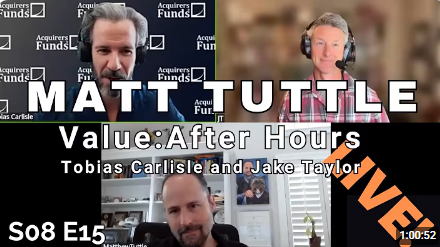
During their recent episode, Taylor, Carlisle, and Matthew Tuttle discussed:
- Inverse ETFs Explained (SARK & Shorting ARK)
- Can There Ever Be Another Warren Buffett?
- The HEAT Investment Framework
- Retail Investors vs Institutions
- Why ARK Invest’s Performance Reversed
- How to Launch a Successful ETF (Timing, Themes & Strategy)
- Top Investment Themes Driving Markets (AI, Space, Defense)
- (Jake’s Veggies) Hapax Legomenon in Investing: When Markets Break the Pattern
You can find out more about the VALUE: After Hours Podcast here – VALUE: After Hours Podcast. You can also listen to the podcast on your favorite podcast platforms here:

 Breaker

 Overcast


 RadioPublic


 Stitcher

TRANSCRIPT
[Matt] Yeah, I can tell you. [Tobias] We are live. This is Value After Hours. I’m Tobias Carlisle, joined as always by my co-host, Jake Taylor.Our special guest today, Matt Tuttle, Tuttle Capital. You know him from Short Arc, maybe the Inverse Kramer. How are you, Matt?
Lots of bangers.
[Matt] I am doing great. Thank you very much for having me. [Tobias] Yeah, my pleasure. So I think that probably like a lot of people became aware of your existence with the Short Arc ETF. Can we talk a little bit about that?What gave you the inspiration? Did you get the timing right? I think you did.
Inverse ETFs Explained (SARK & Shorting ARK)
[Matt] Yeah, we got the timing perfectly. So you know, what I find is, you know, a lot of people in my industry, you know, don’t really want to rock the boat. And that’s never really bothered me much.And you know, one of the things that I’m able to kind of do with my platform is when I see something that bothers me, I can say something about it. So you know, if you remember kind of coming out of COVID, you know, all of a sudden, you know, ARK had an amazing parabolic return. I think they were up like, you know, 120% in a year.
And you know, then all this, you know, everyone is dragging Cathie Wood out, who I have great respect for as a marketer and what she’s built, but they’re all dragging her out saying she’s the next Warren Buffett. And I would argue, because of the way this market is now, there can never be another Warren Buffett. And you know, there’s one immutable rule of markets is that any parabolic move eventually gets retraced.
Why ARK Invest’s Performance Reversed
So I’m watching this, and I’m like, this is going to hurt people. And so I decided, you know, and it was really, it was a tweet, which I’ve never been able to find. I’d love to find that tweet.
So at the time, we were doing an inverse fund on D-SPACs, companies that had come public through SPAC mergers, all that stuff was toxic waste. We’re killing it on that. And someone tweets about it.
And then someone said, you should do an inverse on ARK. No one had ever done anything like that before. So we’re like, huh, that’s an interesting idea.
Call up the lawyers. They’re like, can we do this? Like, I don’t see why not.
Call up the swap providers. Can you get a swap on ARK? I don’t see why not.
So we did it. And we launched it right at the top of the market in 2021. In 2022, it was the number two top performing non-leveraged ETF in the country.
Number one was our inverse D-SPAC ETF. You know, unfortunately, I no longer have either one of them. I sold SARK because I don’t like that trade nearly as much as I did back then.
And I had some partners who shut down the D-SPAC. But you know, that’s what did it. You know, I wanted to call out the issue.
But I was also looking at the market at that point. If you remember, that was around the Fed saying inflation is transitory, like, I don’t think so. And, you know, what’s the one thing that would cause all those ARK returns to move back to the negative?
Inflation. All of those no revenue growth companies will get killed. So you know, I just said, you know, perfect timing.
Boom, we did it. And you know, we called out the issue. And I heard from a lot of retail investors thanking me, you know, because a lot of them lost a lot of money because they listened to CNBC and they’re buying it up 120%.
And yeah, I think we’re able to help some of them at least make some of it back. So you know, felt good about that project.
[Jake] What did the SEC say about that one? [Matt] The SEC, their real only issue was they were worried we may, you know, we may move markets. And, you know, so they were worried, well, you know, you’re shorting an ETF. Like ETFs have an arbitrage mechanism, doesn’t matter.Well, they own a lot of Tesla. Are you going to influence Tesla? Like we’re playing on a pimple’s butt when it compares to the volume of Tesla.
[Jake] Tesla’s, you know, millions of shares per day. [Matt] We’re not going to influence Tesla. So you know, they were just trying to wrap their head around it because it was novel. They were fine.The ARK guys weren’t.
[Jake] Yeah, did you hear about that? [Matt] They were a little bit pissed off. And if Cathie Wood is watching, again, nothing against you. Great respect.You know, it was really more of, I was mad at the media for portraying it as something that was like, you’re getting in early on the next Warren Buffett because I knew you weren’t. And I knew if you’re listening to that, you’re going to get your butt kicked.
[Tobias] God only knows what drives Tesla, certainly not fundamentals. It’s like the moon or something like that. [Matt] Yeah, I mean, Tesla is one of those where, you know, and I mean, it’s not a good example, but it’s the best I can come up with. I remember I was a broker in the 90s and I couldn’t understand why Amazon was worth more than Borders and Barnes and Noble combined, because I was looking at Amazon as a book selling company. And if you look at Amazon as a book selling company, they weren’t worth more than Borders and Barnes and Noble combined.Obviously, Amazon is not a book selling company. And that’s a lesson I’ve taken with me. Now, Tesla is not Amazon, but you could look at Tesla as a technology company, as a robotics company, as a lot of different things.
And then, you know, then there’s also the cult of personality. You know, Elon Musk is worth something to the stock price and it just is what it is.
[Tobias] I just want to pick up something that you said before, there’ll never be another Warren Buffett or these markets make it impossible. Why do you think that?Can There Ever Be Another Warren Buffett?
[Matt] So I started investing in 1981 in middle school and I grew up in the same town as Peter Lynch. So I learned kind of at the feet of Fidelity, a lot of Fidelity guys in my town, you know, rigorous fundamental analysis. And that was pre-Internet, pre-Bloomberg, pre-anything.So if I was smarter than you and willing to work harder than you, I could probably uncover tonnes of undervalued companies, hidden gems, on and on and on. Fast forward to today, we’ve got the Internet, we’ve got Bloomberg, we’ve got AI. I have access to the same information you’ve got access to.
Now, you could still look at it better than I can. But are you going to consistently find undervalued companies that Wall Street has missed? I would argue you’re not, at least not like Warren Buffett, where you can put up the returns Warren Buffett put up.
And I’m talking about his early years. In his later years, he just became, you know, a self-fulfilling prophecy. He’s getting deals that we’re not getting.
You know, just him buying a stock makes it go up. So, I mean, that’s a whole different story. But I do not believe you can generate those types of returns today when the playing field has been levelled and I have access to all the information you’ve got access to.
[Jake] We discussed the early partnership days. He was at like 40 percent over the market or something like that. [Matt] I just I don’t think you can do that consistently. So I see a Cathie Wood doing it and I know what’s going to happen. You’re going to come back to earth.And that’s all across the board. I mean, I’ve got a hedge fund guy that calls me every once in a while and he’ll call me like, oh, man, we’re up so big this past couple of weeks. This is great.
Hedge. Like, what do you mean? Hedge.
You’re going to give back a good chunk of those returns, sell, hedge, whatever. Then he’ll call me. Oh, my God.
You know, we’re having a rough spot. But we can’t buy because, you know, that’s just that’s just how it works. You know, I tell when the market gives you more than you think it should give you, you’re going to give some of that back.
You just are. That’s the rule of the market.
[Tobias] One of the things we saw with with ARK was that there’s been the second reflation or whatever you want to call it, since sort of the AI craze kicked off at the beginning of 2024. And ARK didn’t capture that as well. Well, they’ve had much better.They’ve had a few much better years than they had previously. Did you foresee that sort of reflation coming? Did you have any?
What do you think about that?
[Matt] I mean, you know, after 2022, yeah, I just wasn’t bearish on the market and really didn’t think it was such a great trade anymore. You know, would I still maybe go long queues, short ARK? You know, maybe I haven’t even looked at it in that long.I mean, what I do with ARK now is every once in a while when I have time, which I don’t all the time, when I have time and I think the market’s overvalued, I’ll either buy puts on ARK or I’ll sell a call credit spread. You know, that’s kind of my preferred hedge, because if the market’s going to come down, ARK’s probably going to come down more. But, you know, I think we’re in such a target rich environment, too, in kind of the innovative space that it’s almost hard to really do poorly when you’ve got, you know, memory, photonics, space, semiconductors, you know, all that stuff ramping.
So I just I don’t see it as as cool of a trade as I saw it back, you know, in 2021, especially with the run ARK was on.
[Jake] So are you excited to maybe short some of these new IPOs that are coming out? Do you have any thoughts on getting ready for that? [Matt] Yeah, I mean, that’s a possibility. You know, the problem is we’ve got you know, we do a lot of 2X levered and inverse. And the problem you have from an ETF provider standpoint on the inverse is they trade a lot, but they’re rentals.People trade them in and out very quickly. So we’ve got a 2X short micro strategy that you think, oh, my God, 2X short micro strategy. You should have you should have billions in it.
We have 100 million in it and it never gets above 200 million in assets. And, you know, micro strategy will be getting killed and people are going to be selling. Micro strategy goes up, they buy in.
But we just we never really raise a lot of assets under management on the short side. So it’s tough from a business perspective to say, hey, yeah, let’s short SpaceX, let’s short, you know, you know, whatever, figure AI and any of these names and roll. So we certainly want to participate on the long side, whether we do on the short side or not.
I don’t know.
[Tobias] What makes for a good ETF launch? What are the themes that you sort of look for? Toby’s asking for a friend.Help me out.
How to Launch a Successful ETF (Timing, Themes & Strategy)
[Matt] So, you know, the key is the marketing and the timing. So, for example, we just launched SPCI. You know, we look at that’s our space ETF that pays a weekly dividend.And, you know, it’s the only really pure play space out there. It’s 11 names. But we would kind of look at, all right, where are the bottlenecks and, you know, where are, you know, where are the bottlenecks that people haven’t realised yet?
And to me, space is huge because where are you going to put these data centres? So, you know, Bernie Sanders, I saw in the news, came out, wants to put in a bill, no new data centres. I don’t want one in my backyard.
You don’t want one in your backyard. Where are they going to go? They’re going to go into space.
And a lot of stuff’s going to go into space. So, you know, we got into a hot theme. We got into it early.
You know, it was up 50 percent in a month. So, you know, timing, hot theme, stuff people aren’t thinking about. We were talking before about EUAD.
Right after the election, we realised, you know, what is the only true Trump trade? Trump’s going to come after NATO. And, you know, the European countries are scared.
Russian tanks are going to roll in. What does that mean? That means I want to own European aerospace and defence companies.
There are no, I mean, there are now, but back then there were no pure play European aerospace and defence companies. We launched it. That theme hit.
We got one point four billion in it. So you’ve got, I mean, what just happened with DRAM? You know, the only memory.
Crazy. Yeah. So you’ve got to kind of anticipate.
Top Investment Themes Driving Markets (AI, Space, Defense)
It’s not, you know, it’s like the hockey analogy. You want to hit the puck to where the guy’s going to be, not where it is now. So, you know, what’s going to be the hot area, you know, three months from now?
That’s what you want your ETF to be.
[Jake] So deep value, probably. [Matt] Oh, yeah, yeah. Definitely deep value. [Jake] Got it. [Tobias] Skate to that puck. I assume that’s not suck, isn’t it? [Matt] Yeah, I mean, I mean, you look at Twitter. Everyone is like, oh, my God, if we only had a deep value ETF. [Tobias] There’s a lot of that stuff. [Matt] I mean, those are financial advisor products. And, you know, so it’s not as much about the buzz in the hot area, but, you know, it’s an educational process. You know, first off, why do I need value when all value does is underperform? [Tobias] You need a short value ETF. [Matt] Yeah, I mean, maybe you’ve got an educational process there and, you know, and you’ve got to get shelf space. Financial advisors, you know, control a lot of assets. So everybody is talking to them.You know, how do you get their ear and how do you show them the need for your ETF? Now, if you can do it, it can be very lucrative. Like you look at something like Pacers Cash Cows, I think that’s got a couple billion in it.
I don’t think it’s even done that well, but they were able to convince financial advisors why Cash Cows had to be in your portfolio. You know, and I was talking to a guy who runs a competing fund. He’s got like 250 million.
He’s like, Matt, I’m killing them performance wise. But, you know, I can’t get the ear of the financial advisor. These guys already did.
So it’s, you know, how do you capture the ear of the financial advisor and, you know, get them to understand, hey, this is what we do. And, you know, this is why this needs to be in your portfolio.
[Jake] Yeah, you have to give them the story that they need to tell their clients, right? [Matt] Right. I mean, you’ve got to educate them and you’ve got to show them why, hey, you put this in your portfolio, your clients are going to love you. [Tobias] Tell us a little bit about the story of the 2x MicroStrategy ETF, because MicroStrategy has got a lot of its own sort of products out there. Do you feel like you get lost in the mix a little bit with their alphabet soup of stuff? [Jake] Their security offering factory. [Matt] Yeah, a little bit. And, you know, we do a lot on MicroStrategy. So we, you know, we launched 2x MicroStrategy at some point back in 2023.And, you know, we hit it right off the bat. You know, again, you know, knowing kind of where the puck is going to be, you know, there are a lot of kind of these crypto companies. What’s going to be the big one?
It was MicroStrategy. We hit it perfectly. We got to about three or four billion in it.
You know, now that MicroStrategy is, you know, falling on some hard times, we still have about 600 million in it, you know, 100 million on the short side. You know, so it’s still a great product for us. You know, and what we see is a lot of people who are not able to own crypto buy it as a crypto substitute, because, you know, there are, you know, there are funds in countries and places you can’t buy crypto.
The Koreans love it. You know, they like MicroStrategy. They’ve always liked MicroStrategy.
So, you know, they’re buying it hand over fist. We also, and this will be out in June, we formed a partnership with the guys at Strive. So we’re going to take MicroStrategy’s preferred stretch, STRC, take Strive’s preferred SEDA, lever it up a bit and try to generate 14.5% yield. So, yeah, MicroStrategy is the gift that keeps on giving for ETF guys.
[Jake] Going back to the space, and you said it was sounded like it was an income fund, like it was dividend creating, I assume that all of these guys are not producing dividends. So how is that? How do you like create cash for the investor? [Matt] What we’re doing is on our 11 names, you know, we own the underlyings and then we’re selling put credit spreads to generate the income. You know, so nobody, you know, there’s this preponderance of option income ETFs out there. First off, they’re doing them as covered calls, which I think is stupid.Now, would I do covered calls maybe on some of your names? Sure, because they’re not going to go up 20x in a month. Would I do covered calls on MicroStrategy, NVIDIA, Tesla, you know, some of these other names?
No, you’re giving up your upside. So that’s why we’re doing the puts. And, you know, nobody has launched a thematic income strategy, which I think is a mistake.
You’ve got all these guys doing like single names, you know, so by covered call on MicroStrategy, covered call on Palantir, covered call on Tesla. And, you know, I don’t think that’s the way you want to generate income. Again, you’ve got single name risk and you’re giving up your upside on stocks that could move parabolically.
So what we want to say is we want to give you access to the theme and we want to give you, you know, it’s a 30% yield right now. We could make it 80. We could make it 500 if we want to, but we don’t.
We make it a sustainable number. And all we’re trying to do, we teach people this in our wealth management firm, is from a portfolio standpoint, if you go to a wealth manager, say I got a million dollars, how much can I generate in retirement? They’re going to tell you four to five percent.
I want to bend that curve and give you seven to eight, which I think I can do when I add in some put spreads.
[Tobias] Do you model out if you have like a systemic drawdown, does that impact your, that hits all of your levered positions? Do you model out what it sort of looks like in that scenario? Have you got enough sort of short stuff out there like that? [Matt] No, we don’t. So our AUM and our levered and inverse went down a lot when Bitcoin went from 120 to like 60. And, you know, we’re crawling it back.But a lot of the names we have, unfortunately, are correlated to Bitcoin. You know, our biggest names are 2x MicroStrategy. We’ve got 2x BM&R, which is the Bitminer.
[Tobias] Tom Lacy. [Matt] And, you know, we’ve got Hood, which isn’t crypto, but it’s correlated with crypto. We’ve got 2x Long Bitcoin. We’ve got 2x Long Ether.So all that stuff, when it’s 2x, it takes such a hit. You know, so from a business standpoint. We are trying to come up with 2x products in other industries and to come up with buy and hold like EUAD has 1.4 billion in it. You know, that can go up and go down, but it’s probably not going to go from 1.4 billion to 100 million in a month. Whereas 2x Long MicroStrategy could easily do that.
[Tobias] One of your more fun ETFs was the Inverse Kramer. [Matt] So we did the Inverse Kramer, you know, as great as our timing was on ARK, it was awful on Kramer. So we launched in, I think, January 23. And we’re doing all right.Things are going great. Kramer’s pounding the table for the Mag 7. He may have even coined that term.
I don’t know. So we’re short the Mag 7. Nvidia has their earnings in May.
No one really cared about Nvidia. And all of a sudden, Nvidia is like, we’re making so much money. It’s insane.
And all of the Mag 7 is just ramping. Kramer’s telling you, buy, buy, buy, buy, buy. We’re short, short, short.
Now, the interesting thing is we should have been down like 80 percent. We were down 15 because all of his other picks were so bad. But I’m sitting there at the end of 2023 and I’m like, I can’t justify telling you to buy this when we’re short Mag 7.
And we shut it down. But that was another thing, like when you see something, say something. So what pissed me off, and again, Jim, I’m sorry.
I have nothing against you. He does hate my guts. And I am banned from CNBC.
Even though, Don Chu, if you’re watching this, please try to get me back on. I’ll be a good guy. But, you know, what pissed me off was they would bring him on every day and present him as a guru.
And have zero accountability. And the one thing that I was proud of is that at some point during that process, he came on one morning and apologised for a bad call. And, you know, and then, you know, everyone’s hitting me up like, Toto, look at what you did.
Look at what, and he’s like, awesome. You know, it, you know, have some accountability. So at least people don’t think that you’re right 100% of the time.
And that if Jim comes on and gives you five stocks, those are guaranteed to make money. You know, at least let people know, look, you know what? He’s just like everybody else.
You know, I think I’m a great investor and trader. I, you know, I’m, I’m wrong a lot. Uh, you know, Kramer’s wrong a lot.
Let people know that it’s not a road to riches and make sure they know, you know, mad money. I mean, it’s entertainment, you know? Yeah.
Maybe you’re going to pick up a tidbit here and there. Maybe he’s got a good thing. Maybe there’s a good gas, but it’s not the road to riches.
And that’s what I wanted to call out. And again, I knew I was going to get banned from CNBC and I was willing to do it because, you know, again, if I see something, I’m going to say something.
[Tobias] He’s a shorter term trader than we would be. And I think he’s also got a little bit of an advantage where the day that he, often the day that he announces it or the day after, there’s a lot of trading in those names that are often up or down, depending on how he feels like. Maybe he needs to be like a one day guy.The inverse Kramer was hilarious.
[Matt] I mean, it was great, you know, and again, I just, I wanted to call out the issue and I think I did. And again, I think I might’ve gotten him to apologise. I think it was meta that he got wrong and, you know, I did what I wanted to do.I wish I’d launched it beginning of 2022. We’d have billions in it, but you can’t, I mean, I I’ve had so much good timing with stuff, you know, I, I’m not, I’m not going to win them all either. And I didn’t win that one.
[Jake] Is there any one that jumps to mind that you either couldn’t get through the SEC or I don’t know, whatever it got killed before you decided. Oh, that was like, what’s the most fun one? [Matt] Well, it wasn’t that fun. My most fun one we got through, that’s my UFO disclosure ETF, but this one was my government grip ETF. And, you know, the idea was, you know, multiple things, people close to the president have an unfair advantage and, you know, what, what we also saw with Trump.And, you know, whether you like Trump or not, doesn’t matter. He’s the most investable president we have ever had because he is picking winners and he’s picking losers, but then people are close to him. So Elon Musk is Trump’s buddy stocks going up, you know, Oracle, Hey, we’re buddies, you know, his kids in all these business ventures.
So I wanted to do some of that, but also we figured out a way to try to really isolate what congressional trades were inside information. So not just, Hey, I want to do everything Nancy Pelosi does. I want to find Nancy Pelosi’s weird trades.
Like, why would Nancy Pelosi buy this? You know, that’s got to be some sort of inside information. And we called it the government grip ETF.
It went through the SEC fine. You know, we had we had more comments than normal. Every exchange turned it down.
[Jake] Really? [Matt] But interestingly, not at the beginning. Every exchange said yes. And then it got to some lawyer in corporate.Killed it. So we were never able to launch that. Interestingly, like last week, Bloomberg wrote a piece kind of surmising what the stocks would have been.
Showing that my returns would have been insane. And we’re like, you know what? Tuttle was right.
Like, yeah, I was. You know, Congress people are trading on inside information. Trump is picking winners and losers.
You know, when Trump tweets out, I love good, clean coal. Buy coal. When Trump tweets out, I love rare earth.
Buy rare earth. I mean, it’s it’s it’s not hard. He’s giving you.
I had one guy tweet to me. No, not tweet to me. He texted me.
You know, I love Trump. He’s giving out free money. And, you know, he is when he talks about the market.
I mean, when he told you to buy after Liberation Day, market was up 10 percent. He’s giving out free money. And I wanted to launch an ETF to capture some of that.
And they wouldn’t let me do it.
[Tobias] It’s so strange, and it was the exchanges that won the exchanges, he didn’t like it. [Matt] I think nobody wants to talk about corruption. You know, I think maybe like, you know, I don’t know if you know the Sean Ryan podcast, but I think on one of Sean Ryan’s podcasts, he called out a senator unnamed. It was Dan Crenshaw, but unnamed, that theoretically was not a rich guy, had a birthday party that cost a tonne of money and just wondered how he could afford it.Dan Crenshaw then threatened to sue him, even though he hadn’t been named and he didn’t say, hey, Dan Crenshaw is trading on inside information. He just said, wondered, wonder how he affords that. So I get the sense that that’s kind of a third rail that nobody wants to touch.
You know, we all know that people in Congress trade on inside information. We know that, you know, 30 minutes before Trump announces a ceasefire, people are buying oil or people are shorting oil or, you know, people are going massively long, the S&P. You know, we know this stuff is leaking.
We know there are people who are, you know, accessing information. They’re trading on it that they’re not supposed to, but we don’t want to talk about it. And again, my nature is I want to talk about it.
I want to call it out. I know we’re not going to change it because what senator is going to vote to not get free money? But, you know, at least, I mean, let’s call it out.
So it’s not like, huh, so you came into Congress, your net worth was one hundred thousand. You’re making like 150 a year and you leave Congress 20 years later and your net worth is 200 million. How’d you do that?
[Jake] A financial court jester of old, like who would call out, you know, the things that people couldn’t say to the king. [Matt] Right. Or, you know, the guy who, all right, I’m in a briefing, you know, with the secretary of defence. I leave and immediately buy a Lockheed Martin stock.But no, I didn’t know anything that you didn’t know. Like, oh, really? OK, yeah, I believe that.
I’m an idiot.
[Tobias] It’s not illegal for them to do. [Matt] I know it’s not illegal. [Tobias] Carved out, which is crazy. [Matt] Why? And the answer is simple. All of my employees have to submit their stock trades to me before they do them.Then I look and see, all right, what trades are we making today? Are we trading in those names? No, we’re not trading in those names today.
Approved. Or, you know what, dude, I’m actually trading that name today. You cannot buy that stock today.
You’ve got to wait until tomorrow. They should have a chief compliance officer in the Congress. I should have to submit.
Here’s what I want to do. And that chief compliance officer should say, wait, you’re on the defence appropriation subcommittee and you’re telling me you want to go 300 percent long in Lockheed Martin. I’m going to say no to that one.
[Tobias] But if you’re an operator, you’re not allowed to bet on yourself on Polly Market. I’ll see that track down that guy. He made 400 grand on the capture of Maduro. [Matt] The poor, you know, and yeah, I mean, he probably did something wrong. But, you know, the poor soldier who, you know, bet on his country. [Tobias] Bet on himself. [Matt] Right. I bet on myself. We kicked ass.I mean, I get it. It’s it’s not right. But if you’re going to go after that guy, go after the people in Congress.
Figure out who is it that’s, you know, trading oil or trading the S&P half an hour before Trump sends out a tweet. Go after those guys.
[Tobias] We’re at the top of the hour, so JT’s got some veggies for us, folks. Mark it on you. Two minutes past, two minutes past the top of the hour, JT.Hapax Legomenon in Investing: When Markets Break the Pattern
[Jake] All right. So there’s this term in linguistics that I recently learned, and it’s called hapax legamemnon, and it refers to a word that appears exactly one time in a body of text. One occurrence, no repetition, no later examples to anchor what it really means.And translators of ancient texts run into these pretty often. A word will show up one time and you have to decide what does it mean with no other usage to kind of triangulate against. You can’t look it up in a dictionary.
You have to use context, grammar, surrounding themes to try to infer. And, you know, two equally smart people can land on completely different interpretations and both could be defensible. And I think this is kind of an interesting idea to consider with respect to investing.
Almost everything that we know how to do in markets depends on repetition, you know, base rates, mean reversion, momentum, factor exposure, cycle analysis. All of it assumes that the future is in some probabilistic sense an extension of what the past looked like. And most of the time that works just fine.
Like markets do exhibit recurring structures. But every so often something happens that doesn’t quite fit. And the thing when it doesn’t fit isn’t in a tail of the distribution.
That’s not what we’re talking about. It’s completely outside of the distribution. It’s a financial hapax legamemnon.
So Buffett has a line about this, of course. He said the kind when he was looking for investment managers, when he was hiring Ted and Todd, he said he was looking for managers who think about risks that have never happened before. And of course, Howard Marks has another thing he said, he quipped that things that have never happened before happen all the time.
And the risks you can’t model with any kind of historical frequency. So, Toby, I know you’ve spent a little more amount of time figuring out the drivers of what works in investing when the past is prologue. I mean, that’s, I think, mostly what you’ve done.
And what can history actually tell you? So how do you kind of tell in real time the difference between a situation where, you know, you think the base rate applies in a situation where you might be looking at a hapax potentially?
[Tobias] Yeah, I can’t. I’ll wait until 12 months after the fact and then determine it. [Jake] Then it tells you whether you’re in that situation or not. That’s fair. I mean, I think the human instinct is to is to force a comparison.You know, pattern recognition is one of our survival mechanisms. We evolved in a very fairly narrow band of inputs and outputs, and, you know, they tended to be very linear, actually. So we’re wired to provide a narrative to these one off events to make them feel less random.
So, you know, when you hear people say this is like 2008 or this rhymes with the dotcom bubble or this is the new nifty fifty, sometimes those analogies are completely useful and often they might be a way instead of avoiding maybe some harder work of admitting that we’re maybe looking at something completely new. So let’s try to think of a few examples here. I think indexing is kind of an interesting one.
You know, most of the market history was active. Price discovery happened because investors were making individual judgments about the value of companies trading back and forth. We had price discovery.
Now, trillions of dollars are moving around based on rules, not analysis, not judgement. You know, if a dollar comes in, you buy more. If the stock is big, you buy more of that one.
And this is a structural shift in in how the marginal price is being set. And there’s I don’t think there’s really any real historical parallel for this. Every other large pool of capital in market history, whether it was mutual funds, pensions, insurance companies, sovereign wealth, they were making some judgement about price and indexing really doesn’t.
And that’s that’s that’s new, I think. So I don’t know if we have a lot of data about what does this volatility change? How does volatility change?
Capital allocation, mispricings and maybe most importantly, like what happens when we have the next real serious drawdown that’s extended and when the marginal seller all of a sudden is like, just get me the hell out of here. Like what happens? I don’t know.
Do you guys have any guesses as to how good or bad that might look? Are we just worrying about nothing?
[Tobias] The next. [Matt] Yeah, I don’t think you’re worried about nothing. You know. I, you know, I don’t look at the past because I think, you know, the only thing that is static in markets and that’s until AI takes over is fear and grief.So, you know, fear is going to cause things to go down more than they should. Greed is going to cause them to go up more than they should. You know, beyond that, things change so often structurally in markets like, you know, you see right now, you know, we’re at all time highs.
Oil is looks like it might be over 100. I can’t see anymore. You know, rates are higher.
You know, who, you know, who would think that? But, you know, all of the Iran war losses right back, you know, it doesn’t make a whole heck of a lot of sense, but it but it is, you know, if you’re around long enough to you see things that you shouldn’t see negative oil, negative interest rates, you know, flash crashes, you know, all sorts of things. So, you know, what I always tell people, and I think you said this or something like this is whatever you think can’t happen will and you’ve always got to protect from your downside.
Yeah, I will never forget in 2028, I had two separate people show me a fund and the fund was selling naked index auctions. And it was making 9% every single year, like clockwork. And both of them I went to and I said, I get it.
But if you have a volatility spike event, these guys haven’t covered their downside. Like, oh, yeah, statistically, that wouldn’t happen. Then we had volume again, that fund that was up seven to 9% every single year, five stars from Morningstar went to zero in a day.
And, you know, so you’ve got to look at it from the standpoint of, yeah, don’t tell me it can’t happen. It will happen at some point. And I was talking to one group, they had it is like a 20% holding in portfolios.
And it’s like, guys, you should make it one or two. They didn’t listen. They kept it at 20.
They probably had some lawsuits. You know, that’s a tough day to lose 20% of your portfolio in one day. So, you know, I do live by that rule.
If I think it can’t happen, it can’t.
[Tobias] Buffett made a comment that he has seen Berkshire down 50% three times in his entire career, and I thought it was funny that I’ve seen Berkshire down twice in my career, which is much, much shorter than Buffett. So, yeah, it’s happening more frequently. [Jake] So example number two that I might put forth for us to consider for a potential HAPACS that we’re living with is AI CAPEX. The hyperscalers are committing anywhere from 300 billion to a trillion dollars a year for AI infrastructure in the near next projections. Mostly it’s coming from a handful of companies.The useful lives of this CAPEX, like nobody really knows what the ROI is going to look like. Again, who knows? Every comparison I hear to previous historical examples kind of breaks in some important way.
So, you know, telecom build out of 99, you know, 2001 time frame. OK, roughly 500 billion total spent there, mostly financed with high yield debt and against assets with 25 year useful lives. All right.
That’s kind of broken. AI CAPEX is 300 billion a year financed out of operating cash flow, mostly against assets people are depreciating over five to six years. OK, that doesn’t really work.
All right. How about railroads? We hear that one a lot.
Capital intensity per dollar of eventual revenue was an order of magnitude higher for railroad. So the build out took 50 years and this is happening now over three to five years. OK, that kind of breaks a little bit.
How about electrification? Here, the spenders were very diffuse. It’s not like five big companies.
You had utilities, municipalities, industrial firms across the entire economy were electrifying. AI CAPEX is concentrated in a small number of companies. So it’s not that these comparisons are useless.
It’s just that they’re being used to do something that they can’t do, which is tell you really whether this CAPEX is going to earn its cost of capital or not. And I think the honest answer is that we don’t know. So I think we just have to be careful with some of these when we try to make analogies from the past when we might be coming across a HIPAAX.
[Matt] And so, yeah, I mean, on that, I mean, you can’t. I mean, people say it’s like dotcom bubble. Maybe, maybe not.But even in the dotcom bubble, I mean, if you bought Amazon or Microsoft at the beginning of 2000, you’re still pretty happy with how things have turned out. So I try to simplify it down. I have no idea what’s going to happen.
So what I want is I want the bottlenecks. Where are the areas that are keeping AI from expanding? So, you know, things like the power, memory, you know, photonics, space.
But then I want to buy them on dips. So I’m not chasing the memory names right now because I know they’ve gone up parabolic. They’re going to come back to me and I’ll buy them when they come back.
So like, you know, yesterday at the end of the day, we bought Poet. That’s a photonics name that violated an NDA, lost the deal with Marvell. I mean, high risk, but it was down 47 percent.
And I’ve been looking for a way to get back into photonics. So we bought Poet because it had retraced the entire up move that it made in this whole photonics thing. So that’s how I look at it.
Where are the bottlenecks? And then buy the bottlenecks on dips. You know, don’t be exit liquidity for all the people who, you know, who bought it, who bought the dip and are now selling the rip.
Be the guy who buys the dip and sells it on the rip.
[Jake] I’ll give a few more potential that are maybe zoomed out a little bit further on things that you might be able to do. And you guys can feel free to tear these apart. But so maybe one, you know, your confidence intervals should be widened, not narrowed.I think the instinct is often to do the opposite. We humans like to resolve ambiguity quickly because it feels uncomfortable to position sizing should reflect your actual understanding and not your modelled understanding of the world. I think that’s where people run into problems a lot.
So, you know, the math checks out can get you into a lot of trouble. And if you can’t model the downside because there is no historical analogue, you shouldn’t pretend that you can. Three, perhaps pay up for optionality in an environment where you’re not sure whether you’re looking at something new or not.
There’s a lot more value in being able to change your mind more so than usual. And that means keeping liquidity, shorter duration, willing to look ignorant for a while, but then maybe scramble out of your mistakes and kind of position and prepare rather than trying to predict. So I think that the dangerous moment isn’t when you’re staring at something, you know, that’s unprecedented, like that’s an easy case.
You could see it like, you know, you can be appropriately humble. The dangerous moment is when something feels similar and familiar, but when that frame snaps into place, you think you’ve seen this movie before, but you actually haven’t. And that’s where you really get yourself into trouble.
You know, 2008 maybe felt like a manageable housing correction until it didn’t. Long term capital management felt like a bond convergence trade with a bit of leverage and a failing ruble until it didn’t. And the risk isn’t missing the new, it’s mistaking it for the old and then using that playbook.
So most of the time, and you really only know whether you missed the turn in retrospect. So just to be, it should be humbling for everybody, I think is the main takeaway. Like, you know, less than you think you do most of the time.
[Matt] Yeah. I mean, you know, to us, you hedge your downside and you prepare for the worst and hope for the best. You know, I mean, is private credit going to be like 2008?Maybe, maybe not. You know, I, a lot of people have opinions. I don’t.
You know, my opinion is maybe. So let’s prepare in case it is, you know, are we going to have stagflation like the 70s? Maybe.
Better be prepared just in case, you know, on and on and on. So yeah, I mean, I’m not trying to make parallels. You know, I’ll look at things from the standpoint of, you know, 2008 was long and drawn out where, you know, some of the downturns since then have been quick.
And so my sense is the next bear market will look like more like the COVID sell-off than 2008. But I’m not married to that opinion. We could have another 2008.
So really to me, it’s just, you know, like I said, prepare for the worst, hope for the best. The market is smarter than you are. You know, if you’re doing something and it’s going against you, you’re wrong.
The market’s not. And, you know, you’ve got to kind of make a decision accordingly based on that. You know, you might eventually be right, but how much bleeding are you going to go through until you’re proven right?
[Tobias] Let me just give a quick shout out and then let’s talk, take us through your heat philosophy. Breckenridge, Toronto, Dead Cat Gully, New South Wales, Madeira Island, Portugal, London, Snohomish, Boise, Petit Ticva, Israel, Trumbull, Texas, Gothenburg, Sweden. London, Cincinnati, Poznan, Poland, Surbiton, Jupiter, Florida, Lausanne, Switzerland, Philly, Las Vegas, Havartown, Pennsylvania, Tallahassee, Snohomish again.There’s two of you guys there. Nanaimo, Monterey, Chicago. What’s up, fellas?
We appreciate you being here. Matt, take us through heat, H-E-A-T. What’s the, what is it?
What’s it do?
The HEAT Investment Framework
[Matt] Yeah, so that is my investment philosophy. As much as possible, we try to launch ETFs around that. We write about that in our daily newsletter.And that’s how we manage portfolios at Tuttle Wealth Partners, our wealth management firm. So it stands for H is for hedges. And our philosophy, as I said, is you always need to be hedged.
And bonds are not a hedge. For something to count as a hedge, it’s got to work every time. And, you know, Wall Street’s traditionally pitched bonds as the hedge.
But if you look at this Iran war sell-off, Liberation Day, 2022, not only did bonds not protect you, they hurt you. E is for edges. Whenever possible, be the casino, not the gambler.
And, you know, there are edges that are out there that are exploitable, that don’t get arbitraged away. You want to take advantage of those. A is for asymmetry.
Limit your downside, not your upside. You know, what we talk about, there is no right answer when it comes to investing. You interview a lot of top money managers.
I do as well. Everyone’s got a different way of doing it. But the key thing everyone has in common is when they’re right, they make a lot of money.
And when they’re wrong, they don’t lose a lot. That’s the key. And then T is for themes.
You want to always be invested in today and, more importantly, tomorrow’s top themes. We teach people to look at kind of a thematic investment hierarchy. Identify the theme.
Who are the obvious winners? Who are the suppliers to the winners? And then what are the asymmetrical players?
You know, the names that could 20x, 30x, that are going to be more risky. And you want to have a mix of all of that. And again, one of the ways we identify that is when we want to look at where the bottlenecks are.
But you also want to cut through, you know, the noise. Like, you know, the EUAD example, you know, again, what is the obvious Trump trade? You know he hates NATO.
And, you know, think about things from a thematic standpoint. And that’s the HEAT formula. You know, beyond that, there are multiple ways you can use it.
You know, we’ve got a portfolio approach to it, which, you know, takes from the old permanent portfolio and modernises it. But, you know, if all you do is take away the H for hedges, you know, I’ve made your life a little bit better. Or if all you do is think about asymmetry, I’ve made your life a little bit better.
You know, thematic investing, you know, great. So it’s not like a 60-40 portfolio where, boom, here’s exactly what you invest in. But it is concepts.
In a perfect world, you’re using all four. But if you just use one or two, you’re better off. Take us through.
[Jake] If someone wanted to push back and say, like, where does valuation fit into this? [Matt] Valuation can fit into it, you know, on the thematic side. And I’m not as concerned about valuation, you know, because you have, like, some of these moves that, you know, don’t make any sense. Now, again, when I want to buy into these themes, I want to buy into them when they dip.So, you know, I’m not chasing a lot of this crazy stuff. But then, you know, I do want to add in, you know, and I don’t think of it like value. So, like, one of the themes that I love is called HALO, heavy asset, low obsolescence.
So one of the issues I have with value investing in a time of AI is, is a company undervalued because people just don’t appreciate it? Or is it undervalued because AI is going to eat their lunch? So what I want to find is the companies that AI cannot put out of business.
So AI is not going to put a railroad out of business. AI might make a railroad operate more efficiently. AI isn’t going to put a copper mine out of business, but they may help them run more efficiently.
And then, you know, AI not only isn’t going to put, like, a utility out of business, it’s going to need that utility to pump power in. So what that ends up doing is it ends up getting me, quote, unquote, value stocks in my portfolio by comparison. And then I would argue diversifies me, you know, against, like, if I go into the memory and the photonics, which if you look at them from a value perspective, you’re like, no effing way I’m going to buy those companies.
You know, they’re trading at a gazillion PE, you know, whatever value metric you put on SanDisk, I mean, it’s not going to work. But, you know, we mix it with, like, a Freeport, McMoran or an Alcoa, you know, in a railroad, then, you know, there you go. There’s your stock portfolio.
[Tobias] Matt, do you have any views on the market, changes in the market structure? Like this, one of the, I think you sort of alluded to it a little bit early before, but there’s obviously this sustained passive bid that Michael Green has talked about a little bit as meaning that we’re always going to favour, you know, the bigger companies are always going to succeed over the smaller companies. Do you have any views on that idea?Retail Investors vs Institutions
[Matt] So I’ve got two views. There is that. There’s something that I think is just as powerful and maybe more, but yeah, I think, you know, whenever anyone says, oh, Mag 7, Mag 7, it’s like, dude, there is so much money going into the Mag 7 every single month.You know, people going into the S&P, people going into the Qs, dollar cost averaging, 401ks, institutions that, you know, it will be very hard for the Mag 7 to die unless the whole market is going down. So I think that is certainly something out there. The big will keep getting bigger.
What’s maybe more interesting to me is the rise of the retail investor. So what we had coming out of COVID is, you know, a generation of retail guys who were sitting at home, boss isn’t looking over their shoulder and they start trading. Now we’ve got technology where they get connected.
They get connected over social media. They get connected over Discord. They start getting on the same companies.
They start realising when they kick a hedge fund down that they’ve got power. And then they start getting smart. They move on from the GameStops and the AMCs and they start identifying these themes.
And they don’t have the constraints that, you know, a fund manager has. A fund manager is going to closet index. A retail investor is going to go all in on Sandisk or all in on Momentum.
You know, they’re not measured against an index and they’re going to move the market. And then what you have happen is the institutions start realising it and start doing the same thing. So for example, my hedge fund manager I mentioned, you know, told me, he’s like, you know, we were killing it.
And then a couple of years ago, we stopped killing it. And one day our boss came in and said, you know what, screw this. We’re just going to buy the stocks people like and short the stocks they don’t.
And they’ve been killing it ever since. So I think that’s why this market has become so thematic because the retail guys are in on the themes. The institutions jump in and it’s why you have these stocks go parabolic that just don’t, you know, going back to like looking at how things happened in the past, it just doesn’t work that way.
Now, again, it may eventually. Don’t chase these names. But, you know, it is a different market.
And I think it’s because of the retail investor and what they’ve caused.
[Tobias] Do you feel like it’s streakier than it was before? Like some of these things? [Matt] It is way streakier than it was before. And, you know, in the dips, retail guys buy the dips. You know, the institutional guys, they get margin called and they’re worried about their job and all this stuff.You know, the retail guys, they’re buying the dips. And I think that’s one of the things we saw with the Iran war. It’s like, you know, why aren’t we down?
I think a lot of it is the retail guys. You know, they saw the stocks they like get hurt and they’re just buying the dips hand over fist.
[Tobias] Without kind of giving away any trade secrets, so not any sort of newer time themes, are there any like longer term themes that you think are interesting that you’re kind of watching that maybe folks aren’t talking about? [Matt] So I love my UFO disclosure theme, which is not as much about disclosure. I don’t really, I mean, I care from a personal standpoint, but I’m more interested, you know, I think, you know, the defence contractors are sitting on technology way advanced than what they’ve shown. And we’ve seen that with the discombobulator in Venezuela, which was a directed energy weapon.And we saw it with that quantum heartbeat thing in Iran. And I think a lot of what we’re seeing in Congress, a lot of what Trump is doing is going to force the release of that technology for commercial use. You know, space is another, I mean, that’s picking up.
You know, one of the bottlenecks I’m kind of playing around with in AI is glass. You know, glass substrates, you know, some kicking around some ideas there. There are not a lot of stocks in that, but that’s interesting.
Another theme that we may very well launch an ETF on is European digital sovereignty. So kind of going back to my European aerospace and defence idea, what we’re seeing is the European countries when they can, and they can’t always in every situation, kicking out U.S. tech companies and replacing them with local companies. And, you know, they don’t have the mag seven there.
They don’t have anything close, but I’m seeing a trend. And, you know, and I think it’s an investable trend. And I think that’s something that, you know, I may want to add to client portfolios, which means I need some of these European locals, which means I got to launch an ETF for it.
So that’s one of the themes that’s kind of interesting to me as well.
[Tobias] Talk to us a little bit about your UAD ETF. What does that hold? What’s in there? [Matt] UAD is just, you know, the European defence names, Rhinomental, you know, Airbus, you know, companies like that, that, you know, we just, I mean, we just knew, you know, Trump is saying, hey, we’re not a big fan of NATO. We’re not paying for your defence. European countries are going to have to pay.Are they going to go to Lockheed Northrup or are they going to go to their own home companies? They’re going to go to their own home companies. So we wanted to own them.
We still do. I mean, it was up a ridiculous amount last year. So, you know, it’s bound to give some of it back.
But, you know, I still think that is a great theme as well.
[Tobias] Yeah. I was wondering if you had enough names to fill out an ETF when you said European defence contract. [Matt] We get around the ETF diversification rules using swaps. So, I mean, I could launch an ETF, obviously I have, with single names. [Tobias] Oh, just in terms, I just wasn’t, I wasn’t even sure if there were enough names there. Yeah, just to fill a basket. [Matt] Yeah, no, there are enough. [Tobias] Matt, we’re coming up on time. If folks want to follow along with what you’re doing or get in touch with you, what’s the best way to do that? [Matt] So our website is TuttleCap.com. And I’m on Twitter at Tuttle Capital. Our website, there’ll be a pop up for our free daily newsletter.It’s a lot. You know, I usually every day I’ll do a deep dive on some theme I’m looking at. I’ll, you know, I’ll call out a stock I’m looking at.
I’ll talk about the markets. I mean, it’s pretty beefy. Feel free to subscribe.
It’s free. Unsubscribe if it’s too much. But we do that.
We do a lot of webinars. We do our own podcast. You know, we talk to you on our podcast.
That’ll be up as soon as our editors are done. So we do a lot of educational stuff. It’s all free.
Take advantage of it. You know, hopefully you’ll get something out of it.
[Tobias] Well, thanks so much for talking to us today. Great learning about the market structure and themes and things like that. We appreciate it.Matthew Tuttle of Tuttle Capital. Thank you very much, folks. We’ll be back next week.
Same bat time, same bat channel. JT, sorry. All good.
Check out Journalitic, folks.
 Closed-End Fund Investing: Buying Assets Below Net Asset Value
 Where Is the Deep Value in Small and Micro Caps This Week?
 AI Stock Market Bubble: Can the Technology Succeed While Stocks Crash?