
Mohnish Pabrai On AI, Market Speculation, And Long-Term Investing
Monday, May 11, 2026 · Johnny Hopkins
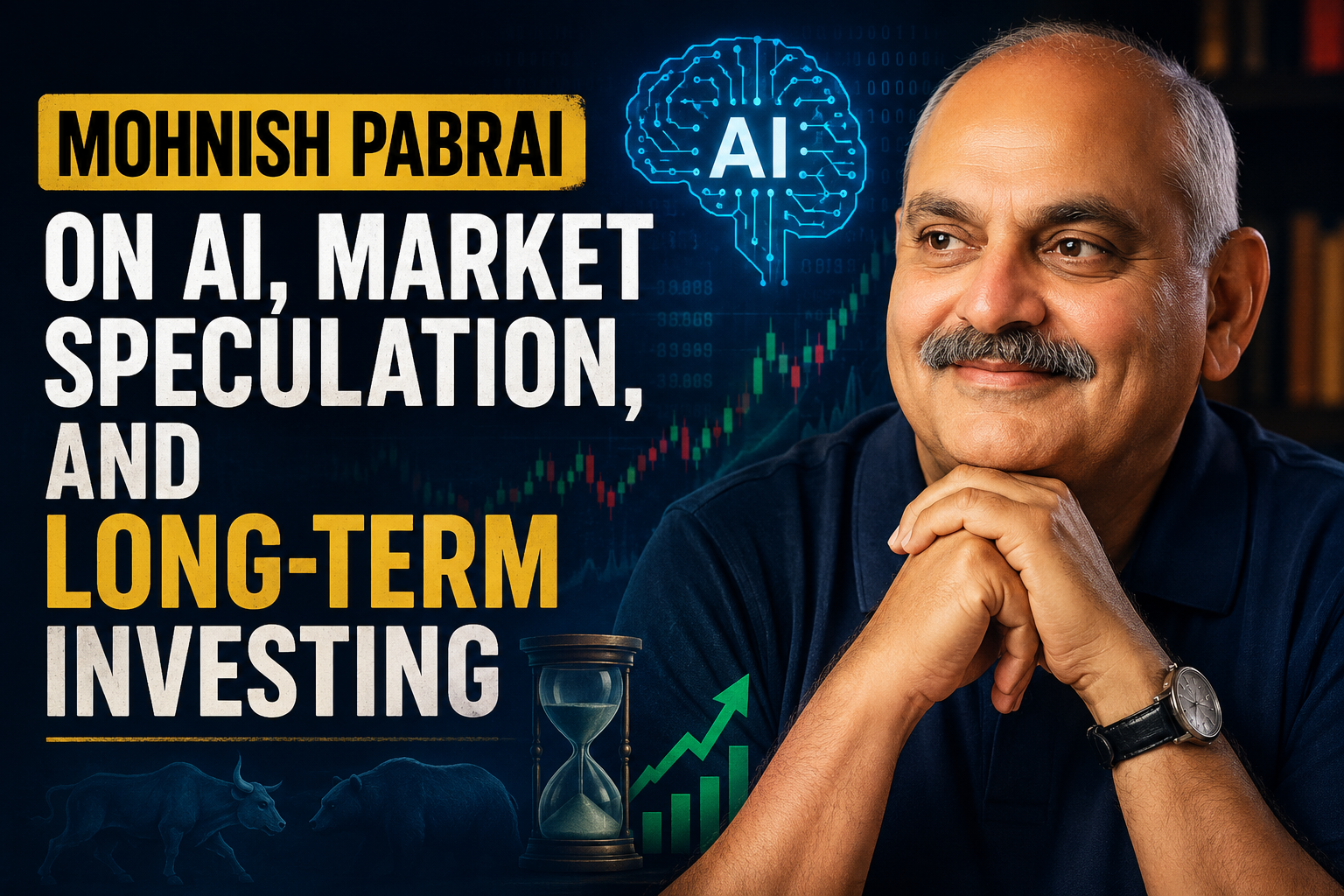
The current market backdrop is increasingly shaped by speed, narrative momentum, and the rapid spread of artificial intelligence across nearly every sector. Investors are being pushed toward constant reaction as capital floods into businesses perceived to be direct beneficiaries of technological change. Against that backdrop, comments from Mohnish Pabrai at VALUExBRK 2026 offered a reminder that long-term investing still depends more on temperament and clarity than prediction.
Pabrai framed much of the discussion around the uncertainty surrounding artificial intelligence and its eventual economic impact. “Well, so very early days, very embryonic in terms of what’s going on with AI.”
That observation feels particularly relevant as markets increasingly behave as though the winners and losers of the AI cycle have already been permanently determined.
The current environment resembles many prior periods where investors extrapolated emerging trends far into the future before the economics were fully understood.
Capital continues concentrating into a narrow set of companies associated with AI infrastructure, semiconductors, software, and automation. Meanwhile, many mature, cash-generative businesses remain overlooked despite producing durable earnings and strong free cash flow.
Pabrai’s broader investing philosophy has always emphasized asymmetry and patience over forecasting precision. That mindset stands in sharp contrast to the increasingly speculative tone visible across parts of today’s market. Investors appear more willing to pay for potential than proven economics, particularly when growth narratives dominate headlines.
He also highlighted the importance of internal conviction and long-term orientation. “One of my mental models is that your deepest desire is your destiny.” In investing terms, that idea carries important implications. Investors who remain anchored to discipline, independent thinking, and intrinsic value are often better positioned during periods where enthusiasm overwhelms fundamentals.
That discipline becomes harder when momentum appears self-reinforcing. Passive inflows, algorithmic trading, and AI-driven excitement can create an environment where valuation concerns are temporarily dismissed. Yet history repeatedly demonstrates that sentiment-driven markets eventually reconnect with underlying business performance.
Pabrai’s comments also reflected an appreciation for long-term resilience rather than short-term optimization. “If you don’t have a deepest desire then you can make that your deepest desire.”
The remark was not directed specifically at markets, but it speaks to a broader investing truth: clarity of process matters far more than reacting to every cycle, headline, or technological shift.
Today’s market increasingly rewards immediacy. Investors are pressured to respond instantly to earnings reports, AI announcements, macro forecasts, and shifting sentiment. But enduring investment success has historically come from maintaining rationality while others become emotional.
That may ultimately be the most useful takeaway from Pabrai’s remarks at VALUExBRK 2026. Artificial intelligence may reshape industries, alter cost structures, and accelerate productivity across large parts of the economy.
But successful investing will still depend on the same principles that have always mattered: patience, independent judgment, and the ability to stay grounded when markets become excessively enthusiastic.
Full VALUExBRK 2026 here: