
Mohnish Pabrai Explains Why Only 4% of Stocks Drive Market Returns
Tuesday, May 5, 2026 · Johnny Hopkins
Markets have entered a phase where valuation discipline matters again. The easy gains from liquidity expansion and multiple re-rating have faded, leaving investors to confront a harder truth: durable compounding remains extraordinarily rare. That reality sits at the center of a recent conversation with Mohnish Pabrai on The Investor’s Podcast, where he repeatedly returned to the idea that investing success is driven less by activity and more by patience.
Pabrai framed the problem with unusual bluntness: “most of the time when we act, the odds are stacked against us.”
At a moment when investors are chasing artificial intelligence beneficiaries, speculative turnarounds, and momentum trades, that observation feels especially relevant.
Markets have become increasingly concentrated, with a handful of mega-cap companies driving index returns while the broader market struggles to keep pace.
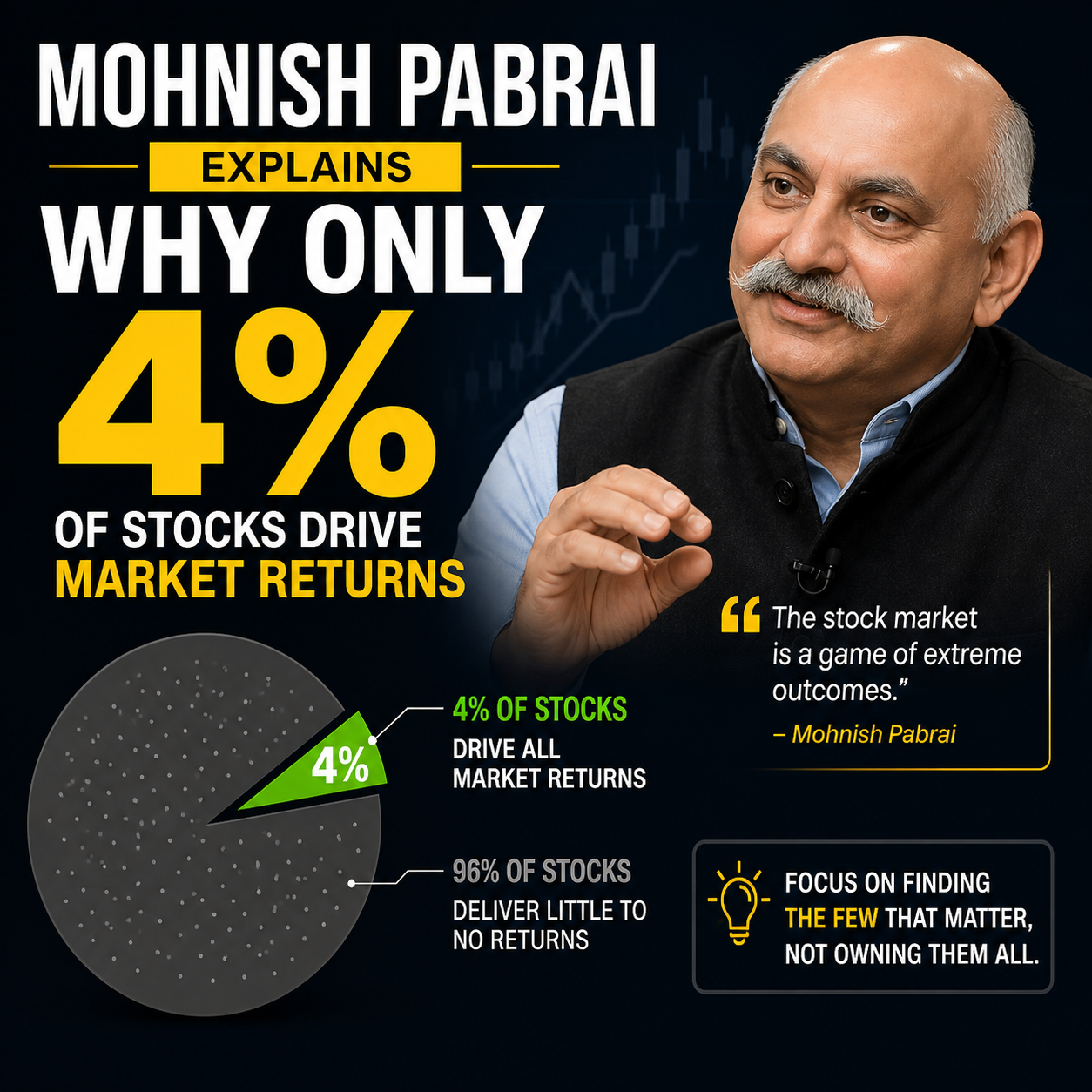
He tied that concentration to a historical reality many investors ignore: “about 4% of the businesses have delivered all the returns in the market. The other 96% have barely matched bonds or inflation. They haven’t done much.”
The implication is uncomfortable for active managers and retail traders alike. Most stocks will not become life-changing compounders. Most will simply absorb time and capital.
That helps explain why high-quality businesses continue commanding premium valuations even as economic uncertainty rises. Investors are no longer paying merely for earnings growth. They are paying for resilience, adaptability, and management quality.
Pabrai pointed directly to survivability as the defining trait of enduring winners: “the species that survive are not the strongest or the biggest. But he says the ones that are the fittest, its survival of the fittest.”
He applied that framework to companies capable of reinventing themselves repeatedly through changing economic cycles.
This increasingly matters because the macro backdrop remains noisy. Inflation concerns persist, rates remain elevated compared with the prior decade, and geopolitical tensions continue influencing capital flows.
Yet Pabrai argued that investors often exaggerate macro risks while overlooking operational strength. “for most businesses, almost all businesses, the micro is going to trump the macro.”
That perspective stands in sharp contrast to the prevailing market mood, where every inflation print and central bank comment can trigger violent swings. The obsession with forecasting the next quarter may be distracting investors from identifying businesses capable of compounding over decades.
Importantly, Pabrai also warned against prematurely selling exceptional businesses simply because valuations appear stretched. “one of the lessons that took me many decades to learn is not to sell a good company or great company when it’s fairly priced, or even overpriced.”
That lesson may prove critical in today’s environment. Investors waiting endlessly for the “perfect” entry point into elite franchises risk missing the small collection of companies that ultimately dominate long-term returns.
As volatility returns and speculative excess gradually unwinds, the market appears to be rediscovering an older investing principle: owning fewer exceptional businesses for longer periods may still outperform constant repositioning. Or as Pabrai put it, “the important thing is just leave it alone.”
Full interview here: