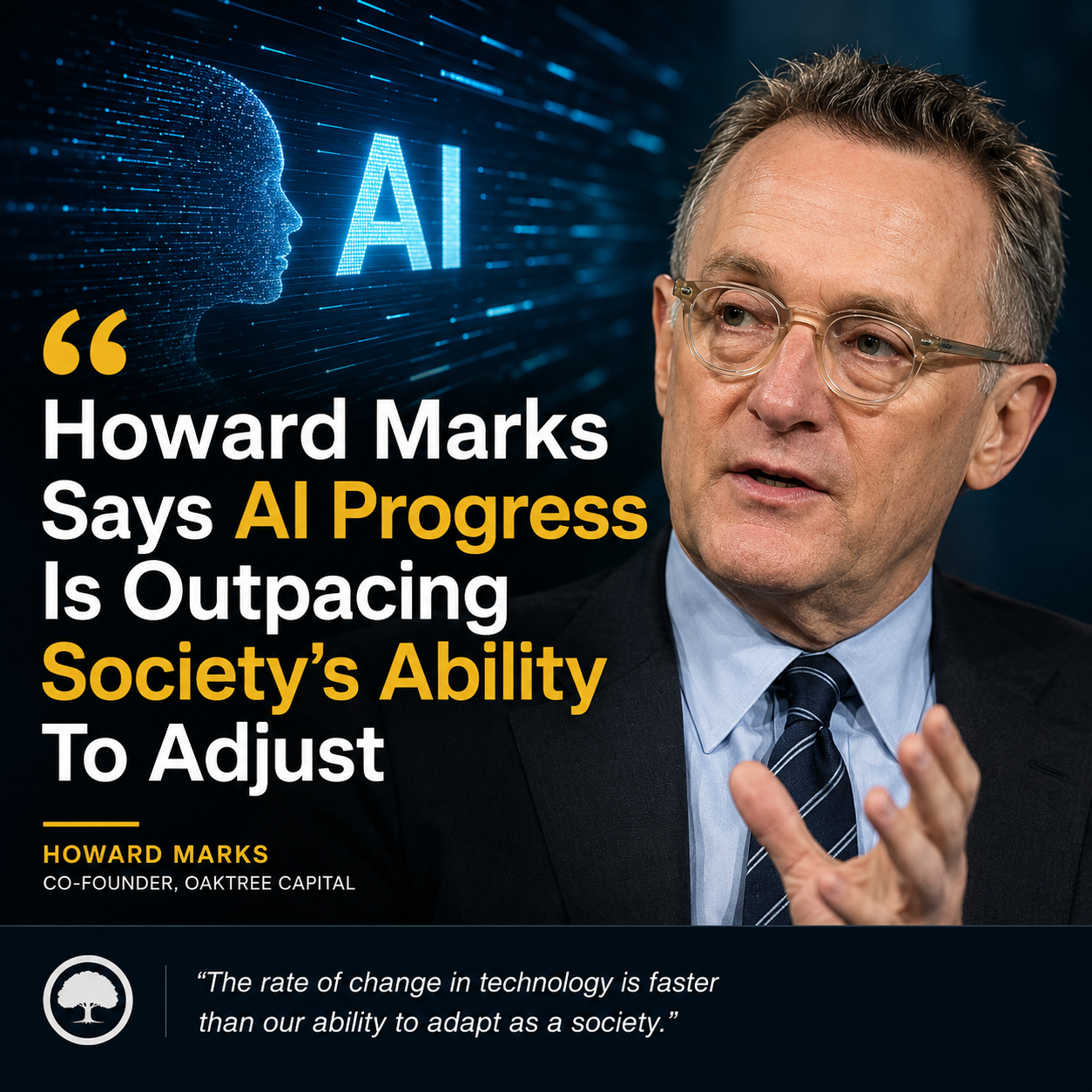
Howard Marks Says AI Progress Is Outpacing Society’s Ability To Adjust
Tuesday, May 26, 2026 · Johnny Hopkins
Investor enthusiasm surrounding artificial intelligence, passive investing, and perpetual technological disruption continues to dominate market psychology. Yet beneath the optimism, veteran investors like Howard Marks remain focused on the cyclical behavior that has repeatedly driven booms and corrections throughout financial history.
During a recent interview with TBPN, Marks explained that while businesses and economies tend to progress steadily over time, investor psychology rarely moves in a straight line.
As he put it, “the value that it creates should progress along that trend line.” But markets often become disconnected from that underlying reality because “sometimes people get too excited and they overvalue that progress and the market goes to an unsustainable high.”
That emotional volatility remains highly relevant today as capital continues pouring into AI infrastructure, software, semiconductors, and automation-related businesses at extraordinary valuations.
Marks argued that the underlying driver behind these recurring cycles has remained remarkably consistent across centuries. Referring to speculative episodes from the tulip bubble to modern technology manias, he noted that “the things that rhyme are the elements of human nature.”
Among those recurring behaviors, Marks highlighted “the desire to get rich quick,” “envy of seeing others get rich quick,” and “the fear of missing out.”
Those impulses have become increasingly visible as investors aggressively chase companies associated with AI adoption regardless of valuation, profitability, or competitive durability.
Importantly, Marks does not frame his investment philosophy around forecasting precise outcomes. Instead, he focuses on understanding where sentiment sits relative to risk. “The scariest thing in the world, the riskiest thing in the world is the belief there’s no risk,” he said.
That observation may be especially important after several years in which investors have repeatedly been rewarded for buying every decline.
Markets have become increasingly conditioned to assume rapid rebounds, continued liquidity support, and uninterrupted technological expansion.
Marks warned that periods of widespread optimism often create the conditions for future instability because investors gradually stop demanding adequate compensation for risk.
As he explained, “when people believe there’s no risk, the world gets crazy.”
At the same time, Marks acknowledged that artificial intelligence represents something more powerful than previous technological shifts.
While he compared today’s enthusiasm to earlier technology bubbles, he also argued that “the power of AI relative to the predecessor technologies I think is vastly higher.” He added that “the speed of innovation is vastly faster.”
Still, his concerns extend beyond valuation alone. Marks suggested the pace of AI development may exceed society’s ability to adapt, warning that “I think that the speed at which AI can innovate is faster than the speed at which society can adjust.”
Despite those concerns, Marks continues emphasizing discipline rather than prediction. His approach remains deeply contrarian, particularly during periods of widespread optimism. “When everybody else is terrified and wouldn’t touch risk with a 10-ft pole and as a consequence you get highly paid for taking risk, that’s when we turn aggressive.”
For long-term investors, that distinction may matter more than ever.
Full interview here: