
Buffett-Style Options: How Buffett Turns Options Into a ‘Can’t Lose’ Setup
Wednesday, May 20, 2026 · Johnny Hopkins
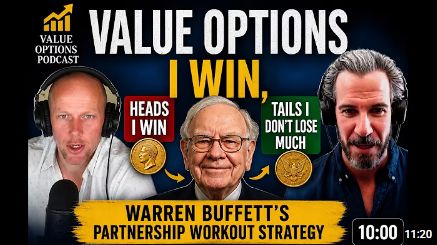
Markets remain heavily focused on momentum, AI narratives, and short-term price action, but beneath the surface a growing number of investors are revisiting more conservative strategies designed around risk reduction, cash generation, and disciplined entry prices. One approach gaining renewed attention is the use of “value options,” a framework that Tobias Carlisle and Tim Travis recently connected directly to Warren Buffett’s early investing playbook.
During their recent discussion on the Value Options Letter and Acquirers Podcast, Travis described the core philosophy behind the strategy in simple terms: “value option is an option on a stock that you’d want to own anyways.” He explained that the approach centers primarily on cash-secured puts, where investors are paid upfront premiums in exchange for agreeing to potentially purchase stocks they already consider undervalued.
The appeal becomes particularly powerful during periods when valuations across broader equity markets appear stretched. Carlisle noted that Buffett himself used similar structures long before Berkshire Hathaway became the giant conglomerate investors know today. Referring to Buffett’s partnership years, Carlisle explained that Buffett favored “workouts” during overvalued market environments because “there was a timeline and a known return.”
That distinction matters. Traditional value investing often requires patience without certainty regarding timing. A stock may remain cheap for years before the market recognizes intrinsic value. By contrast, selling options can create defined outcomes and immediate cash flow while waiting for valuation gaps to close.
Travis argued that options effectively became “a great workouts tool” for Buffett because they created what he repeatedly described as a “heads, tails situation.” He summarized the setup clearly: “Heads, if the above your strike price, when you sell a cash secured put, you make that double digit target annualised return and you don’t end up owning the stock necessarily. Tails, you’re buying the stock at a very large discount.”
One example discussed was Buffett’s use of puts with Coca-Cola in the late 1980s and early 1990s. Carlisle explained that with Coca-Cola trading around $39, Buffett sold puts with a $35 strike price and collected approximately $1.50 per share in premium income. “He was agreeing to buy more at 33.50. And for that, he was paid $1.50,” Carlisle said.
The broader principle behind the strategy is less about speculation and more about improving entry prices and generating returns on idle cash. Travis compared the process to “writing basically insurance,” emphasizing that Buffett was comfortable either collecting premiums or ultimately owning the underlying business at a discount.
Importantly, both Carlisle and Travis stressed that risk management remains central to the approach. Carlisle acknowledged that “selling options is risky,” but noted that the risk can be controlled through “cash secured options,” where investors already hold the capital required to purchase the stock if assigned.
For investors increasingly uncomfortable with speculative excess and elevated valuations, Buffett-style value options may represent a return to something simpler: patience, disciplined pricing, and getting paid while waiting for opportunity.
Disclosure: This article contains an affiliate link. I may earn a commission if you subscribe through it.
Interested in Buffett-style options strategies alongside long-term value investing?
Value Options Letter focuses on conservative options strategies around undervalued businesses, including cash-secured puts, covered calls, and disciplined “getting paid to wait” opportunities inspired by Warren Buffett’s approach to risk and valuation.
Value Options Letter is a research publication and not personalized investment advice.
TRANSCRIPT
[Tobias] Welcome to the Value Options Letter Podcast. I’m Tobias Carlisle, joined as always by my co-host Tim Travis. Tim, how are you? [Tim] I’m good, Toby. How are you? [Tobias] I’m well. We’re talking value options. What is a value option? [Tim] Right. So value option is an option on a stock that you’d want to own anyways. So utilising two basic strategies, cash secure puts, where you’re willing to sell a put on a stock that you want to own, creating a heads or tails type situation where heads, if the stock’s above the strike price that you sell the put, you make an attractive profit.Normally we target double digit annualised returns there. Tails, you end up owning the stock at a large discount to our estimate of intrinsic value. And then you have all the upside or downside, the dividends from there, Toby.
So that is the definition of value options.
[Tobias] We’ve talked about this a little bit before. Warren Buffett, many folks don’t know, has been a user of value options, but we feel that it fits in his broader strategy when he run the Buffett partnership. This is pre-Berkshire Hathaway. [Tim] Yeah. I mean, that’s when he posted the best returns, Toby. A lot of people forget that aspect, and he was doing it very differently, much more concentrated portfolio.And when I was reading through the partnership letters, which I’ve done many times, as I’m sure you have too, he talked about generals, which are just generally undervalued securities. So that would be kind of his core American Express, Wells Fargo type positions that he had all those years. And then he had workouts.
[Tobias] Well, just before you, the key with those positions is that there’s no catalyst, right? They’re just undervalued, and you hope that over a period of a longer period of time, three to five years, the underlying valuation is reflected in the stock price. Right. [Tim] The stock price converges with the intrinsic value. Exactly. [Tobias] He had these workouts that he liked to use when the market was overvalued. And the reason that he liked to use these is that there was a timeline and a known return, which is what is the, that’s the keys to value options. So value options in a workout context. [Tim] Yeah. And what’s so amazing about his record during that era was he did not have a down year. From my recollection, I don’t believe he had a down year, even though the market was down and workouts were a big reason why.And so when I was reading the partnership letters the first time many years ago, over two decades ago now, and he was talking about workouts, I was thinking about it. Well, M&A is what? Arbitrage.
Arbitrage on mergers and acquisitions is a way that he historically did workouts. And what’s attractive is of that is you kind of can assign odds to the probabilities that a deal is going to go through. And if it does, you make a designated profit and it’s kind of unreliant on the overall market.
If it falls apart, you can kind of take a big hit. And, and that has been, there’s so many funds that got dedicated to that space that I think it’s squeezed out a lot of the profit margins, Toby. But I feel like options became a great workouts tool for him with Berkshire Hathaway as, as we talked about last week with his acquisition of Burlington Northern Santa Fe, how he used the puts to, to get into that stock and how he did with Coca-Cola as well.
And, and so, so basically what’s great about the options, the covered call and cash secured puts, is it creates a heads, tails situation. Heads, if the above your strike price, when you sell a cash secured put, you make that double digit target annualised return and you don’t end up owning the stock necessarily. Tails, you’re buying the stock at a very large discount to what you’d be able to buy it at now.
And it’s a stock you already want, Toby. So that, that value options is really a modern day workout in our estimation.
[Tobias] So the Buffett example is a good one because we use two in our book value options. One was the Coca-Cola situation where he’d bought the position in 1998. By the early 1990s. [Tim] 1988. [Tobias] 1988. By the early 1990s, the stock was trading north of where he had bought it, but still probably below where he, above where he would have bought some more. But he, he found that, so the stock was trading at $39.He bought a, he sold a put with a, an expiry $35, with a strike at $35 and the expiry, it’s not entirely clear, but we think five or six months into the future. And he got a $1.50 per share. So in that scenario, he either pockets the $1.50 and his downside is 33.50, which is where he would then buy the stock. So that was with Coke trading at $39. He was agreeing to buy more at 33.50. And for that, he was paid $1.50. Now the internal rate of return, if we do that calculation, it’s not a huge internal rate of return for that. He was looking at about 6% where we would look at higher rates of return in the sort of stocks that we would, 6% is a low, is a low rate.
That’s close to the cash rate now. So we would want to be north of that. What’s your threshold for an internal rate of return?
[Tim] Even really it’s, it’s low double digits is, is where we target. There will be some exceptions. For instance, I mean, if you’re selling put on like a, put on like a Berkshire Hathaway at a, at a low valuation, because of the relative security and the high quality nature of the company, you might lower that hurdle rate a little bit to maybe eight or 9% just because, just because you feel like it’s a low risk stock.And for Buffett in the way that Buffett’s thing, obviously there’s risk and everything, right. But in the way that Buffett thinks to him, that was as low risk of an investment as possible. I mean, same way, I mean, Charlie Munger, you know, with the way his, he talked, he’d probably say it was risk-free in his, you know, the way he talked.
I loved his, I loved his persona and the way he articulated things. But, but yeah, so for, it’s a great risk reward scenario. It’s a stock that he was willing to buy at a higher price.
So for him, it makes all the sense in the world. You either pay him, he keeps the premium, he’s writing, he’s writing basically insurance. And if, if the insurance pays off for the buyer of the option, he’s more than happy to end up owning that stock at a discount price.
[Tobias] Yeah. So there are two outcomes in the coin flip. One is that you just pocket the premium and you never put the stock on.The other option is that you, you receive the stock, but you get the stock at such a significant discount to where it’s currently trading and what you estimate the intrinsic value to be that you’re also happy with that outcome. So you either you’re happy with the rate of return on the insurance premium, you receive the, the option premium you receive, or you’re happy to receive the stock at a big discount. And so that’s the sort of situation that we’re trying to find in stocks that you want to own at a premium rate that, that is significantly above the cash rate.
And so whatever happens, you’re happy with the outcome.
[Tim] Right. Right. And the whole, the whole thing is the key principles with options with value options, Toby is you let time do its thing.That’s important because what some people do is they’ll sell a put and let’s say it says put that six months out and the stock dips a little bit and they’re negative on the put and it’s all, I’m down, I’m down on this. But the whole, the whole name of the game is letting that option expire or get close to expiration. And, and worst case, you end up owning the stock.
And a lot of my biggest winners historically have been when we’ve been put the stock, you end up owning it at a really discounted price. You ride that stock up and then, you know, the wheel comes in as, as you talked about in the book. And, and, and as we, we wrote about is, is when you’re exercised on the put.
So in the scenario, the tail scenario where the stock expires below the strike price that we sold it at, now you own the stock. You own it, you’ve got the dividends, you’ve got all that. So that starts the wheel.
So what we can do then is we can sell calls at levels that we’re willing to sell the stock at. Maybe that’s a little bit above where we, where, where the stock was when we initially entered into the position, maybe it’s way above. And it depends on a lot of different factors, how, how far we go out, what our estimate of intrinsic value on the stock is.
But what’s great, Toby, is you can keep selling calls over and over again, and that’s generating additional income. It’s reducing your cost basis on the position. So these are risk reduction, income enhancement opportunities that make sense to the logical mind.
And a lot of people, Toby, I know you’ve heard this too, is you say the word options and they’ll either say, look, it’s too risky because most people talk about buying options or tails, or I’m so used to that framework, or secondly, they say they don’t understand it. And so our job at the value options letter is to make it very simple for people to understand. And you might not get it on your first time hearing it, but basically in all of our investments, or in all of our, in all of the suggestions, it’s heads, tails, two different scenarios, either way we’re comfortable.
That’s, that’s the beauty of it.
[Tobias] The other criticism is that selling options is risky, which it is, but we can define the risk by making sure that we’re doing it in a, we’re selling cash secured options. So what that means is that we’re already putting the cash up for a position, assuming that the option will be exercised and then we’ll be asked to take, take the stock. And so we’ve already put the cash in the account to take the stock.And that’s why the internal rate of return on the option premium is so important because that is what you earn on the cash that you’ve put up to secure the option position.
[Tim] Correct. Correct. We want to own the stock.That’s a perfectly fine scenario. Either way, we’re, we’re, we’re comfortable. Either we collect the premium or we own the stock at a discount.
And we’re going to say it a lot. Warren Buffett’s rule number one, don’t lose money. Rule number two is don’t forget rule number one.
And so that is the premise of, of the value options method.
[Tobias] On that note, folks, check out value options, letter slash subscribe the links in the description below. We’ll be back next week with some more value options, letter podcast.You can find out more about the Acquirers Podcast here – Acquirers Podcast. You can also listen to the podcast on your favorite podcast platforms here:

 Breaker

 Overcast


 RadioPublic


 Stitcher

 AI Spending Boom: Are Big Tech Companies Taking on Too Much Debt?
 Where Are the Highest-Quality Value Opportunities This Week?
 Undervalued REITs: Finding Opportunities in Commercial Real Estate