
VALUE: After Hours (S08 E12): Charles Lemonides of ValueWorks LLC on $RIVN, $JOBY, $BA, $AMZN and his $TPL short
Monday, April 6, 2026 · Johnny Hopkins
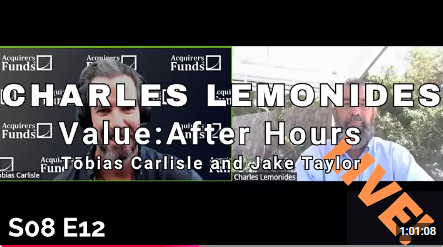
During their recent episode, Taylor, Carlisle, and Charles Lemonides discussed:
- Why Rivian Could Be Worth FAR More Than $15 Billion
- Why Amazon Is Still a Hidden Value Play
- Boeing Stock: Turnaround Opportunity or Value Trap?
- Tesla’s Biggest Problem Isn’t EVs — It’s Elon Musk
- The Real Reason EV Startups Like Rivian Have an Edge Over Legacy Automakers
- Is Tesla’s Auto Business “Basically Dead” in Europe?
- Flying Taxis Are Closer Than You Think – Inside Joby Aviation’s Breakthrough
- Why Electric Air Taxis Could Become a Multi-Billion Dollar Industry
- The Investor Immune System: Jake’s Brilliant Analogy for Surviving Market Crashes
You can find out more about the VALUE: After Hours Podcast here – VALUE: After Hours Podcast. You can also listen to the podcast on your favorite podcast platforms here:

 Breaker

 Overcast


 RadioPublic


 Stitcher

TRANSCRIPT
[Tobias] We’re live. This is Value After Hours. I’m Tobias Carlisle.Jake is joining us today. He’s just, he’s on audio. He’s having a bad hair day.
Our guest today is Charles Lemonides. He’s the CIO and founder of ValueWorks LLC. Charles, welcome.
[Charles] Thank you very much for having me. [Tobias] Tell us a little bit about your investment philosophy at ValueWorks. [Charles] You know, we named our place ValueWorks because we think we are value investors, but that doesn’t mean we ply in the bottom half of the valuation continuum. It means we look at stocks and try to get a dollar’s worth of assets today and pay 50 cents. And, you know, that discipline can be applied to a wide array of different stocks and securities.And we build really diversified portfolios using that approach. Look, the stuff in the world today is worth X and we’re paying half of X. And it doesn’t matter if the stuff is office buildings that may not be appreciated that quickly or offshore oil rigs or, you know, Boeing or Amazon is going businesses.
So it’s a value discipline that ends up with a really diversified portfolio. And it’s not always just stocks in the bottom half of the valuation continuum. So they’re not always the cheapest price to book, price to cash flow, price to earnings.
But there’s some metric by which we think what they own is worth more than what we’re paying.
[Tobias] How did you get your start, Charles? [Charles] I was, I thought about career paths for a while and I decided that it made a lot of sense to be an analyst so you could understand what drove investments and then a portfolio manager so that you could benefit from it. So I started in a research department. I had a retail brokerage firm and tripped across a bond that was backed by an aircraft and the plane was worth more money than the amount of the bond.And the yield on the bond seemed higher than made sense. So that was my first pitch to my director of research and I wrote it up as an idea and started filing high yield bonds across the board in the late 80s and take over stocks and then distressed in bankruptcies in the early 90s.
[Tobias] And you describe or I’ve seen value works described as deep value in special situations. So do you continue that process on? Do you continue that strategy on today? [Charles] Absolutely. You know, it’s something that served us well and we’ve done well with it over time. And it’s a discipline that makes sense that it’ll work okay.We don’t argue that value is better than growth. We just argue that, you know, a growth investor decides that they want to have the best asset going that’s appreciating the best over time and the price be damned. And, you know, that discipline works well also, you know, we use our discipline because it suits our skill set and my temperament, frankly.
[Tobias] You’ve got some unusual holdings in your portfolio. Do you want to talk us through a few of these names? If I throw a name at you, you want to give me how you guys see it? [Charles] I’m probably ready to discuss any one of them. [Jake] Before we go there, though, can I ask Charles on what about your personality do you feel like lends value investing to be a good congruent match for you? [Charles] Well, I have a very analytical event and a very strong risk assessment. Like protecting on the downside is super important to me. And I’m willing to be stubborn and disagree with the consensus.I would be a terrible trader. You know, if you’re a trader, you got to go with the flow. I’m not a consensus.
Yeah, you make an argument to me and I’ll take the other side just to find out how it feels.
[Tobias] Yeah. So the first thing that I had for you was Rivian because I thought that that was a little bit as you point out, that would not fall in the bottom half of the value distribution. So Rivian is an interesting one to talk about.Why Rivian Could Be Worth FAR More Than $15 Billion
[Charles] Yeah, yeah, it is. Look, they’re about a billion shares outstanding. It trades in the mid-teens.So you’re paying $15 billion or so to control that enterprise. And the question is, you know, what is it worth? They’re selling 50,000 cars a year right now, generating $5 billion worth of sales.
That’s not worth more than $15 billion, more likely than not. So why do we think there’s more value than that there? And it comes from our premise that EVs are the future.
The Real Reason EV Startups Like Rivian Have an Edge Over Legacy Automakers
You know, electric powered cars are more efficient than internal combustion engines. And that’s where the world is going. And if that’s true, standalone EV makers have an advantage over the incumbents because the incumbents have to defend a losing proposition.
Rivian is highly likely to be one of only two standalone EV makers in the U.S. You know, Tesla has market share and scale and Tesla is not going out of business anytime soon. Tesla is going to be around in a standalone EV maker. But Rivian at $5 billion in sales is three times the size of the next one on the list.
And it’s super important to a car buyer to have confidence that their company is going to be around because, you know, you separate yourself from $100,000 or $50,000 to buy one of these premium cars. And if the manufacturer goes out of business, as a whole bunch of them have, you know, then you can’t change a headlight. You can’t fix a fender if it gets dented.
Your investment is at risk like on day one. So I think Rivian is in a place where there’s confidence they’ll be around. Look, they’re backed by Amazon as a significant investor.
They have a super solid balance sheet. They’re probably profitable this year or at least run rate profitable soon. And more importantly, and they’ve built a brand recognition that is very, very important and a distribution network that is hard to replicate.
You know, the incumbent automakers have a couple of disadvantages. One, they’re defending the internal combustion engine and two, they have a dealer network that they rely on that they have to push their cars through. Tesla and Rivian sell their cars directly and don’t have those middlemen taking an important part of the profits.
The knock on Rivian is that they’ve been at 50,000 cars a year for three, four years. And look, their car that they’re selling has a market of 50,000 cars a year. Like, you know, they’re competing with BMWs and Mercedes and that high end luxury SUV market and 50,000 run rate for those vehicles is great.
This One New Rivian Model Could 10X Its Addressable Market
It’s plenty of market share. Why we’re optimistic about the near future for Rivian is because for the past three, five years, they’ve been developing a midsize model that’s more like $50,000 price point. And it is rolling off the production lines right now.
They’re planning on having sales in the second quarter, which starts in 12 hours from now or 15 hours from now, depending upon what time zone you’re in. So that’s massive upside in terms of their addressable market. You know, the market for $50,000 SUVs is, you know, potentially a million units a year.
They’re in a position where they’re going to be able to build 250, 350,000, not in 27, but surely in 28 and 29 and then go in a half a million. And that gives you a real revenue base that more than justifies your 15 ish billion dollars that you’re paying for them today. They also have the best technology going as evidenced by the fact that Volkswagen put a couple of billion dollars into them in order to get access to their EV technology, which is a wide ranging set of technological tools.
I mean, it’s not just making the car, it’s not just the systems on the car, but it’s all the telematics and all the smart driving and self driving and automation that happens. And so they’ve got the best technology going. They’ve got a well established brand name.
So how is it? And they could be doing, you know, 15 billion in sales in two years from now, which is, you know, if you get maybe three or four years, but, you know, you’re at five now. So you go from five to 15, it’s not hard to see how you get valued at two or four times sales.
And it makes sense that they’ll have a long trajectory because of their competitive position. And look, they have been at it for a long time and they’ve spent a lot of money to build this operation. They’ve invested almost $40 billion, $35 billion for sure to get what they have today.
And what they have today is cash and they have technology and they have factories. And some of that stuff is tangible and on the balance sheet, but most of it has been expensed, but it costs them $35 billion to be where they are today. It’ll cost someone else that much money and then some to be there in the future.
So I’m getting their $35 billion investment for $15 billion at a place where the revenue trajectory is about to torque. And the market acceptance is because they’re going to, you know, a $50,000 vehicle has a lot more potential consumers than the $100,000 vehicle that I drive.
[Tobias] What do you make of legacy OEMs struggling to transition across into EVs? It seems to me like a lot of them have tried and then made these huge write-offs and sort of abandoned it for reasons that aren’t entirely clear to me, but it looks like they think either not yet or not ever. Do you have any insight into what’s going on there? [Charles] I think it’s hard. And I think that a pure play has advantages over an incumbent that is defending existing businesses. You know, a pure play can price it in a way that undercuts the internal combustion alternative without, you know, taking their own market share from themselves.And look, when you have your DNA that you’re an EV maker, it’s really different than when you have your DNA that you’re a legacy automaker with the ways you do business and your labour contracts and your factories and your stuff that generates sales every year. And look, up until now, the range issue and the charging issue has been a huge impediment. The range issue has been basically solved.
Look, they go 300, 400 miles on a charge. And if you need to go a long, long distance, you know, you can find a fast charger that fills you up in half an hour. So if you’re driving across country, you know, you’ve got to make your 10 stops to fill up and each one of them costs you half an hour.
Okay, so if you’re driving across country, it might be a little inconvenient, but, you know, most of us are not driving across country every week. Most of us are driving a couple of miles to the office and back or to the grocery store, and most of us can plug the thing in at night and have it fully charged in the morning and never stop at a gas station again. So the incumbent guys have had a hard time getting their arms around and their heads around the fact that the charge issue and the range issue has been solved.
They don’t have a competitive advantage when it comes to the battery technology. They don’t have a competitive advantage when it comes to the electronics of it. And they have a competitive disadvantage when it comes to their dealer network that extracts value from every car sold.
[Jake] What do you think about the threat of Chinese EVs, which, you know, when Toby and I were over there last year, you know, we sat in some of these and they’re incredible and they’re cheap. And I just saw the BYDs coming out with a, I think it’s 600 mile range on their high end one. And it can recharge like from whatever, 10% to 70% in like five minutes.I mean, they’re really, really making good progress there. And I’d be curious, is your thesis predicated on you kind of can’t let Chinese EVs into the U.S., otherwise they’re going to eat everyone’s lunch?
[Charles] No, it’s not that you can’t let them into the U.S. or they’ll eat everyone’s lunch. It’s that it’s hard to establish an auto brand in the U.S. You know, they haven’t done it yet, right? There are no major Chinese auto brands selling important amounts of cars in the U.S. If there are any selling any. And there’s a reason for that. You know, it’s hard to get a consumer’s confidence when they’re making a sort of big ticket purchase on a new technology and a new idea. Like, you know, if your market is a guy who’s trying to save money and is conservative about how they spend money and it’s cheaper, so they’re going to do it.They’re going to be super hesitant to buy a car that’s from a manufacturer that they don’t know, a brand they don’t know. And like someone said, it was good in the newspaper. So I think the challenge for the Chinese automakers will be, you know, it’s going to be hard to get market acceptance.
And I think one of the things Rivian and Tesla have done very well, Rivian came at it from the high end of the market. Tesla started at the high end of the market, the fanciest, coolest thing you could be buying that was expensive. So that’s not going to be the Chinese’s advantage necessarily.
They’re not, you know, they could start coming in at the $100,000 super high end product and try to win over market share. No one’s done it yet. And I think it’s going to take a long time and be an uphill battle.
And I think ultimately the economic advantages or the cost advantages that the Chinese manufacturers will have over Rivian won’t be there. You know, labour is not going to be a huge part of why these cars cost money. The reason these cars cost money will be the technology and the brains of them.
And that scales. You know, once you have the brain and the software code, it doesn’t cost a lot to make the next version of it. And so, you know, one of the advantages of EVs is they’re just fundamentally simpler to make.
You know, an electric motor is just a whole lot simpler to manufacture than an internal combustion engine. Internal combustion engines are insanely complex. EVs are a battery and an electric motor and telematics and the software.
I don’t think the Chinese are going to have an advantage on the software. I think the batteries are going to be a commodity product with a commodity price. And I don’t think, I think a battery manufacturer might be more competitive than another one.
But I don’t see why an EV maker is going to have a lower cost battery. And then the steel and the rubber tyres, you know, that’s going to cost you exactly the same if you do it in China or if you do it in Michigan. So I don’t see how they have an advantage long term.
And I think they have a headwind breaking into the market short term.
[Tobias] Charles, Tesla has, seems to me that their growth has stalled a little bit in the U.S., in Europe. [Charles] Around the world. [Tobias] I was going to say around the world. I’m just working through each region yet. It sounds like it’s everywhere.Any thoughts on what that might be? Is that EV related or is that more personality?
Tesla’s Biggest Problem Isn’t EVs — It’s Elon Musk
[Charles] I am sure there’s a very, very big personality component to that. You know, Mr. Musk really did not make friends with his client base and his customer base over the past couple of years. You know, Greens were the ones buying those cars and he just alienated them dramatically.And look, there’s no question that the sales in Europe fell off a cliff for Tesla because of politics and his personality and his damage to the brand. In the U.S., you could say it’s other things. You could say it’s the expiration of EV credits and blah, blah.
You could say it’s a saturated market. But yeah, I think they’ve cut themselves off from half of the U.S. potential market. And I think that’s more than half of the EV market.
Is Tesla’s Auto Business ‘Basically Dead’ in Europe?
So I think their auto business is highly, highly challenged. In Europe, for sure. It’s basically dead.
And in the U.S., I think it’s very challenging. And so that would argue one should be short Tesla stock. But Tesla stock is such a cult of personality that that has been a fool’s errand.
And not because of valuation or anything great the company has done, except built a cult of personality. And, you know, it’s hard to say that his fanatic following is not worth some hundreds of billions of dollars, because it is worth money.
[Jake] Probably tell your Santa Monica story. [Tobias] Oh, well, my wife drove out Tesla into Santa Monica and got a sticker on the car that said this car supports fascism, which she didn’t appreciate. It was welded on, so it was hard to get off. [Charles] Yeah, it doesn’t make life easier for selling cars. I don’t know how your wife felt about it. She was upset.I’m not a fascist. Or she thought, well, you know, maybe I don’t want to support the fascist either. Or maybe she felt that’s just not fair.
But either way, it’s a headwind. And it’s not a headwind for Rivian.
[Tobias] I think the risk for Rivian, though, is that it’s probably going to need more capital than it has now to really compete. And you’re going to get a little bit you’re going to get diluted as that goes along. So the 15 billion market cap to get to the next stage.How do you how do you where does that capital come from? Is it Amazon or is it the public? And how do you feel about this level of dilution?
[Charles] You know, I think I think that is that has been a very, very important concern and something you have had to be careful about with these types of investments. And, you know, it’s it’s a real question mark. I don’t think that Rivian will need more capital than they have today.Their base operation is probably cash flow positive. They’ve invested to build out this manufacturing capacity and that investment is behind them. The initial sales of their new model will likely be profitable from, you know, if not day one, like, you know, day 90, which is.
You know, which is a function of them having an existing vehicle that they figured out how to make and making another one that is at a lower price point and less expensive. So and they have billions of dollars on the balance sheet. And so if they don’t need more capital, which I don’t think they’ll need, that will be the case.
I think I think they won’t need more capital. I think as that if that becomes clear to the market, then that major overhang of people saying, well, I’m going to get diluted. And, you know, are they going to sell more stock at 15 or 10 or or 25?
I don’t know. And so I don’t want to do it. If we get to a point, and I think we will within the next nine months or so, where it becomes clear that cash flow from operations going forward covers everything they need, then that overhang goes away, goes away.
And I think the stock gets a huge tailwind as a result.
[Tobias] Yeah, that was a big moment for Tesla when it went from burning cash to being a little bit cash flow positive. Yeah. [Charles] And look, from a gross margin perspective, Rivian got there six months ago, or I guess it’s nine, but relatively recently. And the investment in bringing the new car to market is, I think, behind them. And look, they have hundreds of thousands of orders.Now, they won’t all translate into sales, but they don’t need a huge marketing campaign. And I think the fact that they have generated awareness with the high-end vehicle is the marketing that they need for the mid-range car.
[Tobias] Let’s change gears a little bit, Charles. Talk to us a little bit about Joby Aviation, because that’s another one that’s a little bit left field.Flying Taxis Are Closer Than You Think – Inside Joby Aviation’s Breakthrough
[Charles] Yeah, so to my mind, they’re really, really similar stories with important differences. Joby has been working for about 15 years to bring a flying machine to market. And the product is a hybrid between an electric helicopter and an aeroplane.So it takes off like a helicopter and then flies like a plane. It doesn’t go very far because it’s electric, but it’s quiet, which makes it completely different for urban settings. And Joby’s anticipated market is short hop stuff around cities, very much like Blade does in New York right now, where they take the helicopter to take you to JFK or to Newark.
That’s the type of market Joby sees for their electric flying machine. And that market, you don’t need range. You need to go seven miles.
And the reality is, if you get in a Blade helicopter today at 34th Street, you land at JFK six minutes later, and it’s a fun, beautiful way to make the trip. The problem is it’s exceedingly loud, and they’re expensive to operate, so they’re not very profitable, and they’re intermittent. And they’re hard to get places where you can do it.
The fact that the EV tolls are nearly silent is probably going to be a game changer. Now, this is sort of a story that’s been told for 10 years, and it hasn’t happened yet. So it’s a fair question to ask, like, okay, so this has been a pipe dream, and why do you think it’s not a pipe dream anymore?
But if you look at it and you go to the air shows and the conferences and stuff, there’s been a real industry that has been built around this technology and this idea, and Joby is the furthest along in that space, I’m pretty confident. They have gotten to the place where they’re making aircraft or flying machines, as we speak, maybe one a month, that meet the FAA’s protocol for what they will potentially approve. And they have taken that through the certification process up until the point where the next step is getting the FAA pilots to get in them and start doing the tests that Joby has done on the aircraft.
And the current administration seems very much to back this technology. They’re all for it. They’re all in.
So it makes sense to me that the FAA will be flying those things, if not in two months, in four or six months. And it’s, I don’t know how long it takes after that, but it could be, you know, a quarter or two quarters or four quarters after that, that they approve them, which would be, you know, a huge milestone. And, you know, it’s the first new type of flying machine to be approved.
If it happens, it’ll be a big deal. The stock has gotten crushed over the past couple of months from two things. One, Eurovision concern.
You know, what if they need more capital? You know, the stock was on a tear. Investors were excited about their being close to launch.
They flew their flying machine at the Dubai Air Show, and it’s up and around and no one else’s is. And they have deals in Dubai and the UAE to start service there this year.
[Jake] How much would it cost to go from, let’s say, like, Midtown Manhattan to JFK in one of these at some point? Because that is such a pain to do now through the subway. [Charles] Jake, Blade does it today for $195. So, you know, for me, if I’m taking an Uber Black, I’m spending $150 anyway. [Jake] Yeah. [Charles] You know, $195 and $150. Okay, I still have to take an Uber to get there. And maybe it’s a pain in the neck if I have heavy bags.And it’s more if I’m travelling with my family of four. But if it’s me with my overnight bag going for a two-day business trip, you know, it doesn’t cost me a bit more to take the Blade. Now, because it runs every half hour, you know, it doesn’t necessarily save me time.
And because I have to get to Midtown and I live and work downtown, you know, it takes me, I need to give myself half an hour to get there. And then maybe the thing leaves within 15 minutes, or maybe it leaves in 25 minutes, or maybe it leaves in five minutes. So it doesn’t save me that much time right now.
But when they’re running, like clockwork, and taking off every five, 10 minutes, and they’re doing it from multiple locations around the city, because people don’t mind a quiet little bzzz taking off, you know, it could be an important amount of people using it. It’s not going to take, it’s not going to change how many cars are on the roads. You know, the number of people using it is not going to change traffic patterns.
It’s not like taking a train with 5,000 people to the airport. But it’s a big enough market that Joby is going to be able to sell as many helicopters as they can make for the next, for the first five years of production. And their plan is not to sell them.
Their plan is to operate the taxi service. Which allows for a totally different revenue range. Because, you know, when you have to sell a $5 million aircraft 100 times a year to make $500 million, you know, it’s harder to get to $5 billion.
Then every time you produce one of those, you’re generating $2 million worth of annual revenues for as long as the eye can see. And the other thing that’s important to consider is that these things work today. They work today with today, not even with today’s battery technology, but they’re working today with the technology that was designed into these batteries two and three years ago.
Because that’s the battery that they showed the FAA they were using to get this thing going. Today’s batteries are going to be more efficient, and three years from now’s batteries are going to be significantly more efficient. So every year that goes by, this thing gets more range, or the next one off the production line will get more range.
Why Electric Air Taxis Could Become a Multi-Billion Dollar Industry
And if you upgrade the batteries, they’ll get more range. And so it’s potentially a very, very, very big market. And look, it doesn’t mean that everyone’s commuting with these things.
If there are 50 of them in 50 cities around the world, you get to where you need to be fast.
[Jake] I’m ready for the Jetsons future that you’re describing. [Charles] It may really be very close. And it’s been coming a long time. It hasn’t happened yet.But they’re sort of flying this thing in demo flights for the past two years. I mean, there was one flying in lower Manhattan a year and a half ago, and they’re flying them all over the place right now. They’re flying thousands of hours a month, I think, right now.
[Tobias] Charles, let me give a shout out, and then we’ll do some of Jake’s veggies, and we’ll come back. We’re going to discuss Boeing and Amazon shortly. But Petitik for Israel, what’s up?Boise, Gothenburg, Sweden, Breckenridge, Valparaiso. What’s up? Bangalore, India, Tallahassee, Jupiter, Florida.
Yorkie’s Knob in Australia. Is that real? Is that place real?
London, UK, Australia, Switzerland, San Francisco. Bellevue, Snohomish, Toronto. Thanks, team.
We appreciate you. JT, got some veggies for us. Take it away.
[Jake] I do. And of course, this segment is, you know, I know Charles has been in the game for a long time. So hopefully some of these things resonate with him.And also Mother Nature is not without her irony, because this segment that I wrote was about the immune system. And then I woke up this morning feeling kind of crummy. So my own immune system being triggered.
The Investor Immune System: Jake’s Brilliant Analogy for Surviving Market Crashes
So this is very meta. But so right now, inside your body, there’s a war going on at all times. Bacteria, viruses, fungi, parasites, they’re all trying to get in and replicate and use your cells as the raw material.
And most of the time, you don’t even notice. Your immune system just handles it quietly. Millions of small battles per day.
But you don’t have one immune system. You actually have two. And they work completely differently.
And you die without either one. So the first one is called the innate immune system. It’s very ancient.
Every animal with a backbone has one. And versions of it exist in insects, plants. It’s fast.
It’s blunt. It’s very nonspecific. That’s your skin, your mucus, your stomach acid.
If something gets past those physical barriers, the innate system sends in these things called neutrophils. And they’re basically like these little kamikaze white blood cells that swarm the invader and destroy it. And usually themselves in the process as well.
And it triggers inflammation to wall off that infected area. It raises your body temperature because most pathogens, they replicate slower in heat. And fever feels terrible, but it’s actually a feature.
It’s, you know, it’s not a flaw. And the innate system doesn’t know what it’s fighting. It doesn’t care.
Its job is very simple. Slow the invasion and buy time. And it can be fully activated in minutes.
The second is called your adaptive immune system. It’s newer in evolutionary terms, maybe 450 to 500 million years old. It’s slow, it’s expensive, and it’s extraordinarily precise.
Your body maintains billions of these T cells and B cells. And each one is genetically configured to recognise a slightly different molecular shape. So when a pathogen enters your body, most of those cells are useless against it.
But there’s a tiny fraction that happen to match. And through this thing called clonal selection, those matching cells get activated and begin replicating furiously. So your B cells produce antibodies that tag the pathogen for destruction.
And your T cells coordinate the attack and kill these infected cells directly. But this takes time. Like on first exposure to a new pathogen, the adaptive response can take 7 to 10 days to ramp up.
And without that innate system holding the line during that window, you’d be dead before your adaptive system even showed up. So the remarkable part comes after this. Once the infection is cleared, some of those activated cells convert into memory cells.
And they persist inside your body for years, sometimes decades. The smallpox vaccine produced memory cells that have measured persisting over 75 years at this point. And if the same pathogen ever returns, the adaptive system recognises it and immediately responds in hours instead of days.
And that’s what immunity actually is. It’s a memory. So maintaining the system is very expensive, though.
You’re mounting a full immune response. It can raise your metabolic rate by up to 25%. You’re burning a lot of calories to do this.
And even at rest, your body dedicates a significant amount of energy to maintaining an army of cells for threats that you may never counter again. And by any efficiency metric, this looks like a total waste until the day that it saves your life. Now, let’s see if we can land the analogy here.
Every investor has an innate immune system. This is your rules for position sizing, diversification, cash reserves, leverage limits, liquidity, discipline, counterparty controls, checklists you run, et cetera. These are your skin, your stomach acid, your inflammatory response.
They’re fast, mechanical, and they keep you alive without requiring any real judgement. You need them, and the portfolio without basic guardrails is sort of like a body without skin. But the innate immune system is limited, especially compared to the adaptive system.
It’s much less specific. So October 19th, 1987, the Dow dropped 22.6% in a single day. Portfolio insurance used a simple mechanical rule.
As the market falls, systematically sell futures to reduce your exposure, an innate immune response. But the selling pushed prices even lower, which triggered more selling, which pushed prices lower still, and that protective mechanism became the pathogen. In immunology, this is what you would call an autoimmune disorder.
The system meant to protect the body attacked it instead. That’s what happens when you only have the innate one. So let’s go to Warren Buffett, as we always do.
By the late 1950s, of course, he’s a net investor, using Ben Graham’s playbook of buying stocks trading below liquidation value, wait for the gap to close, almost algorithmic in approach. But of course, he didn’t stop there. Over time, he accumulated a repertoire, quality compounders, merger arbitrage, workouts, derivatives, preferred stock rescue, financing, carry trades, insurance float, regulatory returns for utilities and railroads.
Not one style, a library of stored patterns. So your adaptive immune system doesn’t keep a bespoke response waiting for every single pathogen either. That would be impossible.
Instead, it generates massive diversity and keeps it in reserve. So most of these cells are dormant for years, meaning they’re never activated at all. But when the pathogen arrives, the cell that happens to match gets amplified.
So Buffett’s investment repertoire works the same way. Most of these strategies sit on the shelf at any given time. He’s not always doing merger arbitrage.
He’s not always writing derivatives contracts. But when the environment shifts and an opportunity appears, he recognises the molecular shape quickly because he’s encountered it before. So in 2008, when everyone else was in full innate immune response mode, they sell everything, raise cash, hide.
Buffett was writing preferred stock deals with embedded warrants. He’d seen that shape before. He’d already written long-dated equity index puts at that point, collecting billions of upfront premiums.
You know, his adaptive system activated while others’ innate systems were still firing blindly. So here’s where the biology gets really interesting. Sometimes a memory cell built for one pathogen happens to recognise a completely different one because they share a similar molecular shape.
And immunologists call this cross-reactivity. So See’s Candy was a cross-reactive event for Buffett. He bought See’s in 1972 and learned something very important.
A business with real pricing power and minimal capital requirements could generate returns that looked nothing like what the balance sheet suggested. That memory cell built for a candy company is what let him recognise the same shape in Coca-Cola. Without See’s, it’s not clear that Coke ever happens, actually.
And the antibody for branded consumer monopolies was built in one domain and then activated in another. So that’s the tough thing about this game is the next opportunity rarely shows up exactly like the last, but the patterns can transfer. So the next crisis won’t show up labelled 1973 or 1987 or 2008.
It’ll arrive with a different protein coat, in a different asset, under a different story. And when it does, you won’t invent a response in real time. You’ll express the cells you’ve already built.
So then the question becomes, how are you building this? Most investors build memory cells the hard way. Direct exposure, you live through a crash, a mania, a regime change.
And that experience leaves you with antibodies, but it also leaves you with scars. It’s very painful. And unfortunately, some infections can kill you before you develop immunity.
But there’s a better way. And that’s one of the most important medical breakthroughs in history. In 1796, Edward Jenner took material from a cowpox sore, and he inoculated this little boy named James Phipps.
And when Phipps was later exposed to smallpox, he remained healthy, showing that a mild exposure could train the immune system against a far deadlier disease. So Jenner’s advance built on these kind of older inoculation practises, but he made the core idea safer and more scalable. And he gave the immunity system a controlled preview.
He let it build memory, then let that memory do the work when the real pathogen arrives. So that single insight became the foundation of modern vaccination. And over time, it helped make smallpox the first human disease eradicated worldwide.
So the body mounts this immune response, it builds memory cells, you gain protection without ever getting fully sick. And that’s learning manageable damage. So for investors, vaccination is studying market history with enough depth that it creates real memory, reading real time accounts from 1929, not just knowing that there was a crash, quote unquote.
Understanding how the Japanese bubble had risen and deflated, not just that it happened. Doing post-mortems on other people’s failures with enough rigour that your body builds the antibodies. As Peter Cundell said, there’s always something to do.
So the costs are real, though. The payoff is intermittent and hard to measure. And most of the time, it looks like you’re just wasting your time doing all this studying.
Buffett has been vaccinating himself for 70 years at this point. Every annual report, every obscure stock market, stock manual, sorry, every hour spent studying an industry he may never invest in, each one is a weakened pathogen building memory that he may or may not ever need. And of course, Munger made a lifelong habit of studying others’ failures and building his immunity without paying the full tuition.
So your body figured out this trade-off roughly 50 million years ago and kept paying for it. So one system is very fast and blunt and nonspecific. The other is slow and expensive and learns over time.
And I think the markets demand that same kind of architecture. You need guardrails that keep you alive and memory that tells you when the thing in front of you is going to die rather than just merely frightening. So you don’t want to build, you’re building your first immective, you don’t want to start building all this stuff when you’re in the middle of the infection.
You want to build the pattern recognition before that. And then when the pattern returns, that investor who looked very inefficient for years is suddenly the only one with the antibodies that fit in that moment. So your survival comes from rules, but the exceptional returns come from memory.
And yet memory is expensive to build and maintain, and it takes real work.
[Tobias] Good stuff, JT. [Jake] Thanks. [Tobias] That was great. Charles, you were around in 1987? [Charles] I was around in 1997. [Tobias] 87, 87. [Charles] I was around in 87. I was long calls. What happened, Charles?That were expiring on Friday. Had I been long puts that were expiring on Tuesday, I would have been retired. Bad day.
But yeah, I was a year into my first job in the research department at Gruntal and Company. And so, yes, I remember it. I remember people tearing their shirt sleeves off.
I remember people with real money at risk and real careers, you know, all of a sudden nervous about tomorrow. And I found it exciting, but, you know, I had nothing. As my senior analyst said, I was perfectly hedged.
I didn’t have anything.
[Tobias] Nothing to lose. What about the late 1990s? [Charles] You know, the late 1990s, I was there working then too when I was actually managing portfolios by the time 1997 came around. And I had an important experience in the late 1990s from 95 to 2000 when the internet bubble took off. I was lucky enough to buy a, my investment discipline was to have a diversified portfolio of things that were worth more in the real world, but they were different from each other.And some of them were technology names. So we owned Apple, which we bought at networking capital when Mr. Buffett said he didn’t buy technology stuff. And we bought a Qualcomm convertible preferred that was dead money for a couple of years in the late 1990s.
And in 98, we had a typical bad value year and made investors like 12, 14% when the S&P did 20. And in 99, we made the Delta back when the S&P again did 20 and we did, you know, 10% more than they did. And it was a really important lesson for me.
And when you talk about, you know, things you picked up over time, you know, I think the environment we’re in today is probably as analogous to the late 1990s as we could ask for. And to me, it’s the environment that takes the most investment expertise to navigate successfully. You know, when markets and, you know, 15 years ago when everything was dirt cheap, you didn’t need me to build your portfolio.
Just buy high quality stuff at 10 times earnings and you were gonna do really, really well. In this environment, you know, if you just buy the go-go names, you know, they’ll go up until they go over the cliff. And when they go over the cliff, it gets ugly.
If you don’t buy go-go names, you just didn’t value stocks to the bottom half of the valuation continuum. You know, look, those are not the stocks that bring you into the top of a bubble. Like, you know, boring companies at low prices will do well in a correction.
They won’t go down as much, especially in the first part of a correction. But they’re not what captures investors’ imagination and enthusiasm in these bubbly periods. And so, you know, we talked about a couple of names in our portfolio that definitely could capture that sort of enthusiasm, Rivian and Joby.
And we have a handful of other ones that could. Some of them are completely out of favour now, but could become loved. And it’s tricky because if you just poo-poo the last upstage of the market, the bubble, and say, well, it’s going to end badly, you know, you’ll be right.
But it won’t matter because, you know, if in 1998, it said, you know, the NASDAQ has gone high enough. It’s at 1800, wherever it was. It’s been a big move.
It’s going to come down. Seven years from now, it’s going to be lower in pricing. And then the year later, it’s up 40%.
And then a year later, it’s up 100%. You know, and in the end of that, your investor base is leaving you. And they’re buying the go-go stuff that made everyone else a fortune.
And then three years later, when the NASDAQ is at, you know, back down to 1000 from 5000, and you’ve lost 80% of your money on the way down. And the guy who said in 1996, well, yeah, it’s not going to work out well over the next 10 years, turns out to be right at a moment in time, 10 years later, or eight years or whatever it was. But, you know, not participating on the way up is not an option.
So you have to find some way to participate without going over the cliff. And I think that’s what our investment style is well suited for.
[Tobias] Let’s transition to Boeing, because I think Boeing is an interesting name that it’s been through a little bit of a rough period, but it has been a stock that’s done pretty well for a lot of people for a long period of time. And I’m glad to see someone hasn’t written it off completely. What’s the thesis for Boeing?Boeing Stock: Turnaround Opportunity or Value Trap?
[Charles] We owned Boeing a long, long time ago and did very well on the investment. And then it got to be a price we thought was fair and we exited. I don’t remember when that was, but it was not in the past two or three years.It was five or seven years ago. It was a while ago. And we were hesitant to revisit the name even though it became cheap for a long time because the company just seemed to be kicking the ball in the wrong direction at every time.
And you couldn’t not blame that on management. There were too many times in a row where they did things wrong and had bad consequences to blame it on just luck or one mistake. So when it’s bad management, it’s a melting ice cube.
It’s a value trap. If it’s worth $200 billion today, but they’re going to make it worth $150 billion next year, it doesn’t matter if you’re buying it at $75 billion or $200 billion. The value is eroding.
But we don’t think the value is eroding at Boeing anymore because we think there is new management. We’re confident that new management has firm control of the enterprise and is doing an importantly good job and their ability to execute has just been totally different over this period of time. And their fundamental business prospects are beyond extraordinary.
We’ve underinvested in aircraft for 10 years. No one can build enough. Everyone wants more.
And the capacity is in two companies and it’s highly unlikely to become in three or four. And they can’t meet demand and they’re sold out for a long time. Their problem has been that they just haven’t been able to build the planes in an economic fashion.
And they seem to have been solving that nut. They seem to be building more consistently with quality. No doors are falling off planes in a long time.
My goodness.
[Tobias] Which is good. [Charles] Which is good. And look, it’s $150 billion equity cap doing $90 billion worth of sales. And those sales are going to grow for 10 years.You can’t meet demand in the next five years almost under any scenario that’s reasonably credible. There’s always… Go ahead.
[Tobias] Boeing’s big misstep was they had a plane that they wanted to upgrade. I forget the name of the plane. They stuck heavier engines on and that changed the angle of attack or something like that.So it had to be… They had to control the angle of attack with a computer which evidently can break down. Is that…
That was their…
[Charles] That was the 787, right? No, I’m sorry. Not the 787.The 787 was never a problem plane. It was the 37 MAX, right? Anyway, yes.
It was their workhorse. Two of them crashed over the space of a very few months. Relatively new aeroplane.
And that was… You know, that was previous management. That was one major misstep of previous management.
But there were a bunch and they just couldn’t seem to shoot straight. Had that been their only thing? You know, they had that one problem.
Okay, fine. But then a door blows off an aeroplane because someone forgot to put a nut in place. And, you know, there were lots and lots of stories of missteps that, you know, happily didn’t become like, you know, crashes.
But yeah, they messed up that aeroplane. And they did a bunch of other mess ups. They’ve now been making that aeroplane.
It’s the same plane, but the controls are a little different. And the pilots know that it could happen. So they know what to do if it happens.
I think any pilot who flies anything like that aeroplane knows exactly what could go wrong. And they’ve been trained on it. And it’s a problem that’s now fixed.
[Tobias] Making sure those doors are screwed on properly. [Charles] Also very important. [Tobias] Last name, Charles, because I think this is perhaps the most interesting one. Certainly the one that I’m most interested in is Amazon. Because I think that, yeah, potentially a value and also one of the mag seven.So what’s your take on Amazon?
Why Amazon Is Still a Hidden Value Play
[Charles] Look, it’s a two-ish trillion dollar equity cap right now. And you could easily say their businesses are worth $3 trillion. You could probably make a case for higher.And they’re great, great businesses. Their media business is super solid. Their retail business is super solid.
And AWS may only be growing at 22% a year or whatever it is. But man, is it growing. And man, do they have unlimited demand.
Obviously, it’s one of the leading technology companies in the history of the world. Obviously, it’s been one of the best run businesses in the history of the world. The stock has been dead money for a long time.
I mean, pull up a chart. No one’s made money in this thing for, I don’t know, five years or something. And that is not because they’ve done badly from an execution point over the past five years.
It’s really not. It’s because five years ago, the stock got ahead of itself. It was a huge, huge run.
And it got to be really, really expensive. So it’s taken several years for the company to grow into that market cap. They’ve now grown into that market cap as far as I’m concerned.
And again, it’s a sum of the parts story. And the parts are worth $3 trillion. And you’re paying too.
[Tobias] What do you think about Bezos sort of stepping back? Looks like he’s now raising a private equity fund of $100 billion to chase something. I mean, he’s not Amazon anymore, but I’m just sort of interested. [Charles] He has done an incredible job of building a very complex organisation with a lot of people in it that are doing really well. And it’s not a cult of personality, and it’s not all about him, and it’s not Steve Jobs making or what it was. Bezos got you here.But for the past, I don’t know, five, seven years, it’s been a big team of people executing. There’s no question he was incredibly impactful and very, very smart about business strategies. And he’s still there to do that.
And I don’t think he’s uninvolved in Amazon by any stretch. But I don’t think he needs to be there on the day-to-day in any one of their businesses.
[Tobias] What do you think of the, just more generally, the market? I know that you had a, I looked at your portfolio. We discussed this a little bit before we started.Your September portfolio had a heavy weighting in energy, which was pretty shit given what’s happened. What’s your thought process on energy?
[Charles] Well, energy is still cheap, even after the run-up we’ve had. It’s not nearly as cheap as it was during the pandemic and when oil prices went negative. When oil prices went negative, we were building positions left and right, all at small weightings, but with extraordinary torque to the upside.They gave us our holdings today. We’ve scaled back a tremendous percentage of that, but we still have an important weighting. And look, it’s still massively underweight relative to its historic weightings in the indexes.
Energy is a third or 40% of what has been normal. I don’t know that it stays that way. And there are individual names that are still very, very cheap.
And we own Cord Energy and Tidewater and Belarus and Unicorp. And they’re still cheap. And look, it’s a diversifier.
And energy doesn’t trade with every other asset class and doesn’t trade with every other stock group. So if you want a diversified portfolio and you’re looking at things to put in it that are cheap on their metrics, Energy’s got a great array of options to put in that portfolio. And then one of our big short names is related to the energy space, which is one of the names that I think is most ripe for a fall, which is an old value name, was an old value name.
It was a name given to me in the 1980s by my director of research who said, you want to be the last shareholder of this company. And I thought about it, and I thought that was interesting and confusing. And the stock did exceedingly well for 30 years.
And then it got put in the S&P 500 a year and a half ago, a year and change ago, and it took off and went to new highs. And it’s been retesting those highs lately, but I don’t think it makes any sense at all. It’s a company that owns a million acres of land in Texas, in the Permian.
[Tobias] TPO, Texas Pacific. [Charles] Yep, Texas Pacific land. That’s a $35 billion equity cap. A million acres of land are probably worth $3,000 an acre.3,000 million is 3 billion. The other stuff they have is some resource, mineral rights revenues, which are fine. And they’re worth a couple of more billion dollars, but the assets there are worth five, $7 billion.
And this company has historically traded at very close, a slight premium or a slight discount to NAV. I am sure sometime over the next 10 years, it will trade at a discount to NAV again. When?
I don’t know. It seems to only go higher now. But it’s a $35 billion equity cap, and their assets are worth 7 billion if.
And then they tell you, oh, but they’re going to build data centres in the Permian. And so those million acres are going to be worth more money because someone’s going to buy 10,000 of them for $10,000 an acre. And they’re going to get millions of dollars.
And that’s going to impact a $35 billion equity cap. And your million acres are going to be worth more because someone wants 100,000 acres in the Permian. And there are 100 million acres in the Permian.
It’s really a great, great story of people having too much confidence in a name. And the fact that you’ve made money on it allow you to think it’s good. And people have made money on it, and people believe it’s good because it sure has been good to them.
But those are the ones that correct brutally when they correct. Yeah, it’s been an extraordinary run. And we’ve been short it since one third today’s price.
So if you want to talk about someone who’s been dead wrong, that would be me.
[Tobias] Charles, we’re coming up on time. If folks want to get in touch with you or follow along with what you’re doing, what’s the best way to do that? [Charles] Take a look at our website and reach out to us and send us an email. My email address is charlesatvalueworksllc. And we like investors. [Tobias] JT, any final words? [Jake] No, just that may value continue to works. [Tobias] Thank you. That’s sometimes. Charles Lemonides, Value Works LLC.Thanks so much for joining us today, folks. We’ll be back next week. Same bat time, same bat channel.
We’ll see everybody then.
 Closed-End Fund Investing: Buying Assets Below Net Asset Value
 Where Is the Deep Value in Small and Micro Caps This Week?
 AI Stock Market Bubble: Can the Technology Succeed While Stocks Crash?