
VALUE: After Hours (S08 E11): The $40 Million Decision: How Elon Musk Saved Tesla and SpaceX at the Brink
Wednesday, April 1, 2026 · Johnny Hopkins
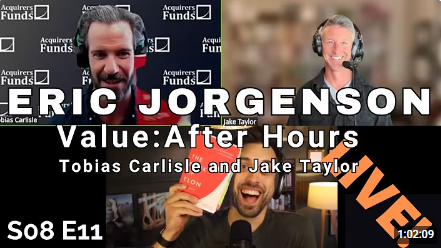
During their recent episode, Taylor, Carlisle, and Eric Jorgenson discussed The $40 Million Decision: How Elon Musk Saved Tesla and SpaceX at the Brink. Here’s an excerpt from the episode:
[Eric]He’s down to his last $40 million.
If you can imagine being so destitute and, uh, he’s, he describes it as feeling like he’s sitting there with like his, uh, holding a kid in each hand over a cliff. Like the mission of SpaceX is to make life multi-planetary and preserve consciousness. The mission of Tesla is to electrify the future, like resolve climate change and, and save lives through autonomous driving.
And he’s like, I cannot give up on either of these companies. And if I put all my money into either one or the other, they both have a much better odds of success. And he takes the path that is maximum risk for him personally, financially, and reputationally, but gives both missions, even a tiny chance to succeed.
And this is the kind of decision that you could only make if you are deeply principle driven. If you’re not coming into this saying, God, I really got to make sure I get my $40 million back. Or, you know, this is not how this man thinks.
He thinks like a hero in a sci-fi adventure movie. And he says like, I got one life left. Like I’m going full YOLO.
Here we go. So he splits the money, puts them into both the fourth launch at SpaceX works. And immediately after NASA calls and offers a billion dollar contract at SpaceX is saved and Tesla, he puts all his money in investors say they’ll match what he puts in.
So Christmas Eve, 6pm, he puts in his money investors come in. And that is the money that gets the initial roadsters out the door and like gets Tesla into actually producing the Model S that becomes like the you know, best rated product or car to date of all time. And really became like the inflexion point that is when he had sort of taken over as CEO of Tesla and things began to kind of turn around.
But that story to me characterises him as being like, it reveals it is a test that most of us will never have to take. And most of us would fail if we had to take it. But it is this like purity of intent.
And I read a great line in Jed McKenna that I think summarises the stories like he asked the universe for something in the way that the universe understands.
[Jake] So do you think I know that we’ve kind of been sometimes even on the show, we’ve been a little bit critical on different points over the years of Elon and kind of feeling like there’s a little bit of refusing to play by the rules that everyone else has kind of agreed to play by. So I’m, you know, maybe the most obvious one would be, you know, you could make the argument there was some securities fraud and, you know, funding secured timeframe. There’s been other things, but is that kind of part and parcel of that, you know, I’m on a bigger mission, like I can’t let your normal human rules stand in the way?Like, how does that manifest itself? And what do you think about that part of it?
[Eric] Yeah, I mean, so I would say this, this book is not about me. But if asked, I will answer questions about my personal views. Like, this is not an endorsement of every decision or action Elon Musk has ever made in his life.My attitude is sort of, I think he’s an incredibly interesting person. And like, let’s study the outliers and figure it out. Anybody who’s an outlier to that extent is going to have, you know, light and dark traits that make them who they are.
His, he is, to his advantage, I think, a showman. And he understands that people respond to like superlatives. And I think he’s deeply optimistic.
So I think there are, there are many, many, like, I don’t know, he gets accused of like over promising and under delivering. And I think like some of that is an interesting mix of like, optimism and earnestness. That is like, actually probably on net a good thing.
I think there are definitely like things that come from a dark place. And he’s had, he has had a very rough childhood. I think he, he is interesting in that he burns like both you dirty fuel and clean fuel.
You know, I think he’s running from like a dark childhood and has demons, but like makes the demons pull the plough. I also think he’s very, like, willing to incur speeding tickets, I guess I would say. Like, I think, I don’t think he has a tonne of respect for like stupid laws.
And I think some laws he’s sort of learning about as he goes. What an adventure. And to some extent, I think he probably believes that in some cases regarding stupid laws, the ends justify the means, as long as the ends are good.
And, you know, I’m probably the wrong person to debate like any of the super, super, super specific issues with. But I think it’s no surprise that the yeah, somebody who’s like primary trait is moving quickly on the like, sort of first principles basis to move as fast as humanly possible might disregard some of what he considers red tape along the way, or, or truly just like it not even occurred to him because he’s just trying to take the most direct path. And then it’s like, wait, wait, wait, I didn’t even know that was, I didn’t know that road was close.
Who closed it? Yeah.
[Jake] Yeah. [Eric] I was just doing the obvious next step that seemed fastest to me. Who knows? Who knew? [Jake] Yeah. Why do you guys care about that? [Eric] Yeah. And I don’t know. And to be clear, like, you know, I had no special access to him.I did not interview him. I did not follow him around. I have no, like, I didn’t interview people from his past.
Like, this is a book that I collected all his most useful ideas from public sources. So I, I spent a lot of time on his ideas, but I don’t want to claim any, like, especially unique insight into his sort of psyche or know how he thinks about or how he made those decisions or whether it was like a knowing, you know, shortcut or like, oh, fuck my bad. My bad, but it’ll be fine.
[Jake] But we’re going on. [Tobias] Yeah. Yeah. You’ve, you’ve raised this idea of first principles thinking, which is one of the things that Musk is known for.Can you tell us what that is and sort of apply that in a, in one of the scenarios that he’s used it in?
[Eric] Yeah. So the, the sort of most common example here that it’s used for is, is really the origin of the observation that SpaceX needed to exist. So Elon’s, this is another sort of goes to, to character and principle and his goal was SpaceX.It was not originally to start a company. It was originally to get NASA’s budget increased. So when he’s sitting there with $200 million, his original vision was, all right, I’m going to just spend a hundred million on this philanthropic mission to increase NASA’s budget.
He was going to go buy a rocket. He was going to put a tiny little greenhouse on it, send it to Mars. It would be the first life on Mars.
And we get like this, you know, front page, beautiful newspaper cover shot of a greenhouse, the first life on Mars. And that would spur this great adventure kind of like we had, you know, when Columbus discovered the new world and catalysed this whole you know, transatlantic shipping movement and all the economic boom that came with it. So what he discovers in this is that it’s actually quite expensive and difficult to buy a rocket and that the launch costs are very inefficient.
You can find out more about the VALUE: After Hours Podcast here – VALUE: After Hours Podcast. You can also listen to the podcast on your favorite podcast platforms here:

 Breaker

 Overcast


 RadioPublic


 Stitcher

 Closed-End Fund Investing: Buying Assets Below Net Asset Value
 Where Is the Deep Value in Small and Micro Caps This Week?
 AI Stock Market Bubble: Can the Technology Succeed While Stocks Crash?