
Why Ray Dalio Thinks Gold Still Matters for Investors
Sunday, March 8, 2026 · Johnny Hopkins
Market cycles rarely unfold in isolation. In his recent interview on the All-In Podcast, Ray Dalio argues that several structural forces are simultaneously shaping the investment environment. As he explains, “I studied these big cycles in history going back 500 years and there are five big forces that are intertwined to determine the answer.”
For investors, recognizing those forces can help frame decisions about asset allocation, risk management, and the durability of current market trends.
One of Dalio’s primary concerns centers on debt dynamics. He compares the flow of credit in an economy to a biological system, explaining that “the capital markets bring credit to different parts of the economy and if that credit is used to be productive and produces an income that pays for the debt service, it’s a healthy process.”
When borrowing finances productive growth, leverage supports expansion. But when debt grows faster than income, pressures begin to build beneath the surface.
That imbalance, he notes, can gradually crowd out spending and investment. Dalio describes the mechanism vividly: when debt obligations expand faster than income, it becomes “like plaque in the system growing up and it squeezes out spending.”
For equity investors, this matters because government finances, interest costs, and capital flows ultimately influence corporate earnings and market valuations.
These macro forces are also reshaping how investors think about money itself. Dalio emphasizes a concept that often surprises newer market participants: “money mechanistically, money is debt.”
In practice, most financial assets represent promises of future payment. When debt levels expand rapidly, confidence in those promises becomes a central variable in market behavior.
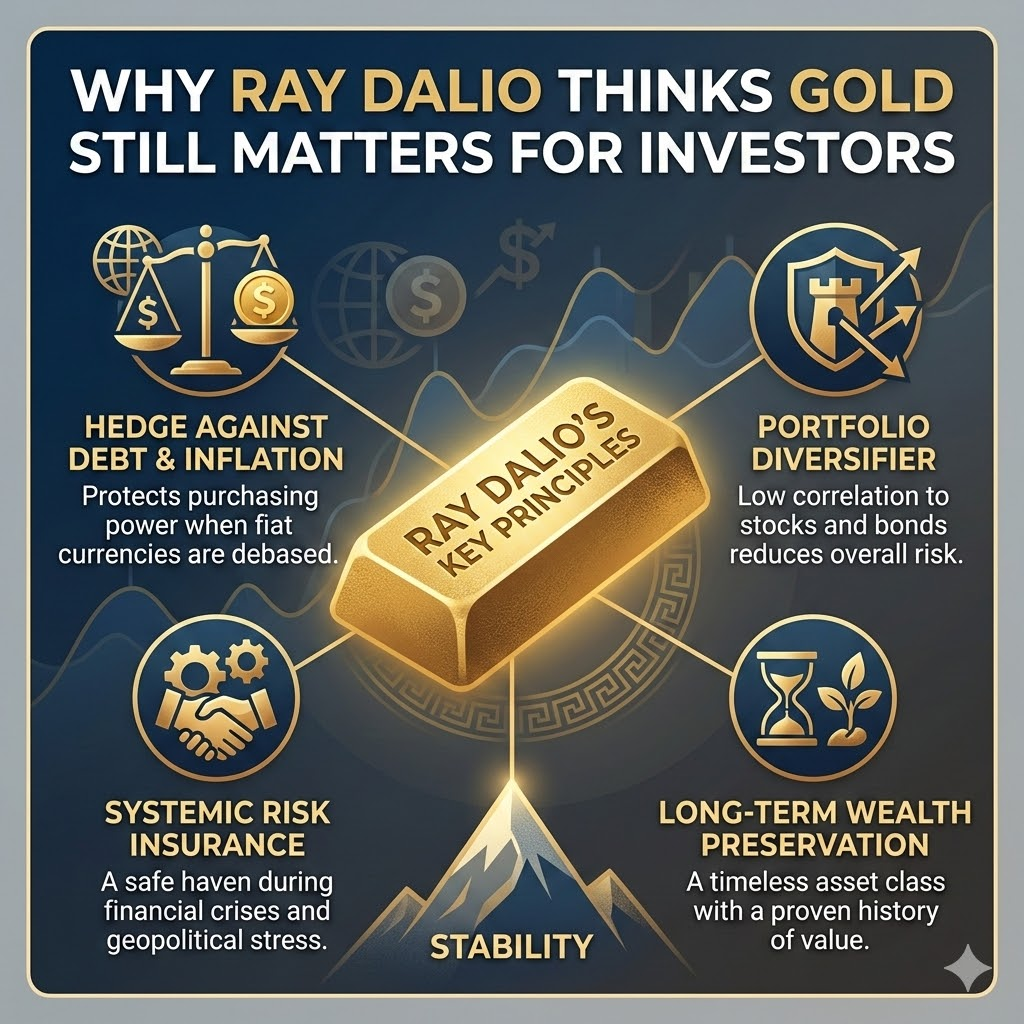
That dynamic partly explains the growing interest in assets perceived as independent of financial promises. Dalio notes that “gold is the only asset… they can’t print a lot of it.” While he does not advocate abandoning traditional investments, he argues that diversification into assets with different monetary characteristics can help stabilize portfolios during periods of uncertainty.
His portfolio framework reflects that thinking. Dalio suggests that even without a strong directional view, investors should consider holding some exposure to hard assets.
As he explains, “one should have between five and 15% of their portfolio in gold because of the fact of how it works with the other components.” The rationale is not speculation but diversification, particularly when financial systems become strained.
Technology also complicates the current cycle. Dalio cautions investors not to confuse the success of technological breakthroughs with the long-term success of individual companies. He explains that “a lot of companies won’t survive… but the technologies will go on and it’ll be great.”
This distinction is especially relevant for sectors like artificial intelligence, where valuations can reflect enormous expectations.
For investors navigating these conditions, the takeaway is not panic but perspective. Markets evolve within broader cycles of debt, policy, and technological change. Understanding those forces may not eliminate volatility, but it can help investors position portfolios with a clearer sense of the structural currents shaping returns.
Full interview here: