
VALUE: After Hours (S08 E10): Blue Owl (OWL) and OBDC: Hidden Value in Private Credit Stocks?
Monday, March 23, 2026 · Johnny Hopkins
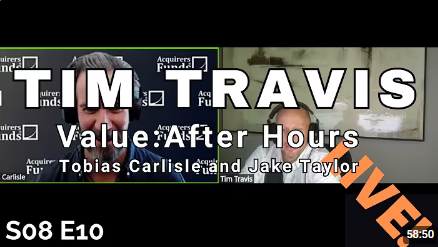
During their recent episode Tobias Carlisle and Tim Travis discussed Blue Owl (OWL) and OBDC: Hidden Value in Private Credit Stocks?. Here’s an excerpt from the episode:
[Tim] Yeah. Well, Blue Owl’s got a variety of different. So Blue Owl itself, OWL the ticker, they’re an asset management company.Okay. So they’re collecting fee income. The asset management company itself is not taking credit risk.
And what’s unique about their model is that they have a tremendous amount of permanent capital. So like 85% of their fees are from permanent capital. And so 300 billion is in locked up AUM.
So their fees are very durable. But people are worried about one segment of the funds that they manage, which is private credit, but they’re forgetting about they’re also financing the data centres. They’re financing a myriad of, they have asset-based lending.
So there’s all these things associated with them. But what’s interesting is to see an asset manager trade down so radically. I mean, I think when they went public, they had some, don’t quote me on the exact number.
I think it was something like 65 billion under management. Now it’s well over 300 billion. I think it’s like 360, 370 or something like that.
And the stock is actually cheaper than where it was when it went public. These companies like a Blackstone, they trade on distributable earnings and it’s trading at about 9.4 times distributable earnings. And it has a dividend yield of 10.3%. So really, really cheap. I think it’s a fantastic long-term investment opportunity. You don’t really get this type of quality. This is a much higher quality business than like a bank, right?
I mean, where you’re taking a lot of credit risk, it’s more heavily regulated, all of these things. The margins on Blue Owl are four to five times higher than most banks have. So it’s an interesting environment for sure.
[Tobias] So there’s some sort of bank run then going on in Blue Owl’s private credit fund. [Tim] In the private credit fund. Yes. So what happened was on these private funds, where it’s not permanent capital, they might have something written in the prospectus where it’s like, okay, in 10 years, we’re either going to liquidate the fund or we’re going to merge it.And so their initial plan was they were going to merge it with their publicly traded BDC, which is ticker symbol OBDC. And at the time when they came up with this idea, OBDC was trading around book value. So it’s like, okay, not a big deal.
When these private funds redeem, it’s at net asset value historically. And so it’s like, okay, we’ll merge it with that. We’re going to cut some costs associated with it.
It’ll be a good thing. Similar portfolios, just different size, that sort of thing. But then what happened was with the bankruptcies that occurred last year in the bank syndicated, which is different, the valuation sold off on OBDC.
And it’s like, okay, now I’m going to take a 20% haircut if we do this merger, that’s not going to work. So Blue Owl was working on solutions. Some of these people wanted money more quickly than others.
And so basically what they did was they sold 1.4 billion of loans from the private BDC and then also the publicly traded BDCs because they have similar portfolios. And they sold it for 99.7% of par, which is phenomenal, phenomenal result. And so they basically said, okay, we’re going to accelerate.
We’re going to give you back 30% of your money now. So you’re going to get that check, but then we’re going to stop the normal gating process and we’re going to unwind this portfolio over time and pay you out over the next months and year, year or so. And the media just kind of picked up on, oh, well, look, they’re restricting redemptions now.
They’ve always restricted redemptions because there’s a liquidity mismatch. You’re getting a higher yield because this money is not as liquid. And so it’s just really kind of taken on a life of its own.
And then there’s other elements to it, Toby. This is private debt. So like these software loans, for instance, that everyone’s so worried about, they’re written at 30% loan to value.
So guess what? There’s 70% cushion before we’re losing any money on these loans. But what about private equity?
I mean, what about the stock market? So if all of these were to come into trouble, there’s obviously way bigger issues at hand. And I think when you think about it, these are very sophisticated people.
Like if Blackstone has a private equity company that runs into trouble, let’s say a software company that runs into trouble, what they’re probably going to do is maybe inject some equity into it, maybe negotiate with the lenders, including the BDCs for maybe a lower interest rate or something like that. But these aren’t loans that are going to zero. They’re first thing loans where they would take the keys over for the business.
So it’s just, I think that the hysteria does not match up with the reality whatsoever. I think it’s a huge difference.
You can find out more about the VALUE: After Hours Podcast here – VALUE: After Hours Podcast. You can also listen to the podcast on your favorite podcast platforms here:

 Breaker

 Overcast


 RadioPublic


 Stitcher

 Closed-End Fund Investing: Buying Assets Below Net Asset Value
 Where Is the Deep Value in Small and Micro Caps This Week?
 AI Stock Market Bubble: Can the Technology Succeed While Stocks Crash?