
VALUE: After Hours (S08 E09): Alexander Roepers on constructive activism and concentrated value in $KEX, $AXTA, and $FLS
Sunday, March 15, 2026 · Johnny Hopkins
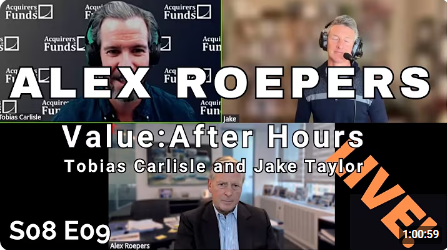
During their recent episode, Taylor, Carlisle, and Alexander Roepers discussed:
- Alexander Roepers’ Value Investing Strategy
- Why Alexander Roepers Avoids Tech, Biotech, and Financial Stocks
- Why Europe and Japan Offer Hidden Value Investing Opportunities
- Three Catalysts That Unlock Value in Mid-Cap Stocks
- The $2B–$20B Sweet Spot: How Atlantic Targets Mid-Size Companies
- Constructive Activism: The “Gentleman Activist” Approach Explained
- Dynamic Position Sizing: How Roepers Trades Around Core Holdings
- Case Study: Why Kirby Corporation Became Atlantic’s Largest Holding
- Compounding: From Berkshire Hathaway to the Limits of Exponential Growth
You can find out more about the VALUE: After Hours Podcast here – VALUE: After Hours Podcast. You can also listen to the podcast on your favorite podcast platforms here:

 Breaker

 Overcast


 RadioPublic


 Stitcher

TRANSCRIPT
[Tobias] And we’re live. This is Value After Hours. I’m Tobias Carlisle, joined as always by my co-host, Jake Taylor.Our special guest today is Alexander Roepers, the founder and chief investment officer of Atlantic. Alex, welcome. How are you?
[Alex] I’m good. Thank you for having me. [Tobias] Our absolute pleasure.I’ve been following you. I said this before we went on live. I’ve been following you since 2010, when I saw you speak at a value investing Congress in New York.
Tell us a little bit about the strategy that you have at Atlantic.
Alexander Roepers’ Value Investing Strategy
[Alex] Yeah, my pleasure. So I started Atlantic over 30 years ago, initially just in the US. And the idea was to concentrate capital and research on high conviction public equities.And if you concentrate capital, you have to be careful and you need to go into areas that are in the area of competence and that have good margin of safety. So we started with a universe definition that excludes areas that we are uncomfortable with or that present idiosyncratic risks, such as technological obsolescence risk. That’s a mouthful, I realise, but it has to do with the fact that certain companies do high tech stuff that is subject to, either their own fantastic developments in high tech, making certain projects or products obsolete, or somebody else doing that for them.
Why Alexander Roepers Avoids Tech, Biotech, and Financial Stocks
So for us, it’s very important that a service or product is really not subject to that risk to a large extent. And so we steer clear of high tech and biotech companies for that reason. There’s a lot of money that you can make in those areas.
And we know people that can do that, or you can, as a retail investor, you can buy ETFs or the individual stocks, but Atlantic will not do that. So that’s one aspect. The second one is areas that lack transparency.
So banks, insurance companies, brokerage firms, again, can be many great companies, but we think there’s a lack of transparency that makes us uncomfortable to be highly concentrated in any of those names.
The $2B–$20B Sweet Spot: How Atlantic Targets Mid-Size Companies
So we basically have decided to be in this midsize, at least 2 billion and up. Again, we’re in the public market, putting up with market to market.
So the last thing we want is to be illiquid. So 2 billion is for us a fairly arbitrary, but commonsensical point below which we really don’t look in terms of our targets. And then above 20 billion, it’s not really interesting because we wanna have top level management access, reasonable liquidity, of course, you would get that in very large gaps as well, but also the potential for all three catalysts for unlocking value to be present.
Three Catalysts That Unlock Value in Mid-Cap Stocks
The first one is corporate action. I’ll elaborate that a little bit more later. That’s everything management can do to improve the value of a company.
Then there’s activism, which is more likely to be successful in midsize companies than in very large companies. And then thirdly, takeover. And takeover, we’d like to have both strategic and financial buyers potentially looking at a company when it becomes very attractive or when it goes into play.
And if you look at financial buyers, private equity firms, for instance, they typically would like an eight or $10 billion deal at the high end, not too much larger, hard to finance, typical big private equity fund is 20, 25 billion, $2 billion equity check is big, plus leverage, you get to six, seven, $8 billion. So we’ve had since inception, which is a long time ago now, companies in that sweet spot where if they don’t perform well and they’re undervalued, they’re gonna attract attention by either strategic and or financial buyers. So that’s the reason we’ve chosen all the way back to the $20 billion, exclude high tech and biotech, exclude financial service and insurance companies for the transparency issue.
And then focus on industrial products, services, companies, and then being Dutch, they’re pretty known to be stingy. We like to, there’s a joke as to how many Dutch people you can get into a Volkswagen. All you need to do is flick a dime in there, they’ll get in there.
I’m all over something that is very inexpensive and yet solid. So we want always money-making companies with solid balance sheets in our little universe of two to $20 billion industrial products and services companies that are down. We’re basically lying in wait.
I have all these analogies, like the sniper lying in wait, I’m not a hunter, I’m not a sniper. But you just imagine, you know what your target looks like, you wait, you wait, you wait. And then when you see it, you strike.
And we know our targets. And the targets are about 500 companies publicly traded in the US. After about 12, 13 years of doing that, well enough, we got to a level of self-imposed capacity limit in 2003, by which we basically say, okay, we wanna be about 10 companies in our portfolio.
And we want it to be an average five to $8 billion. And we don’t wanna be more than four or 5% of these companies. So then you’re at about a billion and a half, you’re maxed out in your capacity.
So with that, we were strict, we hard and soft closed our funds, which is basically the US fund, and then set up our capability to do the same in Japan and in Europe. And in Japan, there’s about 250 companies that fit our bill in terms of size and industry focus. And you have Europe, about 300 companies, Western Europe, where, you know, have a little bit of an advantage, have grown up in Holland, speaking four languages.
And so we went over and became very active in Europe starting 2004 as well. So that’s in a nutshell what we do. We have three funds that are regional, and then one global fund that captures the top names in these three regional funds.
And we keep doing the same thing. And we’re doing that now for like almost 35 years. And when you saw me in 2010, I was probably proclaiming the same strategy that I tried to do in a nutshell here.
And, you know, we don’t try to stray from that. I mean, markets go through, you know, momentum plays, growth cycles, value cycles. We just had the most amazing growth and momentum cycle that started after the great financial crisis in 2009.
We had a good run too, but by 2015, it became almost all growth and momentum, and then Magnificent Seven, and you know where that led. And then eventually with COVID, it became even more pronounced. There was a detour in 2022, but then AI, the narrative there picked up, and it was unstoppable until about three or four months ago when people started to scratch their heads on the actual, you know, who’s the beneficiary?
Who’s the one hurt by AI? And in some cases, they’re the same company. People don’t know yet.
That’s very unclear. What we do know is there’s a lot of spending going on and a lot of overvalued companies, and people are starting to really worry and do a little second guessing on that. All that is somewhat helpful for people like us who are in the forgotten corner of the market where there’s real companies with real profits, with real benefits from AI.
All our companies are not to get railroaded because they’re not tech companies. They are benefiting from this productivity tool that is AI. So we’ve seen very good returns, relative returns as well in the last four months.
And I think it’s the beginning of what may be hopefully a long cycle for improved performance, relative performance as well for value.
[Tobias] Alex, I’m glad you narrated that period from 2015 to date because that was going to be my next question. But I was just wondering, from 20, sometime after the pandemic, there was some stimulus around 22. And I’ve observed that mid cap and small cap have been pretty weak on an earnings basis since 22.I’m not sure where that picks up. It looks to me like we’re still, we’re close to the bottom, close to troughing. But do you think that that pickup over the last three to four months is that the equity getting in front of the earnings releases that are coming or how do you view that?
[Alex] It’s a good point. I think there’s a little bit of that going on because a lot of value names, including some of our portfolio, are struggling with earnings still because their end markets have been, people worry about a recession for the overall economy. I’m sorry, automotive, construction, chemicals, packaging are all in a recession full blown for four years.It’s unbelievable. And these companies are blocking and tackling to right size their footprints, to get the overhead down, to maybe buy back shares, bring the debt down in order to get earnings per share growth. And some of them have done a very commendable job and some are trading now at trough multiples on what we can still consider to be trough industry conditions now.
What will the chemical and the automotive market need for a pickup or the housing market? I’d say lower rates are helpful, less uncertainty in the world. Of course, a whole bunch was just created with the Iran conflict, but that comes and goes.
We had the Ukraine. We’re a little bit looking at this from the 40,000 foot view and not get, as a yachtsman, I don’t really get concerned about any wave, in particular, crushing over the bow of the boat. I’m particularly looking at the horizon so to avoid being seasick and also keep your bearing.
And so I think the geopolitical noise comes and goes. I think it’s important for M&A to pick up. M&A picks up when board of directors and private equity principals are more comfortable and they get more comfortable when they see a certainty in the interest rate environment.
I think we have some of that. We see more certainty in the domestic economic policy environments. Got the big, beautiful bill.
We got Trump there. We know what that means. And then you need a little bit more certainty in the geopolitical environment.
And of course, that is right now, tumultuous. The tariff environment was also tumultuous, a little less issue now. So I think with the midterms coming up and the incentive for the current government to get a little bit more calm waters, I think we’re gonna see some faster than expected resolutions to the turmoil in geopolitics, as well as in tariffs coming up.
And then you have the stability in economic and Fed policy to some larger degree. And that, again, is gonna give impetus to more M&A. And as M&A happens, it shows private market values, which are quite often mark to mark, they’re quite high into the public equity market, often quite low because of all these uncertainties.
So M&A is clearly positive, certainly for small mid-cap and value stocks. And we’ve seen that also being an underpinning for what we’re doing. But overall, earnings need to improve.
We’re obviously picking through that field for very individual cases. I’d like to think that we have quite a few that have very strong earnings growth stories already, and some that are sitting there with a lot of promise at a low multiple, and that could give a lot of upside if things improve.
[Jake] Alex, I know one common lament that we’ve heard from a lot of value managers over the last decade at various points was that in order to kind of get the same prices that they, and valuations that they felt comfortable paying, they had to sometimes sacrifice a little bit on business quality and maybe cyclicality of the business. And how have you thought about that trade-off over the last decade? [Alex] Yeah, no, I mean, this is a, that comes with the territory. I mean, if you’re a real value investor and you’re sticking to your guns on like, I don’t wanna pay more than five or six times EBITDA or no more than 10 forward PE on a stock, in a certain market, you’re getting driven into certain areas. You gotta be very careful, not to own old tyre and automotive parts companies and you have this concentration.So we make sure that we have an eclectic bunch of companies as concentrated as we are with multiple drivers and never have any industry be more than 20 or 22% of the total capital. And that would then be a number of companies in that 20 or 22% with very different drivers. But yes, you could say they’re in the same bucket, you could say chemical companies or automotive.
Yeah, so you get driven in a corner. There is a chance, of course, that you step into what’s called a value trap and there we need to make sure that as a constructively engaged shareholder, we work with management to see how can we enhance and accelerate shareholder value and be in a quote unquote pole position as a really concentrated active researcher and serious investor, that we can see these opportunities and not stay around too long in something that’s not gonna go anywhere. And so that’s our job, right? I mean, it’s deadwood in the portfolio or something that can eventually fall down further is not what you want.
[Tobias] What do you make of private equity spending over the last five years? So there’s, they tended to trade between themselves, create continuation vehicles, which means that they’re probably not as active in the public markets as they have been in the past. Does that impact your strategy and do you see any way of them sort of working their way through that?Because it seems to me that the private marks are much higher than what the public markets are giving them, which sort of means that public market exit is an issue. Maybe public market acquisition is attractive, but I don’t see a lot of activity.
[Jake] One of the LPs in the funds as well, that if there’s no DPI behind it, that next fund needs to get funded from somewhere. And one argument we’ve heard is that that might actually come out of the public market liquidity in order to meet capital calls for the private. [Alex] Well, let me first state, I have a lot of friends who are principals in private equity firms. Some of them are clients and I don’t want to say nice things for all of them, but let it be stated that I came out of an environment before I started Atlantic where I was a corporate development guy in a conglomerate, an industrial conglomerate involved in buying and selling companies. And that job was not that different other than you get paid a lot less than being in a private equity firm where you’re buying and selling companies.And I learned to dislike two things which made me start Atlantic, which is I hate to pay premium for something when I buy something. And then I don’t like the liquidity of owning something outright. I wanna be able, when I see dark clouds gathering, I wanna be able to get out of a stock.
You can’t do that with a stock. You can’t do that with a company you own. And then I don’t like leverage.
So here you go. So I don’t like paying premiums. I don’t like liquidity and I don’t like leverage.
So I just said, well, how do I solve that problem? So I’ll take my little private equity toolbox in the public markets and I’ll do the same thing in the public market. So we have put together almost a 35 year record with no leverage, full transparency, quarterly liquidity to our clients, paying on the low multiples because we’re buying when things are out of favour with no premium.
And we put together a gross record that is, I’m not supposed to talk about these numbers online so I won’t say, but many multiples of the index and the net return as well. So I think that, and that’s without IPOs, without high tech, without leverage, with transparency liquidity for our clients. So we’ve proven that with concentrated disciplines, stock picking with constructive activism, liquid activism, we can talk about that later because that’s an important thing where you can add additional alpha by dynamic sizing your positions and getting out at will.
And with that, we’ve been able to put up this record. Now, not every year, every period we’ve outperformed, obviously, because we are so focused on our universe and we’re not participating, for instance, in the whole growth, momentum and tech things that are going on. But that was the same way before we met in 2010, in 1999, I was getting questions from my Den LPs, some of them are still with me, like, why don’t you invest in tech?
Why don’t you do this? Why don’t you do that? And I’m like, you know, uncomfortable, not doing it, not our strategy would be style drift.
We’re sticking with these mid-size industrial products and services companies at low multiples. And everybody’s like, you know, yawn, yawn, we’re doing so well in the tech area and having this big party. Well, then it all turned, as we know, in March of 2000.
And we went from, I think, minus 10 that year to two months to plus 50. And the market went from plus 20 to minus 40 and the rest is history. That gap was so enormous in terms of our performance that continued in 2001 and 2002.
And that’s where we went from, you know, a couple of million on a management to much bigger and had to close it for being, you know, disciplined on our strategy, self-imposed closing it for new investors, I should say, not closing the firm. Then opening up the European and Japanese activities.
[Tobias] Alex, you’ve been described as a gentleman activist or the gentleman activist, and you’ve got this approach, this sort of constructive activism. Sometimes it’s called constructivism. That means no public proxy battles, no sort of 13-D letters, that sort of stuff.How do you implement the strategy behind the scenes? And does not having those sort of other tools, does that define that? Does that limit you?
Constructive Activism: The ‘Gentleman Activist’ Approach Explained
[Alex] And back to my original point of like, what got me to set up Atlantic, you know, looking from the private equity industrial buyer and seller of company perspective, don’t like illiquidity, don’t like paying premiums, don’t like leverage. And so now you’re in the public market, you’re putting up with market to market with a concentrated portfolio, mid-caps. So you’re gonna have higher volatility, you know, and that makes it, you know, perhaps less appealing to some investors or consultants that look at your returns.The higher volatility, as Warren Buffett will say, it doesn’t matter at all. It really matters what you own in terms of a business. But the point back to activism is on the staying liquid.
You know, what’s the point of going into public market and putting up with market to market, which is that volatility and maybe the stomach churns you and your investors may get. But for that, you get the gift of being able to buy a whole range of companies at any given time without a premium at the point you want, right? So I don’t wanna get illiquid.
So my activism was designed not to be illiquid at any given time. So there is liquid and illiquid activism. People like to put a spectrum hard to soft activism.
Useless, activism is a tool, just like universe definition, exposure management, due diligence, buy-sell discipline. These are all tools to get to, what do you wanna get to? Compounding net at a high level to your clients over time and outperforming the market.
So the activism should be yet another tool. It should not be a detriment. So it’s a means to an end, not the end itself.
For the aggressive overt activist, sometimes the publicity and the instant gratification that comes with shooting off your mouth and doing a proxy battle and trying to replace the whole board. First of all, we love all these guys, mind you, because they really make our life easier. They’re like the bad cops and we’re the good cops.
So we’re always staying liquid because I look at return generation as three components. One is Warren Buffett’s statement, time in the market. You wanna do a return for your equity, 100% invested.
Don’t have 20% in cash. I mean, this is for a money manager, right? The client can do that, an investor can be in cash and bonds and real estate.
Once you come to like us or to another manager, I’m not gonna run cash, I’m gonna be 100% invested. You know, it’s like sailing with your sail flopping, trim the darn thing in, okay? You’re sailing for performance.
It’s like being on a bicycle to Tour de France and you’re hanging back for a while, you know, taking it easy. No, it’s full on. So time in the market.
Second, then it’s stocking.
[Jake] Can I ask, what about if you’re, you know, you see a storm coming, don’t you wanna reef your sails a little bit? [Alex] No. Okay. No, I go in as full on in this point because, you know, basically we’re incompetent.The storm that’s coming quite often is getting reflected very quickly in your public equity portfolio. And to then pull back, like for instance, recently we just had that with the first week of March. You know, you can see this whole year on war.
You don’t know what’s gonna happen the next day or the day after. So no, we don’t pull back. Clients can redeem, clients can pull back.
We are maybe shifting between companies a little bit, but not really pulling back and going into cash. That’s not our style. So back to the need for liquidity.
The third piece besides sort of time in the markets, stock picking, and then there’s exposure management and dynamic sizing. Stocks fluctuate. And so we look at the 10 companies we have, particularly the top five, which may be 70% of the portfolio, as let’s say five Formula One cars on the track.
You don’t go full speeds with each car all the time because there are straightaways, there are curves, there’s traffic, there’s wet spots, whatever. You wanna just slow down. Same with the stock.
Dynamic Position Sizing: How Roepers Trades Around Core Holdings
If you buy a stock that went from 50 to 30, you love it at 30. You start buying from 35 to 25, averaging 30, you have a $50 target, 12 to 18 months. Now it goes to 38 in a matter of three months.
And by the way, for private equity, it would be almost a 30% return in three months. That’s 120% IRR, okay? Just to take a little knock at our friends at private equity.
But anyway, so you have that. I will take money off the table. First, I say it’s 15% of capital.
I will trim it to keep it at 15%. I don’t let it grow to 22. So keep selling.
So we’re selling stock for that $30 stock up to 38. We will be selling it every day. But then at some point we say, you know, the risk reward is not as good at 38 as it was at 30, obviously.
So we’re gonna bring it down from 15 to 10%. And then at 42, we bring it down to 5%. And at 45, we’re out, even though we have $50 target.
Why? Because that was the 12 to 18 month target. And we’re getting that.
So then, guess what? Stock comes down from 38 back to 32. Hammer down again.
Accelerate out of the curve. So we are very actively, dynamically sizing the positions of our core holdings while we own them for one or two years. And so the activism needs to allow that.
And if you look at, you know, public, you know, professionally managed equity, there’s only about 0.5% of all of that is in portfolios with less than 30 names. Let that sink in, because 99.5% of all professionally managed money, that’s ETFs, that is Fidelity, that’s T. Rowe Price, BlackRock, is in portfolios that are hundreds of companies or 100 companies.
The S&P 500 is 500 companies. The Nasdaq 100 is 100 companies. So to be in 10 or 15 stocks, you’re in a very small group.
You know, you got the Nelson Peltz, the Bill Ackmans, the Chris Hans, people like that, that are very concentrated. Most of those would have a benefit of dynamic sizing, but they typically throw it away. Either they’re too large and they become too illiquid to really make that a difference, or they’re too overtly activist on the board, doing a proxy battle, going on TV that doesn’t allow them to trade, basically.
Maybe they do it, but then they could be accused of pumping and dumping and who knows what. So we’ve always said, let’s stay a little bit below the radar. Typically don’t have 13 Ds, although we’ve had 13 Ds in the past.
We don’t shy away from that, but no board seats, no illiquid activism in order to capture the alpha that is available in dynamic sizing, the position. Long answer, but hopefully that explains it. The general activist moniker I got was, you know, a surprise because I was doing an interview for, it was Alpha Magazine at the time, before the O8, it was in O8 it came out, I think.
And it’s always a good sign, by the way, if you’re on the cover of the leading hedge fund magazine, you probably should sell everything and go take a rest. But that was, I think it featured in July of O8, Alpha Magazine, I was on the cover. I didn’t even know that would be the case.
And it said gentleman activist on it. And it was the late Professor Hart Russell, Jay Scholl, who was a famous writer for Barron’s. She did the article and came up with that.
So it could have been worse. I mean, when it came out, I’m like, okay, you know, we’ll take that. Been called worse.
Yeah, exactly.
[Tobias] Alex, could you take us through one or two names in your portfolio or names that you have held in the past, just so we can understand the application of the strategy to an individual name?Why Kirby Corporation Became Atlantic’s Largest Holding
[Alex] Well, today we have in the US, our largest holding is a company called Kirby Corporation. Nobody knows Kirby, I think, less to people that are immediately involved with Kirby. Symbol KEX, $128 stock right now.Kirby is the largest owner and operator of barges in the United States. There’s about 4,000 barges floating around the Mississippi and coastal areas, transferring bulk goods, mostly oil, chemicals, things like that. The rates of, and I’ve known this company since the mid 80s, by the way.
When the company I worked for before I started Atlantic, owned 5% as a minority holding in Kirby. So I already studied it back in 85, date myself a little bit. I’ve not held it at any time for Atlantic until just about four months ago, when it fell down in my lap.
I’ve known it for a long time. It was always zooming around the universe, cut into our top 30, which is our bench for interesting names and names to study closely in the US. We have the same in Europe and Japan, by the way.
We always have this bench of 30 companies that we’re very actively working on. And then we decided to pull the trigger and get into it. And so Kirby has two stories to it.
One is the barge business, which, as I mentioned, they have about 1,200 out of 4,000 barges. The day rates right now, because of a recession in chemicals and things are not that good in the end markets, the day rates are about 40% below where it makes economic sense to build another barge. So guess what?
There’s not a lot of barge building going on, okay? Little fact that just happened is that Venezuela is getting all this oil to our refineries in Houston. Net, net, that’s gonna mean a pickup in barge usage there to get transfers of oil tankers to the refineries.
Nice little pickup there. Chemicals are looking a little bit better. Either way, it doesn’t matter.
They’re about 94% utilised. They’re making very good money at the current rates. But I’m sensing there is something good going on in terms of a new barge takes two years to build anyway.
There’s not a lot of new barge building going on and there is some pickup in the areas that matter to them. Then over time, they found that not only barges, but they have tugboats and what have you. They know a few things about engines and they started taking their engine expertise outside and that became a division called Distribution and Services, which is mostly engine repair for other people as well as their own.
And then they got involved years ago in the fracking and the power pressure pumping area. Again, engines repair service. Now something new happened, data centres.
They are distributing units or putting together units with industrial gas turbines and generators in 40 foot container like structures that are then delivered to VoltoGrid, a company that will go public soon and will shine a bigger light in this whole thing. And they are basically like a United Rental kind of company for standby power for the oracles and for these data centres. So it’s a very quick solution for power.
Of course, you need to do much bigger things long-term like nuclear power plants, et cetera, to get the power that you need for the electricity grid. But the standby power units are very needed and VoltoGrid is going public on that subject. So Kirby is a very subdued play on that area.
Not so subdued, the power generation piece that is now 40% of distribution services just grew 47% in revenues in the last quarter. So people are starting to figure out that this distribution service business can have some very spectacular growth numbers in the years to come. That’s Kirby.
[Tobias] And so the thesis is just a general uptick in the performance of the underlying business rather than any sort of catalytic event from you don’t expect any production. [Alex] One can imagine a number of things. It is a potential takeover candidate. They could split the business.They could separate it. I mean, that is still in the offing, but for now, both areas are looking very solid and it’s still quite underdiscovered at this point.
[Tobias] Do you track any macro factors? Do you watch the oil prices as it’s exploded over the weekend with Iran? See that as a knock-on impact?That seems to have impacted the industries that you listed before, chemicals, automotive, and so on. They seem to be at the tail end of that oil price sparking like that.
[Alex] Of course, we track all the commodities and what’s going on there, the mining sector, copper. There’s so much need with the electricity growth in mining. So we’ve played in the mining equipment area quite a bit.We’re in the oil service area and a few companies here and there. In particular, Weatherford, WFRD, is the smaller one of the four big ones. You have Schlumberger, Halliburton, and Baker Hughes.
Weatherford went through a very tough period. They had to restructure their debts and came out of near bankruptcy. We waited until their balance sheet got in good order and picked it up.
And we’ve been involved with Weatherford for a while now. That, I think, eventually is a company that’s likely to get bought by Halliburton or somebody else, most likely Halliburton. But even if it doesn’t, it’s very well managed.
They’re doing share buybacks. They are very active. 80% of their business is outside the US, a lot of it in the Middle East.
And of course, with this hiccup, there’s been some issues there, but still, you’ll see it the last year, the stock is up 80% and it’s still trading at about a five times EBITDA, so.
[Tobias] Let me just go around the horn a little bit and then we’ll come back with Jake’s Veggies. Paris, St. Germain, Gothenburg, Sweden, Valparaiso. What’s up?Limerick City, Ireland, Orlando, Florida, Snohomish, Cleveland, Tumble, Texas, Toronto. Jupiter, Tallahassee, Sacramento. JT, someone nearby.
Vegetables with Jake. It’s one past the hour, folks, mark it.
Compounding: From Berkshire Hathaway to the Limits of Exponential Growth
[Jake] So with Alex coming on the show and knowing he has a very long-term record of terrific compounding, we’re going to have a little segment today that gets at compounding a little bit more. And so there’s something that’s kind of deeply reassuring about growth. We grow crops, we grow cities, we grow companies, we grow investment accounts, and growth feels like health, like it feels like we’re moving in the right direction.But compound growth also has a geometry all of its own. And in any bounded physical system, a constant percentage rate eventually becomes a very large claim on reality. And you could see that in a very flattering financial case in Berkshire Hathaway.
So just to rewind the clock, 1965, Buffett takes over the reins. Berkshire’s reported about 49 million in sales at that point. And 2 million of earnings.
And it did not necessarily look like this embryo of a financial colossus. I mean, it was a small textile business with small business numbers, really. And later in the segment, we’ll cover what that compounding turned into from the latest annual report that came out recently.
But first, here’s a little quiz. Imagine a civilisation that lasts for 3,000 years. And that’s about how long the span of ancient Egypt was.
I think it’s actually a little bit underrated when we talk about historical longevity of civilisations. In the US, we’re at like 250 years. We got a ways to go before we get to 3,000.
But at the beginning, this very early civilisation, let’s just imagine, and there’s one cubic metre of material stock in this civilisation. So tools, grains, structures, infrastructure, whatever, one cubic metre of organised matter. And now let’s let that stock of atoms compound at a 4.5% per year growth rate. All right, by the end, are you looking at A, something that’s city, like the size of a city? B, something the size of an entire planet? C, something just bigger than our entire solar system?
Or D, something bigger than billions of solar systems?
[Tobias] So that’s three or 4% compounded for 3,000 years going from a square metre, was it? Correct. [Jake] That’s right. [Tobias] Alex, you wanna take a shot at that one? [Alex] Oh, that’s not fair. That’s not fair. I’m all with you, Jake, on the value of compounding.And I like the Berkshire Hathaway example a lot better, but going back 3,000 years. Gotta be the biggest number. I have a feeling it’s whatever the largest number is that you have.
Yeah, that’s what I think too.
[Jake] You gentlemen are intelligent because that is the correct answer. One cubic metre compounded at 4.5% for 3,000 years becomes a number with 10 to the 57th power of cubic metres, which is bigger than billions of solar systems. So even a 1% for 3,000 gives you a multiplier of 9.2 trillion. So there’s an absurdity that happens in all of these exponentials. And the trick is that they’re really, they’re so backloaded. And the human mind did not evolve for any intuition around how this works.So for a very long stretch, this curve always looks quite civilised. And that shape has this strange parallel in theoretical physics called vacuum decay. And this vacuum doesn’t mean empty space necessarily.
It means the energy state of the fields that fill that space. And so the question of does our universe today, and this is all theoretical physics, don’t ask me to explain very deeply, but does it sit at the truest low energy state as hypothesised? Or in a temporary state that only looks like the fully stable version, which physicists would call like metastable.
So there’s like a simple analogy to imagine this. Imagine a ball that’s resting in a valley and it sits in the deepest part of the valley and it’s truly stable. But if it sits in a shallower valley, it can stay there for a really long time, like unimaginably long, even if there’s a deeper valley that exists somewhere else in the landscape.
And usually it can mean that like, this is, we’re talking about like timescales that stretch on into longer than the universe has been around so far. But if there was to be a transition to a lower energy state that ever occurred, it would begin locally there and then spread outward as a bubble and change that vacuum state of regions all around it. And this thought experiment is really just to show like the value in the analogy is the structure and kind of relating to exponentials.
Long apparent calmness forever, and then this kind of hidden instability in it really, and then this discontinuity feeling where it really ramps up. So Berkshire is kind of the benevolent version of this exponential force. So by 2025, remember those early numbers I gave you, which sounded like a small business, reported over $370 billion of revenue, 67 billion of net earnings, and really something like 45 billion of operating earnings, let’s call it.
That’s like 7,500 times revenue and 29,000 times earnings. So, and of course that equated into a 19.7% annualised return since then. So fair play to the old guy there running it.
But what it shows is that a small base can compound so long that the end state, it barely resembles anything about the beginning. And it also shows this other side, which is that scale changes the character of compounding. Warren has said for years that Berkshire is gonna eventually get too big where we’re never gonna be able to keep up the pace of compounding.
And of course, Greg, in the latest letter said the same thing, like at Berkshire scale, the math of compounding works against us. So once this base becomes enormous, maintaining that old percentage becomes almost impossible. And there’s kind of this broader tension in finance that might be a little bit underappreciated.
Financial claims can compound on paper for a very long time. Stocks, bonds, budgets, pension funds, asset prices, all lean on these growth assumptions. But underneath those claims sits a physical system, energy, materials, land, labour, time, ecological carrying capacity.
And there’s a real question, if like, does the paper always match up to be able to be filled? Like you’re writing a check on the future, can you cash that check in reality later? So it’s not that, is growth good or bad?
Growth can be fantastic. The real question is like growth of what, at what rate, how long, against what constraints? And Berkshire shows how quietly compounding can begin.
And then physics kind of gave us a little bit of a language about this sort of delayed instability of it. But you put them together and you get to this deeper point, which is the first half of compounding feels harmless, feels like you can’t even see it. And then the second half is where this base gets really heavy and all the results are.
And so hopefully maybe that builds a little bit more intuition for you.
[Tobias] Good stuff, JT. Alex, we’ve had a request from the crowd and it was my next question anyway. Could you tell us a little bit about the ExxonMobil-Exalta merger and what you see happening there? [Alex] Yeah. Okay. May I quickly respond to Jake’s? [Jake] Yeah, please. I would love to hear it. [Alex] Very interesting 10 minutes. Thank you for that, Jake. And very, I think, instructive of anybody on the call.My entire professional goal is to compound at a very attractive, let’s not call it superior, but very attractive, absolute and relative return against the market. And in order to not have scale work against me, we control the size of our AUM, which is not that typical. There’s some managers that do that and they return money to investors or they close it.
And we’ve always been aware of the fact that scale is an enemy of compounding. Of course, Berkshire Hathaway is a corporation. They grew as they did.
And it’s been harder and harder for Berkshire Hathaway to look much different than the market over time. But in our case, I’m only 33, 35 years into my record. I think Mr. Buffett decided to retire at 94. I got close to 30 years more to go. Wouldn’t mind to have a 63-year record, which first of all, sets you apart from a lot of people. I’d say already 33 years does.
Most people don’t wanna do it that long or can’t do it that long or whatever. I’m on this mission to really compound at a very attractive rate with the same strategy, controlling my scale in order to do that. And so all these points well noted about compounding, the importance of compounding, sticking to something over time and in controlling scale.
Back to the question from the participant on the call, AXA Nobel and Exalta. So we liked Exalta a lot. We invested in Exalta for the third time in 10 years recently in October or something like that, $28.
And we thought that it was both at a trough multiple and trough conditions in the refinishing. They do automotive coatings, refinishing coatings. We liked the management of Exalta.
And lo and behold, here comes AXA Nobel, Dutch company, also coatings company. I’m particularly well versed as a Dutch American to comment on this Dutch American intended merger, I thought. But anyway, so AXA Nobel comes in.
We’ve known AXA Nobel. We felt that they were not as well managed, a little bit more expensive, but when they put them together, you create a $17 billion company with 600 million of synergies. And that all makes a lot of sense to us.
And so we were very much, after we listened to both management teams in late November, became very promotional of this deal. And it actually worked out because we owned both. We ended up buying AXA Nobel stock and we had, of course, Exalta.
And it worked out pretty well. And we got into January with the kind of run-up in small mid-caps and value. And we decided to say goodbye for a little bit because it is still about a year until the closing happens.
And we had captured the lion’s share of what we expected to capture in that 12, 18 month period fairly quickly. So we actually sold out of both stocks in January and February. And it looked, now it looks certainly with the noise out of Iran and what have you and the hit in the market, it looks pretty good.
We’re actively looking at them again. I think it’s probably at a very good level right here but I think it’s a good merger. It will make sense, but probably there’s still a bit of a long runway to get it closed.
But in our view, Exalta should be worth 42 bucks. We made that clear to management. We think they can get there before the closing because both stocks will go up as people get excited about the merger benefits.
But, you know, it was at 34, 34 and a half. That was high enough for us. So now it’s, I think it’s back at 29.
So around this level, it’s a very good buy, I think.
[Tobias] Alex, you’ve been involved in Japan since 2003. What have you seen in that market since then? There’ve been some initiatives by Tokyo Stock Exchange to encourage companies to get their price earnings above one and there’ve been some other, sorry, price book, thank you.Yeah, and some price earnings above one.
[Jake] Price book above one. Those are cheap companies. [Tobias] And there’s some discussion of them sort of opening themselves up a little bit to a more perhaps American approach. But when we were there, I think it’s fair to say that we were pretty hot talking to the funds. And then when we spoke to some of the companies, we understood the challenge perhaps that activists in Japan face.So can you talk to your experience?
Why Europe and Japan Offer Hidden Value Investing Opportunities
[Alex] Yeah, so first of all, Japan is a market not to be overlooked. It’s a very important developed economy. It’s probably the most relevant developed economy in Asia, which is the largest, most promising growth continent as far as I can tell.And so it’s really a preferred area that over a long period of time suffered not only from zero interest rates, no inflation and some empty or non-shareholder friendly policies, but also from a loss of market share within Asia. That’s less published. But China and Indonesia and Vietnam grew so much in terms of market cap, that if you think about somebody allocating, say Shell Pension Fund gives $10 billion to Goldman Sachs to manage in Asia, they would cover the indexes.
And it used to be 70% in Japan in 2000, that as a market cap, and it became only 20, 25% by 2020. So there was constant like market share loss for Japanese companies, lack of interest. But then when Abe came around in 2014, I think, he had the three arrows of economic growth, as well as improving public company behaviour, getting more independent directors, improving ROEs to share buybacks and acquisitions, et cetera.
So things have improved quite a bit on that front, on the governance front and on how Japanese corporate managements are more aware and more well-versed in also being a good steward of shareholder money. They are stewards of being wellness for society, wellness for workers, wellness for everybody. And those are important constituents.
They should not be ignored in any continent or country, but shareholders are kind of forgotten. And that has changed markedly, I think, with Abe. And it’s now continuing under the new prime minister, Saneha Takeuchi, who is very much a disciple of his whole philosophy in that account.
But we’ve been there, as you mentioned, since 2003 or four. I started investing in four, started analysing in three and being very successful actually there, doing our constructive behind the scenes activism, respectful, genuinely. If there’s any form of activism exportable to Japan, that would be the one and not the overt proxy battle, guns blazing one.
In fact, I had to defend myself in almost every meeting that with all due respect to a very nice guy, Warren Lichtenstein, who was there early, Steel Partners, who is not very well there in general. But are you like Steel Partners? They were asking.
So no, we’re not. We’re from the US, but I played my Dutch card. I said, you know, I’m Dutch.
You know, and the Dutch have 400 years of uninterrupted trade relations and they care about that stuff. So I say, how’s it me, master? Which is nice to meet you.
And a couple other things that it makes you that you are interested in speaking some Japanese. And so with all that kind of charm and laughing and this and that, we’re able to get pretty far with our due diligence. But then also, you know, we make our proposals of share buybacks and dividends and some portfolio rationalisation.
And we write that up and then we write it up again in letters to them. And if they don’t really act on it, said, yeah, now you’re, you know, we’re giving you all these nice proposals. You can do them.
We don’t want any credit. It’s all you. But if you’re not gonna do anything and the stock is still going sideways, you’re forcing us to broaden the conversation with other constituents.
So what do you mean with that? Well, we could file a proposal for the annual meeting to put it to a vote. And that means there’s publicity with the financial press, which we know well.
And, you know, it’s not good because then we talk about the fact that we do this against our will, not the way we like to do it. And we’re doing it because you are not acting. You’re lethargic.
Oh, and so that’s kind of pressure, very much verbal behind the scenes has caused some changes in a number of companies where we had to do it. Not too many. Most of them started to adopt some of these proposals and we were happy with the share price.
And then we left and we came back later. Some had got a little bit more confrontational and those we actually, we had some success rates applying some more subtle pressure, if you will, behind the scenes. We actually never had to file an actual proposal, which we didn’t want to do anyway, but we had a fairly credible threats and some good arguments that convinced them to act that way.
[Tobias] Can I change to Chart Industries has had a major merger agreement with FlowServe that ultimately fell apart before they were acquired by Baker Hughes. [Alex] Yeah, oh, so happy with all that. So Chart Industries, we followed it for quite a while. Jill Ivanko, CEO who came from Dover Corporation, in fact, the company I worked for way back when.And so I have some affinity that way, even though it was many years in between. So I got to know Jill who was ambitious and she took this one and a half billion dollar hydrogen renewable new energy LNG related company into a much broader space by buying a $4 billion company in Scotland called Howden. In one fell swoop, you go from debt free to 4 billion in debt, and you go from a high growth story with high growth investors and high multiple to suddenly being a more diversified company, more legs on your chair, better from my perspective, but the current crop of investors back in 2022 hated it.
And so that made it a value proposition for us. We waited for a while and we got involved, I think in 2004 or 24, and immediately met with Jill a bunch of times. And she had to really improve our messaging because she was still talking about growth and all that, but the cashflow was a problem and the debt repayment was a problem.
And the whole notion in the market was you need to bring that debt down before anybody starts paying attention to the growth again. So that messaging and behind the scenes work worked and she had a really good capital markets day, stock flew up, but it still was quite volatile because it’s a mid gap, it’s a growth story here and there, and it’s too much debt. Anyway, so through all the hoops and downs, a lot of dynamic sizing, we eventually got to the point where in, it was in 2025, yeah, it was in 2025, where FlowSurf showed up.
FlowSurf, I mean, FlowSurf we’ve known for 30 years, $5 billion pump and valve maker with really good end markets, lots of maintenance, repair, and overall, it was in fact in our top 30 is ready to go into the portfolio. At the moment, they decided to do a merger of equals, a marriage, if you will, with our beloved largest holding chart, which has given us some indigestion, but a lot of trading opportunity and already good gains. The moment that merger was announced, both stocks went down 10% in June of 2025.
Didn’t make any sense to us, so we bought a lot more chart, made it even bigger, didn’t touch FlowSurf at the time, and we figured that would improve and it did. Once the management on the road, looked at the synergies, all good, but we always felt there was a chance of an overbid because it was really not what we wanted originally, but okay, we were gonna stay with it. It was a stock for stock deal.
We like both companies, fine. So then two months later, Baker Hughes comes in with $210 to put in perspective. It was at 160 before FlowSurf dropped to 140, went back to 170 shortly thereafter, and then Baker comes in with 210.
Okay, cash. Stock goes up to 195 on that. We’re happy, it’s our largest position.
We’re doing really well with this. And I immediately go to CEO of charts, saying, what are you doing? You can’t do that.
I mean, now you’re forcing me in a short-term massive capital gains. I have to pay tax on that. In New York, that’s 55%, between state, city, all that stuff, and federal.
And I’d rather own the upside of the company. Why don’t you do a share deal with Baker? Because this is not better in my view than the FlowSurf deal.
Anyway, so then back and forth, they couldn’t recut the deal. We tried to push our rights, which you can do as a shareholder, but it was too much of an uphill battle. We ended up selling the stock in the low 200s with a huge gain, and that was the end of chart.
And so chart will be soon part of Baker. I think it’s still publicly traded. Great deal for Baker.
Baker stock has gone since then from 45 to whatever it is, 65 now. And so clearly she should have taken stock and not cash. So it’s really not the best deal, in my view, for chart shareholders, but they did what they did.
They thought it was the right thing. Interesting side note is that FlowSurf, we bought with chart money in October of last year. FlowSurf somehow, they got the $250 million breakup fee from Baker, so that was nice.
Not insignificant for a $5 billion company. And then they got out of favour with a whole bunch of other companies in their space. So we got into FlowSurf, and there too, we had to take a short-term gain.
We went from 80, sorry, from 50 to $87 a share in four months. I mean, it was a little too much for us, so we had to sell that again. A lot of people would hold that because it’s a great company, there’s nothing wrong.
They played up their nuclear angle. They do a lot of work on nuclear facilities, and they put a slide up saying that 75% of the 400 nuclear facilities around the world have their pumps and valves, whatever on it, and so they are in a pole position to do well there. So FlowSurf is a great story, too expensive right now, but, and chart is out, and Baker’s too expensive.
So that’s where we are, on those names.
[Jake] Sounds like an unmitigated disaster. [Tobias] Sorry? Sounds like an unmitigated disaster. You’re active in Europe, Alex.What do you make of the goings on in Europe presently?
[Alex] Yeah, well, Europe is, again, a wonderful, large candy store full of candy to grab at because it’s also full of storekeepers who are sour and pessimistic and don’t think they have a lot of good stuff, but there is a lot of good stuff in Europe. I don’t invest in the European economy or any country, just like I don’t invest in the Japanese or US economy. I invest in companies that are headquartered in these locales, and they trade typically or do business worldwide.Within Europe, you have fabulous publicly traded companies, and particularly in my size range, away from the obvious large names in luxury, LVMH, Novo Nordisk, ASML. Those are not the names we play, of course. You can just buy the index funds and be exposed to them, and you can also go into mid-cap value stocks.
I mean, an example, Syntes, which does uniform cleaning and linen cleaning, and it’s a service business in the US, now an $80, $90 billion market cap, trading at 25 times or more earnings. It’s the largest player of its kind in the US. It’s consolidated a mom-and-pop business into something large industrial for them.
Well, there’s a few other players. In fact, Universe is a company that’s being taken over by Syntes now. In Europe, there’s only one really big one that’s publicly traded.
It’s a French company called ELIS, E-L-I-S, space F-P is the symbol. It’s a French company with a 25-euro share price, and it’s a $5, $6 billion type of name. 400,000 customers, huge renewal retention rates, one-to-five-year contracts.
Largest customers, 1.5%. It’s the Alcor hotel chain or something. Trading at five times the EBITDA. I mean, this is like a private equity giant candy for private equity if they can get their hands on it with a big premium.
We got in at 18 because now it’s at 25, so it’s about seven, eight months ago. This will go much higher. It will be a 34 to 40-euro stock in about a year at very reasonable multiples, and they’re executing very nicely.
They’re automating things. They’re benefiting from all the technological developments, and they’re gaining share, and they’re buying companies. They’re small.
They’re integrating them, so an example is ELIS. Another example is a company called Vopak, Vopak, V-P-K, space N-A. It’s a Dutch-based company out of Rotterdam.
They’re the largest independent tank terminal operator in the world. Sounds like a mouthful. Think of an aerial shot of a harbour, and you see all these round drums full of oil or gas or chemicals because ships come in.
They put them in there, then they get offloaded either into a pipe system or trucks or what have you, barges maybe, and so they have 77 of these tank storage terminals with multiple tanks, many multiple tanks in all over the world, Oman, Shanghai, Antwerp, Rotterdam, Hamburg, all over the US, et cetera. The replacement value of that is hard to estimate. I can give you that they’re spending 4 billion euros over the next three years to do three new terminals.
They got 77 of them. I’m not saying you can multiply it like that. The market value is ridiculously low right now.
People have forgotten that this should be trading on a cap rate because it’s a 95% utilisation, long contract business with high retention rates again. You can see some similarities in what I’m looking for, and so Vopak is trading at a very low multiple, good dividend yield. It’s 52% owned by a Berkshire Hathaway-like company, publicly traded company called Hull Trust, which we know very well.
We’ve had a long relationship with them. They have in the past made a full bid for the remaining shares. They did it with the largest dredging company in the world, a company called Boscalis.
That happened three or four years ago. I’m not saying that I have any knowledge of them wanting to do this. I’m just saying they own 52%.
They are encouraging the company to buy back shares, which means that it goes from 50 to 52 to 54 to 55. You do the math from there. We are happy to be in this ever-shrinking public float.
I think it’s gonna be very good, and it’s our largest European position right now.
[Jake] I was trying to think about, if we have time for one more question, Toby. You know, in these kind of family dynamic situations where if you vote with the family, then you guys both control it, but how do you think about who you’re getting in bed with? If you are gonna be a minority, obviously, how do you make sure that you don’t get taken advantage of? [Alex] Well, first of all, if we have any notion that we might be taken advantage of, we would sell. That’s the beauty. We’re not stuck.We’re not in partnership. We have no agreements. We have public shares that are reasonably liquid, and we can sell.
It is very helpful, having done this for a very long time, and knowing, for instance, the family behind Hull and the executives for decades, as I mentioned before we got started. We have a number of investments in Germany, on and off, and again today, and they’re all related to what the Schaeffler family is doing, including the Schaeffler company, Continental, Omovio, prior Vitesco Technologies. It’s all related to the same family, and we have some familiarity with the managements and the family, and we feel it’s, from time to time, a good moment to be with them.
We rather avoid insider-controlled companies. We just happen to, somehow, because of OPEC coming to that subject, I would say that is maybe 10% of our names over time have been insider-controlled companies, but then for sure, we wanna have a good understanding of who the controlling shareholder is. We like vulnerability, right?
I mean, if management and family or whoever owns less than 10%, they’re vulnerable. If their quality company is undervalued, that means that there’s this vulnerability, and we’d like to point out in one of our first meetings, welcome to the vulnerability zone management. It’s time to get active here on everything from messaging, corporate action, shelter family activities to get out of this zone because somebody can come in tomorrow, bid 40, 50% over your share price, and you suddenly are on your back foot, hire an investment bank to deal with it.
So why don’t we do this now ourselves before we get, quote, unquote, attacked? So we like vulnerability. So that’s 90% of our cases.
[Tobias] Alex, we’re coming up on time. If folks want to follow along with what you’re doing or get in contact, what’s the best way of doing that? [Alex] Well, we have a website, atlanticinvestment.net, and that would be one good way to see some information on us. And to send us an email. [Tobias] JT, any final words? [Jake] No, just thanks, Alex, for coming on. And it’s not too often that Toby fanboys as much as he was doing before we started this one. So that was fun for me to watch. [Tobias] It’s true. I’m very grateful. To both of you and all of them on the programme.Thanks very much. Alexander Ropers, Atlantic Investment Management. Thank you very much.
Folks, we’ll be back next week. Same bat time, same bat channel. We’ll see everybody.
 Closed-End Fund Investing: Buying Assets Below Net Asset Value
 Where Is the Deep Value in Small and Micro Caps This Week?
 AI Stock Market Bubble: Can the Technology Succeed While Stocks Crash?