
VALUE: After Hours (S08 E07): Jonathan Tepper on The Myth of Capitalism, his “Shooting Up” memoir and $BKMG
Sunday, March 1, 2026 · Johnny Hopkins
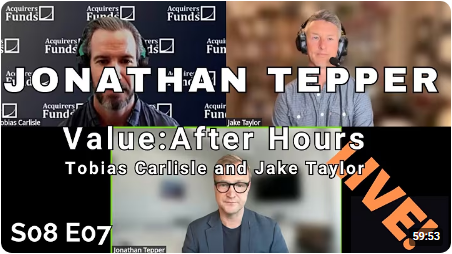
During their recent episode, Taylor, Carlisle, and Jonathan Tepper discussed:
- Building a Dominant Long-Only Fund in a Distorted Market
- Buying Booking at Peak Fear: COVID, Google & Mispriced Risk
- Will AI Disintermediate the Platforms?
- AI Winners, Losers & the SaaS Apocalypse
- The Myth of Capitalism: Why Profit Margins Stay High
- Has the Antitrust Pendulum Swung Back?
- Shooting Up: A Childhood Inside Spain’s Heroin Crisis
- The Five Rungs of Intelligence — and the Investor’s Ladder
You can find out more about the VALUE: After Hours Podcast here – VALUE: After Hours Podcast. You can also listen to the podcast on your favorite podcast platforms here:

 Breaker

 Overcast


 RadioPublic


 Stitcher

TRANSCRIPT
[Tobias] Looks like we’re live. This is Value After Hours. I’m Tobias Carlisle, joined as always by my co-host Jake Taylor.Our special guest today is Jonathan Tepper. He’s the founder and portfolio manager of Previt Capital. How are you, Jonathan?
Welcome.
[Jonathon] Doing all right. Thank you so much for having me. [Tobias] Tell us a little bit about Previt.Building a Dominant Long-Only Fund in a Distorted Market
[Jonathon] Certainly. So we launched in 2020. We’ve been going for about six years now.We are 580 million assets under management. The philosophy and the investment style is very simple. We’re a long only fund, but we have an absolute return orientation.
We try to buy quality companies and we try to buy them at a discount to their intrinsic value. And we do deep analysis into companies and industries. We’re trying to buy dominant companies, so companies that have a high market share.
It’s not necessarily done so via mergers and regulatory barriers, but ones where we think that the delivery of the product dictates few players. And we’re trying to make sure that we’re finding companies that have a high free cash flow yield where that cash flow can come back to us, whether dividends or buying back their shares if they’re undervalued.
[Jake] And if Jonathan’s name sounds familiar, he wrote a terrific book a while back called The Myth of Capitalism. And I was curious, what in that book informs how you practise investing today? [Jonathon] Certainly. So I think that as I was doing a lot of research on the book, it was interesting that as I was finding industries that had become more concentrated and then just mapping out all different industries, often I was finding investors that I admired, and I mentioned Buffett, but you have other investors there like Chris Hone and Steve Mandel and others owning some of these companies. And it seemed to me that you can invest cyclically, you can buy cigar butts, and there’s not only one way to invest.And that’s one of the beauties of investing. But I think that if you want to sleep at night and you want to make sure that your portfolio is growing over time, I thought one of the best ways to do it is to buy companies that have high returns on capital, that have a dominant position and provide goods that people need. And so in the fund, when we launched it in 2020, COVID was happening.
Obviously, it seems like distant memory in a stone age. But we bought Booking.com, for example, which is an online travel agent. You have them and Expedia are the main two players.
And people were treating this like no one would ever travel again. We bought it very cheaply. It was one of our largest holdings.
We still own it to this day. And so that’s an example where it just makes the most sense to have an online platform that can bring all the different things together with, particularly in Europe, a fragmented market for hotels and accommodations.
[Tobias] Can you take us through the thesis on Booking.com when you bought it, what you saw that you thought was different from the way that the market was reading it?Buying Booking at Peak Fear: COVID, Google & Mispriced Risk
[Jonathon] Certainly. So with Booking, it was actually very interesting because it wasn’t just COVID. Obviously, COVID, people had questions about the duration of the lockdowns and the disruption of travel.And our view was that historically, when you’d seen, for example, there was the recession in 2001, 2002, and you had SARS and there were fears about travel, these tend to be temporary in nature. People want to travel, they want to see friends, they want to see relatives. Almost any interruption of travel historically had been brief.
And our view was that that would be the case. The stock price was certainly not priced for that. It was priced for a much more negative outcome.
But on top of that, you had the fear that essentially Google might get into travel, it might disintermediate booking, people might go to booking first, sorry, Google first and then go book their hotel. And so you had a variety of reasons why it might be lowly valued, despite being such a high quality company. Today, it’s interesting that you obviously have the fear of AI, where agents might do what people were thinking Google might do, which is to disintermediate some of the platforms.
So some of these fears don’t go away, they just sort of recur over time. Our view is that Google does not want to be the merchant of record. They don’t want to run a customer service department.
They don’t want to be the ones dealing directly with the hotels. Booking and Expedia actually do advertise significantly on Google. They would end up hurting themselves too in terms of losing all the ad revenue if they actually did want to go into that line of business.
And Google is much more sort of search for everything rather than trying to dominate a vertical. And so I think our view is diverse in those two areas. One, the duration of the downturns and two, the threat posed by Google.
And as it turns out, booking, I think they have one of the best CEOs in the world, Glenn Fogle, and they’ve managed to dramatically increase the traffic that they get directly going via their app. People aren’t starting on Google and ending up on booking. And then Google has never really actually followed through in terms of the worst fears that people had, where people might do their entire booking experience via Google, which just doesn’t happen.
[Tobias] It’s a similar sort of question today, isn’t it, with AI that folks could just tell their agent to go and book these flights. How do you come to terms with that?Will AI Disintermediate the Platforms?
[Jonathon] Certainly. So the last conference call that booking had as worth reading, people have the time and energy, but Glenn Fogle pointed out that, one, when you have a middleman, basically, they’ve aggregated supply and demand. And you have a lot of hotels across Europe that are independent, mom and pop, where you have sort of alternative accommodation, where it’s an individual.The idea that all these people are going to get all their inventory and make this readily searchable by every AI, whether it’s ChatGPT, Anthropic, or XAI, or whatever it might be, doesn’t make a lot of sense. You don’t have that much sophistication. And furthermore, a lot of these AIs, whether it’s Claude, do they really want to be the merchant of record?
Do they want to deal with the customer when their travel plans go bad? I don’t think people have fully thought through what it is to run an actual travel business. And if you think about people book from countries all over the with different payment systems, and the websites and the history of reviews are translated into 40 languages, it’s not a simple undertaking.
And it’s unlikely that the AI agents would be able to do deals without the platforms. Some of the agents are actually pretty good at scraping the platforms, and certainly the platforms themselves control whether they’ll be able to do that on an ongoing basis.
[Tobias] Tell us a little bit about the myth of capitalism.The Myth of Capitalism: Why Profit Margins Stay High
[Jonathon] Certainly. So I wrote that in 2018, towards the end of the year, I think it came out in November or so. And then obviously, near the end of the year, so most people probably actually read it in 2019.But the book essentially was set out to answer the question why corporate profit margins were so high relative to history. One of the, there’s certainly multiple reasons, but one of the main reasons, in my view, was the rise in industrial concentration, where many industries were becoming more concentrated, and this gave greater pricing power to companies. It, in many cases, disadvantaged the consumer or disadvantaged the worker where you’re, you know, you can’t go out and sell your skills if you have a limited number of people who might bid for those skills.
And so to me, that seemed like a very interesting phenomenon. And the book was really about public policy and history and sort of looking at why, you know, despite the US having the Sherman Act from 1890 to the present, there was these sort of pendulums, effectively, that were multi-decade in nature, and you went from having sort of very aggressive antitrust enforcement in the 50s and 60s, to then early 80s, there’s a change with Reagan and the merger guidelines.
And so the book goes through all of that. It looks at quite a few industries, and it has various chapters on themes regarding this. And so that was the central idea, was that basically capitalism in theory should be about competition and about, you know, free enterprise.
And in fact, you often find that, particularly in industries that are more concentrated, typically a regulation often is a key barrier to entry, not in all, but it’s the regulation often that impedes competition. Then you have certainly regulators who, you know, over time, and there’s, you know, I have a chapter on how you had a revolving door basically between sort of the FTC, the DOJ, and a lot of companies wanting to merge. And so you ended up with mergers towards monopoly, where there may have been competition there initially, but sort of the mergers got rid of that.
And so that was the book. At the same time, obviously, I was looking at a lot of this with an investing angle, trying to understand sort of the investment implications of this. I wrote another book, which we’ll never see the light of day, but it’s our sort of internal monopoly guide or sort of guide to understanding sort of investing, you know, given the implications of all of this.
Has the Antitrust Pendulum Swung Back?
[Jake] Where are we today in the pendulum swinging as far as kind of antitrust enforcement and competitive dynamics? [Jonathon] So it was quite interesting. It seemed to have bipartisan support to have more enforcement. And I think that, you know, certainly Trump and Biden, so Trump won and Biden were moving in that direction.I think in the last year, it seems to be going almost in the opposite direction. You know, it’s to say that businesses did not like some of the reforms or some of the mergers that were blocked. And so, you know, I’ve obviously been busy focussing on my funds.
So I’ve spent less time looking at the public policy side of this. But, you know, I think there were plenty of reasons to be optimistic. Now, I think it’s a bit more of an open question.
And I don’t know, you know, where the chips are going to fall.
[Jake] We didn’t stop Big Purse, right, with the merch merging. Apparently, we can’t do that. [Tobias] I do think that’s funny that that was the one merger that really got pushed hard. [Jonathon] Yeah, I mean, I certainly, I, you know, I’m not responsible for DAJ or FTC policy. Some of them, I thought, you know, the mergers that were blocked made a lot of sense to block. I guess we’re a little more in question of one idea. [Tobias] It’s funny, I don’t know where the profit margins were in 2018, but I would guess they were 10 or 11% or something like that. And now in 2026, I saw there’s likely record profit margins, like 14.3%. That’s funny in the context of, you know, Buffett said anything above 6%. And Rantham said the same thing.And Hussman, I think, has said the same thing.
[Jake] About that meme reversion. [Tobias] Six seems like a quaint, like, it’s impossible to imagine how we get back to that. [Jonathon] Well, so, you know, we’re bottom up stock pickers, you know, trying to find good companies, good industries, trying to understand sort of how sustainable the profits are. From a macro standpoint, you know, clearly some of this is driven by taxes and interest rates. And so I think there certainly will be a reversion to the extent that interest rates go back up.And obviously, if you want to do something about the deficits, then taxes are likely to go up too. And so I suspect that record high profit margins probably are not here to stay.
[Jake] How about AI? How do you think about AI impacting profit margins? [Jonathon] I mean, to be honest, I don’t actually spend all that much time thinking about it in the sense that I think a lot of these things aren’t entirely knowable. I think what we can do is try to, what I do spend time thinking about is looking at sort of previous technological revolutions and bubbles and seeing how those played out. And there are two books that are terrific.I think Philippe Lafont recommended one, so the hardback now is actually pretty expensive, but it’s not expensive if you want to buy it on Kindle or iBooks. And the Engines that Move Markets by Sandy Nairn is a very good book, and it’s about the history of technological waves. And another very good one is Technological Revolutions of Financial Capital by Carlotta Pérez.
And they both have similar lessons and sort of look at it in different ways. But the consumer tends to be the net beneficiary in technological waves. Early investors often face intense competition because there’s too much capital going into these new exciting areas.
And then often the winners in terms of companies aren’t even necessarily the ones that are around when the revolution starts. And if you think of the internet, for example, the big, big winners, Facebook was started in 2005. Google really wasn’t even a company anyone really talked about during the dot-com.
It had been founded in 98.
[Jake] 17th search engine, maybe, something like that? [Jonathon] Exactly. Technically sophisticated people used it, but everyone else was playing around on Yahoo. [Jake] Exactly. [Jonathon] And so it’s not obvious to me who the winners are with AI. And I suspect that if we had this conversation eight years from now, people might be surprised about the companies we’re talking about today versus the ultimate winners. I think that given the uncertainty, it’s difficult to pay very high valuations with a high degree of confidence because you don’t know.And so I try to focus on things I can understand, things that I have some reasonable idea about, and where I might get my cash back, the company returning it to me. And I just don’t see a lot of that. And so we’re not a hedge fund in the sense of running a short book.
So I don’t feel any obligation to go out and find things to bet against. And bubbles can certainly go further being if they’re rational. As my friend John Hampton said, there’s no reason why it couldn’t be five times more rational.
So I think that we’re just trying to find the losers or the perceived losers. And in the dot-com, certainly, I started my career at SAC Capital in 2003, and they had what was informally known as the old economy group, because you had that new economy and the old economy. And that area, obviously, was very cheap and unloved and ended up doing very, very well.
So I think right now, I’m much more interested in the things that people think are going to be disrupted or losers that might actually be good investments.
[Tobias] Well, that’s an interesting question. What do you think is going to fall into that bucket?AI Winners, Losers & the SaaS Apocalypse
[Jonathon] So there are four areas currently, I think, that are the most affected by AI, or currently, the market’s telling you that they think these are going to be losers based on the change in stock prices and the fall in multiples and valuations. And the first one is which I think most everyone’s focussing on, which is software. So you have sort of SaaS, they call it a SaaS copalypse or apocalypse or whatever.And then you have such software, obviously, number one. You also have data and analytics firms, right? If AI is going to go off and do the analysis, then do you really need to pay for FactSet or Morningstar or Refinitiv, which is part of the Siebel, Thompson, and Reuters, but it’s part of London Stock Exchange Group.
And even S&P and Moody’s have been hit, not as badly, but they’ve been hit. And then you have online platforms, the idea that the agent’s going to go out and do the booking for you, and therefore, you don’t need the platform and the network effects effectively. Yeah, classifieds.
Have been neutered. And then you have the fourth, which is, I think, not as badly as affected as the others, but certainly, I think, has been hit, have been some payroll processors and you have ADP, Paychex, Paycom, and so on. And so within all of these, I think that there are some businesses that will certainly be affected and others that will probably, I believe, actually benefit in the sense that if you think that these AI models are ultimately commodities, right, where Chad GPT is not that different from Claude, which is not that different from AI, and anyone can use them, then surely, as in previous technological waves, it’s the consumer that ultimately benefits and people can use them, where you can travel further and get cheaper railroad tickets, or you can make phone calls more cheaply.
All these things are great for humanity, not so great for shareholders, but there’s no reason to think why a lot of these companies can’t use AI in their own workflows and the experience they might provide their customers.
[Tobias] Yeah, it seems to me that that’s a likely direction. There’s some commodification in the models, and even if you’re just using the next best model, there’s not much drop-off in between the two. It might be a little bit of lock-in with people creating their own projects and workbooks or whatever the case may be, but that doesn’t give you much pricing protection.You can’t gouge your customer the way Microsoft has been gouging their customers, for example. You know, hands off to Microsoft.
[Jonathon] Yeah, and if you want to see who has the power, you know, one gauge of that is like how long do you have to sign up for the subscription, right, and Bloomberg gets you for two years, right, like that tells you quite a bit about Bloomberg’s power. The fact that with almost all of these AIs you basically have monthly subscriptions, I mean, that pretty much tells you everything you know, right? Interesting. [Jake] That’s a good metric. I haven’t really thought about that before. [Tobias] They said that they limit the $200 super version that you use, JT, because there’s such a huge discount on it. They don’t want people using multiple versions of this to steal a whole lot of compute. So they’re still selling it below the cost of goods. [Jake] They have to be losing a tonne of money on me. There’s no way. [Jonathon] Well, I mean, I think that one thing that’s very interesting is that, you know, similar to the dot-com bubble today, none of these companies are profitable. A lot of the CapEx that’s being done is being done on their behalf, right? So you can talk about how demand is extraordinary.And I read a long blog post a friend sent me, you know, unlike the dot-com where you’re laying down dark fibre, you know, there’s tonnes of demand here. Well, you know, who’s that coming from? And ultimately, these are companies that have to go out to the equity market to raise, which is why we’re gonna get some big IPOs this year.
And, you know, if like 45% of your, you know, revenue performance obligations are coming from a company that, you know, has about 13 billion in revenue and a trillion in sort of planned spending, you’ve probably got a problem.
[Jake] Those numbers get a little scary quickly, don’t they? [Jonathon] Yeah.Shooting Up: A Childhood Inside Spain’s Heroin Crisis
[Tobias] Jonathan, you’ve got a new book, Shooting Up a Memoir. Do you want to tell us a little bit about that book? [Jonathon] Certainly, yes. So I, my parents were Christian missionaries and I grew up in Spain in the 1980s. My parents started a drug rehab centre working with heroin addicts.And so this, I wrote this, believe it or not, when I was at SAC Capital years ago, evenings and weekends. And so it’s a world away from my world as an investor. But almost all the heroin addicts shared needles and became HIV positive.
And they were brothers and sisters to me. And it’s a story of love and loss. It’s a, I hope a beautiful story of family and friends.
And so it’s a, it’s not an investment book, but it’s one that the early readers absolutely love. And it came out last week and I almost never do any podcasts. I’m glad to talk about the book a little.
Obviously, I’m very happy to talk about investing and I’ll probably go back into my shell and maybe probably not do a podcast for another five years.
[Jake] That’s not how book sales work, Jonathan. You got to pound the podcast. [Tobias] Why release it now? [Jonathon] So it was very interesting. I was having lunch with a mentor of mine who’s a retired fund manager and it’s two years ago. And he said, and I mentioned that I’d written this thing.It was sort of sitting in my, on my shelf or in my computer drive. And he said, you really should get this out before your father dies. And my father’s 79.
And I just thought, he’s probably right. And so I went away, edited it a little, a literary agent went out and got a contract. And so I’m very glad that I’ve done that.
And I hope it honours the memory and of my friends. And I hope that their memory is a blessing to others. I hope it’s a beautiful book that people will enjoy reading.
[Jake] What’d your family think? [Jonathon] So it’s interesting. [Jake] Fun strolled out of memory lane for them or what, you know, was it painful? [Jonathon] Memoirs lead like families to stop talking to each other or, you know, blow them up. My father thinks I was too hard on him in the book, but he, he loves the book and thinks that I told the story as it was. And almost everyone who was in the book loves the book.And I didn’t realise when I wrote it and then now that it’s coming out that like the daughters or some of the main characters, you know, were three or four when their father died and they didn’t really know their father very well. And I hope that through this book, they told me that they feel much closer to him and that it brings his personality to life. So I was just thrilled.
You know, obviously I want the book to do well and I want everyone to read it, but no one ever read it. Like for me, that’s just a beautiful thing.
[Tobias] Yeah, that’s really nice. How long ago did you write the book? [Jonathon] So it took me about probably three, almost four years. Cause I was like writing an hour an evening after building financial models and, you know, a little bit on the weekend if I had some time. And so I think I probably finished it early 08.And then, you know, like typical publishing, you get some rejections and I was just very busy. You know, I’d started a user-generated newswire with a friend, Terry, we sold it to Corbis, which Bill Gates owned. And at the time I was writing sort of investment pieces, which became Variant Perception.
And so life just sort of took over and I just put it away on a shelf and didn’t really sort of hustle to get a book contract. And that was really the only reason for putting it away for so long.
[Tobias] What was it like revisiting it after such a long time? Yeah. [Jonathon] So I think like, I hope it’s improved a lot with a bit of maturity, but also like I’m a dad now. I wasn’t when I wrote it. I think, you know, when you have children or even as your own parents, you know, you’re 20 years older when the book’s coming out and you start to see sort of, I mean, I think that we’re all links in a long chain of love and you realise, you know, one day my son will lose me and, you know, it changes the way you read and the way you edit.And I hope that it leads to like a more mature editing and writing. So the story is the same, but I hope it’s better or deeper.
[Tobias] Yeah. So you did revisit it and you did rewrite a little bit as 20 years hence. That’s interesting.And not because you felt that you’d mischaracterised the events, but perhaps because you were, you just, you had changed a little bit.
[Jonathon] Yeah. I think that’s a very good way to put it. And, you know, it’s, you get a lot more perspective on the events that were there and, you know, and I hope it’s a more profound and deeper book because of that.And I think that, you know, one of my mentors, he had written a memoir and when he read the first draft, he said, I don’t think you’re old enough to write this. And I was very upset at him. And now that I’ve read it, I think he was a hundred percent right.
So at any rate, a good lesson to the listeners, you know, if you have an investing mentor or someone, you know, you may not like what they have to say, but they’re probably right.
[Tobias] How was the transition from Spain to, where did you go after Spain? [Jonathon] So I went to the University of North Carolina at Chapel Hill. [Tobias] How was that? [Jonathon] So that was a big culture shock. I went from basically, Madrid at the time had maybe four, a little over almost four and a half million people to a college town that had, you know, maybe 20 to 30,000, an exact number. And, you know, businesses were open and closed nine to five.And, you know, it was all students. And I was used to living in a slightly chaotic neighbourhood where, you know, grandkids, grandparents, junkies playing in the street and shooting up. And so it was a very big, big change.
And at the same time, the peak of deaths from AIDS in Spain was 94, 95. And that was when I was going off to college. So for me, I felt very, this sort of cut off from my friends.
Didn’t know if I’d be able to see them again when I got home. And in many cases, if not most, I didn’t get to see them. So I was very isolated.
And I think I poured my energy or angst or sadness into studies. And I think that’s probably why I ended up becoming a Rhodes Scholar. It was just sort of how I found my outlet, I think, just sort of studying.
[Tobias] Were you Spanish speaking at home or you speak Spanish? [Jonathon] We always spoke English at home, but I spoke Spanish in the street, Spanish in the drug rehab, obviously watched Spanish TV. And so like, I’m, you know, fully fluent in bilingual, but, and it was all English was always at home. And then went to a very small missionary school where they spoke in English. [Tobias] And you lived in London for a while. [Jonathon] Yeah. So after Oxford, I moved down to London and then basically was there until about 2020 and then moved to Nassau to the Bahamas where I’ve been ever since. How are the Bahamas?It’s great at this time of year, you know, you have a blizzard in the Northeast of the US, or it’s like dark and miserable and cold in London. It’s a bit hot and humid and oppressive in the summertime. But I do love it.
There are quite a lot of very thoughtful investors and family offices and others there. So it’s, I find it’s a great place to work. And Sir John Templeton was one of my investing heroes.
So it was another reason why I ended up moving there.
[Jake] Does that geographic distance, do you feel like it creates some insulation for your own thinking? [Jonathon] I think it does actually. I tend to, it’s not to say that like, you know, we don’t speak to people or we don’t read what other people write. But I think a lot of the work that we do tends to be driven by like our own research and thinking.And I’m grateful for that.
[Tobias] Jonathan, you’ve got to go at the top of the hour. [Jonathon] I do, unfortunately. And I really do apologise. As I said, I’m going to like turn back into a turtle and go back to my shell eventually.But I do have, my publicist for the books ended up scheduling too many questions. But I absolutely love your show and both of your books and well, many books. But I am just very grateful to be able to chat with you guys.
And, you know, if you did want to have me again, I would love to come back and not five years from now. So I’m very, very grateful. And we can do no talking about the memoir and do more about anti-bubbles and great investments.
[Tobias] Well, we do like talking about that stuff. Just give us a quick, if folks want to follow along with what you’re doing, get in touch and tell them where they can get the book. [Jonathon] Oh, yeah. So anywhere people buy books, whether it’s Amazon, Barnes & Noble, your local bookstore, you can find it there. It’s called Shooting Up.And hope people enjoy that. Myth of Capitalism 2, if they want to get into that, didn’t read it the first time around. And then our fund, you know, but we do have an extraordinarily simple webpage with our email address.
And obviously, you know, just happy to chat more with thoughtful investors, like-minded, thoughtful investors.
[Tobias] Well, thanks very much for coming on, Jonathan, and telling us about your book. Thank you, guys. [Jonathon] Thanks, Jonathan. [Tobias] Good seeing you. Absolute pleasure. Cheers.Thanks, Jonathan. Bye. I’ll give a quick shout out to the folks, Jupiter, Florida, Breckenridge.
What’s up, Yorkshire? Orlando, Southshire, Tallahassee, Pettitigva, Israel, Waterloo, London. What a great spread, Toronto, Monterey, Mexico, Mendocino, California, Chicago, Bologna, Italy.
What’s up? Main streets of Gerrard’s Cross, Capaverga, Iceland, Barrow-in-Furness, UK. What’s up?
Valparaiso, Serbaton. Thanks, team. Here comes JT with some veggies.
Market.
The Five Rungs of Intelligence — and the Investor’s Ladder
[Jake] Right at the top of the hour. All right. So imagine a world before trees, before birds, before nearly anything that we would recognise as biology.And we’re down on the seafloor, and life is doing what life always does. It’s trying not to get deleted. And this is the story of how that foreign world turned into human intelligence.
Like, how did we get here? How did our brain evolve? And this segment comes from this really terrific book called A Brief History of Intelligence by Max Bennett.
Highly recommend it. And in that book, Bennett describes a ladder. And there are five rungs to this ladder, and each one is built on top of the last.
You can’t skip steps. So these are the five biological breakthroughs that really bootstrapped human intelligence. And each breakthrough, it’s only possible because the earlier scaffolding already existed.
Like, you can’t take shortcuts here. So breakthrough number one is steering. And remember, we’re going back to like, you know, we’re down on the ocean floor, and it’s a very different world.
But the ability to navigate by sorting the world into good and bad, and then turning toward good and away from bad. And actually, at that time, the body plans shifted. Animals went from being like things that were symmetrical, where they kind of would float around in any direction, it didn’t matter, to actually being bilateral, meaning like, you could cut them in half, and like each half would then be symmetric.
And they now all of a sudden have navigation is a series of binary decisions. Do I turn left? Do I turn right?
Do I go forward? Do I go back? And the brain at this stage is basically like this little internal compass with two needles, positive valence, like approach, like I want to go towards this good thing, and negative valence, like I want to go back, I want to avoid the bad thing.
And even back then, we had neuromodulators like dopamine and serotonin that created these persistent states that helped an animal keep searching, keep moving, keep trying again, instead of resetting to like a neurological neutral every second. And this is also where early affect shows up, like pleasure, pain, stress, satiation. All right, breakthrough number two, reinforcing.
This is the ability to learn from experience by repeating behaviours that lead to positive outcomes, and suppressing behaviours that lead to negative ones. So vertebrate animals, they add this machinery for pattern recognition and trial and error learning, like do more of what worked basically. And with that, we had a much, we get a more familiar kind of emotional palette that we would all like sort of imagine, like curiosity, fear, excitement, disappointment, relief.
Because once you can kind of learn over time, you can also start to anticipate a little bit. Breakthrough number three was simulating. And this is the ability to run a rough internal model of reality and then test actions inside of that model before you go test them with your actual body.
So this is the neocortex starting to form, like we’re learning by imagining. And the simulation then buys you something really priceless in a dangerous environment, which is planning, episodic memory, so being able to replay past events to see like, how did that go down? Counterfactuals, like, hey, if I had done X instead, what would have happened?
And it’s very expensive calorically, like the brain burns a lot of fuel, but it’s a big advantage to spend those calories now to avoid dying later. And so breakthrough number four, mentalizing. This is like modelling your own mind as an object that you can then inspect.
This is like kind of a bit of a strange jump, like the brain builds a model of itself, intent, knowledge, uncertainty, and then uses that machinery on others. So now this is where you start to get into theory of mind, like anticipating what someone else wants, what someone else knows, what they believe, what they might do next. And then this is where social learning starts to become more efficient, because you can learn by the observation of others, and not just by your own expensive trial and error.
And then the fifth one was speaking. And this is language, naming things, grammar to convey actions. This is where individual intelligence starts compounding into cultural intelligence.
And language tethers all of these inner simulations that we’re doing together. And then, and this is really key, it lets thoughts persist across generations. So you’re no longer limited to what your own nervous system can kind of discover in one single lifetime.
You inherit this accumulated library of priors from all the generations before. So bringing this all kind of back to the investing world, those five rings and Bennett’s ladder that I just described of intelligence made me think also about Graham Duncan’s five levels of the game essay, which is kind of describing the maturation of investors. So, and I love it when there’s symmetries to these things.
But before we get into Graham’s observations, let’s do a quick little quiz for the value investors. When you say mean reversion is inevitable, which rung are you outsourcing your thinking to? Is it A, steering, which is cheap equals good.
And we’re basically done here. B, reinforcing. So it worked in 2000 to 2004.
Therefore, this is basically a mathematical certainty like physics. C, simulating. I read three scenarios, baseball and coping.
And then D, speaking. I’m not wrong. I’m just early.
And now here’s a 40 page memo to support that. So what’s your, this is very tongue in cheek, obviously, so if you want to guess, you can guess.
[Tobias] I’ll take the bottom level. [Jake] All right. You want to go D, speaking with your 40 page memo. [Tobias] I took the dumbest level. Yeah, yeah. [Jake] Cheap equals good. And we’re done here. OK, good.That’s the correct answer, probably. All right. So part two of this is bringing it back to the investment world of Graham Duncan and his levels of mastery.
And Duncan’s premise is that great investors view investing as this game where they always know what game they’re playing at the time. And he ties this really to like a locus of control, like strong investors focus on what can be controlled and they don’t narrate every outcome as the world was like happening to them. Like, could you imagine Buffett complaining about something bad just happening to him?
Like, you know, he takes responsibility. He’s a big boy. And in evolution, you know, cognition upgrades came in these layers.
And the same thing is mastery upgrades come in layers as well. So level one from Graham is apprentice. And this is, you know, this pipeline of huge numbers of ambitious young candidates.
They’re all competing for a small number of seats. And they arrive sort of all with this base, the same basic training that they get in school. But otherwise, they’re pretty much blank slates.
And, you know, the most efficient path here tends to be like apprenticeship model. You find a mentor, you absorb the craft, you learn what matters. And this is like steering in biology.
Like you’re getting these very primitive but essential skills of kind of sorting the inputs into good, bad, or, you know, I need to turn from this or away from this. And the steering builds on this kind of internal compass of distinguishing signal from noise, separating risk from volatility, learning which mistakes are annoying versus fatal, developing the ability to act, to not act actually when it might be seductively, you know, available to act. And Duncan notes that these early environments leave a very lasting frame of mind on people.
They kind of carry their first market dialect for years. And I think we see that with like, you know, people who came up during GFC seem to have different risk appetites than those who would come in even a few years after them who didn’t get that early imprint. All right, level two, what Duncan would call the expert.
And this is, you know, survivors who move from processing other people’s research agendas to actually generating ideas on their own. And this is typically in your late 20s, early 30s. A lot of people plateau here, especially if you have kind of a static identity that locks in a particular style and limits the ability to cope with change.
He also flags pride of authorship as a common failure mode. So when you get too attached to your own analysis, you can kind of block adaptation. And this maps to the reinforcing part of biology, like repeating what worked, inhibiting what didn’t, letting feedback do all of the steering.
And it’s an essential skill to learn how to spot those key drivers, like seeing the underlying reality, rather than just producing sort of raw analysis for its own sake. All right, level three is the professional in Graham’s terms. And this is, you know, imitation finally gets shed.
There’s more idiosyncratic style emerging, consolidating maybe multiple influences beyond an original mentor and like integrating those. And he uses Buffett as an example here of synthesis, you know, blending influences from Graham and, you know, Munger, obviously, Bill Fisher, yeah. And then being pushed, you kind of start to push beyond the previous constraints.
And Duncan also makes a point of like the very highly ecological point. The game often gets crowded. And so a single playbook can work, and then it becomes common, and then that edge decays.
So this is kind of like the simulating part of the biology, like you’re running internal models of possible futures, testing strategies before testing them with actual capital, iterating without dying, basically. Level four is master. And this is changing the game that you play, like, and this is kind of a small minority.
But they become like true, kind of absolute return orientated over multiple decades, defining success internally, rather than by peer comparison at any given moment. He uses David Tepper as a study of flexibility, like multiple mental models moving across context, not being constrained by any particular fixed role. And this is like the mentalizing part of the biology terms, like theory of the mind.
So modelling other minds, incentives, intent, knowledge, you know, markets maybe aren’t just cash flows, they’re also cash flows filtered through other people’s incentives and constraints and fears. And Duncan explicitly leans into this psychology of the player’s view by quoting Robert Greene, with mastery includes seeing not just chess pieces, but the whole game. He even gives an example from Paul Tudor Jones, which was putting himself in the shoes of a pressure Japanese fund manager helping anticipate behaviour and market directions.
So really, like, there’s a lot of mentalizing here that gets rendered into a P&L. And then level five, the last one, we’re almost done, is the steward. And this is becoming like part of the playing field.
So this is like a mastery, plus enough success to redirect attention towards taking care of the playing field itself. You know, mentorship, modelling, good behaviour, influencing the norms that make you a steward of the system. And he uses Buffett as during 2008 crisis as an example, higher, you know, bigger public presence than calming metaphors by America, I am taking responsibility for the system itself, not just your own results.
And this is like the speaking part of the biology language as this kind of technology that lets thoughts compound across generations. And the steward is really not just like a better stock picker. It’s like transmitting teaching frameworks that outlive the teacher using metaphors to coordinate shared attention for everybody.
And Duncan describes stepping back for like a bird’s eye view of the whole field. So if you strip away the miracle that is intelligence, really, it’s just sort of like better error correction under constraints. And investing is just error correction with money attached effectively.
And Bennett shows why the upgrades arrive in a particular order. And Duncan kind of shows the same thing why careers do it too. So if you want one practical takeaway here for the investors, locate the rung that you’re likely on, and then do kind of that unsexy work that that particular rung demands, because they’re really every shortcut here is just kind of delaying paying some bill of tuition.
And you can’t skip steps in biology or investing.
[Tobias] Good one, JT. Do you think that Buffett becoming a steward around that 2000, wherever, somewhere between 2000, 2008, somewhat diminished the signal from him saying, you know, in 2007, like there’s lots, you can find lots of quotes from him in 2007 at the absolute peak saying, market doesn’t look that expensive to me. [Jake] I would put the stewardship even earlier than that, though. [Tobias] Like, I mean, I would say it started earlier than that. But I’m just saying, do you think it diminishes the signal a little bit? Like when he’s saying, I don’t think that, like you say, if you if you know that he’s a steward, and in 2007, he’s saying, I don’t think the market looks that expensive, as he’s saying, don’t panic, rather than, I actually think the market, I think the market’s cheap here. [Jake] I’d have to go back and see like the specific reference to that. But my hunch is, what he said was had some caveats stapled to it, which were like, if rates stay low, if profit margins stay elevated, exactly, then, then stocks are reasonably priced here. Those are the kinds of comments he says in those time periods. [Tobias] So yeah, so if everything stays at perfection, then there’ll be no problem. But if we move away from perfection, you got to hear the part that he doesn’t say. When you started talking about underwater, I saw this, I saw a YouTube video on an animal called an isopod.Have you ever heard of an isopod?
[Jake] No, but I’m ready for your veggie segment. [Tobias] I’m going to do some veggies, folks. It’s, it’s a, it looks, it’s, it’s very closely related to a roly poly, those little insects that you see on the ground might also, might almost be identical to a roly poly, except they’re about two feet long and they’re like covered in kind of crab shell looking stuff. So they look like a, a crab cockroach hybrid kind of thing. [Jake] And these are really old though, right? Is that they don’t, well, they exist. [Tobias] They continue to exist. [Jake] They’re still around. [Tobias] They live on the floor of the Mariana Trench. So right at the very bottom. And what they do is they eat whale carcasses when they fall to the bottom.So you can imagine how infrequently a whale dies and it falls all the way to the bottom of the Mariana Trench. So when they find them, they have to gorge on these very, and they can, they can eat and then not eat again for something like two to five years. It’s like a value investor.
So when they find these things, they fill themselves up so much that they can, they literally can’t move. They just jam their body full of what, you know, rotten whale meat to the point that they’re fixed in place. And then gradually they’re, they digest it over the next two to five years.
And then right behind that YouTube video, I saw another one about this ramen place in Korea that they top their ramen with the shell of an isopod that they steam, they do nothing else to it. And then you can eat the interior of the isopod and the guys eating it thought that it didn’t taste that good.
[Jake] Wow. I mean, imagine the, let’s not get too gross, but imagine the after effects of eating that much. You know, what does that? [Tobias] The really interesting thing about the isopod is that it lives under that crushing pressure at the bottom of the Mariana Trench and every other animal you pull up, like their eyes explode out of their head and all their insides come out because they need to be under that pressure to survive. But the isopod, you can pull it up to the surface and you can keep it in an aquarium that the people can go and have a look at these things walking around. They’re perfectly fine.They don’t suffer from the lack of exoskeleton protects them. And I found one, I think they kept in San Diego or somewhere like that. And they, they put some food in there for it.
And it ate, I think the first time they fed it and then it never ate again. And that lived for another two or five years, something like that.
[Jake] And at the end of the day, no eyes. Do they have no eyes? [Tobias] No, I mean, I’ve got, you know, insect stalk kind of things coming off the head. [Jake] Okay. [Tobias] I’ve got some ability to sense. Anyway, this thing didn’t eat and then it died. And what they realised was it probably died of old age.It didn’t die from lack of eating. It was just, it didn’t need to eat again because it had just decided it didn’t need any more. It didn’t need any more food.
Anyway, gross, but I felt a lot of affinity with it, you know, as a, as a value investor, I think it’s to eat every seven years.
[Jake] What do you do in the meantime? Just lay there inert. [Tobias] As much as possible. That would be my preference. [Jake] Oh, you write books. That’s, that’s how you stay. [Tobias] That’s how it works. What do you think about this market? [Jake] It’s more interesting than it was, right? I mean, there’s definitely some price movements that are grabbing some headlines. I think Twitter’s sentiment seems quite apocalyptic and sass-pocalyptic.Yeah. Although when I, you know, when I go look at, I’ve kicked the tyres on some of these companies that have supposedly been hammered the most. And I still don’t see a tonne of cheapness there yet on any metrics that I kind of care about, especially if you count the stock-based comp, like you throw that back in there as a, to try to arrive at some kind of a flow number of, you can’t, you know, earnings, cash flow from ops, some kind of like version of that.
And it’s still, I don’t know, for all of the hand wringing, I would have thought they’d look cheaper on some of these metrics.
[Tobias] I put this chart up today on Twitter, looking at price to sales for mag seven, which it got up to eight times on a price. I know that, I know that sales is a limited kind of metric because it doesn’t tell you what the margins are like and so on and so on. [Jake] But at least you can’t mess with the number, right? It kind of is what it is. [Tobias] It’s a top line number and there’s very little manipulation that can go into it. Although I know there’s some manipulation that can go into it when you recognise revenue and so on. But even after this most recent kind of pullback, they’re at 7.1 times, which is as expensive as they got in 2021 at the very peak. [Jake] This is mag seven you’re saying? [Tobias] Mag seven. The margins are fatter now. So like it’s not, it’s not an apples to apples comparison, but it is kind of an interesting.And I don’t know, as Jonathan mentioned earlier, and as we’ve discussed many times before, there is some mean reversion in margins. Supposedly, I haven’t actually seen it in my lifetime, but there’s this theoretical, a lot of the older guys seem to talk about it a lot. Like the thing that they’ve seen, it’s nothing that I’ve ever observed in my investment career.
But at some point, like the next print is going to be the highest margins ever at 14.3%. It’s like the lost city of Atlantis.
[Jake] You just hear people whisper about it in hushed tones. [Tobias] How much of that, like, I think Hussman has this, he calls it an accounting identity, where the deficits of the government turn up as profits on private. There’s something about that, that I don’t like. There’s some sort of relationship that says that governments have to run deficits in order for corporates to run profits. [Jake] I don’t understand that well either. I’ve tried to look into it and a lot of the macro economic stuff makes my head hurt. So I don’t know, I don’t get very far, but that doesn’t make sense to me.Maybe I’m stupid. I’m totally willing to accept that.
[Tobias] I don’t like the theory of it either, but the practise of it, when we run massive deficits and then we’ve seen these greater profit margins that we’ve seen at any other point in time, like it does seem that there is some sort of relationship there. [Jake] Well, couldn’t even just like the kind of no-duh version of that is like corporate profit margins going from 35 to 21 is going to increase deficits and increase profit margins? [Tobias] Oh, corporate taxation going from 25 to 21. Yeah, that’s true. [Jake] I mean, that’s like a simple little, I don’t have to have a colicky profit equation to understand that, do I? [Tobias] Do the margins, taxes come out of margins? Ask a dumb question. Sure. [Jake] Net income is below the tax line. [Tobias] Well, how about this? Rates have gone up and rates don’t seem to have impacted much of anything. [Jake] Yeah, but I think corporate America was pretty smart to like term out a bunch of debt when it was really cheap. Yeah, they’re not dumb. They knew that they were probably getting away with something. [Tobias] The little guys after suffering for the last decade or so, evidently that was as good as they could do because the rates were really low and then rates went up and they all just tripped over almost immediately. Having said that, something has clearly changed in the market since beginning of Q4, end of Q3 last year, where I’ve been pointing out this relationship for a long time on my Twitter where for a hundred years, equal weight has outperformed market capitalisation weight because small outperforms large, value outperforms growth for the most part. But there are clearly these periods of time where all of these 100-year relationships have broken down over the last decade.So I’m looking for the turning point and equal weight clearly started outperforming, which is not to say that I’m declaring the end of it. I’m just sort of narrating it in the moment as it’s happening because you don’t know when the reversal sticks because we’ve had at least two other head fakes just in this run from 23 to the current one, not including the big turnaround from 22 to 23 or whatever it was.
[Jake] It is quite interesting to look at the, and I said this to you three times a day privately, but the Morningstar style boxes with different time periods of performance and just looking at the top right corner of large growth and then the bottom left corner of small value and just seeing how those numbers change over today, one month, three months. They’re pretty, there’s something different happening now, right? Because when we used to look at that, it would just be like green in the upper right, red down in the bottom left, like every day, like it was fractal in nature, every single, you couldn’t even tell if you clicked the button between 10 years and one day. [Tobias] It is different. One thing that is interesting is that the rebound has been, I think that growth has lost more than value has gained since the rebound, but value has still made reasonable gains through that period of time. [Jake] Yeah. Last time I looked on, what was it? The three month, maybe it was minus 10 and plus 10. [Tobias] Yeah. [Jake] Something like that. [Tobias] And five year also, because it coincides with the 2021. [Jake] Top. [Tobias] Yeah. [Jake] Yeah, yeah. [Tobias] Also the 25 years started looking pretty funky too, because that’s the top of the dot-com bubble. Catches 2000. It’s been looking good for values over the last 25 because it’s just, catches that first seven years of the 2000s. [Jake] Yeah. Interesting. What would that look like?Is it one, could you imagine that we’re six months from now and the 10 years hence that was like all anomalous against the 100 years before, completely wiped out of the dataset?
[Tobias] It’s amazing how quickly it turns around because I think now value has outperformed over the last 12 months, which I wouldn’t have picked because we’ve gone through the tariff tantrum, plus a big bounce from mag seven with most of the small and micro value mid-cap, not really doing much at all. But the reversal in mag seven and the other more growthy software names has been so severe that now small value, it’s all outperforming on a 12 month basis. So it’s entirely possible.And I think going back five years, it’s entirely possible that turn is violent and quick, and it does start looking better for value. But then the multiple margin that you’re paying for growth over value has collapsed pretty quickly too. And so do you want the better names for a small premium?
[Jake] Oh no, we’re back to 2015 again? [Tobias] It’s amazing how quickly that’s happened. I’ve looked at it a few things. The P multiple advantage for S&P 500 value over growth is not much. [Jake] Really? We’re back to tight dispersions? [Tobias] It’s not back to… It still favours growth, but it’s closing in on flat. [Jake] It is surprising to me too to look at all of the talk about mag seven dominance and outperformance and looking at year to date. And most of the names in there are kind of down, maybe not hugely down, but there’s enough in there where how’s the market still at damn near all-time highs if this big component of it that was supposedly carrying the whole thing starts shedding the load and yet somehow we’re still at all-time highs? What’s going on there? [Tobias] I don’t get it either. The narrative last year was certainly that it was all concentration and it was mag seven concentration that was driving the market and the other 493 were not participating at all. [Jake] Just lazy, shiftless layabouts. [Tobias] But then I look at some charts and I see mag seven has the bulk of the earnings, has the bulk of the margins, has the bulk of the market capitalisation of the S&P 500. I have no idea how. Whatever happens, the index is okay.The components of the index are all over the place, but the index is okay.
[Jake] How does that work? [Tobias] What does it take for a systemic drawdown in the index? [Jake] Can’t be done. Permanent new high plateau. [Tobias] Forever. [Jake] Forever. [Tobias] I think it’s encouraging to see. I mean, I watch equal weight versus market capitalisation, because that’s the simplest. You say value and people say, well, I don’t like bulk value as a measure of value. [Jake] Why do I want to buy those dogshit companies? [Tobias] They’re bad companies. They’re not growing as well. But I say equal weight versus market capitalisation.At least then, it’s the cleanest measure. And so when that turns, I think that it’s interesting. It’s worth watching.
And with that turn, small and value and mid and everything else, cyclical starts working. But it’s nothing to do with rates, because rates have gone up and down. It’s nothing to do with the yield curve, because that’s been massively inverted, uninverted, flattening out again now.
Not absolute rates, not tariffs, or the business cycle deficit. I can’t think of anything else to tell. If anybody’s got any good ideas, let me know and I’ll go and have a look.
Yeah. Momentum. Momentum’s looking a little bit long in the tooth, maybe.
[Jake] Is it? When did some of these previous value names fall into the momentum bucket? [Tobias] My momentum is like 0th percentile in a lot of my names. Actually, waxed. [Jake] Just full doldrums, just dead in the water. [Tobias] Yeah, yeah. It’s been hilarious to watch. I don’t know what caused the turnaround either, from 22 to 23.23, 24, whatever it was. Thanksgiving 23. Thanksgiving 24, maybe, was when cyclicals really fell over.
[Jake] Isn’t it weird, though, the difference between chart time and behavioural time? Like, we look back at these things and it’s like, oh yeah, that looked easy, or obvious, or whatever. But then when you’re actually living through it, it’s like, it’s still pretty much Fog of War, right? [Tobias] I mean, particularly when you look at a backtest, you go, oh, the 70s suck. That must have been rough. That was a decade. [Jake] Yeah, yeah. Right. No problem.I could do that.
[Tobias] And then it’s been so long since we’ve seen a grinding bear, too. Even 2000, 2002, 2003. [Jake] Yeah. [Tobias] 2007, 2009. Those are 20-month bears. [Jake] 18 months is the average, right? Isn’t that what you told me at one point? [Tobias] Something like that, yeah. About 18 months. [Jake] About 18 days? I thought we got it down to 18 days now. [Tobias] I mean, now it just bounces like a golf ball off a concrete path. It just ricochets higher than it came down. But I think there’s been this little earnings recession.There’s clearly been a little earnings recession, certainly in the cyclicals that I watch, from 22 until I think that there was a turn in about Q3 last year. They started looking much healthier than they have looked in the past. And is that tariffs?
I mean, I have no idea what’s causing that.
[Jake] What are margins, S&P margins, going to look like on if you jam $300 billion of depreciation from all of the AI capex per year and over the next five years? [Tobias] Well, I mean, Google’s free cash flow is flat for the last five years. That’s credit to them for delivering flat free cash flow, because I think a lot of the other ones are going to go backwards. [Jake] Yeah. Well, I mean, some of them are levering up their balance sheet now, too, even off balance sheet, right? [Tobias] That’s the only place to carry your debt. [Jake] Yeah. That’s as good as money, sir. That’s an IOU. [Tobias] Tesla is one that I find kind of, it continues to perplex me. It perplexes me that it perplexes me, because I’ve just, it completely defies. Yeah, it just completely defies all, you know, the argument was always, well, it’s growing so fast, so it can command this premium multiple.Well, now the growth’s gone.
[Jake] And I see this morning in the Wall Street Journal that sales in Europe are dropped like 18% and BYDs tripled in Europe. Oh, a competition showed up. Who would have thunk? [Tobias] And in the rest of the world as well. I saw the same thing in Australia, but sales are off. [Jake] Turns out car sales is a hard business. [Tobias] Well, now it’s all going to be self-driving. Self-driving taxis. [Jake] Robots. [Tobias] And robots. I do think it was funny that when we were in China, they said that the Tesla bot was the one that was the most advanced, Optimus. Yeah.And we weren’t sure whether they knew there was a dude inside the costume or not.
[Jake] Yeah. Did they know that that was just a guy inside of the robot suit? [Tobias] On that note. [Jake] All right. We’re supposed to criticise by category, Toby, not by name. [Tobias] That’s fine. [Jake] It’s fine. [Tobias] All right. Thanks, guys. We’ll see you back next week, JT.Journalitic, still great.
[Jake] Yeah. Apply for a job there. Come work with me. [Tobias] Yeah. We’ll talk about value next time. Closed-End Fund Investing: Buying Assets Below Net Asset Value
 Where Is the Deep Value in Small and Micro Caps This Week?
 AI Stock Market Bubble: Can the Technology Succeed While Stocks Crash?