
VALUE: After Hours (S08 E06): Should You Hedge EM Currency Risk?
Wednesday, February 25, 2026 · Johnny Hopkins
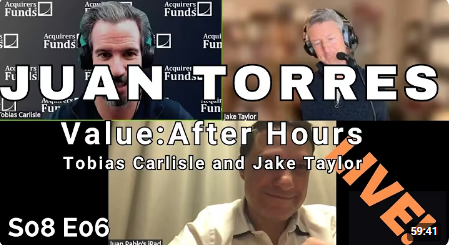
During their recent episode, Taylor, Carlisle, and Juan Torres discussed Should You Hedge EM Currency Risk?. Here’s an excerpt from the episode:
[Juan] So we don’t. And the reason for that is the following. We go into a situation with the mindset that we’re going to own whatever business we buy for at least five years.And the reason for that is whatever is happening, there’s uncertainty. Whatever the problem is, it will take some time to get sort out. And so if you are going to hedge the currency, it’s going to be extremely expensive to do it if you’re going to hold that security for the next five years.
The other thing is, and it’s not perfect, but the aspiration is that when you are entering a country where there’s a lot of uncertainty, that uncertainty is already priced in across the board. It’s already showing up in the sovereign yields, in the corporate bonds, in the equities and in the currency. So it’s not perfect.
You might still find yourself in a could keep falling. But we have found over the past that once we get into a country where there’s a little bit of panic, the sell-off has already sort of happened, or that’s at least the hope. And we tend to think in terms of dollars.
We understand that we think in terms of dollar returns, which is what matters. So it doesn’t really matter if you buy. I pitched Telecom Egypt when I was joining Troyes back in 2017.
That was my pitch to them. And in local currency, it did amazingly well, like 100%. But in dollar terms, it was flat or five or 70, whatever it is.
And so, yeah, I mean, you didn’t lose money, but it wasn’t great.
[Jake] Well, and then theoretically, a lot of times there’s an export-driven component to these businesses, I would imagine. And therefore, a little bit of currency devaluation actually kind of helps you be more competitive on an export basis. [Juan] Yeah, 100%. Especially if you are investing in businesses that are cyclical in nature, your commodities, or businesses that have a footprint that is more global than local. [Jake] Another question. Is there anything that any countries that are no-goes for you? And what would be required for you to put on the do-not-invest list for you? [Juan] So, no. I think that there is no such thing as an investable asset. It’s all about the price that you’re paying for the asset and whether or not you’re being compensated for taking that risk. [Jake] How about Mars, though? Are you ready? Is that EM enough?Or is that frontier?
[Juan] Yeah, exactly. But having said that, I mean, it would have to be, from a regulatory perspective, mandated that you cannot actually invest in those specific countries. Now, having said that, look, every time that you read about finance theory and markets and investing, the textbook example is always like, you need to buy something super cheap that’s going to grow with a very good balance sheet and all of that.And you know where you find a lot of that? In frontier markets. But frontier markets are very risky for a reason.
And they are less liquid and they are more prone to changes in the macro and political environment where you might get stuck in a way that, well, actually, that’s what the price is telling you. That’s why it’s a two times pay or whatever. And so, it’s not an investable.
You just need to be very careful. We always tell clients, when people are pitching EM as an asset class, it’s an amazing asset class. It has, from a macro perspective, all the growth going forward, the demographics, in some places, the youth, the younger populations, the GDP per capita.
But the one thing that they never say is that EM as an asset class is a risky asset class and you need to be compensated for taking that risk. And so, just don’t get carried away. You know, Joel Greenblatt’s book on special situations in the 1990s, when he was talking about bankruptcies, he said, approach them with an open mind, not a hole in your head.
I think that applies to emerging markets all the time.
[Tobias] Do you travel to the markets? What does that achieve? How important do you think it is? [Juan] So, I’ve done it in the past. My manager, Vera German, she has done it as well. Over the course of the last five years, since we launched the strategy, we have not really done any visiting.I believe that it’s important to travel to many of these countries, just because just by being there, you understand what that culture is and how it operates and the different brands and the shopping mall and the stores and all that. But doing the visits to the companies, number one, many of those companies will come to London at some point. And number two, all of the information that they can give you, it’s already publicly disclosed somewhere else.
And so, what you don’t want is, or what we try to avoid is being biassed by the narrative that management might bring to the table. And we try to allow as much as possible for the numbers to do the talking.
You can find out more about the VALUE: After Hours Podcast here – VALUE: After Hours Podcast. You can also listen to the podcast on your favorite podcast platforms here:

 Breaker

 Overcast


 RadioPublic


 Stitcher

 Closed-End Fund Investing: Buying Assets Below Net Asset Value
 Where Is the Deep Value in Small and Micro Caps This Week?
 AI Stock Market Bubble: Can the Technology Succeed While Stocks Crash?