
VALUE: After Hours (S08 E05): Inflation Data Problems, Fed Rate Cuts & Housing Risks — Macro Outlook Explained
Wednesday, February 18, 2026 · Johnny Hopkins
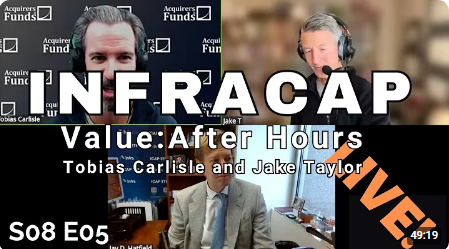
During their recent episode, Taylor, Carlisle, and Jay D. Hatfield discussed Inflation Data Problems, Fed Rate Cuts & Housing Risks — Macro Outlook Explained. Here’s an excerpt from the episode:
[Jay] So we, I would argue have very unique macro research on our website. So this might, so we’re not really going to say things you’ve heard all the time.Our biggest concern probably is this ongoing problem with the BLS reporting inflation data. Specifically the shelter component is buying a design six months delayed. So it’s sort of like we were doing this podcast and then you just wait six months to issue it.
That’s not a good policy, obviously, but then they use renewing rents and they also, which are, you know, if you’ve ever either rented or been a less or typically hold back on all the increases, so you don’t create turnover. So that delays it further. And then they use terrible seventies style data data collection, which they call people and do little panels.
And so for that reason, you can see this on our website. Inflation has been overstated PC core. If you use modern data collection, like the internet developed since the 1970s Zillow and apartment lists, you’ll see the target inflation’s already at two.
And so our fear is that BLS keeps blowing the reporting of, of inflation and we don’t get the three rate cuts we need. And that’s important. Nobody seems to focus on it, but we have a recession going on in residential housing and construction.
And that’s causing the labour markets slow. And people are confusing that with a whole bunch of other things, tariffs and other things that needs to get fixed to have good economic growth this year. And so that’s our big concern is that the data doesn’t reflect what’s already happened, which is relations well-contained and rates are way too high.
And you can see that by the way, money supply is shrinking, which is very dangerous. Typically you have a recession when the money supply is shrinking. So it’s really all around the fed.
We’re kind of okay with worse this year, even though he’s an ultra hawk because he must have promised the president he was going to cut rates. And maybe he understands this issue with the BLS. Longer term, we’re concerned about worse, but it’s probably not today’s or this year’s business.
[Jake] Jay, one thing I noticed, I saw a chart that showed the healthcare expenses and premiums. And apparently it was derived from some tautology of profit within healthcare company insurers and not from actually what the premiums I pay for my employees, which were definitely not down 20% over the last five years, if anything, doubled. So what’s going on there? [Jay] Well, that’s a good example. It goes the other direction, but there is a lot of complete nonsense that’s put out by the BLS. And I agree that our company had a 20% increase in healthcare premiums.So there are these strange methodologies that are used. I mentioned shelter for financial services. So our business, if the stock market goes up, that’s treated as inflation because people are paying higher fees because the AUM goes up.
Healthcare is the opposite. And maybe we’re fortunate, at least if you want lower rates, that that doesn’t get properly reported. But I also give that as an example of why I fear Warsh, because he is probably the biggest proponent of this completely made up 2% inflation target.
So for instance, we could have pretty modest real inflation, which comes from the expansion of money supply, but maybe a little tick up because Medicare or medical inflation is surging. And so he overreacts to that and raises rates dramatically like he did in the 2000s, which precipitated great financial crisis. If you really think about it, raising rates is not going to lower our insurance premiums.
It’s a true supply shock or it’s just, it’s maybe not even a supply shock. It’s just that in the US we have the best healthcare in the world, worst way of paying for it, but the best actual healthcare. And it keeps expanding.
So we’re probably not picking up the quality factors either, but it certainly doesn’t- There’s lots of hedonic adjustments, right? But who knows what the hell direction- So that’s a good example, one where it goes the wrong way. I agree with you.
When I look at medical inflation and it’s like 0.1 or something, I’m like, I don’t know how you’re calculating that. But most of the other ones are overstated. But my real issue with Warsh is we’ve had very strong prosperity since World War II.
So outside the 60s, 70s, and 80s, which were damaged by oil price increases, when inflation, so outside that period, inflation averaged 2.7%. So not 2, but 2.7. So why don’t we care? Why don’t we have a target that’s 2 to 3%? The pushback is that, oh, inflationary expectations will become unanchored.
That’s the most ridiculous theory of inflation ever created, yet gets repeated constantly. So it’s an urban myth. In our models, inflationary expectations are deflationary because the only real place it gets reflected is in bond prices.
So yields rise, bond prices drop, and that tightens up the mortgage market, which tightens up the housing market. The notion that individuals can have high expectations and get higher wages is ridiculous. If you look back over the last couple of years, for Democrats, the Michigan survey, they thought inflation was going to expand at 10% and Republicans at 1%.
Sort of like asking whether you like the bad bunny or not. It’s like, oh, 90% of Democrats do and 90% of Republicans don’t. But believe me.
So the notion is, oh, if you have high expectations, you’re going to get high wage increases. The Democrats didn’t get 10% increases and the Republicans won. Nobody got any increases.
There’s no market power left in the US economy. So this whole expectation series is completely bogus. And therefore, it would not be an issue if we loosened up that target.
And then we could have certain sectors like medical care rise, but not try to precipitate a recession to deal with that. So that’s my fear with Warsh longer term. I think he’s going to be okay in the short run.
But this notion that we can precisely calculate inflation is ridiculous. So that’s why we need a band so we don’t have the volatility that we had. So keep in mind that inflation was barely above two, like basically two.
And the Fed raised rates 17 meetings in a row. We cannot have that. We should all be on the warpath to try to educate Congress, the Senate, and eventually the Fed, that that is a horrible, horrible target and needs to go away.
[Tobias] Jay, what do you think about the idea that the yield on the two-year is a pretty good proxy for the federal fund’s effective rate? And we should be guiding towards that because I track those two and I think it’s been a pretty good… I think it’s led the federal fund’s effective rate pretty effectively for as far back as I can go on the data.That’s an idea from Tom McClellan, McClellan and Oscillator. I don’t think I’ve seen it from anybody else.
[Jay] Well, I always use interviews and questions and comments to learn. So I should look at the two-year more, but I’ll give you the real key to trading bonds is look at the Fed fund’s terminal rate, which right now I just looked it up on Bloomberg. It’s 3.17. So you can be a perfect 10-year bond trader. If you just know that number, then you add 110 base points, then you’ll know exactly where the 10-year is going to trade. So I think the two-year obsession is a little bit probably misleading, but to be honest with you, you need to track it a little bit more carefully. But we have a chart on our website, and like I said, you can get tremendous data you won’t get anywhere else in the world.And so right now, my rule would turn you into a perfect bond trader. And by the way, when the yield curve is not inverted and the Fed’s not tight, it’s not the terminal rate of Fed funds, it’s the actual rate of Fed funds. I mean, there’s the same, but you can see both of those calculations that normally the 10-year trades 100 over Fed funds.
Fed funds trades 75 over the inflation rate. So it’s normally right around 275. So I’ll study a little bit more, but I would say you’re going to have far more clarity if you just focus on those two elements.
And we even trade Fed fund futures. We’re actually making pretty good money. Well, sort of irrelevant amount of money, but we’re long the December contract because people just got way too bearish about cuts.
So right now, going back to that same screen, like now we’re up to 55 base points of cuts this year. We think we’re going to get to 75 by the end of the year. When Warsh was nominated, it was at 45, but that’s really what’s driving the 10-year.
So I wouldn’t focus much on the two-year, but I’ll go and look at those correlations. But I always find like when I go on TV or radio, everybody’s like, oh, well, the yield curve steepened. And I go like, no, it hasn’t.
It’s still 100 over the Fed funds rate. So it hasn’t steepened. Like I guess the 30-year steepened, but the 30-year is really irrelevant.
Nobody prices anything off the 30-year. Like mortgages, I focus the one financial condition that matters is the 30-year mortgage because that drives housing. Housing usually causes recessions.
We have that data also on our website. Didn’t this time because it was offset by AI building boom, not just the technology, but also the chip plants and other infrastructure. Well, although investment’s zero, it’s actually not, the two are netting to zero.
So it’s not helping growth, but it’s not causing recession. But if you watch the money supply housing, you’ll call at most every market turn. And so if you watch Fed funds in the 10-year, 30-year mortgages priced off the 10-year, you got 90% of the battle.
And I think people are just confusing themselves by looking to the two-year. It’s not what the Fed controls, and it’s not the most critical element, which is Fed funds.
You can find out more about the VALUE: After Hours Podcast here – VALUE: After Hours Podcast. You can also listen to the podcast on your favorite podcast platforms here:

 Breaker

 Overcast


 RadioPublic


 Stitcher

 Closed-End Fund Investing: Buying Assets Below Net Asset Value
 Where Is the Deep Value in Small and Micro Caps This Week?
 AI Stock Market Bubble: Can the Technology Succeed While Stocks Crash?