
VALUE: After Hours (S08 E05): How Income Funds Generate Alpha: Macro Investing, Covered Calls & Security Selection
Thursday, February 19, 2026 · Johnny Hopkins
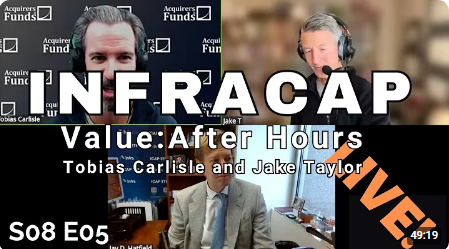
During their recent episode, Taylor, Carlisle, and Jay D. Hatfield discussed How Income Funds Generate Alpha: Macro Investing, Covered Calls & Security Selection. Here’s an excerpt from the episode:
[Jay] Well, on the fixed income side, it’s pretty straightforward. It’s like playing basketball or soccer with no opposing team because you have to manage the risks inherent in fixed income that don’t exist with equities. So that’s, in short, call risk, credit risk, interest rate risk.And there’s also opportunities on the new issue side and arbitraging the index funds, particularly preferred because they’re pretty illiquid. So that’s pretty straightforward. And that’s why we’ve doubled the returns of the index with PFFA and BNDS has beaten it, not by as much, but it’s not as inefficient.
On the equity side, to your point, it can be more challenging to generate alpha with equities because for two reasons, passive funds are calculated, which can be a phenomenal strategy because in effect, you’re a momentum trader. And by the way, that’s a terrible thing to do with fixed income. Because it’s callable par.
So the higher it goes, the more you should sell it. But index funds do that. So that accounts for why we’re so confident about beating on the fixed income side.
On the equity side, there’s two dynamics that give an advantage to index funds, the momentum and also sometimes the dumbest securities go up the most. So meme stocks or I don’t believe that Tesla should trade at 220 times earnings, but maybe everybody else does. And so my analysis doesn’t really help.
It may hurt even. It’s better just to be like, oh, silver, it’s at 80. It’s probably going to go to 180 and just play the momentum.
But what’s in our favour is exactly what you mentioned. So we are, I would argue, really great at macro. You can access to our macro slides, our highly proprietary data that you won’t get anywhere else like the global monetary base, et cetera.
And so we have a macro view. And based on that view, that drives our stock selection. So for instance, about a year and a half ago, we were at Midtown Manhattan.
So that helps a little bit. And I used to be an investment banker, Ty. So it became obvious when the Trump administration came in that there was this huge pent up demand for M&A.
Rates are coming down, huge issuance on fixed income side, likely to be AI related IPOs. So we got really long, all the investment banks. And that works spectacularly well.
But it was driven by the macro, like rates are coming down a little bit by analysing the political situation. So you can use your macro skills to pick stocks. We use a GARP model, so growth at a reasonable price.
So that’s why we hate Tesla, because it’s really not growing and it trades at an unreasonable price. Which like I said, get outsmart yourself. I wouldn’t recommend shorting it.
But we’re okay missing out on the Tesla opportunities. But what you don’t want is to be like, it hasn’t happened yet, but it may be in pound tier at like a peg of eight. So the PE to growth ratio is like seven or eight times.
And then if they miss, it goes down 60%. So we want to avoid the down 60s. We’ll give up a few game stops.
I mean, actually Tesla’s underperformed over the last five years, but in the earlier years, we might’ve given that up. There might’ve been times where it was trading at reasonable pegs, but I mean, I would have to go back and look. But so we do think that being disciplined on the valuation side can add alpha, but more importantly, writing very short term covered calls on individual stocks, where you have a gain and where it’s close to your target based on GARP or peg type valuation metrics can be a phenomenal approach, particularly if I have a diversified portfolio, because what you also capture is overvaluation in certain sectors. Like over the last couple of weeks, for instance, I would argue that consumer staples got pretty fully valued. So like we’re in Coke and ICAP, and some of that was getting called away, but then it’s not like getting crushed, but it’s off a couple of bucks.
So what it does is it forces you to rotate out of fully valued sectors like utilities. We’ve sold Southern Company is a 91, but we’ve sold calls at 98, a hundred and have some of that called away. So when you do it on individual stocks, you’re not taking losses, you’re taking gains and you’re forcing yourself to recycle into better valuations.
And you don’t do stupid things like during the tariff tantrum, we didn’t write any calls because we didn’t have gains and it wasn’t near our target. And so, whereas if you look at most of the call writing funds, they’re just mechanical. Like they always have calls written out two or three months and they redo them regardless of fundamentals.
So they’ll redo them when there’s a tariff tantrum or the market goes down irrationally, like it kind of did over the last three or four days. And so then, and if it’s an index call and it goes into money, they’re just taking a loss. It’s not like selling Southern at in the high nineties when you have like a 20% gain.
So that’s the, we think tremendous value added or alpha. And then opportunistically running a little bit of leverage when the market’s good can get you a little bit better returns. So short answer is if all we could do is pick stocks, we still could probably beat, but it would be harder if we can write bespoke short-term covered calls, little, I would argue heavily stock to deck in our favour.
And then a little bit of extra income from a little bit of leverage on preferreds in most markets while at alpha. So we’re kind of stacked, not super easy, just pure equities, but we stack the deck in our favour by having these kind of hedge fund light strategies, running a little leverage and writing covered calls.
[Jake] What makes that covered call market inefficient? Like where there is kind of a, sounds like a free lunch. [Jay] Well, a lot of times my kids ask me like, who the heck is buying these call options? [Jake] That’s a good way. That’s a better way of asking the question perhaps. [Jay] And to some degree, it is what I would argue somewhat irrational retail investors. So like in our hedge fund, we don’t do this in our ETS, but we’ll write micro naked 1000 micro strategy calls. And I would argue that’s just pure irrationality on the part of retail investors.But to some degree, it’s also just, and even when it’s a mechanically just being done by market makers, the volatility of micro strategy might be driven by retail investors, even though they may be the ones making markets like that. But where I would argue the alpha is coming from is not us analysing, oh, well, the volatility is 3% above or below where it should be, but overlaying fundamentals on what’s mostly a technical market and having a bias towards selling options. Like there are services that tell you, oh, it’s much more lucrative to buy options and you get a higher return, but they failed to recognise that the decay of options makes it like you’re going to casino and the casino is raking off 10%.
And so what we’re doing is the opposite of that. We’re selling risk to the street and sometimes directly to investors. But the fact that that risk we’re selling decays over time stacks it at odds in our favour.
And since we layer them one week at a time out, even when it looks like we take a loss, the stock gets called away and we replaced it with other stocks. So we maintain our exposure to the market. So it’s not so much that there’s just a bunch of idiots out there buying call options.
It’s more that we’re just taking advantage of the fact that the probabilities are stacked in your favour by having theta or decay in your portfolio, and then managing your exposure. This is really what the street does on the other side of the trades, managing your exposure to the market because they’re short a bunch of calls and they have to be long other securities. So if you constantly monitor your exposure to market, you’re really not taking that much risk.
So if you love, like right now, I guess, trying to pick a good example. So we love KKR. I think that everybody’s freaked out for no reason.
We might write a call. We’re actually not writing a lot of calls on that, but let’s say we did a 120 and it’s at 210 right now. I mean 220, it’s at 210.
Then if it ran to 220, we might just buy some stock and then let that get called away over the next week or two. So if you actively manage that selling of calls, then it can produce alpha. If you just sit around and go play golf during the day, then half the time you would be capped out on big returns and you would have a lower return on your overall portfolio.
It requires you to be a bad golfer. So you have to be looking at your screens all day or else, as you’re implying, the times when you get capped out on some stock would offset all the decay of the portfolio. So you have to manage your exposure to the market and your exposure to your ideas to make sure they don’t get called away and then you lose all the upside.
You can find out more about the VALUE: After Hours Podcast here – VALUE: After Hours Podcast. You can also listen to the podcast on your favorite podcast platforms here:

 Breaker

 Overcast


 RadioPublic


 Stitcher

 Closed-End Fund Investing: Buying Assets Below Net Asset Value
 Where Is the Deep Value in Small and Micro Caps This Week?
 AI Stock Market Bubble: Can the Technology Succeed While Stocks Crash?