VALUE: After Hours (S08 E03): The Four Idols of Investing: Wealth, Power, Pleasure, and Honor
Thursday, February 5, 2026 · Johnny Hopkins
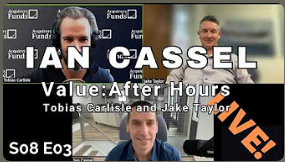
During their recent episode, Taylor, Carlisle, and Ian Cassel discussed The Four Idols of Investing: Wealth, Power, Pleasure, and Honor. Here’s an excerpt from the episode:
Jake: Yes, sir. So, we’re going to be talking about the four idols. There’s this strange thing about investing that we probably don’t talk enough about. On the surface, a lot of times it looks like math, where it’s discounted cash flows, expected returns, risk premia, etc. All very clean, all very rational. But anyone who’s spent real time in markets like Ian has, they know that investing is not just this technical exercise. It’s the psychological one. And even more than that, it can be a moral one.
Markets don’t just reveal information, they reveal us, ourselves. We can learn about ourselves a lot in markets often paying high tuition for that self-knowledge. It’s easy to forget that stocks– They don’t care who owns them and they don’t care how much you paid for them either. We can discover often what we fear, what we want, what we think will make us feel safe or important or complete.
Nearly 800 years ago, this guy Thomas Aquinas made an observation that still feels quite modern. And a little bit of background about old Tom there before we get in, because he’s a bit of an interesting character. He was born into a wealthy noble family in southern Italy. They expected him to become this powerful Benedictine abbot and essentially like a feudal lord with spiritual overtones to it. And instead, he joined this other Dominican order which was this new– I think the term is mendicant. He committed to the basically like poverty, studying and preaching. His family was absolutely furious with him. At one point, his brothers kidnapped him and imprisoned him for a year, attempting to force him coming to abandon the Dominicans and come back to their side.
He was famously this really large and quiet and socially awkward guy. His fellow students nicknamed him the Dumb Ox, because he spoke like so little in class. One of the strangest facts about him was that near the end of his life, he just abruptly stopped writing. He had this mystical experience during a Mass in 1273, and he reportedly said that, “All that I’ve written seems like straw to me.” He’s just like, “I’m over it.”
Anyway, back to Thomas. He argued that human dissatisfaction doesn’t come primarily from hardship or scarcity, but from actually misdirected desires. So, when people take finite things and then they ask them to deliver this infinite meaning to them and then they risk turning these things into idols in the religious sense. He identified four idols, specifically. Wealth, power, pleasure, and honor. Each one promises some flavor of fulfillment to you, and each one activates real psychological reward systems inside your brain, and then each one ultimately fails you if taken too far.
So, modern writers like Arthur Brooks have translated a lot of this into more secular language for us. But it is dopamine loops, it is hedonic treadmills, status reinforcement, all these things. Short-term happiness never quite becomes that lasting feeling of well-being that you’re really chasing after. These idols show up in the investing world as well. So, what I want to do for the rest of the segment is walk through these four idols, not as this abstract philosophy, but maybe as investor archetypes. You’ll see these idols manifest in others. If you’ve been investing long enough, you might even recognize some of these in yourself.
So, let’s start with the first one, which is money. Not money as a tool or money as a means to live a good life, but money as giving you meaning, and as the thing that will finally make everything feel okay for you. Aquinas warned that wealth is uniquely deceptive, because it looks infinitely expandable. There’s always more to earn, more to optimize, more to protect. And unlike food and shelter, wealth never really tells you when you’re done. There’s no real satiation to achieve, potentially.
So, in modern markets that idol produces what maybe we’ll call the accumulator. That’s someone who they’re investing primarily as a mechanism for maximizing net worth. Portfolio size becomes the scoreboard. Their conversations are around net worth. It’s really stripped of any reference as to what’s the meaning of the money for them, what can you actually do with it in the real world. They like watching the numbers go up, because it feels like progress, like competence, like armor against uncertainty. And of course, saving money is all to the good. I would never argue against that. But there’s a trap there that once basic comforts are met, that additional wealth doesn’t produce the emotional returns that you would want. Especially if you have this, the hole in your soul that you can’t feel like, money’s not going to do it.
So, let’s jump to the next one, which is power as the idol. This is a desire to command outcomes, to impose order, to eliminate randomness. And for Aquinas, power tempts because it offers this illusion of self-sufficiency. If your control of everything is total, then you have no vulnerability. So, in markets, this might be called like the controller. We’ll use as a generic term. It’s primarily focused on returns in isolation and focused on– It’s not necessarily the returns. It’s about having the agency, influence, shaping events rather than just participating in them.
So, the archetype is probably activist investors pressuring management, or maybe even macro traders who they’re trying to outguess central bank pronouncements. You feel like you have this control over the system, because you understand it. Action itself becomes the psychologically rewarding sense of urgency. And so, you want to feel smart and decisive and relevant.
But markets are nonlinear. They’re not mechanical. They’re complex adaptive systems. Control over any complex adaptive system is illusory. This dissatisfaction loop appears where reality just doesn’t comply with what you want it to do. This can be incredibly frustrating. Each failure then demands more intervention, more leverage, more complexity, more confidence in the whole scheme. And eventually, market enforces that humility, sometimes violently. And then, basically, your pursuit of power will collapse under randomness eventually.
So, third idol, pleasure. Aquinas understood that pleasure is inherently transient. It exists only in the moment. It can’t be stored. It demands constant novelty as well. So, in markets, this might be called the speculator. You’re treating investing as stimulation really. Volatility isn’t risk. It’s the whole point. I want action, options, crypto cycles, meme stocks, rapidly shifting strategies. You need that action. Maybe today, now, it’s rooting for that team to go for two to cover the spread. [chuckles] I think we’re living in a world where the speculator is having their moment. But the objective isn’t long-term business ownership, it’s an emotional engagement. The payoffs are usually need to be immediate to hit that dopamine, and losses at least got your pulse up. And of-course, social media is terrible for amplifying all of this.
Even your near misses reinforce bad behavior of like, “Well, I almost won. I better get back in there and double down.” But of course, pleasure has a short half-life. Yesterday’s thrill becomes today’s baseline. And to feel that same intensity of the feeling, the stakes have to increase. The frequency, the leverage, like you can’t just sort of like stay in place there as that hedonic treadmill again. So, when often what starts as excitement ends in exhaustion and ruin.
All right, last one idol. The fourth idol is honor. Not the way that we think of it as today we might call– Like, “Oh, this is an honorable person.” This is more like fame, prestige, recognition, people thinking that you’re smart. Aquinas warned that honor in this context is uniquely unstable, because it depends on other people’s opinions of you. It’s not about yourself. So, they can grant it or withdraw it from you at their whim, not at your consent. This idol, we might call, the narrator.
They invest not just for returns, but for recognition. Like, you want to be right, and that matters a lot more than even the financial gain. You want to prove everybody else wrong. Visibility becomes the currency. Platforms, Twitter, podcasts, conferences, you want to turn investment views into this public scorecard that has this psychological payoff of social validation with followers, and likes, and invitations, and all this stuff. Michael Lewis writing your story up, but you know–
It feels good to get things correct and have the proof of it and to show off to the world. But markets are cyclical, reputations can be fragile to these things, that dissatisfaction loop that comes from it– When the performance diverges from the narrative, these public positions then become identity traps, and you fall prey to them in this commitment-consistency bias way. And now, updating beliefs feels like you’re waffling or some self-betrayal, no one wants that feeling. So, honor pursued too far as an idol converts investing into almost this theater of you showing off. Maybe even when it’s at its worst, you’re pulling ticker names out of a scrabble bag. [chuckles] But the portfolio becomes secondary to this persona.
And so, to be clear, none of these idols are inherently evil. Money is useful. Power can catalyze change. Pleasure is part of life. Honor can reflect real contribution. The problem is is not their presence. It’s their elevation above everything. It’s when they get taken too far. Markets are very expensive mirrors to discover yourself. Eventually, though, they do provide an accurate reflection.
I want to give a little tip for everybody to wrap things up to make this a little bit more practical. Before you place the next trade, ask yourself this rude little diagnostic question, which of Aquinas’ idols might I be feeding right now? So, more specifically, is it money? If I doubled my net worth today, what would I stop doing, and why haven’t I stopped already? [Tobias laughs] Can I practice stewardship instead of hoarding? Is it power? Where am I confusing activity with control?
Practice humility instead, build a process that expects randomness and can survive being wrong on occasion. Is it pleasure? Which investments are actually just entertainment with a ticker, instead practice temperance. If you want entertainment, buy it honestly, don’t disguise it as investing. And then, lastly, is it honor? Where am I defending a story because it’s mine, not because it’s actually true. Instead, practice integrity, follow your own inner scorecard, and let being right be incidental part of it, and not this metaphorical hill that you’re willing to die on. The end.
Tobias: Brilliant, JT.
Ian: Yeah, great job.
Tobias: Harsh. Brutal.
Ian: Yeah.
Jake: Thomas Aquinas brought the brilliance. I just recycled it.
You can find out more about the VALUE: After Hours Podcast here – VALUE: After Hours Podcast. You can also listen to the podcast on your favorite podcast platforms here:

 Breaker

 Overcast


 RadioPublic


 Stitcher

 Undervalued Private Credit Investing: Finding Value in Discounted Lending Funds
 Where Is the Deep Value in Canadian Stocks This Week?
 Investing Beyond AI: Why Traditional Businesses Could Still Thrive