
VALUE: After Hours (S08 E03): Ian Cassel on MicroCapClub, the PlanetMicroCap acquisition and IntelligentCM
Sunday, February 1, 2026 · Johnny Hopkins
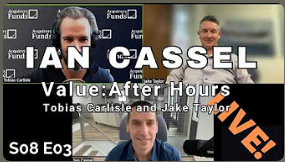
During their recent episode, Taylor, Carlisle, and Ian Cassel discussed:
- Why Even Elite Investors Are Only Right Half the Time
- Letting Winners Run: The Difference Between 20% Gains and 1,000% Returns
- Rabbits, Assassins, and Hunters: How Investors Really Lose Money
- The Four Idols of Investing: Money, Power, Pleasure, and Honor
- Ian Cassel on Acquiring Planet MicroCap and Building the Microcap Flywheel
- Why Microcaps Are Outperforming in 2025 — And Why That Might Be a Warning Sign
- Should More Small Businesses Go Public? The Real Costs and Benefits of Being Public
- Gold, Copper, AI, and Data Centers: What’s Driving Microcap Winners Right Now
You can find out more about the VALUE: After Hours Podcast here – VALUE: After Hours Podcast. You can also listen to the podcast on your favorite podcast platforms here:

 Breaker

 Overcast


 RadioPublic


 Stitcher

TRANSCRIPT
Tobias: And we’re live. This is Value: After Hours. I’m Tobias Carlisle, joined as always by my co-host Jake Taylor. Our special guest today, Ian Cassel, one of our faves. The maestro of microcap, the maven of microcap. How are you, Ian?
Ian: Doing great. Thanks for having me on. It’s always a pleasure.
Tobias: You’ve got some big news. You have acquired Planet MicroCap. Tell us about that.
Ian Cassel on Acquiring Planet MicroCap and Building the Microcap Flywheel
Ian: Yeah, we did a collaboration with the Krafts and Planet MicroCap. Planet MicroCap, they’ve run in-person events in the microcap ecosystem here in the United States for, I think, 14, 15 years. MicroCapClub, we joined up with them in 2025 and to see how it would go, because quite honestly running a large events like planning a large wedding every year and I didn’t feel like doing that. And that’s what they’re good at.
Jake: A nightmare. [laughs]
Ian: Yeah, it’s a nightmare. So, I really wanted to see what we would do if we could join forces with them, and have a larger event, and it would get the word out obviously in MicroCapClub, too. We had a bunch of carved out perks, and we had our own clubhouse at the event, and so we were very visible. After we did the one in Vegas, which was a huge success, I think the companies thought it was and everybody involved thought it was pretty obvious that we should probably join up officially and be under a shared vision.
So, just seeing the synergies of the in-person events, pushing people to the online community and then the online community pushing people to the in-person events just seeing that flywheel spin made a lot of sense. That’s really the game plan. Really just last 15 years and you guys presented at our events that we had for MicroCapClub. It’s really just to expand the space and bring people, bring high-quality companies, investors, stakeholders into it, and that’s how we make the space better, and that’s what this acquisition helps us do. So, I’m excited about it. So, yeah, we have a Las Vegas is coming up June 16th, the 18th. It’s at the Bellagio. We already have I think 220 investors signed up already, even though it’s six months away.
Jake: Excellent. Is it hot in Vegas in June?
Ian: It’s going to be very hot in Vegas. [Jake laughs] The last year–
Tobias: As if you’re going outside the casino.
Jake: : I know.
Ian: It’s going to be torture, because last year it was in April, and that was pleasant being outside, but June’s going to be a little bit different. [crosstalk]
Tobias: It’s so hard to find your way outside. How would you do it?
Ian: Yeah, it’s true. [laughs] Everything just leads to the casino anyway.
Why Microcaps Are Outperforming in 2025 — And Why That Might Be a Warning Sign
Tobias: What’s been happening in the microcap space over the last 12 months?
Ian: I think it’s pretty similar to what’s been happening in the overall market. It’s risk on. Well, first time in a few years, you’ve seen the IWC, the iShares Micro-Cap ETF outperform the S&P in 2025.
Jake: We’re back, baby.
Ian: Yeah. I was talking to Charles Payne on Fox Business the other day about this. I was like, “And that’s not necessarily a good sign.” Because it’s usually an indicator that the bull market is close to an end when-
Jake: Right. Even these guys would rally.
Ian: -basically, a whole bunch of profitable microcaps are outperforming the S&P. [laughs] But we’ll see. I don’t want to say that the end is near, but it’s certainly getting nearer. But yeah. So, I think it’s very frothy and just like in any bull market, everyone is all cashed up, everything is reacting to news. 8 out of 10 stocks are going up, so you think that you’re awesome and skilled. If we get a neutral or bear market environments that 8 out of 10 turns out into 1 out of 10 when the market doesn’t go up four out of five days. So, I think it’s a good time. It’s much more fun to be an investor in this environment, but also to be cognizant of likely where we are in the cycle.
Tobias: Do you see many new issues in microcap land?
Ian: Yeah, I think less than there used to be 10, 20 years ago. Just in generally, I think there’s usually a couple hundred a year that come into the microcap ecosystem.
Jake: And how about dilutions where you’re–
Ian: Yeah. Right. Exactly.
Jake: That’s the new equity– [crosstalk]
Should More Small Businesses Go Public? The Real Costs and Benefits of Being Public
Ian: Yeah, that’s been a big thing for me, too. One of my main things is like, let’s get some good small, profitable companies that are growing to come public, let’s show them why, because everybody talks about in the financial media about how companies shouldn’t be going public, they should stay private longer. A lot of people don’t talk about the benefits of being public, which, the benefits of being public is the multiple that you can get if you’re public versus private.
You could sell toothpicks. If you can grow 10%, grow the bottom line 25%. If you can do that five years in a row, you’re going to get a 20 P/E. You don’t have to sell to private equity for three times cash flow, and so that’s the benefit. If you believe in yourself as a small business owner that you can consistently grow the top and bottom line– Yeah, 95% of folks shouldn’t be public, but there are probably a lot more that should, that haven’t even considered it because they think the cost is very high, which it is, but it’s not as high as what’s been publicized.
Jake: Yeah. Where is that now? Last I heard, it was like about a million dollars to stay compliant, but does that come down?
Ian: I would view it this way. If I want to drive from Pennsylvania up to New York City, I can take different types of cars. I can take a Ferrari or I can take a 1992 Honda Civic. So, there’s different ways to get the same destination. I think for those that are frugal that aren’t looking to use consultants for every single decision, I think that it can be a lot less expensive than the numbers that you see printed in articles. And yes, you can spend as much as you want to. So, that’s the other side of it.
Jake: I always felt that way running a fund where you’d hear people, “Oh, it’s going to be this much operating expenses.” It’s like, “What you talking about? I ran a fund on a 10th of that money.”
Ian: No. Yeah.
Jake: What are you doing? Maybe I’m totally missing the boat here.”
Ian: Yes, exactly.
Jake: Not sure what you’re spending all this money on.
Ian: That’s actually a really good segue, too. It’s the same thing. Yeah, writing a fund, too. You just hear that it’s several hundred thousand dollars a year or whatever it is, and you’re like, “No, it doesn’t need to be.” [laughs]
Jake: Yeah. [chuckles]
Ian: [laughs]
Tobias: What sectors and industries have been interesting over the last 12 months, because they got cheap or got expensive or something happened?
Jake: Yeah. What’s falling down into the pond of microcap world?
Gold, Copper, AI, and Data Centers: What’s Driving Microcap Winners Right Now
Ian: Obviously, the big benefactors have been anything resources related gold, silver, copper, anything critical minerals related is doing well. You can just look at the TSXV, last year in 2025 I think was up 67% 68% for the year, which is funny. If you ever want to look at a funny historical chart, pull up a 20-year history of the TSXV. It’s like, literally, I think flat over 20 years. [laughs]
Jake: And then, just this hockey stick straight up?
Ian: Yeah, it’s like in commodities markets, it just goes straight up and it comes back down. [laughs] It’s pretty comical. What’s actually really funny is when you see some fund managers use the TSXV as a benchmark, because they’ll be like, “I’m up 400 over the last 10 years compared to the benchmark which is down 30 over 10 years.”
[laughter]Tobias: [crosstalk] benchmark.
Ian: So, I think those areas of the market obviously have that tailwind associated with them. Listen, the same thing that’s affecting the large caps comes down to us. Anything AI-related, data center related is doing fairly well. Yeah, I think that’s what’s been pushing a lot of these microcaps is the same things that are pushing the large caps.
Tobias: Any blockbuster returns, any names that have had a giant 2025?
Ian: I have to look at our performance that we track all the companies on the club that were profiled, but I would imagine a majority of them were resources. I know Almonty Industries. I forget the symbol up in Toronto. I think that was up like 1,200% in a year.
Tobias: It’s good to hear. [crosstalk]
Jake: It’s okay. That’ll do.
Ian: Yeah. Golconda Gold is up a 1,000% in the last 12 months. Again, some of these companies came from such low bases that it’s not maybe completely reflective of complete operating performance. It’s just that they were so under the radar even 12 months ago. It shouldn’t have been as low as what they were is what I’m trying to say. But I think a lot of the outperformance probably comes from those areas. There’s been some huge like AI winners that have come out of that category as well that we’ve seen on the club.
Jake: Conversely related to a tweet that you had recently about 100 different companies– If you surveyed 100 microcap, they have a hundred different favorite ideas, and they also hate the other 99 that everyone else would say.
[laughter]Jake: [crosstalk] What do you hate right now? [chuckles]
Ian: Yeah. I write that, but it’s so true. I look at ideas all day on the club and just through networking with your friends that are stock pickers and-
Jake: Yeah. Hate it, hate it.
Ian: -80% of the time you hear something new, you’re like, “Why would you like that? That is the dumbest thing I ever heard in my life.” It’s still after 20 years– But that’s what makes it so fun is that we all– [crosstalk]
Jake: Then it was up 1,200%.
Ian: Yeah, exactly.
[laughter]Ian: Yeah, that goes into it too. It’s like everybody, 10 times more investors like something after it doubles, so it’s just part of the crowd methodology with all of this stuff. The prices lead the narrative.
Jake: Insane.
Ian: Yeah. But it’s interesting. Actually, you’re a baseball fan, aren’t you, Jake?
Jake: Yeah, I am.
Tobias: To put it mildly.
Ian: Yeah.
Jake: Yeah.
Ian: So, I got a statistic to throw at you. I want to see if you know this one. So, who holds the record for the highest batting average in a single season in professional baseball?
Jake: Oh boy.
Ian: And you don’t have to answer.
Jake: It’s probably something from 1897 or something. A guy went 2 for 2 in a season or something– [crosstalk]
Ian: [chuckles] Well, no, this is based on a certain amount of at-bats, but I think most people would say like Tony Gwynn. I think he had a pretty good season of the 1990s.
Jake: Ted Williams was the last one to hit 400, right?
Ian: Yeah, exactly.
Jake: So, that’s the last benchmark.
Ian: He’s up there, too. Well, you would have never got this, because it’s not exactly fair how I framed this up. But the guy with the highest batting average, his name’s Gary Redus. He did it in 1978 for the Billings Mustangs, a minor league team.
Jake: Okay. Cheater. [Ian laughs] What did he hit?
Ian: He hit 462. What was interesting about that is I was looking at some of the stats around him, that was 1978, hit 462, he was paid $12,000. [Jake chuckles] That was less than what Ted Williams made in 1941 for hitting 400. I think Ted Williams made $20,000.
Jake: Yeah.
Ian: I looked at what the fan attendance was of the Billings Mustangs in 1978, and it was like 300 people. [laughs] So, it was only his close family and friends coming out and watching. I was thinking about that more. It is almost exactly similar to microcap investing. It’s like you don’t get much fanfare being a microcap investor, because you’re managing smaller sums, but you can [crosstalk] hit for slugging percentage.
Yeah, you might not be managing $10 billion in microcap and get paid 1 and 20 on it and, create that type of lifestyle for yourself. But you can do really, really well for yourself, your family in the microcap space. You might not get the fanfare. You might only have 400 people or 200 people in the stands, but it’s comparable to what I think to trying to hit [crosstalk] in microcap.
Jake: I like that. Yeah. [crosstalk] Is the pitching soft? Relative to the pros?
Ian: Yeah. Softballs. Yeah. [laughs]
Jake: Okay.
Tobias: Did he get the call up after that season?
Ian: I think he did go up for a year or two.
Tobias: Okay, it’s a tough game.
Ian: I need to dig a little bit more into that.
Jake: Hit 130.
Ian: Yeah.
Tobias: You had some comments about The Art of Execution. Do you want to take us through The Art of Execution?
Ian: Yeah. Yeah.
Jake: What’s the book?
Why Even Elite Investors Are Only Right Half the Time
Ian: I’ve been rereading the book The Art of Execution, which was written by a portfolio manager named Lee Freeman-Shor. And the book was written, I don’t know, maybe back in 2017 or 2016, almost 10 years ago. But it was really interesting, because he invested over a billion dollars with the world’s top fund managers. I think he invested with 45 of them. Some of them are billionaires, a lot of them on TV. He gave each one of them between $10 and $50 million. What he told them was they could only invest in their best 10 ideas, so 10 ideas only.
And then, over a period of several years, he tracked their decision making. I think a total of 1,800 or so total investments made across those managers over that duration or a period of time. He wrote this book on what he found out about it. One of the key things he found out was when he analyzed the data, the best stock pickers, fund managers in the world, investing their top 10 ideas, only 49% were winning stocks. So, basically, these great stock pickers, it was a flip of a coin whether that stock would actually go up or down. What was also interesting was the best-performing fund manager that he was with, he was right 3 out of 10 times. So, even, less than the average.
Tobias: That’s like VC-type distribution.
Ian: Yeah, it feels like that. It’s interesting, too, because I think if you would ask this question to stock pickers or fund managers, “What’s your hit rate?” They’re going to say 60%. They’re not going to say 40%, because it sounds like you’re a moron, because you’re right, 4 out of 10 times. You’re a professional. You’re getting paid to do this.
Jake: Yeah.
Ian: They’re not going to say 80%, because that sounds like you’re just being overconfident. So, everybody just falls– [crosstalk]
Jake: Well, it depends on how attractive the person is that you’re telling the story.
Ian: [laughs] Right. So, nobody says 40% or 50%, because it just– Nobody wants to admit that it’s a coin flip at least you’re right or wrong.
Jake: Yeah.
Ian: And so, that was one of the first points he made. But it also proved that the money is made after the decision, and the money is made on how you react to when stocks are winning or losing, if half the time they’re winning or losing.
Rabbits, Assassins, and Hunters: How Investors Really Lose Money
What he ended up doing was he put– In the book, he describes, these different tribes and– The people that were in the tribe of winning, he called them rabbits, assassins, or hunters. He put them in these three categories, like psychological tribes that you’re in with your winning.
And so, if you’re winning and you’re a rabbit– I’m sorry, I’m going to reframe this. Let’s go to the losing first. So, the three categories of losing are rabbit, assassin, hunter. So, if you’re a rabbit, he said this is the most dangerous category, because when a stock drops, the rabbit freezes, and it’s like a creature in headlights and they don’t do anything. Stock’s down 30%, 40%, they don’t do anything.
Jake: Shell shocked.
Ian: Yeah, exactly. They forget that a stock that goes down 50% has to go up 100% to get back to break even, let alone something that goes down 90% has to go up 900% to break even. And so, rabbits find themselves in holes, hence the name rabbit. So, that’s one category of psychological behavior that he witnessed.
Most of the investors that he invested in, he would say were assassins. They were traders. They had no emotional attachment to the companies. And so, if a stock dropped 20%, 30%, 40%, they were quick to kill the position. Just sell it. He was saying this was a good attribute to have, because you were limiting the damage, limiting the downside risk.
And then, the third one is hunter. This is the rarest breed. I think it was like 1% or 2 of the managers fell into this category. They actually were the ones that required a strong constitution and the ability to double down when the business was fine, but the stock was just dropping. One of the main takeaways was obviously that you need to be a mixture of assassin and hunter in this regard. Anyway, I was just rereading that. That was a three– And so, the two–
Tobias: Just before you move on from that, that’s not what I would have expected because I think that most people double down, don’t they? Most people keep on buying all the way down? Do you think that’s wrong? Is that characterization wrong? Do you think most people keep on buying on the way down?
Ian: It’s a good question. I do think that it’s more prevalent. People just average down just because a stock is down, not realizing that probably 80% of the time a stock’s dropping, especially if it’s not macro related, is probably because the business is deteriorating.
Tobias: Of those three options, so you can buy some more, you can ignore it and hope it recovers and just let it go to zero if it doesn’t or cut the position. I would have said cut the position’s probably– I guess it depends on the circumstances, but cut the position without knowing anything else, that’s probably the worst decision.
Ian: Yeah.
Tobias: Do nothing is probably the neutral position and buying a little bit more is probably the better decision given that you’ve done this work, you’ve done some diligence, you know something about this stock. The stock price can fall in a quarter 50% and nothing much has changed. I would have thought that blindly buying a little bit more that would have been the thing that most people do anyway and that would have been probably the better thing to do. But I don’t know, that’s an interesting finding.
Ian: Well, I think– [crosstalk]
Jake: Were there any commonalities of when you doubled down and it worked? [crosstalk] teased out of that.
Ian: He pulls in the hunter thread a little bit more. He talks about how it’s not just blindly averaging down. They were strictly tracking the business. They believe the business trajectory was the same, if not better than it was before, so it’s not just blind, you’re not buying it more because it just dropped.
Tobias: It’s hard to tell quarter to quarter on.
Ian: It is. No, it is. Like I said, these are just broad categories, Toby. I didn’t write the book.
Jake: Don’t overthink it, buddy.
Tobias: That’s what a podcast is for. Let’s talk about it. I got one of the world’s– Well, I do cap investors here I’m going to ask you.
Jake: Got time to kill. [chuckles]
Ian: Well, I do think that a segue from this is I do think a lot of the problems with lose– When you’re losing in a position, it’s usually a product of bad position sizing at the onset, I find.
Tobias: But if you just assume a random walk for every position that you put on, the market doesn’t know that you’ve bought it as much as you would like the market to know and immediately it turns around and start going up. The reality is that most of the time you’re buying them, because there’s some dislocation between price and valuation. So, as Einhorn points out, on the short side, if it’s half price, then one-third price is no more irrational than half price or two-thirds price or whatever it might be.
Ian: Yup.
Tobias: I don’t know, I think it’s a funny finding. I’m just interested.
Jake: I have a friend who quite clever, and he has a rule that if any position that’s down 20% automatically triggers a review, and he has to decide either you cut it or you add to it, but you can’t just sit there. So, you’re forcing to either be an assassin or a hunter, but you can’t be a rabbit.
Tobias: 20 is not much of a move, though. That could be noise at 20. 50 is more of a move. A third is more of a move.
Ian: Especially at microcap. So, it’s probably more relevant.
Jake: That’s just a–
Tobias: It’s going to be two days.
Ian: Exactly.
[laughter]Jake: He traffic sense of bigger names, so that’s probably maybe answer some of your question.
Tobias: Fair enough.
Jake: Seems like a good rule, though. at least can’t sit there and suck your thumb.
Ian: Yeah. I think the book is interesting just because it does divide it up into these categories. It makes you self-reflect a little bit about where you are, what you overemphasize or where your mistakes are and why–
Jake: Come out on the winner side naming these guys and– [crosstalk]
Ian: Why a tool like Journalytic is a good idea. Sorry– [crosstalk]
Jake: Oh, good idea.
Tobias: It reminds me a little bit of that– John Hampton, who’s the Aussie fund manager who does a lot of shorting, he had probably the best post that I’ve ever seen on it where he talked about doubling down or the conditions that you need to increase the position size. I forget who it was but over the last month or so who was talking about– I think it’s an old joke where people have lost 25% of the portfolio in one 8% position or something like that just because they keep on doubling down when it goes down. I don’t know if there’s any right answer. You only find out if you’re right [crosstalk]
Jake: Yeah, like a value trap.
Tobias: -after the fact. Yeah.
Ian: Yeah. I know it’s definitely something– I do feel like averaging down for a microcap investor is probably one of the biggest mistakes.
Tobias: Because there’s no floor. Because it’s so easy for them just to disappear.
Ian: Yes. I think the only time you really want to– Again, you’re always going to have a day or a week or month where it just gets pulled down randomly for some random reason. But I’m talking about one year, two year, three years, you keep averaging down into something not three weeks in a row. I do think that’s where a lot of the biggest mistakes are made when you’ve just lost track with all of reality that you’re just trying to prove the market wrong by continuing to bury yourself in a position.
Tobias: But I feel like that behavior is much more common or ignoring the position is much more common than someone who cuts the position, who just gets frightened out immediately. I don’t know, maybe that’s–
Ian: Yeah.
Jake: Maybe you want to be right more than-
Tobias: For sure.
Jake: -care about making money, right?
Tobias: For sure. It makes me think of–
Jake: You’re teeing up the veggies really well right now, by the way.
Ian: Good.
Tobias: You know that Bessembinder study, which I don’t know, I’ve seen some criticism of it. I haven’t fully internalized it. I don’t really understand his study either, but he says that basically most companies go zero. I think he’s an advocate for therefore investing in the index which is always in the biggest– in the whatever’s working at the time. But that would seem to be the case. If that is in fact true and most companies go to zero and you start losing in a position, then cutting it is the more sensible position. But then, if you talk to someone like– [crosstalk]
Jake: I have bad news for you, Toby. On a long enough time horizon, they all go to zero.
Tobias: Well, that’s probably true.
Ian: That’s what I was going to say, [laughs] especially since 1926 or whatever that–
Jake: Yeah, when it started.
Ian: Yeah. [laughs]
Tobias: But then, if you talk to someone like Buffett or lots of value investors, they would say that a big chunk of their return comes from trading around positions, like trimming them when they go up too much and buying some more when they go down.
Ian: Yeah, I’m a fan of that approach. I think especially for high conviction long-only investors and small caps or whatever, you do build up this knowledge level of a business and you almost feel like you have a sense of the pulse on the company and the stock after a while. I think, yeah, over a 10-year period, there’s no reason you can’t make a lot of money from the same stock and doesn’t mean [crosstalk] the whole time.
Tobias: If you know it really well and it’s down more, it’s a bargain. What about on the long– [crosstalk]
Jake: It’s one of the ironies of that with you have a very volatile– Even the business results, if you know that they’re not– Maybe they’re a little bit more cyclical. I think this is a good example of Fairfax versus Berkshire. Berkshire’s a better business on almost every criteria that you could imagine. But the price doesn’t really dislocate because it’s so steady. And so, actually chances to make more money on Fairfax over the years actually than Berkshire because of that– The results weren’t as good, the market overreacts, you can take advantage of it, then maybe you sell into an overreaction the other direction. It’s one of those things. It’s like, “Oh, do you want the lumpy 15 or the smooth 12” kind of thing Buffett’s talked about?
Ian: Yeah.
Tobias: We need to close it off on the long side, too, because we haven’t discussed the long side.
Jake: Yes, yes, sorry.
Tobias: The winners.
Ian: Oh, yes. The winners. So, there’s two–
Jake: Let’s win.
Letting Winners Run: The Difference Between 20% Gains and 1,000% Returns
Ian: Yeah, there’s two tribes on the winning side. The one was called raiders. Basically, raiders are the people that just sell their position very quickly after a 10% or 20% gain. I think a majority of the folks that he invested in– Not a majority, but a decent percentage where he would coin as these raiders, they never let winners run. They were quick to take the easy 10% or 20%. The other side of that–
Tobias: That’s the more favorable side?
Ian: No, no, that’s a bad side.
Tobias: Yeah. Okay.
Ian: The more favorable side is the connoisseurs. These are the folks that develop deep conviction. They were very boring individuals, because they’re always in the same stocks, and they were able to hold on to things for 1,000%, plus returns over time. And that’s really where the real money was made. His argument against the raider mentality is you just don’t make enough money to make up for the losses you take along the way when you’re only getting 10% or 20% here and there.
Tobias: I think that’s one of the things that I noticed when I test– Graham’s got the net-net rule where he talks about you sell after two years or a 50% gain. And the 50% gain definitely hurts returns, because that particular group of companies are characterized by– [crosstalk] Yeah. But lots of them don’t work. That’s a really good example of a lot of them don’t work. But you get a handful of big winners and you need the winners to 10x or 20x to pay for the rest of the portfolio, that’s not really working.
Ian: Yeah. I think–
Jake: Friend of the show Kevin Zatloukal wrote a paper on this that it’s a horseshoe looking shape of, you have VC one side that’s very power law driven. A few of the startups make all the money, and then actually your outcomes on deep value bucket is also like that very power law. Like, there’s just a couple of names in the portfolio that drive all the outperformance, and the rest are like duds or break even. You would think these things are so opposite of each other, and yet they have the same characteristic of return profiles.
Tobias: Yeah.
Ian: Yeah. So, his main takeaway was just that all the successful managers, they have a philosophy around letting winners run. I think one of the other takeaways, and I’ve written about this before, is I’m okay trimming. I trim stocks all the time. I have a firm fast rule is, yes, I do sell when things get overvalued and sell a decent chunk of something, but I try not to sell all of it, because usually you’ll miss out on the 5% that actually that right tail continues. So, I think it’s okay to trim, just don’t sell all of the winners.
Tobias: I’ve done tests where I just turn off my sell rules and just hold them forever. One of the problems that you get with that is you get to the end and you have a handful– It’s not so much a problem, because we’re always– The study finishes in the present day, and whatever’s working in the present day is a big chunk of the portfolio. But then you have this question right at that point, well, now I’ve got something that’s 15% of the portfolio that’s up 1,000%.
Jake: I thought it was more than a lot of them. There was like–
Tobias: Yeah, across the entire portfolio, 15%, I think, is about the biggest I’ve ever seen starting at a pretty small– Like, that’s starting at a 1% or 2% or 3% position.
Jake: Okay.
Tobias: But even 15%, you’ve got a decision at that point. Do you want to go forward with a 15% position or trim that one back or what are you doing? So, now you’re really beholden to whatever that big position does. That’s something that’s right at the end of it. It’s had a really great run. Like, everything’s worked and the multiple’s way up, and everybody loves it. You look like a genius, because it’s the biggest thing in your portfolio, but now you’ve got to make a decision.
Jake: Right. Now, you got rich. Do you want to stay rich? [chuckles]
Tobias: And the other side is funny, too, because it looks to me like it’s completely random. I go through the portfolios when they’re bought, and I’m like, “Well, I like these ones because they’re names that I recognize and it’s some of the stuff I’ve just never heard of before.” It’s the stuff I’ve never heard of before. That’s like a 15x or 20x over 20 years.
Ian: Yeah. Well, to that point, Toby, to what you’re mentioning, I think of– An area that I’ve definitely evolved is this belief that high conviction means high concentration, which means high at-cost positions. Now, I tend to take smaller at-cost positions, especially in microcap where it’s probably good anyway to see the management team can execute for a few more quarters, because the main difference between microcap and large caps is just the shelf lives are shorter, the moves can be more fleeting, they can last– They’re usually two to four to six quarters. It’s not 10 years. We all want it to be 10 years, but that’s just not reality. You try to live in reality, not what you hope the world would be that you could coffee can these things.
I’ve reconstructed my beliefs around that, and the number of positions, and the at-cost position sizing, and things like that to reflect that. I still love large positions, don’t get me wrong. But I find that like the bigger the at-cost position, the harder it is to do the right thing. When I start it smaller and let the position earn its right to that larger position size, it’s easier to sleep at night. I would love to have a 20% position. We have that earned the right to get there, but it wasn’t from me trying to prove the market it’s wrong– [crosstalk]
Jake: Was it from you buying 25 positions?
Ian: Exactly.
[laughter]Ian: Yeah, 100%. Yeah. Because it’s always those smaller positions, ones that do better than the largest, highest conviction one when you form it at cost, because it’s the one that you– It hit all the big boxes and you don’t follow it quite as closely, you don’t emotionally think about it so often, you give it the time and the room it needs to breathe in the portfolio. You’re not overanalyzing some Google alert you got on a random news event of a butterfly farting in China. It’s like, you’re letting it just mature. [chuckles] So, it’s easier to let them grow.
Tobias: I want to keep on talking about this, but let’s do veggies and come back to conviction and concentration. JT?
The Four Idols of Investing: Money, Power, Pleasure, and Honor
Jake: Yes, sir. So, we’re going to be talking about the four idols. There’s this strange thing about investing that we probably don’t talk enough about. On the surface, a lot of times it looks like math, where it’s discounted cash flows, expected returns, risk premia, etc. All very clean, all very rational. But anyone who’s spent real time in markets like Ian has, they know that investing is not just this technical exercise. It’s the psychological one. And even more than that, it can be a moral one.
Markets don’t just reveal information, they reveal us, ourselves. We can learn about ourselves a lot in markets often paying high tuition for that self-knowledge. It’s easy to forget that stocks– They don’t care who owns them and they don’t care how much you paid for them either. We can discover often what we fear, what we want, what we think will make us feel safe or important or complete.
Nearly 800 years ago, this guy Thomas Aquinas made an observation that still feels quite modern. And a little bit of background about old Tom there before we get in, because he’s a bit of an interesting character. He was born into a wealthy noble family in southern Italy. They expected him to become this powerful Benedictine abbot and essentially like a feudal lord with spiritual overtones to it. And instead, he joined this other Dominican order which was this new– I think the term is mendicant. He committed to the basically like poverty, studying and preaching. His family was absolutely furious with him. At one point, his brothers kidnapped him and imprisoned him for a year, attempting to force him coming to abandon the Dominicans and come back to their side.
He was famously this really large and quiet and socially awkward guy. His fellow students nicknamed him the Dumb Ox, because he spoke like so little in class. One of the strangest facts about him was that near the end of his life, he just abruptly stopped writing. He had this mystical experience during a Mass in 1273, and he reportedly said that, “All that I’ve written seems like straw to me.” He’s just like, “I’m over it.”
Anyway, back to Thomas. He argued that human dissatisfaction doesn’t come primarily from hardship or scarcity, but from actually misdirected desires. So, when people take finite things and then they ask them to deliver this infinite meaning to them and then they risk turning these things into idols in the religious sense. He identified four idols, specifically. Wealth, power, pleasure, and honor. Each one promises some flavor of fulfillment to you, and each one activates real psychological reward systems inside your brain, and then each one ultimately fails you if taken too far.
So, modern writers like Arthur Brooks have translated a lot of this into more secular language for us. But it is dopamine loops, it is hedonic treadmills, status reinforcement, all these things. Short-term happiness never quite becomes that lasting feeling of well-being that you’re really chasing after. These idols show up in the investing world as well. So, what I want to do for the rest of the segment is walk through these four idols, not as this abstract philosophy, but maybe as investor archetypes. You’ll see these idols manifest in others. If you’ve been investing long enough, you might even recognize some of these in yourself.
So, let’s start with the first one, which is money. Not money as a tool or money as a means to live a good life, but money as giving you meaning, and as the thing that will finally make everything feel okay for you. Aquinas warned that wealth is uniquely deceptive, because it looks infinitely expandable. There’s always more to earn, more to optimize, more to protect. And unlike food and shelter, wealth never really tells you when you’re done. There’s no real satiation to achieve, potentially.
So, in modern markets that idol produces what maybe we’ll call the accumulator. That’s someone who they’re investing primarily as a mechanism for maximizing net worth. Portfolio size becomes the scoreboard. Their conversations are around net worth. It’s really stripped of any reference as to what’s the meaning of the money for them, what can you actually do with it in the real world. They like watching the numbers go up, because it feels like progress, like competence, like armor against uncertainty. And of course, saving money is all to the good. I would never argue against that. But there’s a trap there that once basic comforts are met, that additional wealth doesn’t produce the emotional returns that you would want. Especially if you have this, the hole in your soul that you can’t feel like, money’s not going to do it.
So, let’s jump to the next one, which is power as the idol. This is a desire to command outcomes, to impose order, to eliminate randomness. And for Aquinas, power tempts because it offers this illusion of self-sufficiency. If your control of everything is total, then you have no vulnerability. So, in markets, this might be called like the controller. We’ll use as a generic term. It’s primarily focused on returns in isolation and focused on– It’s not necessarily the returns. It’s about having the agency, influence, shaping events rather than just participating in them.
So, the archetype is probably activist investors pressuring management, or maybe even macro traders who they’re trying to outguess central bank pronouncements. You feel like you have this control over the system, because you understand it. Action itself becomes the psychologically rewarding sense of urgency. And so, you want to feel smart and decisive and relevant.
But markets are nonlinear. They’re not mechanical. They’re complex adaptive systems. Control over any complex adaptive system is illusory. This dissatisfaction loop appears where reality just doesn’t comply with what you want it to do. This can be incredibly frustrating. Each failure then demands more intervention, more leverage, more complexity, more confidence in the whole scheme. And eventually, market enforces that humility, sometimes violently. And then, basically, your pursuit of power will collapse under randomness eventually.
So, third idol, pleasure. Aquinas understood that pleasure is inherently transient. It exists only in the moment. It can’t be stored. It demands constant novelty as well. So, in markets, this might be called the speculator. You’re treating investing as stimulation really. Volatility isn’t risk. It’s the whole point. I want action, options, crypto cycles, meme stocks, rapidly shifting strategies. You need that action. Maybe today, now, it’s rooting for that team to go for two to cover the spread. [chuckles] I think we’re living in a world where the speculator is having their moment. But the objective isn’t long-term business ownership, it’s an emotional engagement. The payoffs are usually need to be immediate to hit that dopamine, and losses at least got your pulse up. And of-course, social media is terrible for amplifying all of this.
Even your near misses reinforce bad behavior of like, “Well, I almost won. I better get back in there and double down.” But of course, pleasure has a short half-life. Yesterday’s thrill becomes today’s baseline. And to feel that same intensity of the feeling, the stakes have to increase. The frequency, the leverage, like you can’t just sort of like stay in place there as that hedonic treadmill again. So, when often what starts as excitement ends in exhaustion and ruin.
All right, last one idol. The fourth idol is honor. Not the way that we think of it as today we might call– Like, “Oh, this is an honorable person.” This is more like fame, prestige, recognition, people thinking that you’re smart. Aquinas warned that honor in this context is uniquely unstable, because it depends on other people’s opinions of you. It’s not about yourself. So, they can grant it or withdraw it from you at their whim, not at your consent. This idol, we might call, the narrator.
They invest not just for returns, but for recognition. Like, you want to be right, and that matters a lot more than even the financial gain. You want to prove everybody else wrong. Visibility becomes the currency. Platforms, Twitter, podcasts, conferences, you want to turn investment views into this public scorecard that has this psychological payoff of social validation with followers, and likes, and invitations, and all this stuff. Michael Lewis writing your story up, but you know–
It feels good to get things correct and have the proof of it and to show off to the world. But markets are cyclical, reputations can be fragile to these things, that dissatisfaction loop that comes from it– When the performance diverges from the narrative, these public positions then become identity traps, and you fall prey to them in this commitment-consistency bias way. And now, updating beliefs feels like you’re waffling or some self-betrayal, no one wants that feeling. So, honor pursued too far as an idol converts investing into almost this theater of you showing off. Maybe even when it’s at its worst, you’re pulling ticker names out of a scrabble bag. [chuckles] But the portfolio becomes secondary to this persona.
And so, to be clear, none of these idols are inherently evil. Money is useful. Power can catalyze change. Pleasure is part of life. Honor can reflect real contribution. The problem is is not their presence. It’s their elevation above everything. It’s when they get taken too far. Markets are very expensive mirrors to discover yourself. Eventually, though, they do provide an accurate reflection.
I want to give a little tip for everybody to wrap things up to make this a little bit more practical. Before you place the next trade, ask yourself this rude little diagnostic question, which of Aquinas’ idols might I be feeding right now? So, more specifically, is it money? If I doubled my net worth today, what would I stop doing, and why haven’t I stopped already? [Tobias laughs] Can I practice stewardship instead of hoarding? Is it power? Where am I confusing activity with control?
Practice humility instead, build a process that expects randomness and can survive being wrong on occasion. Is it pleasure? Which investments are actually just entertainment with a ticker, instead practice temperance. If you want entertainment, buy it honestly, don’t disguise it as investing. And then, lastly, is it honor? Where am I defending a story because it’s mine, not because it’s actually true. Instead, practice integrity, follow your own inner scorecard, and let being right be incidental part of it, and not this metaphorical hill that you’re willing to die on. The end.
Tobias: Brilliant, JT.
Ian: Yeah, great job.
Tobias: Harsh. Brutal.
Ian: Yeah.
Jake: Thomas Aquinas brought the brilliance. I just recycled it.
Tobias: All in there a little bit.
Jake: Yeah. No, we all have it. It’s just, how much do you let the beast out of the cage.
Tobias: That’s a good reminder.
Ian: So, I think we probably all suffer from all of those in varying degrees, right?
Jake: Yes. [Ian [laughs] Guilty.
Tobias: Yeah.
Ian: So, I guess you were saying on the accumulator side, your last points, there were about how do you not contradict those things, but maybe how to counterbalance them if you do suffer from them in varying degrees. And so, if you’re an accumulator, maybe the way to do it is through stewardship, or tithing, or whatever where yes, I’m getting wealthier. But the same percentage is going to the church or whatever you believe, so at least–
Jake: Yeah, have it be for [crosstalk] purpose not just–
Ian: At very least, a good cause is benefiting by your wealth [laughs] to counterbalance.
Jake: Yeah. Not just for more–
Ian: Yeah.
Tobias: Yeah, it was good stuff. Let me do an ugly segue. I get in trouble for segueing away from you too quickly, JT, with that. But sometimes I’m as overwhelmed as everybody else. I’m processing that one today. If you’ve got great questions for JT, stick him in the thing. I’ll ask him, but we’re going to have a quick chat about–
Jake: We won’t answer.
Tobias: I’ll ask. Let’s go back to concent– I think that we’ve got the same thing for the whole thing today, really. But back to that concentration versus conviction question, which I think is it’s sometimes it’s a little bit hard to discuss in the abstract, because we probably need to know the circumstances, very positioned to talk about it. But I do think it’s an interesting topic of discussion, because it’s–
Jake: Can I ask, Ian, a question on this specifically?
Tobias: Please just put me out of my misery.
Jake: Yeah. A hypothesis that I have, is that there’s some curve of marginal utility on research that once you get over, it starts to flatten out. There’s a certain point where you’re adding to your budget of time of learning a company, and you’re adding to your conviction and maybe you’re even adding to the position because you’re like, “Oh, I know this cold.” Like, “I know this better than anybody. I’ve done so much work on it.”
You’re adding that confidence, that conviction, but your competence is probably growing at a slower rate than your confidence is. And so, you’re going to end up off-kilter from do you really know it as well as you think you do. And is there some sweet spot on the curve there where you’re like, “I should probably just shut it down here, because otherwise I’m getting over my skis on research and I’m just going to add to my overconfidence and not my competence”?
Ian: No, I think you’re exactly right. A lot of the research, at least what I’ve found, is a lot of the researching can only happen– There’s only so much upfront work you could do. I feel like you can overdo it on the upfront side, especially with microcaps that tend to be simpler businesses and value propositions to where you–
A lot of times for me at least, since I’m a high-touch, management-focused investor, a lot of the research happens after at least the initial purchase. It just changes things when management knows you own the stock, it changes the conversation, and it’s about accumulating more and more knowledge over time, not necessarily forcing the accumulation of knowledge.
One of my mentors in the business was a full-time private investor. He built a portfolio of a few hundred thousand, up to about $100 million investing in microcaps over a course of 25 or 30 years. Just a cool guy. He was just telling me– Last time, we chatted about when in one of his positions he’s owned for five or six years, and he probably still spends two hours a week on diligence on that name, even though he’s been in that long of a position. So, it’s just that constant accumulation of knowledge.
I think if we were going to have Jason Hirschman on here, who we all– He’s been on this program before. Everyone knows that he’s been in XPEL for a long time. I think he would probably say the same thing. Even though he probably knows that story cold, he’s still continuing to do due diligence on it, keep up to date with the different forces or tailwinds or headwinds, whatever it’s facing, geopolitical ones, whether it’s in China or here or whatever, I don’t think it ever stops. But I do think it gets back to position sizing, too, there is a limit to how much you can do up front. And for me and the way I invest, if it’s not painfully obvious after a day of research, it’s a pass. If I have to pull out the 12th [crosstalk] spreadsheet–
Jake: You’re talking yourself into something then, right?
Ian: Yeah, something’s wrong. That’s maybe different for everybody, but I’m looking for things that can hopefully 2x or 3x over a three-year period. I’m not looking for a 12.1% return per year. So, it’s a– [crosstalk]
Jake: Would you say that you’d only suggest that, though, if you have 20 years in the business? Because you’ve seen the patterns now, and so it’s like, if it doesn’t jump out to you immediately, it probably won’t. Whereas if you’re newer, you might not have that pattern match yet.
Ian: Yeah. No, absolutely. That’s where the pattern recognition comes into play over a couple of decades. You’re actually able to react quicker. I think it also allows you to hold more positions as well versus– When I was in my 20s, I would hold three or four positions. In my 30s, it was five to seven. And now, it’s 10 to 15. I feel like I can get the same absolute return out of a portfolio with less risk with 10 to 15 than I did even with 4 or 5. I think a lot of that’s just pattern recognition, the ability to see these things. You’re an art collector that’s looking for the next Monet or Picasso, and there’s only one or two that come up per year, and you just wait for– When they come up for sale or whatever it is, or some emerging artist, it’s the same thing.
Tobias: I think about it sometimes in terms of the simple algorithms beat expert investors or experts, because once you get past six or seven important pieces of information, then the materiality of each additional piece of information is less. The analogy that I would give is if you have a sector specialist who knows everything in oil and gas or whatever the case may be, but oil and gas is really expensive, then their best position or their best idea in that is not going to be as good as somebody who’s got less understanding, but it’s looking at least at another industry that’s all beaten up and as close to as bombed out.
If they’re looking in there, then it’s probably more likely that there’s a better position in the beaten-up sector than there is in the thing that’s at all-time highs, and you might be better off taking some of that research away from the thing that’s already working, and is a big part of your portfolio and spend it looking at something you don’t understand or an area you don’t know about, because there might be something there.
Ian: That’s it. Yeah, it’s an opportunity to expand your circle of competence that way. Because I do think it’s actually easier to find outlier management teams in beaten-up industries. When you see an industry facing headwinds and there’s a company or two that are still growing in that environment, they’re obviously taking share.
Tobias: And you can look at their behavior.
Ian: That’s when the spidey sense goes off, like they’re obviously doing something different and then you can dive in. We’ve done a lot of that in this microcap side. First with resources and oil and gas over the last few years, trying to find– It’s actually easier to find the great leaders in these small companies in that market environment versus when everything’s zooming– [crosstalk]
Jake: Going up. Yeah.
Tobias: There’s a good question here. “What do you think about Phil Fisher’s take on concentration? It depends on how diversified are the sources of revenue of the company (different customer bases for the products and geographies)”
I think you could just broaden that out to say, it’s something we were talking about before, like how certain are you of the outcome, or what does the downside, the range of possibilities look like including the downside. But as a sizing conviction using Kelly or something like that, how do you think about that, Ian?
Ian: Well, I think each position is different and I think it is important to look at every individual position through the lens of what’s the upside-downside ratio and then produce your position size based off that. Each one of the companies I have has a different downside and a different upside. Obviously, not all of the risk is knowable, but I think a decent chunk of it is, or at least you could imagine that– The good thing about microcap, or the bad thing about microcaps is they all have 50% downside, doesn’t matter. So, that’s the starting point. [laughs]
Jake: No, you have to pull ourselves– [crosstalk]
Ian: Yeah, there’s none of this– [crosstalk]
Tobias: That’s the [crosstalk] spread.
Ian: Yeah, they can all go down 50% or 70%.
Jake: Yeah, that’s the bid-ask.
[laughter]Jake: Good point.
Ian: I think it does start there. Because I’ve invested so long, I don’t have a single flavor of investing that I would– I’m not a single flavor of investor. I have some story stocks in my portfolio, God forbid, that have no revenue, no earnings. I have growth stocks that have some revenue and no earnings. I have GARP stocks that have revenue and earnings, and I have some deep value stocks, and I have a gold stock beside a medical technology company.
Each one of those flavors of business and industries has its own unique set of risks in the business and/or around the business. Just trying to figure out, “Okay, this is a story stock. I think the upside is 10x. I think the downside is 80%. How do you put this position on?” I can have high conviction in that story stock the same as I can have high conviction in a deep value name trading at half of book value, but the initial position sizing will be different because of that. That risk is different between those two simply because of the fundamentals of the company.
The common denominator amongst the companies I invest in is at least I perceive that they have very good management. That is the common denominator amongst those industries, or flavors, or whatever you want to call it. That’s the first thing I look for and what attracts me to an investment is the people. I’m pretty agnostic to the industry.
Jake: Has AI proven helpful yet on management assessment?
Ian: I think it helps dig a little better into some of the people. So, yeah, it’s definitely an amazing tool. Yeah. We see the bad effects on MicroCapClub. I think 80% of the applications are AI-generated. It’s obvious. That’s the most annoying thing. I was like, “At least, don’t make it obvious.” [laughs]
Jake: Have you seen the output of write-ups in MicroCap as the cost of producing a write-up now, you could just put a ticker in and kick off a script and it’ll go put an okay report together. Have you seen a proliferation?
Ian: No, we see a lot of AI-generated write-ups, and we flag them. I think it’s great to use it as part of the write-up, but I think you still need to add your narrative to it and add some differential insights to whatever that AI-generated thing popped out at you. Yeah. [Jake chuckles] When I use Gemini Deep Research or whatever, you’ll still find errors all over the place, where it just gets stuff completely wrong. And so, you have to verify– [crosstalk]
Jake: But it’s so confident when it says it.
Ian: I know. It is. It’s very commanding. Yeah. [laughs]
Tobias: And then, when you point out that it’s wrong, it apologizes so quickly and just moves on.
Ian: Yeah. [laughs]
Tobias: Does AMC still own the gold mine? Did they buy a gold mine? Was it producing? Do you guys follow that at all?
Ian: I vaguely remember that happening. I’m not sure that’s– Is it still?
Tobias: One of your positions you said was like a medical equipment with a gold mine inside it.
Ian: No, no, I was just saying that I have a gold– [crosstalk]
Jake: [crosstalk] say the portfolio has–
Ian: Yeah, different types of gold exposure in the portfolio. No, not a medical technology with a gold mine in it. That would be–
Tobias: I was just wondering if AMCs participated in this comeback because of the gold mine.
Ian: We’re going back to 1980s conglomerates, where no businesses that made no sense to bring together, all brought together. [laughs]
Jake: Yeah. How long till we get a gold treasury company instead of bitcoin treasury?
Ian: Getting closer.
Jake: Yeah, we got to get close.
Tobias: MicroCap treasury company.
Ian: [laughs] I don’t even want to know how much the investment banks made in 2025 on all the money they raised for those crypto depository companies and whatnot. It’s probably revolting to know.
Tobias: So, they’re down a little bit, too, a few of them. I’ve had a look recently.
Ian: Yup.
Tobias: “AMC did, but they sold it.” Thank you, Jon. They let me know. There was another good question.
Jake: We don’t need AI. We have the hive mind.
Ian: Toby, what’s cheap right now?
Tobias: Oil and gas.
Ian: As you say, oil and gas, right?
Tobias: There’s a glut the size of the 2020 glut. Not quite, but there’s a lot of oil around. But everything’s cheap. The multiples are down, Who knows what the commodity does, but lots of commodities have run, so I think energy is interesting here. Everything else has had a little run.
I think probably some banks are interesting, some insurers are interesting. Yeah. But I think oil and gas is dominant. I think some of the consumer-facing retail– Well, a lot of retailers are consumer-facing. But I think the consumer has been pretty beaten up over the last three or four years, and so consumer retail’s bombed out.
Jake: Toby, when is all those SaaS darlings going to fall into your screen? That’s what I want to know.
Tobias: They’re a long way off, but–
[laughter]Tobias: Look, I’d love for something like Constellation to come in. Constellation is at 50%, got a 6% free cash flow yield on the screen. I hear that it’s a little bit higher than that in actuality. So, Constellation (CSU) at some point. Pretty good compounder. Although I guess you’ve got to deal with Leonard stepping back and a pivot in their strategy away from VMS into whatever they’re going to do. I don’t know a lot about it, but it’s one of the– I think it’s interesting just off the top of my head. That’s not investment advice either, folks.
Jake: Yeah, not advice. I think it went from 60 to 25 times, though. It feels cheap, but it’s not as cheap as it feels.
Tobias: But it’s never really got cheap. If you look back, it’s never really had a big drawdown. It’s never really got very cheap.
Jake: I know. It’s always lived at 40 plus neighborhood.
Tobias: But then, it might be a different business going forward. So, it’s hard to– I guess it’s the opposite of the AI trade at the moment. It’s the other side might be the– I don’t know. I’m inclined to think that they muddle their way through and do all right. But that’s time, amigos.
Ian, if folks want to follow along with what you’re doing or get in contact with you, what’s the best way of doing that?
Ian: You can follow me on X. It’s my name, Ian Cassel. You can find me on MicroCapClub, talking about stocks. It’s a great resource if you’re passionate about microcap investing to find new ideas and network with investors from around the world. If you want to meet up in person, come to the events, planetmicrocap.com.
Jake: Ian, thank you for being one of the true good guys in this industry. You’re one of my favorites. So, I appreciate you.
Ian: Thanks, Jake. Appreciate it.
Tobias: Second that. Thanks, folks. We–
 Undervalued Private Credit Investing: Finding Value in Discounted Lending Funds
 Where Is the Deep Value in Canadian Stocks This Week?
 Investing Beyond AI: Why Traditional Businesses Could Still Thrive