
Jeremy Grantham On AI, Valuations, And The Anatomy Of A Market Bubble
Sunday, February 1, 2026 · Johnny Hopkins

Markets rarely move in straight lines, but periods of enthusiasm have a habit of stretching valuations far beyond what long-term fundamentals can justify. In his January 2026 GMO letter, Jeremy Grantham returns to a framework he has used for decades, grounding today’s debate in history rather than novelty.
“At GMO, we have always defined a bubble as a two-standard deviation divergence of the price of any asset class above its long-term real price trend.” By that measure, he argues, “The U.S. stock market has now been in bubble territory for a prolonged period.”
What makes the current episode distinctive is not the presence of speculation, but the refusal of prices to complete the usual cycle.
Grantham notes that past excesses eventually retraced fully, writing that in large developed equity markets, “two-sigma bubbles had always broken and retreated all the way to the pre-existing trend.”
He lists familiar episodes, adding, “We saw this play out in the U.S. equity market in 1929, 1972, and 2000.” The absence of a similar reset after the December 2021 peak is, in his view, the anomaly investors should be studying most closely.
The enthusiasm around artificial intelligence helps explain why the adjustment has been delayed.
Grantham describes AI as “a fast-moving and awe-inspiring invention that seems highly consequential—even world-changing—to almost everybody, myself included.”
He reminds readers that technological breakthroughs have repeatedly fueled market excess, observing that “The rule from history is that great technological innovations lead to great bubbles.”
The appeal is obvious, as he writes that AI resembles “the science-fiction dream of a computer that can talk to you fluently, and that anyone with a phone can access anytime.”
Yet admiration for the technology does not translate into confidence in today’s pricing. Grantham emphasizes that “AI is certainly still an immature technology,” pointing to persistent errors that appear convincing rather than obvious.
That combination of promise and imperfection has appeared before. He notes that earlier innovations experienced booms and busts before reaching maturity, often rewarding patient capital only after severe drawdowns.
Valuation, not vision, remains his anchor. He reminds investors that markets habitually extrapolate good news too far, warning that during booms, high multiples reflect an assumption that favorable conditions will persist indefinitely.
The historical record suggests otherwise. When sentiment finally turns, Grantham argues, the consequences are rarely gentle. “What is more likely, instead, is that when investor confidence sooner or later reaches its limits, the deflating of the AI bubble will lead to a major stumble for the economy, a plunge in profits, and a severe decline in valuations.”
For long-term investors, the letter is less about timing than discipline. Grantham’s career has been built on the idea that cycles do not disappear simply because narratives improve. His conclusion rests on repetition rather than rhetoric: history has seen this pattern before, and patience has usually been rewarded only after excess has been fully unwound.
You can read the entire letter here:
GMO Letter, January 2026 – Part 1 – Valuing AI: Extreme Bubble, New Golden Era, or Both
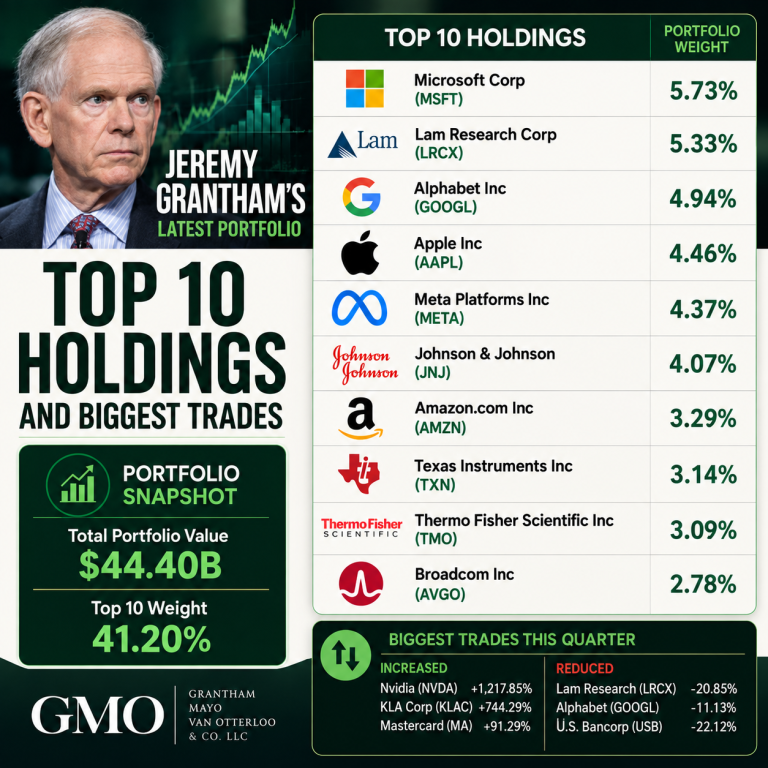 Jeremy Grantham’s Latest Portfolio: Top 10 Holdings & Biggest Trades
 Where Are the Highest-Quality Value Opportunities This Week?
 AI Spending Boom: Are Big Tech Companies Taking on Too Much Debt?