
Carl Icahn: Positioning Through Activism, Control Stakes & Deep Value Cyclicals
Sunday, January 18, 2026 · Johnny Hopkins
The latest 13F filing from Icahn Capital offers a textbook look at Carl Icahn’s continued approach to value extraction through control stakes, activism, and opportunistic accumulation in companies facing dislocation or undergoing strategic transition.
Icahn’s portfolio remains highly concentrated and idiosyncratic — a reflection of his activist model, where influence is often more important than diversification. Core holdings tied to his own controlled entities continue to dominate exposure, while selective adds in energy & restructuring plays highlight ongoing appetite for deep-value cyclical setups. A notable full exit in a long-held healthcare restructuring name further signals a tightening focus.
Below are the most consequential positioning changes from Icahn’s latest filing — and what they reveal about his playbook this quarter:
1. Icahn Enterprises (IEP): +24,149,325 shares
518.9M shares — $4.37B position (47.8% of portfolio)
IEP remains the heart of Icahn’s portfolio. The additional 24M shares represent a material increase in both absolute and proportional exposure.
The add reinforces Icahn’s commitment to his holding vehicle amidst a period of elevated scrutiny and volatility. While critics have focused on distribution sustainability and structure, Icahn appears to be signaling conviction and balance-sheet durability. Increasing the stake here functions as both capital allocation and reputational signaling — consistent with his historical tendency to lean in when sentiment turns negative.
This is classic Icahn: double down when markets doubt.
2. EchoStar (SATS): +4,354,542 shares (New Holding)
4.35M shares — $332.5M position (3.64%)
EchoStar appears as a newly disclosed holding, immediately sized meaningfully.
EchoStar’s strategic combination with DISH creates optionality around spectrum monetization, satellite communications, and eventual consolidation outcomes. Icahn has historically been drawn to complex restructurings with hard asset valuation support, and EchoStar fits that pattern.
The move suggests Icahn sees long-term asset value overshadowed by short-term execution headwinds — a favorable setup in his playbook.
3. Centuri Holdings (CTRI): +4,443,795 shares
10.85M shares — $229.6M position (2.51%)
Icahn significantly increased his stake in Centuri, lifting it by ~69% Q/Q.
Centuri sits at the intersection of regulated infrastructure services, utility capex, and energy transition. The sizable add indicates conviction that multi-year utility investment cycles remain underappreciated by public markets, and that margin improvement opportunities remain on the table.
This fits Icahn’s historical interest in industrial & utility-adjacent platforms where cost rationalization can drive upside.
4. International Flavors & Fragrances (IFF): +1,000,000 shares
4.75M shares — $292.3M position (3.29%)
IFF saw a 26.7% increase in positioning.
IFF continues to undergo restructuring, deleveraging, and portfolio simplification following years of acquisition-driven complexity. Icahn has been actively involved in governance here, and increasing the stake suggests he sees progress in operational clean-up and valuation normalization.
The add is consistent with Icahn’s restructuring discipline: step up capital as management executes.
5. Monro Inc. (MNRO): +1,465,000 shares (New Holding)
1.46M shares — $26.3M position (0.29%)
Monro appears as a new position, albeit much smaller than other adds, but with a 100% increase from zero.
Automotive service chains offer non-cyclical maintenance demand, pricing power, and consolidation dynamics — attributes Icahn has favored historically via auto aftermarket exposure. The entry likely reflects a micro-cap restructuring thesis rather than a macro bet.
6. Southwest Gas (SWX): −1,500,000 shares
6.03M shares — $472.6M position (5.17%)
Southwest Gas saw the most notable trim on the sell side, down nearly 20% Q/Q.
Icahn previously waged a highly public activist campaign at SWX, including proxy battles and spinoff pressures. The reduction here likely reflects partial normalization following governance wins and asset restructuring rather than a full thesis exit.
Icahn tends to harvest capital post-activism once major catalysts have played out.
7. Full Exit: Bausch Health (BHC)
Position reduced from 34.7M shares → 0
Icahn exited Bausch entirely this quarter, closing a long-running restructuring investment in the healthcare complex.
The departure suggests Icahn views the restructuring cycle as largely complete with risk/reward no longer asymmetrically skewed. Capital was likely recycled into newer industrial and infrastructure events where catalysts remain more active.
Macro Positioning Themes
Several patterns stand out across the filing:
Activism Remains Central
High-concentration stakes in controlled or influenceable entities demonstrate Icahn’s preference for situations where governance and outcomes can be shaped directly.
Restructuring Over Growth
Adds clustered in companies undergoing balance sheet repair, governance change, or asset reconfiguration — not secular growth stories.
Energy & Industrial Bias
Exposure remains tilted toward utilities, energy services, and infrastructure — areas with tangible assets, pricing power, and regulatory catalysts.
Selective De-Risking After Catalysts
The SWX trim and BHC exit both follow periods where Icahn’s activism has already surfaced value.
Big Picture Takeaways
Icahn remains who he has always been — an activist, not an allocator.
While markets debate AI, factor rotations, and macro dispersion, Icahn continues to pursue value through influence, restructuring, and control. The latest filing reflects a portfolio built for idiosyncratic alpha, not beta or factor exposure.
This quarter’s moves show:
- conviction in core entities (IEP)
- growing exposure to complex industrial restructurings (SATS, CTRI, IFF)
- disciplined partial monetization post-activism (SWX)
- cleanup of legacy restructurings (BHC)
In short: Icahn is doubling down on what he can control — and stepping away from what he no longer needs to.
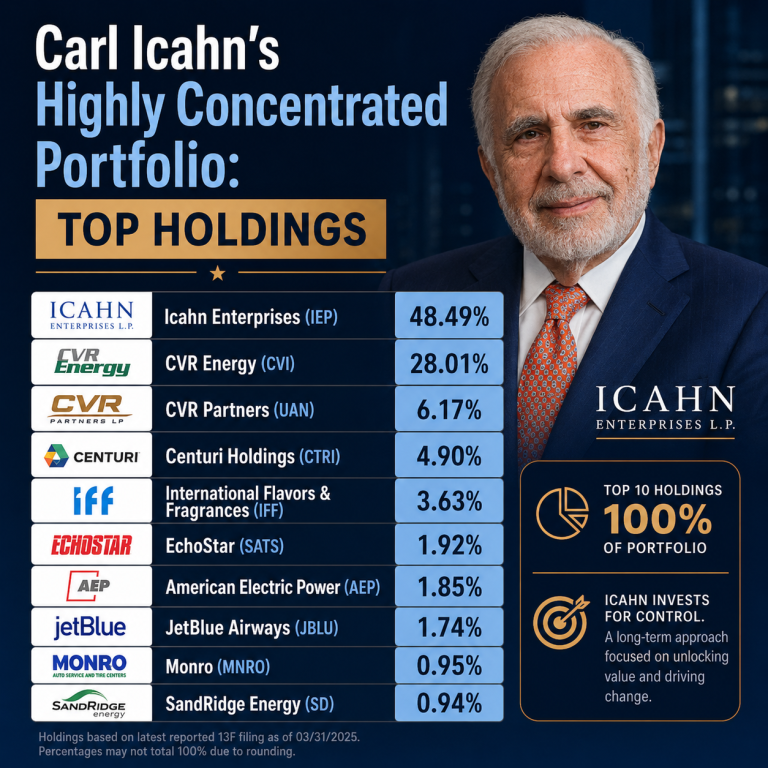 Carl Icahn’s $8.55 Billion Portfolio: Top 10 Holdings
 Where Is the Deep Value in Small and Micro Caps This Week?
 AI Stock Market Bubble: Can the Technology Succeed While Stocks Crash?