
VALUE: After Hours (S07 E44): Value Stock Geek on the Magnificent 7, tech, $AZO, the Weird Portfolio
Sunday, December 14, 2025 · Johnny Hopkins
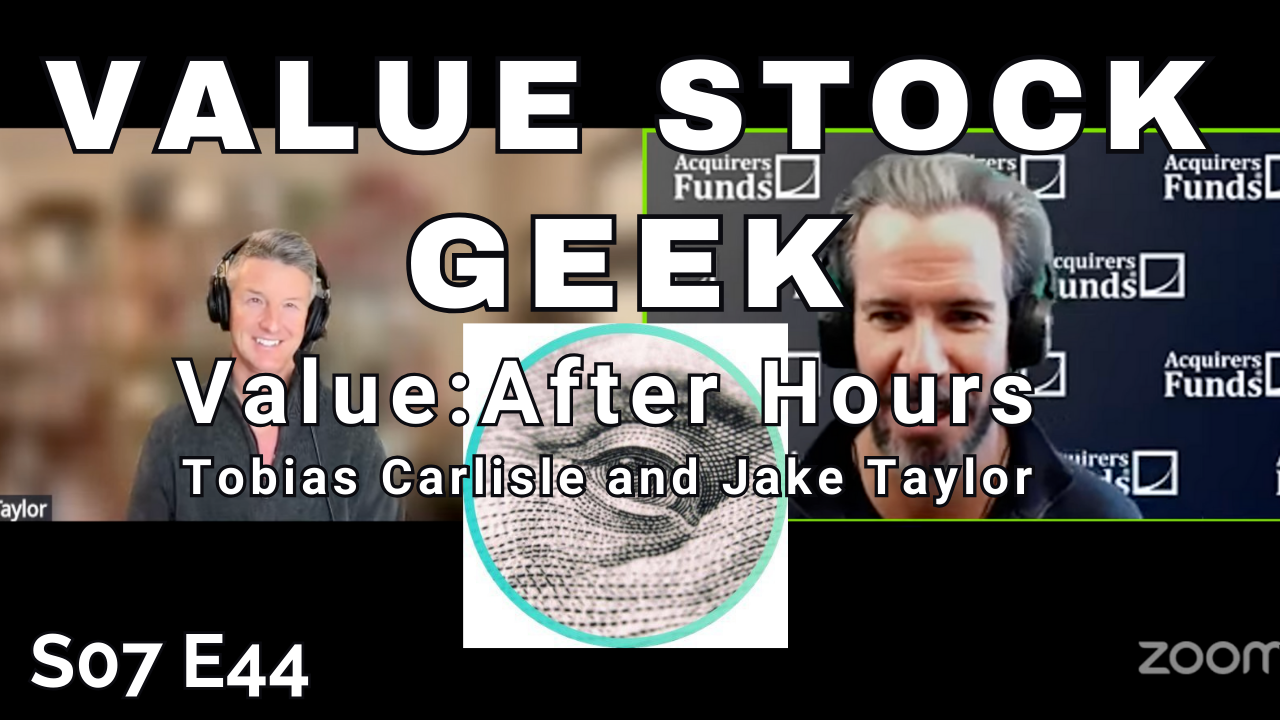
During their recent episode, Taylor, Carlisle, and Value Stock Geek discussed:
- The Weird Portfolio
- Narratives Follow Price — Not the Other Way Around
- Why Price-to-Sales Matters More Than Earnings at the Cycle Extremes
- Why Liquor Stocks Are Screening Cheap Again
- A Quality-First Approach to Finding Cheap Stocks
- Cyclical Pain Creates Opportunity in High-Quality Businesses
- Margins, Mean Reversion, and the AI Productivity Debate
- Markets, Minds, and Models All Hallucinate Under Uncertainty
- When Speculative Excess Still Builds Lasting Infrastructure
You can find out more about the VALUE: After Hours Podcast here – VALUE: After Hours Podcast. You can also listen to the podcast on your favorite podcast platforms here:

 Breaker

 Overcast


 RadioPublic


 Stitcher

TRANSCRIPT
Tobias: I think we’re live. This is Value: After Hours. I’m Tobias Carlisle, joined as always by my cohost, Jake Taylor. Our special guest today, no video, but he is here in voice and spirit. Value Stock Geek, what’s up?
Value Stock Geek: Hey, guys. Thanks for having me on.
Jake: Welcome back.
Tobias: For the folks who don’t know, Value Stock Geek, give us your investment philosophy.
Jake: Those who have been living under a rock. [chuckles]
A Quality-First Approach to Finding Cheap Stocks
Value Stock Geek: Sure. So, I run a Substack, where I analyze a company every week. I’m basically looking for quality companies, and then I’m trying to identify the cheapest names in that universe. It’s a lot like the magic formula, but there’s more, I think, qualitative work that goes into that. It’s just not systematically selecting the wonderful companies. And then, the quantitative component is more about the valuation.
Tobias: And so, what sort of things have you looked at? What sort of names have you looked at?
Jake: Yeah, what’s good right now?
Value Stock Geek: Well, over the years, I’ve been able to pick up some really good names at cheap prices. I was able to pick up a lot of good tech companies actually in 2022, that was like Taiwan Semiconductor and Meta. I was able to get those at 10 PE’s and that thing.
Why Liquor Stocks Are Screening Cheap Again
Nowadays, those are obviously not cheap anymore. [chuckles] Nowadays, you’re seeing a lot of liquor companies actually are popping up a lot in those screens that I’ve been running. I’m about to do a re-balance in early January. It looks like a lot of those names are going to enter that universe, like Brown-Forman, and Diageo, where there’s been a lot of talk about how Zoomers aren’t really drinking as much as previous generations.
You also saw sales decline after COVID. There was a big spike during COVID, and now it’s returned to normal. I think people are just extrapolating that trend. So, I think that’s what you’ll see a lot of these days. But yeah, overall, I think there’s a lot of interesting little opportunities out there.
Jake: A drunk pig in the python? Is that a thing?
Value Stock Geek: [laughs] Maybe. Maybe.
Tobias: I saw that alcohol consumption is back to 1930s levels or something like that.
Jake: What, they’re in prohibition?
Tobias: Well, prohibition is the– Isn’t that the 20s? No, that’s the Roaring 20s, I don’t know.
Value Stock Geek: Yeah, the 20s, and then they repealed it in 32, is what I think it was one of the– Or, 33. It was one of the first things FDR did after he got elected was repeal prohibition.
Tobias: So, we’re drinking as little as we did in prohibition?
Value Stock Geek: The charts I’ve seen go back to the 1960s. and we are at a low. But if you zoom out, it’s more of like we’re down 3% or something from total alcohol consumption.
Tobias: We’re down 3%. [chuckles]
Value Stock Geek: Yeah. I think people read into it, like they’re saying, “Zoomers don’t drink.” I don’t know if that’s necessarily true. There is a lot of concern that marijuana is crowding out alcohol spending. That’s a big concern as marijuana becomes more legal. But overall, I think things are pretty stable. I think people are still going to be drinking alcohol 10 years from now, maybe a little bit less. But I don’t think there’s been this mammoth societal change.
I think it’s more just about alcohol consumption got really high during COVID, because people were locked up and sales went through the roof, and now they’re normalizing and maybe people are adjusting their habits a little bit. But I think it’ll go back to normal.
Tobias: Used to be this idea that booze was pretty recession resistant. Because when people go through bad times, they tend to drink more.
Jake: Yeah, let’s get the unemployment numbers up [chuckles] and then the booze will come back.
Tobias: Is it crowding up by weed, or is it a lack of money in Zoomers, or is it like everybody’s online and they’ve seen all the studies and they’ve decided that they don’t want to drink as much? What do you think’s the causing that little trend, that little down drip anyway?
Value Stock Geek: I really think it’s just about things reversing after COVID. I think it’s really just more about that. I do think those longer-term concerns are valid and are something to keep an eye on. But I don’t think there’s enough evidence to say that people have really significantly changed their habits.
I think more of like people are looking for an explanation for the price action, and they’re creating these narratives like, “Zoomers don’t drink. They’re just looking at the screens all day, and they’re not going to bars anymore. Everybody’s replacing marijuana with alcohol.” I think they’re just crafting a narrative that I don’t really think– There’s some truth to it, but I think it’s being exaggerated.
Tobias: Is it impacting any part of the market more than any other? How do hard liquors, spirits hold up against beer and things like that?
Value Stock Geek: Yeah, there was a ton of interest over the Seltzers. I know in the early 2020s, if you look at Sam Adams stocks, that went through the roof because of their hard Seltzer brand. Yeah, I think that’s just more of an alternative to traditional beer. I think the alcohol companies are adapting and adjusting to that. And then, there’s the traditional spirits, which is more of Diageo and Brown-Forman’s wheelhouse.
Tobias: It’s funny, how many charts went crazy through that 2020, 2021, 2022 period and have come back to earth and how that’s hard to– It’s hard to tease out from that, like, what is secular and what is part of that? I don’t know whether 2022 pulled a whole lot of demand forward, or it was just a whole lot of stimulus through that period.
Value Stock Geek: Yeah, you’re right. There’re so many charts that look like that where it is really difficult to discern what’s a secular trend, what was just a COVID thing, are things just returning to normal. You can see it in all kinds of things. We saw that in lumber. That was a pretty good example. [chuckles]
Jake: Yeah, I remember that.
Value Stock Geek: Yeah. Where there was this big spike. And then, again, there’s a narrative that goes along with that, “Oh, we’re in a housing shortage and lumber prices need to go up,” and blah, blah, blah. I feel like anytime you see something do well or do poorly, it’s almost like people make up some secular trend to go along with it. It’s usually not. It’s usually just a cyclical thing.
Narratives Follow Price — Not the Other Way Around
Tobias: The narrative follows the price every single time.
Value Stock Geek: Pretty much. Yeah. And today, you’re probably seeing with AI. I don’t know if AI is necessarily the secular trend that everybody seems to be convinced it is. And then, I’m sure if AI spending goes down just a little bit, it’ll be, “What a waste of time. This was just nonsense.” And the truth is probably somewhere in the middle. [laughs]
Jake: Right. There’re quite a few companies that– I would imagine there’s some names falling into your quality and expensive for a long time, and now all of a sudden are starting to look a little bit more attractive. Is that accurate?
Value Stock Geek: Well, that’s the thing. So, every week I look at a company and I would say, “90% of the time, it’s too expensive.” But it’s all about just constructing this big universe of quality companies and then trying to identify them when they’re a little beaten up. At the end of the year, there were a lot of good defense names that were good. My screen picked up Huntington Ingalls, which builds the aircraft carriers and that kind of thing.
There was concern in Q4 that there were all the issues that were happening with the budget that these contracts wouldn’t be fulfilled and that all turned out to be nonsense. And now, the stock is up 70% just by reverting to the mean. There’s a lot of things you see like that happen.
It’s the same thing with tech. I looked at all the tech companies in the beginning of the Substack in 2021. At that point, I said, “These are all too expensive.” And then, lo and behold, a year later, Meta is at a 10 PE, Taiwan Semiconductors at a 10 PE, Google was like a 15 PE back then, which is cheap for Google. You’ll see a lot of that.
A lot of that stuff happens. People get convinced it’s a secular compounder. I’ll add it to the universe, because there is some truth that the business is good, and then you just wait a little bit. It usually doesn’t take that long. [chuckles] All of a sudden, this is cheap again. And then, it’s at a moment when everybody thinks that, “Oh, it used to be a compounder, but now it’s garbage.”
It’s usually not. Sometimes it is, but usually when you’re looking at a lot of these really high-quality companies with moats, usually, they just go through cycles. It baffles people’s minds when they do.
Jake: I’m just going to use Copart as an example, but historically a pretty amazing business, but was always very expensive. Now, let’s call it a 23 or something PE. Are they interesting at that level for you, or are you really waiting until it’s like they’re down in like a 10?
Why Price-to-Sales Matters More Than Earnings at the Cycle Extremes
Value Stock Geek: No. So, one of the big things I look at is trending in price to sales. So, what price to sales ratio does this normally trade at and what does it trade at now? That’s a key metric I look at. And so, that keeps me from saying like, “I need to get super deep value,” where some companies will never trade at a 10 PE. Copart is a good example of a company that may not get that low. But if you look at trending in price to sales, you can identify these inflection points when they might be a little bit cheap.
So, yeah, usually I rank everything by discount to its typical price to sales ratio, and I rank all the companies by that criteria, and then I’ll look at absolutely earnings yield. So, I’ll say like, is the earnings yield at least maybe in excess of the current 10-year treasury yield. Basically, today it is the enterprise multiple below 20, and is the price to sales, and then rank that by the price to sales discount to where it normally trades.
Jake: Are you using price to sales, because it’s such a clean metric? There’s not a lot of counting shenanigans between revenue and revenue?
Value Stock Geek: Yeah. I’ve noticed for a lot of these companies, price to sales– You’re right. Sales is more stable. But what you can really pick up, there are cycles in margins. So, you look at margins and price to sales for a lot of companies, and often it looks like a wave, and you can identify points where, okay, this is probably just a cyclical phenomenon and it’s trading at a super low-price sales multiple, because margins are temporarily depressed, as opposed to–
I think that’s better than what the traditional magic formula does where it’s only looking at trailing 12-month ROIC. Because I think what that does is it tends to identify companies at cyclical peaks which is why as Toby’s research has proven that that tends to underperform pure value. I think it’s because it identifies a lot of those companies that are trading at cyclical peaks.
I remember looking through magic formula screens, and it would often things would pop up like that. Like Cal-Maine 2015, the egg producer. You know that was popping up on the magic formula screen. I think back then there was another bird flow, and prices were high. Well, what happens? Markets work. Egg producers will create more eggs, and prices will eventually come down. And then, it identifies a lot of fads like Fitbit. That was another one that was in there.
Jake: Right. Yeah, it is prone for hula hoop behavior.
Tobias: Have you seen those charts on margins? I post them occasionally, S&P, 500, 400 and 600 over the last 20 something years.
Jake: Just up and to the right, or what’s the–
Tobias: It’s amazing. Yeah, the margins are 13% or 14% for the S&P 500 on an average, which is just extraordinary. Even mid and small are elevated well beyond their long-term averages.
Margins, Mean Reversion, and the AI Productivity Debate
Value Stock Geek: Yeah. I guess the question is, is that going to continue or is that going to mean revert. I don’t really know. I guess you could argue that there’s less antitrust, that these tech companies are different and nobody is doing anything to capture their market share. On the other hand, you could say it’s a mean reverting series and all these companies top are in for some trouble. I’m not sure if I know the answer.
Tobias: It has been a mean reverting series. I don’t know if it is– It’s one of those things that’s Buffett and Hussman, Jeremy Grantham– [crosstalk]
Jake: It takes its sweet time to mean revert, doesn’t it?
Tobias: Yeah. [Jake chuckles] I think someone said 6%. I think Buffett says 6% is–
Jake: And Grantham. Both 6%.
Tobias: It’s like an unusual number. Here we are, we’re talking 13% or 14%. That’s crazy.
Jake: So, I’ve tried to play the devil’s advocate. Because my own natural gut instinct is also like, “This is not sustainable. Everyone’s going to get cooked. These are crazy.” So, I’m trying to temper that a little bit with running a counterfactual. So, what would I need to believe about the world to think that not only is 13% the new normal, but maybe we go higher?
I heard or I read about Michael Dell talking about AI potentially adding 10% productivity. I don’t know exactly what that means in an income statement, but let’s just assume that it’s taking 10% of cost out. Let’s just imagine this crazy scenario, like, what if public companies, all companies, were able to run at 20% margins? Then what? Is the market relatively cheap today in a 20% margin 2027 world? What would be a reasonable multiple for a 20% basket of companies? Like, 30 times earnings, 40 times earnings? I don’t know. That maybe, and therefore–
Tobias: You might be clipping this up in 20 years’ time.
Jake: [chuckles] Yeah.
Value Stock Geek: [chuckles]
Jake: Right. Yeah, these bold macro predictions by area [chuckles] economist. But I don’t know, I’m just trying to temper my own biases which I know are more towards the like, “This is all bullshit and is going to come crashing down.”
Tobias: Does it come out of labor? Is that the other side of the coin?
Jake: Of course, the counter to all this is like, “Okay. Yeah, so, now we fire half the workforce? Is that what we’re saying? Where’s the demand for these products now if half the people are unemployed?”
Also, this assumes that no one is going to compete ever again in business, which, like, “Wait, I got 20% margins and I see that you have 20%. Well, maybe I’ll take 18% and I’ll take some of your market share.” And then, you go, “Well, hold on, I’ll take 14% and then I’ll take some of your market share.”
Tobias: That’s how it’s supposed to work.
Jake: That’s how it’s supposed to work, right?
Value Stock Geek: Yeah, that’s how capitalism is supposed to operate. No doubt about it. But yeah, I have the same biases. My gut says, “This is a mean reverting series.” I also thought that seven years ago, eight years ago, and it doesn’t seem to be reverting. So, I don’t know, maybe it’s just that these tech companies aren’t being reined in by any antitrust anymore, and they’re eating up a lot of other businesses. They’re destroying a lot of businesses along the way.
You could argue that’s a good thing, a bad thing, I don’t know, but it seems like they’re dominating a lot of– They’re going in and they’re taking away a lot of– Advertising businesses, for instance, are basically getting destroyed by Google and Facebook. That’s been going on for a while. And those were businesses with certain margins, and they’re consuming that. I don’t really see what is the competition that’s going to change that. It’s hard to imagine at this stage of the game. [crosstalk]
Jake: Well, aren’t they all coming to compete though on AI? They had their cozy monopolies before where they didn’t try that hard against each other in their space, and then– It feels like they’re all heading towards one goal, which would be to win the AI world, which to me seems like, “Okay, now the elbows get a little sharper and maybe there’s actually competition.”
Value Stock Geek: Yeah. Maybe this is the catalyst.
Tobias: I feel like AI is like protein. It’s in everything these days. Like, you try to buy any kind of thing, [Jake laughs] it’s got additional protein.”
Jake: Cupcakes. Still protein in there.
Tobias: It’s got some AI in it, and you’re like, “Well, what am I going to do with that?”
[laughter]Jake: Get swole, Toby. What do you mean?
Tobias: Gmail keeps on trying to get me to AI my email account. I’m like, “Dismiss, dismiss, dismiss. Go away.”
Value Stock Geek: [laughs] Yeah. I don’t even know if what we have as a what we’re calling AI is really AI. I’m not an expert on the subject by any means.
Tobias: That’s the marketing. That’s the label, the advertising.
Value Stock Geek: It seems like maybe this is just like searching the internet and plagiarizing. [laughs]
Jake: I know a lot of it does feel that way, isn’t it?
Tobias: It’s brawn day. It’s got electrolytes in it.
Jake: It’s what plants crave.
Value Stock Geek: Like, is this really HAL 9000 or Data from Star Trek? I don’t know, I’m not sure if it’s that level yet.
Tobias: A little bit of a non- sequitur. Have you followed AutoZone? AZO? AZO is the ticker?
Value Stock Geek: Yeah. Great company. Yeah, AutoZone and O’Reilly, they’re both really good companies. They have a great little niche. They buy back tons of stock.
Tobias: Yeah. That’s their business isn’t buying back stocks.
Value Stock Geek: Yeah.
Jake: And business is good.
Tobias: I saw that AutoZone took a whack today, or has over the last few days, I thought because–
Jake: Perfect. Cheaper buybacks.
Tobias: Yeah. That was my initial thought. But the point of the tweet that I saw, was that they’ve managed their payables and their working capital to create a lot of the money that they use to buy back stock. And with First Brands and those other companies falling over, they may not be able to play that game anymore, and I think that’s the reason why the stock has been hammered today. Do you have a view? VSGE, did you ever dig into that enough to sort of–
Cyclical Pain Creates Opportunity in High-Quality Businesses
Value Stock Geek: I did. I’ve written both of them up, AutoZone and O’Reilly. I didn’t know AutoZone had a big decline today, but if that’s the case, I wouldn’t be surprised if my screen picks it up at the end of the year, because it’s in that universe of wonderful companies. Once it shows up there, I don’t really question it. Like, I’m going to buy the 15 cheapest companies in that universe. I do trim the universe, but I’m not going to exclude something, because I think it’s secular, or that the trend has reversed, or whatever. I’m going to trust the process and [crosstalk] will probably–
Jake: So, that the argument is they’re using working capital as a source for buybacks?
Tobias: That they’ve freeing up cash flow in every single way that they can, and one of them is by you pay your suppliers layer and layer.
Jake: You can do that one time, but that’s not–
Tobias: You can extend it. Yeah, that’s right. You’re right. But at some point. Yeah.
Jake: And then, it unwinds when you–
Tobias: But the collapse of First Brands is going to impact them. It changes their financing.
Value Stock Geek: Interesting.
Tobias: I’m not over enough to know. I like companies that buy back a whole lot of stock, and so I’m just wondering if that impacts anything else.
Value Stock Geek: Yeah, I’ll have to take a look at it and see if that’s true. But yeah, I also like companies that buy back tons of stock, that’s definitely– One of the things I’m always focused on a shareholder yield, I want to see a really decent and growing shareholder yield. And if you do really look at any company that has bought back a significant amount of stock over the last 20 years, almost always you get a pretty really good result for investors for any kind of company that does it. Sometimes it’s like a delayed reaction, like you see that with some like Dillards. They bought back stock for 10 years, and then–
Jake: In a non-linear way.
Value Stock Geek: And then, boom. It just all happens at once. It’s all like a coiled spring there.
Tobias: They get a little bit lucky with COVID. I think there was some stimulus that flowed through, and that was a big part of that. That was the catalyst.
Jake: Good things happen to cheap stocks, Toby.
Tobias: Yeah.
Jake: Or, not sometimes. [laughs]
Tobias: I’ve said that. I don’t know if that’s true, but I hope so.
Value Stock Geek: [laughs]
Jake: If you say it enough times, it might come true.
Tobias: Before we came on, we were talking about Palantir and NVIDIA, their reactions to Burry’s. So, Burry’s got a new Substack. You guys have taken a look at the Substack?
Jake: Read one of them so far.
Tobias: Did you–
Value Stock Geek: I read one article. Yeah.
Tobias: What is his Palantir, NVIDIA thesis?
Jake: It’s around stock-based comp, and that they’re aggressive with that. If you do an actual owner’s earnings, look at it, NVIDIA’s trading it more like 60 times and not 30 times if I remember what he said correctly.
Tobias: That’s a sin around here these days. Is it like paying a whole lot of SBC?
Jake: I know.
Value Stock Geek: [laughs]
Tobias: That’s just businesses that 15% of you guys are doing SBC.
Jake: That’s exactly right. Like, it hasn’t mattered for at least the last–
Tobias: 10 years.
Jake: Yeah. It’s just like, “Okay, well cool. You could be technically correct, but who cares? Like it’s going up. It doesn’t matter.”
Tobias: You like accounting, or you like to make money?
Jake: Yeah, exactly. Do you like– [crosstalk]
Value Stock Geek: He really seems to think that this is a lot like the late 1990s. I remember he talked a lot in the article about basically comparing the current era to when he started his blog, I think, around 1997 or something when everything was really getting going. At the time he was living in the epicenter of the tech bubble, so he was surrounded by it all. So, he seems to think that the two environments are very similar.
Tobias: 1997, nobody’s got the balls to say 1999. Nobody’s got the balls to say March 2000.
Value Stock Geek: [laughs]
Tobias: Everybody’s like, “It’s four years away.”
Jake: But that was one of the interesting things that he talked about, was that the spending, the CapEx, didn’t peak in March of 2000 like the market did. It peaked like a year or two after that.
Tobias: Two years after. Yeah.
Jake: The market had already given up and fallen off a cliff while the spending was still happening. So, even if maybe we have this big runway in front of us that everyone can see of AI CapEx, maybe the market doesn’t– It looks past that and it looks down the slope from there. Who knows? But I think that was one of his points.
Value Stock Geek: Yeah. I remember Cisco traded at I think it was 50 times earnings at the peak or something. The business did very well from 2000 to 2010. I think it tripled or something, but stock was dead money, because–
Tobias: I think it took out its all-time high in November.
Jake: When it said it was an AI– [crosstalk]
Tobias: 25 years. 25 years.
[laughter]Value Stock Geek: 25 years for a business that had [crosstalk] probably grown, I don’t know, over 10% a year for 25 years, which shouldn’t be a much better–
Jake: I’m a patient guy, but that’s a long time.
Tobias: Stock prices can get a little ahead of themselves.
Jake: They can.
Value Stock Geek: Ain’t that the truth? [laughs]
Tobias: I think that was thesis that the NIFTY 50 have ultimately delivered nearly a market perform since the NIFTY 50 were founded in whatever the 1970s sometime. Even though they got ahead of themselves in the 1970s, they fell back– You were dead money for 50 years or something in the interim.
Value Stock Geek: Jeremy Siegel wrote a paper about that.
Tobias: That’s it. Yeah.
Value Stock Geek: Yeah. I think he did it in 1992, and he said, “If you bought them, they all recovered.” But at the same time, it’s like, “Okay, you had an 80% drawdown and you just delivered a market return.” I don’t know if that’s a great result. [laughs] I’d rather buy the NIFTY– But to his credit, it is true that those companies continue to compound in value, but my takeaway from that was, well, then I’d rather buy the NIFTY 50 in 1975 versus 1971, [chuckles] and you’ll get a much better result.
Jake: Wasn’t Philip Morris drove 50% of the results or something of that, too? So, if you took that out, if you didn’t hold that through the whole thing, I don’t know if you ever made it. I could be wrong about that.
Value Stock Geek: No, that might be true. Yeah, there were a lot of really good companies in there. McDonald’s was in there. Xerox– [crosstalk]
Jake: Kodak, bunch of really.
Value Stock Geek: [laughs] Yeah. Then there’s the duds like Polaroid and Kodak. [laughs] That’s true.
Tobias: They weren’t duds. They weren’t duds until they were crushed. They were pretty strong for a long time.
Jake: Hot shit for–
Tobias: Yeah.
Jake: They were the modern equivalents.
Value Stock Geek: Yeah. I read once when Buffett brought Bill Gates to one of the meetings of– He would have Walter Schloss there and all his friends. I remember he wrote that they asked Bill Gates about Kodak. Bill Gates said in 1991 or so, “Kodak is toast.” Like he saw the writing on the wall at that point, which no one else really did yet. I think it was trading a book value or something in the early 1990s. I guess it worked for a little bit until it didn’t.
Tobias: I want to know who picked the cameras with toast, because it seems like as much as that destroyed film, it was really the phone that destroyed cameras, because there’s just no reason. The cameras on a phone are so good now, and that the utility– [crosstalk]
Jake: Do you imagine buying a regular camera nowadays and bringing it with you on vacation?
Tobias: It’s like a steampunk thing, or it’s like you’re doing [Jake laughs] it for the look.
Value Stock Geek: [laughs]
Jake: Yeah, yeah.
Tobias: It’s fashion. It’s not like it’s functional.
Value Stock Geek: Yeah, absolutely. I don’t know anyone who does that. But yeah, I remember that. When I was a kid, my dad had the huge camera with the strap and everything and you on the family vacation.
Jake: Yeah. Had pictures are like eyes are closed or it’s just out of focus.
[laughter]Tobias: A month after you take the photo, you get the film developed and then you figure out what happened in the moment. Yeah.
Value Stock Geek: Yeah, I remember those little– There’d be these little closet stands in mall parking lots where you’d go and get the film developed. You remember that?
Tobias: Yeah. Yeah.
Value Stock Geek: [laughs] Yeah. And then, you just wrap it all–
Jake: And then, now, they’re all Dutch Bros coffee shops and stuff.
[laughter]Value Stock Geek: Yeah.
Tobias: Is Dutch Bros still going?
Jake: Oh, yeah.
Tobias: Is Dutch Bros still a popular stock? Do people still talk about it?
Jake: It’s not as popular as it was on the IPO. It’s still probably legit. I don’t know. I remember when it first came out, I looked at it, and I was trying to underwrite what growth rate was implied in the current price. Basically, you had to know for sure that it could go east of the Mississippi successfully.
It’s hard to tell if brands can go national or not. See’s Candy couldn’t push that direction, but it was killer in California. Dr. Pepper is 20% of the soda market in Texas, but 1% everywhere else. There’s no guarantee that brands can travel, and so that seemed like a dangerous bet to me when I looked at it.
Tobias: There’s a psychological component to taste that in chocolate, and soda, and stuff like that’s just insurmountable. If you didn’t like get exposed to it as a kid in a happy scenario, then it just doesn’t–
Jake: It didn’t take– Yeah.
Tobias: There’s nothing special about it.
Value Stock Geek: Yeah. Buffet talked about– Oh, go ahead.
Jake: No, no, go ahead.
Value Stock Geek: I was just saying Buffett talked about that with Coke, like you went to baseball games as a kid and you remember the taste of Coke, same thing.
Jake: I was going to say it’s easier though when it’s enough caffeine and sugar and fat to kill a horse.
Tobias: Yeah.
[laughter]Tobias: Those are keys.
Jake: Those help. Yeah.
Tobias: Some addictive component. Let me give a shoutout, and then JT, take it away.
Jake: Veggies?
Tobias: Brown Marubozu. Is that Toronto? Tomball, Texas. Tyler. Gothenburg, Sweden. Petah Tikva. Lausanne, Switzerland. Tallahassee. Jupiter, Florida. Surbiton, London. The Mean Streets of Gerrards Cross. I love it. Yorkshire, England. Nashville, Tennessee. Toronto. Havertown, Pennsylvania. Bellevue. I saw a good one down here. Valparaiso. Snohomish. Pforzheim. Am I saying that correctly?
Jake: Stay dry– [crosstalk] It’s quite wet in Washington right now. Good luck.
Tobias: Is there a racetrack in Pforzheim am I forgetting? Let me know. That’s a good spread. That’s fun. Thanks, everybody. JT, take it away.
Markets, Minds, and Models All Hallucinate Under Uncertainty
Jake: All right. Today’s veggies are a synthesis of actually two fascinating recent reads that I had. The first was called Collective Hallucinations and Inefficient Markets. It was a deep dive into the neuroscience and psychology of hallucination and how the brain is constantly predicting and reconstructing the world and how perception itself is basically like this controlled hallucination. And really, they arise from these predictive signals that drift away from grounded sensory feedback.
And then, the second was an interesting piece that was about AI as the new shadow banks. These obviously couldn’t be more different on the surface. The second article explored the financial ecosystem growing up around the AI infrastructure, chip supply chains, data centers, credit structures around them, all these speculative expectations around compute demand. And the way that capital markets are behaving almost like a new shadow banking system that we had in the derivative world of mortgage-backed securities in 2008, for instance.
And so, as I’m reading them, something clicked together about them and I thought I might share that. Really one is about brains hallucinating and the other is about markets hallucinating. They’re actually describing the same phenomena, but at different scales. So, both the mind and markets are predictive engines. They’re both constantly guessing about what comes next. They both hallucinate when prediction outruns reality. So, today, we’re going to explore this extraordinary parallel between these systems. There are really five core ideas that I want to use to tie everything together. Those are over belief, illusions that become real, narrative, gravity, sensory poverty, and why hallucinations sometimes can drive progress.
So, we’ll start with the first one, which is over belief. In neuroscience, hallucinations don’t appear, because the brain is malfunctioning. They appear because this predictive machinery, it becomes too confident. It’s always filling in these missing information pieces and constantly smoothing out the gaps in sensory input.
So, for instance, you’ve got a literal blind spot where the optic nerve exits your eye and connects to your brain, and there’s no sensors there at all, and yet your visual cortex just paints over that whole area so cleanly that you never even notice it. Like, it just fills in the gaps. Under normal circumstances, reality is constrained to those predictions. But when those constraints get weakened, the brain leans harder on its priority estimations. And so, it trusts its own internal model more than the external world. That’s what over belief is.
So, now let’s think about AI. An LLM works in a lot of the same way. It’s trying to predict which is the next token. Whether its grounding data is weak or absent, retrieval isn’t available, the model leans harder on its statistical expectations. It fills that gap in with patterns that “make sense,” internally, even if they’re maybe not true. And that’s how we end up with hallucinations.
And then, in markets, perhaps the most powerful over belief, machine investors predict future revenues and earnings, and companies predict future demand for things, and governments predict future technological competition. When real cash flows or sober feedback is thin, markets become trusting of their own narratives at that point. So, AI infrastructure with chips and data centers, power build outs, it’s getting financed today not because the demand is known and verified, it’s because the expectations of demand are so strong. When these internal predictions outweigh the external constraints, all three systems, the mind models and markets, all hallucinate about it.
So, the second idea here is one is illusions that generate real consequences. So, in humans, hallucinations don’t just stay in the mind, they trigger bodily reactions. If you hallucinate a threat, your nervous system is going to respond and queue up as if that threat was real. Your body really enacts the hallucination. The financial system takes this phenomena to the next level, which is, investors believe in this unstoppable demand for compute. Billions of dollars are flowing into GPU factories, etc., cloud providers. This ecosystem reinforces everyone else’s belief that this is a real thing, and then something really astonishing happens like that belief becomes infrastructure. [chuckles] We have it now, like it gets built. And that imagined future becomes a physical one.
Even AI participates in this loop as well. Like, a hallucination maybe, but with a persuasive explanation, gets posted online and then later future models pick up– they scrape that and they turn that into a factual source. So, you’re like bootstrapping yourself into a belief or what is “true.” So, in each case, whether it’s a brain or a model or the markets, these illusions escape the confines of prediction and alter the world itself in a reflexive way.
Let’s jump to the next one. This is, what you might call, narrative gravity. This is the idea that there’s this pull towards stories that feel coherent, we all want that. It shows up everywhere. The mind is instinctively looking for patterns and explanations. Even with incomplete sensory input, it stitches together a narrative that will make sense internally. AI does the exact same thing with trying to hit optimization targets. And then, in markets, narratives are even more powerful than numbers often, and the story is often the asset. This compelling narrative AI will transform everything. Compute is the new currency. GPUs are the new oil that attracts capital long before the revenues ever appear. And that narrative gravity explains why hallucinations become so believable.
And then, the fourth idea is this idea of sensory poverty. So, in an environment where there isn’t, let’s say, darkness or monotony or sensory deprivation, that sensory grounding in the external real world is weakened, and the brain will then generate its own version of what reality is. That’s why you see the monster in the dark. AI systems also do the same thing. When feedback is scarce, they’ll skip citations, and retrieval, and just come up with something. The model’s running in free mode, and its output cranes its own input, and it just goes off on its own. Financial markets, they do the same thing when fundamentals are weak.
In early technological cycles, like AI– The actual revenue today is tiny, customer demand is totally uncertain, unit economics are immature, like we have no idea what it actually costs to run all these tokens. We must extrapolate then out from this very sparse data. And in the absence of sensory feedback, the narrative becomes the only thing that really matters. Eyeballs during dotcom is a good example of this.
All right. And then, now the fifth idea. This is the maybe more surprising and maybe optimistic version of things, is that these hallucinations often are how progress happens. Creativity itself is a structured hallucination. The brain’s ability to imagine what does not exist is what produces hallucinations under stress, but it also leads to creativity. AI does the same thing. It can be a source of novelty, which is actually pretty impressive. The models can make these leaps that maybe humans hadn’t thought about yet.
And in finance hallucinations are this hidden engine, maybe behind a lot of the major infrastructure revolutions. People are speculating to fund railroads that are still in use today, speculating to build fiber optic cables that we’re still using today, speculating on electricity grid decades before there was any profitability. And the same thing with cable systems in the 1960s, 1970s, 1980s. All these things happened, and maybe it’s happening today with AI and compute.
When Speculative Excess Still Builds Lasting Infrastructure
Even if the demand collapses, maybe the infrastructure remains and we’re all going to better off for it.
Now, of course, we’ll ignore the depreciation schedule, controversies around all this that maybe throws a wrench in that. Let’s zoom out a little bit and wrap this thing up. What we’ve covered is a shared architecture across systems that seem unrelated. Brains hallucinate perceptions, AI models hallucinate language, and markets hallucinate future cash flows. And all three are hallucinate for the same structural reasons. They’re predictive engines operating under uncertainty.
When predictions outrun their grounding, when feedback is weak, when narratives are strong, these hallucinations appear. Not maybe necessarily as malfunctions, but as the natural extension of inference. The deeper insight is really this that hallucinations aren’t errors, maybe to be stamped out necessarily. They’re really how complex systems feel their way into the future. Even as they distort and misprice and sometimes people get hurt. The job of an investor in this AI cycle, I think, is to stand inside these hallucinating systems, minds, models, markets, and keep asking, “Is this the kind of illusion that leaves useful infrastructure behind, or is it just another story that ends up on the shelf of the library of mistakes” which we talked about last week?
Tobias: Good one, JT. So, it’s a hallucination if it turns out not to be true, but it’s a vision if it turns out to be accurate.
Value Stock Geek: [laughs]
Jake: That’s right. And if you can figure out the difference a priori, then you’ll do well.
Tobias: You’re the messiah.
Jake: Yeah, exactly.
Value Stock Geek: Are there other animals that experience hallucination, or is it a uniquely human thing?
Jake: I would imagine that other animals– I don’t know for sure, because I think it’s hard to tell subjectively. But I would imagine that there’s hallucinations in other animals. They’re making predictions the same as we do about their environment. I mean, other animals dream. So, that’s probably another data point that might be point in the direction of hallucination.
Value Stock Geek: Gotcha. Yeah, I just was wondering if maybe there’s a unique human thing towards trying to visualize and predict the future that’s unique to us. [crosstalk]
Jake: No. Every animal has a working model of their environment and how they fit into it. That expectation is always crashing against the sensory input to see what surprise is, which is like, “Oh, my model [crosstalk] I need to update it.”
Value Stock Geek: Gotcha. Okay. Interesting. Well, a lot of it sounds like an explanation for the momentum factor, if you think about it.
Tobias: I posted about momentum factor today. It’s been very, very strong. As you’d imagine, it’s been strong for a very long period of time, but it really took off in 2000. I contrasted it with the equal weight versus S&P 500, which has collapsed relative to the market capitalization weight index, which is up a lot, which is why it looks like it’s collapsed. But just the average stock is not doing very well while the big end of town is doing very well.
Jake: If you had to bet, if you were a betting man over the next 10 years, would you bet S&P 500 market cap or equal weight?
Tobias: I’d bet equal weight, because you can look back over 100 years, it’s clear that small beats large, and equal weight is just one expression of that. You can create the same chart with S&P 100 versus 500, where in that instance, 100 is the large, like 500 is the large relative to the equal weight. But there are a lot of charts. I think we’ve discussed this before, where you’ve got to decide whether you want to see, do you want the thing that’s worked over 100 years or do you want the thing that’s worked over the last 10? I think you can see–
I posted another chart today which was the Russell 2000 versus the S&P 600. So, the 600 is the small cap index, and it is the 600 that’s outside the 900 that includes the 500 that’s large and 400 that’s mid. And so, there is 500 stock potential overlap with the 2000. So, they’re not directly comparable, but there’s some overlap. The big difference is that the S&P 600 has these profitability requirements for inclusion in the index, whereas the 2000 is just all comers.
The 600, as a result, in a little bit of a defiance of that, large over small, because this is the profitability factor is so much more powerful here. The 600 has massively outperformed the 2000. Since 1990, I think that chart goes back to– So, it’s 35 something years. But you can clearly see there are these distinct little heart attacks in 2000 where there’s a massive spike to the 2000 over the 600.
And then, in 2020, there was another big spike to the 2000 over the 600. We’re currently in another big spike of the 2000 over the 600. If you pull up the 2000 and you look at the largest names in the 2000 or representative names in the 2000, it’s a– [crosstalk]
Jake: Pretty inspiring list of–
Tobias: Junkie index. Yeah, there’s a lot of science experiments in there. There’s a lot of stuff where they’re pre-revenue. They’re still trying to figure out they got a vibe rather they got some-
Jake: That’s as good as money, sir. [chuckles]
Tobias: -logo and some branding. They’re telling people what they’re planning to do sometime in the future, and people are like, “That’s a $25 billion enterprise.”
Value Stock Geek: Yeah, the contrast is pretty amazing. I was looking at the returns on the S&P 400 and the S&P 600, and I think they’re both up 7% year to date versus the S&P 500 which is up 17% or 18% now, which is pretty insane. Pretty insane– [crosstalk]
Jake: That’s a pretty big delta for things that are not that far apart from each other otherwise.
Value Stock Geek: Yeah.
Tobias: It’s very much a size driven market. The bigger the company, the better it’s done. I don’t know if that’s because when you get these technological revolutions, you get new companies going to the forefront, and that’s what drags the whole index up. Or, if this is a 2020 style.
Jake: Shitco rally.
Tobias: We call it a meme stock market but, it’s like every boom is a meme stock market, because there’s some narrative that drives interest over the underlying fundamentals delivering or generating the returns. And so, we’re back into that kind of market right now.
Value Stock Geek: If you look back at the last major bubbles, say the late 1990s Japan in the 1980s or in the NIFTY 50, pretty much all of them were large cap phenomena. So, it makes sense that that’s what will be happening now.
Tobias: But has the meme moved into the large caps in this instance in a sense that the AI–
Jake: Nvidia and meme stock.
Tobias: Yeah, maybe. Clearly, there’s a fundamental story there as well. It’s very, very impressive on a fundamental basis.
Jake: [chuckles] Yeah. 80% gross margins, that’s a real–
Tobias: Plus, the growth. The seemingly infinite demand, like just endless demand for these things, they cannot produce enough.
Jake: Yeah.
Tobias: But it does seem like there’s a little bit of a defection from that ecosystem. Like, Google’s making its own chips and training them. I think Tesla is too, but maybe it’s doing it with Nvidia. There’re so many announcements, it’s hard to figure out from the headlines what is real and what is not.
Jake: I think we’re selling to China now, too, but with a 25% rake?
[laughter]Tobias: For the big guy?
Jake: Yeah, sure.
Tobias: 25% for the big guy?
Value Stock Geek: It’s hard to imagine that Google, Microsoft, Apple would just sit around and say, “Well, I guess we’ll let Nvidia do all this.” It doesn’t seem like [chuckles] that sustainable for that long. Like, they’re going to compete on some level.
Jake: Yeah. The counter argument might be this was the argument for intel in 2000 to really until they started pooping the bed in whatever 2020-ish. But it was always like, okay, Intel can spend the most money on R&D and spread it over the biggest amount of fixed costs. How is anyone ever going to catch them? They can just– [crosstalk]
Tobias: How did anybody catch them?
Jake: I know. It’s a great question. That’s a trillion-dollar question there.
Tobias: Only the paranoid survive.
Value Stock Geek: Taiwan Semiconductor, they were able to do it. They were able to do it cheaper.
Jake: Yeah. So, what’s the–
Value Stock Geek: That’s the lower labor.
Jake: feel like NVIDIA’s got similar– They got Intel 2000 vibes right now of infinite demand, 90 plus percent market share. No one can catch them on R&D. They’re so far ahead.
Value Stock Geek: Did anyone listen to his interview on Rogan? I haven’t. have you either?
Tobias: I just saw some clips. No. I don’t think I’ve ever heard him talk before.
Value Stock Geek: Yeah. He apparently did a crazy interview. All I’ve seen is the tweets about it, but apparently he claims he read 7,000 emails a day and he needs–
[laughter]Value Stock Geek: Crazy claims.
Jake: Is there room for that in the schedule while you’re signing boobs? I feel that’s like–
Value Stock Geek: [laughs] I didn’t want to mention that.
Jake: I shouldn’t have said that.
Value Stock Geek: That’s a top–
Jake: Toby, take that out in post-production.
Tobias: When people brag about that stuff, I find it so weird. I read this many books in a year– I would have no idea how many books I read in a year. Why would you go and count the number of books that you read in a year? That seems like bizarre behavior. Why would you have that much time in your day?
Value Stock Geek: And are you really [crosstalk] the book?
Tobias: Aren’t you reading books?
Jake: Yeah. You don’t have to take your shoes off to count that high, do you?
[laughter]Value Stock Geek: If you’re reading that many– When I hear people make that claim, how are you possibly retaining the information from the book and really internalizing it?
Tobias: He’s getting the Wall Street Journal headlines forwarded to him, and he’s getting all of his– He counts every coupon 25% off, that’s one more email read. [Value Stock Geek laughs] [crosstalk] headline. All the junk mail, that counts, too.
Value Stock Geek: Yeah. So, that’s pretty bizarre. The other thing I’ve noticed about NVIDIA, maybe, Toby, you would know more about it, but I’ve just seen the Beneish M-score is trending towards the earnings manipulator territory. Have you looked into the components of that for NVIDIA, or anything?
Tobias: There are lots of people out there who say that they’re doing a little bit of channel fluffing, and that they’re financing some of their customers. There’s lots of rumors like that out there. I don’t know if you have so much demand why you would be doing that stuff, so that is a little bit of a funny story. But the demand seems to be real. But then, there are those stories like that. I don’t know.
Jake: I think if I was him, I would hit the at the money equity issuance. They’re doing that with SBC right now, but I would be like, I’m going to bring in a trillion dollars onto the balance sheet right now.
Tobias: It doesn’t matter. You just– [crosstalk]
Value Stock Geek: Not a bad idea.
Jake: You could always use it. You probably, at some point, will be glad you had it.
Value Stock Geek: And in this market, people wouldn’t even care. [chuckles] They should be outraged. [laughs] I think in this market, it makes a ton of sense and you probably get away with it.
Tobias: The only point that I get to looking at those big stocks, is that they’re doing very, very well.
Jake: The business, or the stock price?
Tobias: The business. Yeah, so, the business is doing very well, but the stock price is already discounting 25 years of– Maybe not 25 years, but the stock price is ahead of them a little bit. They look expensive to me. I don’t know, that doesn’t necessarily mean they crash. It just means that they’re a little bit more sideways for period of time. And then, there’s other stuff in there where there’s really not much–
Even in the S&P500, there’s a whole lot of stuff that hasn’t worked. And then, as you go further down 400 and 600, it gets suicidal. They’re looking pretty sad down there, and not much has to happen. Are we still using oil and gas, or has the economy just moved on completely?
Value Stock Geek: [laughs]
Jake: Pretty sure, we’re still using it.
Tobias: Because it looks like it’s being given away for free. Like, you go and buy a bottle of water and you can fill your tank up at the same time at the—
Value Stock Geek: [laughs]
Jake: That is quite impressive, isn’t it? I’ve always been amazed by that. You can literally move, what, 1,500 pounds of vehicle 40 miles for the same price as water, like, “Wow, that’s impressive.”
Tobias: You got to pull up out of the ground, and process it, and then– [crosstalk]
Jake: Boil it to oblivion and then– Yeah, [chuckles] it’s amazing.
Value Stock Geek: I always think about that when people complain about the price of gas because yeah, it sucks when gas prices go up. But at the same time, you got to zoom out and think like, “Look at how cheap this is compared to what it allows me to do, to what most of my ancestors never even could imagine.” It’s pretty incredible when you think about it.
Jake: Yeah, the megajoule per kilogram, so the energy density of fossil fuels is just absolutely incredible.
Tobias: If we don’t have jet fuel, can we fly? Our batteries aren’t energy dense enough, are they?
Jake: No, they’re like– I did the math on this at one point. They needed to be 30 times denser than where they were at that time to get to the same energy density as jet fuel.
Tobias: We are improving them. This is five or so years ago now where I saw an article that said that if you use the same battery out of an old school laptop and you put it into a modern laptop, it lasts for like a second. It just torches the battery-
Jake: Is that right?
Tobias: -instantly. This article was answering this narrative that had been out there that there had really been no improvement in battery technology for a very long period of time. I don’t know whether they meant like just literally– We’re still using the same style of battery, but clearly the batteries are much more efficient, better than they used to be. Like, 30 times. How far into the future is that in terms of improving battery technology?
Jake: I don’t know. Certainly– [crosstalk]
Tobias: Is it impossible, or is it just like wait 10 years and we’ll be doing it?
Jake: That’s above my pay grade. I don’t know. it might even be like much closer now. I wouldn’t be surprised if there’s some Moore’s Law that’s happening there that–
Tobias: Because there’s some VTOL, right? There’s those eV.
Jake: Yeah. JOBY-
Tobias: eVTOL.
Jake: -is one of them.
Value Stock Geek: I could see how people could think that the batteries were better, because my old Nokia brick could last a week, and you wouldn’t have to charge it, remember that?
Tobias: Yeah.
Value Stock Geek: But yeah. At the same time, okay, my iPhone has to get charged every day. Okay, my iPhone is 100 times better than the old Nokia.
Tobias: That might be underestimating it.
Value Stock Geek: [laughs] Yeah. It still makes sense.
Tobias: 100,000.
Value Stock Geek: And the battery has had to advance tremendously to just be able to keep up with all the new features and tech that’s in it.
The Weird Portfolio
Tobias: VSG, you had a weird portfolio for a while. Do you want to give us an update on the weird portfolio? What is it? What goes into it and– [crosstalk]
Value Stock Geek: Oh, it’s basically a risk parody style portfolio composed of treasuries, gold, and then basically small-cap value funds, and a real estate fund. It’s a vehicle for a lot of my savings. It’s actually having a banner year. It’s up 20% this year.
Tobias: Lots of gold.
Jake: Yeah. Gold’s helped. Huh.
Value Stock Geek: Yeah, the chunky gold allocation has helped. And then, international small cap value has actually–
Jake: [crosstalk] quite well, too. Yeah.
Value Stock Geek: Yeah. So, I own AVDV in there and that’s up over 30% this year, and gold is at a banner year. The philosophy behind that portfolio is to have something that can basically compound at a decent rate over the decades and then be able to handle multiple economic environments. So, you want it to be able to deal with recessions, you want it to be able to deal with booms, you want it to deal with strong dollar, weak dollar. There’s components in the portfolio that should do well in all those environments.
It’ll never be like the best performing portfolio ever, but for me, I was just looking for something that would be able to control the drawdowns. It was almost like my spin on a passive portfolio. In a lot of the financial independence circles, they always talk about just going pure market cap weighted. And to me, that didn’t make a lot of sense, I wanted something more robust than that. I wanted something where it’s not going to decline 50% in a 2008. It’s not going to have a lost decade.
Yeah, that’s been the whole philosophy behind that. It served me pretty well. Really, it just helps me stay invested is the big thing. When I’m freaking out about something, macro happening, I can look at that portfolio and say, “Well–
Jake: At least gold’s going to work, or at least this is going to work.
Value Stock Geek: Exactly.
Tobias: It’s nice to have had something that’s rallied over the course of a year. When you’ve got something like small-cap value which has been crushed, and you’ve had something that’s rallied and you need to rebalance, so you’re taking away from gold.
Jake: Yeah. How much of the return is from that farmer’s fable rebalancing?
Value Stock Geek: Yeah, it’s a lot of the return comes from that. So, you do generate excess returns by rebalancing uncorrelated assets. That’s the whole Shannon’s demon thing where you could have two assets that don’t return anything over the long run. But if they’re uncorrelated and you’re regularly rebalancing, you can eke out a return from that.
You see that. If you were to just average the CAGRs of all the different assets in the portfolio, the actual CAGR, the actual result that you get is always higher than just the sum of the parts, because you do have those times like today. When I rebalance that portfolio, I’m going to sell gold and I’m going to buy us small-cap value when it’s cheap. Potentially small-cap value will have a good year or in a year like 2008, you’ll have long term treasuries up 20%. Okay, well, now you can buy some stocks when they’re cheap. And that does produce a good effect over the long run. You limit volatility and you get a result that’s more than the sum of the parts.
Tobias: Just on recessions, I know I’ve been talking about this for a long time, but the 10:3 inversion seems to be–
Jake: Whoa. Where are we? Inverted again?
Tobias: Well, we un-inverted about a year ago, something like that. And then, we’ve been basically flat where the 10 and the 3 are trading at the same level. Even though they’ve both moved around quite a lot over the last 12 months, they’ve been-
Jake: In sync.
Tobias: Yeah, in sync. Well, they’ve done it. Just over the last few days, they’ve diverged– going back to normalization pretty markedly.
Jake: So, you’re telling me there’s a chance.
Tobias: I don’t know what that means, but the un-inversion seems to be here for the moment.
Value Stock Geek: I remember you had Cam Harvey on talking about this. That was an interesting podcast.
Tobias: We inverted in 2022. That’s how long we’ve been inverted. It’s the longest inversion by a mile on the record. I mean, on the data that we have, which is–
Jake: That’s a lot of blood flowing to your head when you’re upside down for that long, huh?
Tobias: I don’t know what that means. It’s a strange thing where the front month yields less than, or the front month yields more than the 10-year. Not good for banks. Maybe banks look a little bit better with the inversion gone. But it’s also the harbinger of the recession. It shows up three to six months before the recession.
Jake: The un-inversion is what is the trigger, is what–
Tobias: The un-inversion is the trigger. Yeah.
Value Stock Geek: And is the extent of the inversion, is that an indicator of the severity of the– [crosstalk] No?
Tobias: No, it doesn’t to be. There’s not enough data point. The N is like 8 or something like that, so it’s not big enough.
Jake: But that won’t stop us from extrapolating.
[laughter]Tobias: Well, it doesn’t seem to be. Although the length of the inversion does seem to have something to do with the length of the recession.
Jake: Length of the recession. Okay.
Tobias: And so, it’s been a very long inversion, so it’s possible we’re in for a very long recession.
Jake: Here comes nuclear winner.
Tobias: I’ve been saying, there’s been an earnings recession. This is another weird thing from 2022, where the 2022 was just all of that profit being pulled forward. But there’s been a little earnings recession since 2022 to date, certainly in small and mid.
Jake: When you say that that’s EPS?
Tobias: Yes, EPS. Thank you. Yes, it is. Earnings per share.
Jake: Yeah.
Tobias: Earnings per share for large topped out in beginning of 2022 as well. Haven’t quite recovered that ground yet. SBC does count for EPS.
Value Stock Geek: Wow. Really? It still hasn’t recovered?
Tobias: No. It’s below.
Value Stock Geek: Wow.
Tobias: Below where it was.
Jake: Narrative violation.
Tobias: There’s a little bit of a narrative violation, isn’t it? I was surprised by that, too.
Value Stock Geek: Interesting.
Tobias: Dude, VSG, we’re up on time. If folks want to follow along with what you’re doing or get in touch, how do they do that?
Value Stock Geek: Yeah, you could go to securityanalysis.org or valuestockgeek.com. Directs to the same place. That’s my Substack. That’s where I look for wonderful companies at wonderful prices. And I host a podcast on the same platform.
Tobias: Yeah, it’s very good. I’m a fan.
Value Stock Geek: You both are great guests. [chuckles]
Tobias: JT, promoting anything?
Jake: No.
Tobias: Any wise words?
Jake: Just human kindness, I guess, coming into the holiday season. I think something that stuck with me from the last Berkshire meeting was Buffett said like, “If you’ve been lucky in life, then you probably owe it to make sure someone else feels lucky.” So, do what you can to help your fellow human right now.
Tobias: We’ll be back next week. We’ll figure out whether we’re here the week after that. But we’ll certainly be here next week. So, we’ll see everybody next week, same bat time, same bat channel. Thanks for tuning in.
 Undervalued Private Credit Investing: Finding Value in Discounted Lending Funds
 Where Is the Deep Value in Canadian Stocks This Week?
 Investing Beyond AI: Why Traditional Businesses Could Still Thrive