
VALUE: After Hours (S07 E43): Todd Wenning on Flyover Stocks and Small Cap Moats $GMWKF, $ODFL, and $CPRT
Sunday, December 7, 2025 · Johnny Hopkins
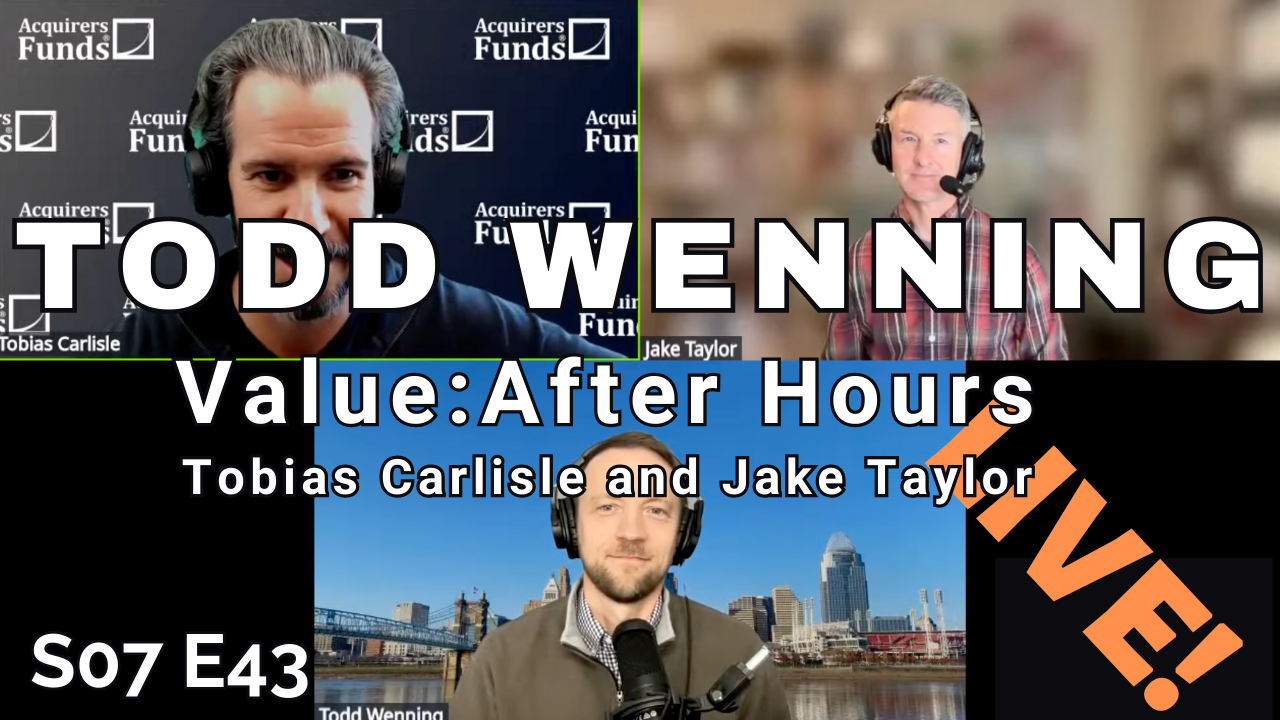
During their recent episode, Taylor, Carlisle, and Todd Wenning discussed:
- Inside the Warhammer Flywheel: Why Games Workshop Has a Real Moat
- Why Trucking Cycles May Be Turning
- Old Dominion Freight Line: A Case Study in Network-Effect Moats
- Can ESG and Buffett-Style Investing Coexist?
- How To Find Durable Small-Cap Moats
- Copart’s $5 Billion Question: What Comes Next?
- The Library of Mistakes: Jake Taylor’s Four Categories of Financial Failure
- The Fine Line Between Conviction and Arrogance in Investing
You can find out more about the VALUE: After Hours Podcast here – VALUE: After Hours Podcast. You can also listen to the podcast on your favorite podcast platforms here:

 Breaker

 Overcast


 RadioPublic


 Stitcher

TRANSCRIPT
Tobias: I think that means we’re live. This is Value: After Hours. I’m Tobias Carlisle, joined as always by my co-host, Jake Taylor. Our special guest today is Todd Wenning, KNA Capital Flyover Stocks. How are you, Todd?
Todd: Doing great. Thanks for having me.
Tobias: Pleasure. Tell us a little bit about KNA Flyover Stocks. What’s your focus there? What’s your philosophy?
Todd: Yeah. So, Flyover Stocks is a blog that I started in fall of 2023. When I was at Morningstar, I did a series called Seeking Small-cap Moats that proved pretty popular. And I kept getting emails about it. For years after, I had left Morningstar. And so, I figured when I started a Substack, I was going to focus on around the same thing.
So, Flyover Stocks is focused on companies that I think are quality, that are worth looking into, that may not have a lot of analyst coverage, that I find particularly interesting, that may have an economic moat led by good managers. So, that’s the context of Flyover Stocks.
KNA Capital is my Ohio registered RIA, where I help people manage money. I have an equity strategy called The Core Equity Strategy that I use to employ my investment philosophy. So, there’s a lot going on, but enjoying it all.
Jake: Do they have to be Midwest based companies to qualify as Flyover?
Todd: Some. Some are in like the Southwest. I have some UK companies as well. But generally speaking, they’re names that people don’t know very well.
Jake: And then, how about teaching that you do? I know at Dayton.
Todd: Yeah. So, on top of Flyover Stocks and KNA Capital, [Jake chuckles] I’m also a lecturer at the University of Dayton, where I teach finance. Right now, I’m teaching Intro to Finance, and I also teach a class called Applications of Sustainable Investing which integrates some ESG things, but also thinking about economic moats and what makes companies durable and sustainable. So, I try to bring in the Buffett approach, thinking about moats and great management teams and how they all integrate together.
I’m staying pretty busy these days, but the semester is wrapping up soon and I’ll have a little break here. So, that’s one perk of teaching university classes, is that you have some extended breaks along the way.
Tobias: Let’s talk about small-cap moats. Asking for a friend, how do you find small-cap moats?
[laughter]How Todd Wenning Finds Durable Small-Cap Moats
Todd: Yeah. So, small-cap moats, there’s a lot of similarities with large-cat moats. It’s thinking through the five frameworks that Morningstar had taught me, which are switching costs, network effects, low-cost production, intangible assets, and efficient scale. So, trying to put the companies in one of those five buckets or more. Some companies have switching costs and network effects, for example. Those are really the gold mines where you can find two moat sources, which makes them really difficult to compete with.
Really, when you find these small companies, what differs them from the larger companies is maybe growth runway. They may not have a huge addressable market, but they have a nice niche market. They can generate strong returns on invested capital. So, I’m looking for all the same factors that I do with large-cap companies, which are high returns on invested capital, predictable free cash flow, predictable revenue growth, all the things I’m looking for in the large-cap. There are also some in the small-cap world.
Now, sometimes the big difference might be the quality of the management teams. So, I do a lot of work looking into those as well trying to figure out if they are smart capital allocators or if they’re perhaps not the snuff in terms of their ability to grow the business long-term.
Jake: Does that tend to be where thesis breaks down, is it’s a decent little niche business and it’s earning, but then the cash is being squandered potentially by bad cap allocation?
Todd: Yeah, that’s a common theme that I see. It can also be one that just puts me off on the company. Now, there are companies that are real exceptions to that. They just have a really niche business, and management is happy to grow the business at a decent rate. But there’s other companies where you run into small-cap managers, where they don’t have a large ownership position, or maybe the financial incentives are misaligned and they’re just not–
Or, perhaps not equipped strategically thinking about how they can move their business into new markets, perhaps they want to grow, but maybe they do it in the wrong way, maybe they do an acquisition or they get acquired, and they’re not really thinking about the small shareholders in those situations.
Tobias: I’m surprised that small-cap moats still exist, because it feels like if something has a moat, then it should be growing into mid-or-large-cap world should be passing through smalls. Anything that lives in small-cap world is a little bit like economically disadvantaged, which is why it’s a small-cap in the first place. Do you have any–
Jake: How do you reconcile that?
Tobias: Yeah. [crosstalk] Sorry, go.
Todd: No. Okay. Thinking about just going back to the Buffett analogy, the initial moat analogy, which is the moat is there to protect the castle, the economic castle. And that’s supposed to be led by a virtuous knight who’s looking to expand the castle. The moat is really there just to protect the steward’s ability to grow the castle. So, the moat itself can be thought of as a separate issue from the growth runway or the size of the potential castle. It’s just a structural note that protects what’s going on inside the castle.
Now, it’s up to the management team to figure out, hey, how can we maximize this opportunity that we have? What the moat does is just give those managers time. You might have some businesses that have huge growth runways and huge reinvestment opportunities and the castles can become very, very big. But there are also companies, like small companies that maybe just have a niche. It’s a nice little castle, but it’s not a huge gray castle that can become the next S&P 500 star, for example.
Tobias: Do you have any examples of names that small-cap, but moaty?
Inside the Warhammer Flywheel: Why Games Workshop Has a Real Moat
Todd: Sure. So, one of the companies that we have in the KNA Capital portfolio is a UK company called Games Workshop. If you’re a hobbyist, if you’ve ever followed Games Workshop, you know the Warhammer 40,000 brand. And so, they make tabletop caricature games that are pretty intense.
It’s the most similar comparison is Dungeons & Dragons. I know I might get fried by the passionate Warhammer Group for saying that there’s like Dungeons & Dragons. But it’s a similar concept, and it’s an opportunity to create these deep narratives. Games Workshop, they have a publishing arm, so they create all these stories and they release new editions and new characters. They have new scoring systems. It just keeps it really fresh and interesting.
And so, they are growing very nicely. In fact, they have an upcoming series on Amazon that’s going to be coming out about– That’s led by Henry Cavill, the actor. He’s apparently a huge Warhammer fan. So, they’re going to be creating–
Jake: Superman plays Warhammer, huh?
Todd: Exactly. Exactly. He’s a big hobbyist and big Warhammer fan. So, they’re creating all this IP around its movies. That’s really taking it, I think, to another level, which is why it’s currently in the portfolio. But it’s such a niche business, and that’s their focus. If you read the annual letters, which are great. I highly recommend reading their annual letters, you’d think with all this IP and this fantasy world, that they’d have these glossy annual reports with all these crazy characters. But it’s just–
Jake: And then, yield English.
Todd: Exactly. Exactly.
Jake: [laughs]
Todd: But it’s just like a word document. It’s great. It reminds me a lot of Berkshire in that way. The CEO Kevin Rountree just speaks very plainly, talks about what their focus is, and their goal is to create the best games possible, best characters possible and that’s it. That’s their focus. They want to continue doing that forever. His phrase is, “We’re going to keep doing this forever.”
And so, when I hear that phrase, that gets me interested. It’s like, this is something that I’m thinking about long-term beyond my tenure that tends to be sign of a good steward of capital.
Tobias: So, what is the business they own the Warhammer brand? It’s not a retail location selling games. It’s a–
Jake: Well, there are stores. I’ve seen them.
Todd: Yes. Yes. So, they do have stores around the world. There’s one in Cincinnati here where I live. There’re most major cities. Most of them are run by a hobbyist. So, they’re single person stores, and they’re open from 12:00 to 08:00, six days a week. You can–
Jake: [chuckles] It’s like Comic Book man from The Simpsons?
Todd: Very similar. I remember my daughter and my son and I walked into one and everyone’s turned and looked at us like, “Who’s coming?” [laughs]
Tobias: New blood.
Jake: You don’t belong here.
Todd: New blood.
Tobias: Strangers.
Todd: Yeah. I’m not one of you guys yet. It’s a very addictive habit. I’ve told people that I bought my first set of Warhammer characters– It’s really cool, because there are these little plastic figures that you can snip out and then you take the time to paint them. And so, there’s an IKEA effect where you’re building and creating these characters, making them come alive and they’re yours, and then you can take them and play them against your friends and you can have these really ornate landscapes where the games are happening. A friend said, “You’re crazy for starting this because it’s a really expensive habit.”
Jake: Yeah.
Todd: I think the starter kit was about $65 for just the first set of aliens and humans to fight each other. So, it’s an interesting business model. They have retail shops, and they have the business through third parties. So, if you’ve just a general hobbyist gaming store, they may have the Warhammer games there as well.
Jake: Any sense of like, what’s the annual spend on the power user?
Todd: Yeah, there’s definitely a power law in effect here. There’s the super players where the top 10% spend. It would not surprise me if it’s well into the five figures per year in terms of what the top decile of spenders do play on. There’s been a risk of 3D printing for a long time. This idea that, “Hey, we can just replicate these characters using 3D printers,” that happens a little bit around the periphery. Maybe there’s a really expensive character that someone just really wants to play with.
But generally speaking, the hobbyists, I think, understand that if they don’t give money to Games Workshop, what that’s going to do is the whole world just slowly fades. Because Games Workshop also is engaged with the publishing. They create the narratives in the world. So, if you take them away, what are you really left with? And so, there’s this really good, strong, virtuous flywheel I think that happens. That phrase gets thrown around a lot.
But when people enjoy their games, they want to play with other people, it creates community, in-person community, which is increasingly rare today. And so, I think generally speaking, people are seeking community, real physical community and this is one way to do it. Anything that can do that today and be very profitable at it, that’s a good place to be, I think.
Jake: Have they done any video games?
Todd: They do. They do license video games. So, if you have a switch, you can buy Warhammer games on there as well.
Tobias: There is a big Warhammer franchise, where the Space Marines– Is that associated with it?
Todd: Yeah, those are like the “human characters.”
Tobias: So, that is part of that universe.
Todd: Right.
Tobias: Okay, that’s interesting. What revenues, market cap, profitability, margins? What’s all that look like?
Todd: So, it’s very small, relatively speaking. Certainly, in the Nvidia world, it’s well short shy of that. It’s a fairly small company, still fairly niche. I don’t know what it is in pounds off the top of my head, but it does a nice steady business. High returns on invested capital. High returns on common equity. It’s just a very profitable little smid-cap business.
Tobias: Sorry, we’re getting some notes. “Switch, PC… 5000 games with GW IP per year.” What’s GW?
Todd: Games Workshop.
Tobias: Games Workshop IP. Okay.
Todd: Yeah.
Tobias: Interesting. So, there’s a movie upcoming with Henry Cavill or a TV series upcoming with Henry Cavill, and you expect that to expand the user base?
Todd: Right. I think it’ll help people find the hobby which will then turn it into, “Hey, create new communities and then just the flywheel starts and continues.” So, they’ve had very successful results. There was an expectation a couple of months ago that maybe they were going to have a tough comp coming into the second half of this year, and they just had a trading update saying, “Actually, it’s going to be a little bit better.”
The licensing revenue is 100% margin. So, anything that they do with Amazon or whatever, whoever they license to goes straight to profitability. So, that’s a really nice option that they have in the business.
Tobias: That’s traded locally on the ticket GAW?
Todd: Yes. You can buy the pink sheet or the OTC equivalent in the US, if you don’t have access to the UK market. But as with any small-cap trading overseas, if you’re going to buy it, use a limit order, make sure that [chuckles] you’re getting the best price possible.
Tobias: Does your portfolio look like those kinds of positions? Do you hold moaty positions or do you hold some more cyclical stuff? Can a cyclical be moaty?
Old Dominion Freight Line: A Case Study in Network-Effect Moats
Todd: Yeah, I think cyclical could be moaty. I think when they have downswings in their industry, that’s a good time to pick them up. Because I think the moatiest companies in a cyclical industry are the ones who are most durable and can continue to think longer-term, while some of their competitors are freaking out, maybe trying to drop price, trying to get volume in through, cover those fixed costs while they can have a more long-term perspective.
I think one company in my portfolio that has been doing that, and I think will continue to be strong in their industry is Old Dominion Freight Line, which is a less than truckload company that has networks and nodes across the US. I think they’re the second largest LTL freight company in the US behind FedEx Freight.
Tobias: What’s LTL?
Todd: Less-than-truckload. So, there’s two major types of trucking. There’s truckload, which is what you might see driving on the highway where they’re taking one trailer from the shipper right to the end destination, so point A to point B. Whereas LTL is a shipper you rent or you buy a part of the trailer, so you might put a couple of pallets on a trailer at ODFL, and they’ll take it to their local service center or their warehouse where it’ll be unpacked off the trailer, put on another trailer, going to another destination with other products from other trailers, and so it can get broken up and shipped.
If you’re shipping something from, say, Florida to Washington state, it might be on three or four different trucks that go along. So, you’re not just hiring one trailer to take you from Florida to Washington, it might be put one truck, taken off, put on another one, so on and so forth. So, having that operational efficiency, that really strong culture, that Old Dominion Freight Line has to make sure that they are on time and there’s no damage to the materials.
You can imagine how many opportunities you have to break something when you’re taking things on and off a trailer three or four times. And Old Dominion has a 99% on time and less than 0.1% claims rate. So, it’s a very, very small breakage issue.
Tobias: So, what’s the moat that you need a network of these depots and trucks around the country to make it work?
Todd: Right. So, think about if you had a billion dollars, let’s say, to take on Old Dominion, it would be really hard to do that in a reasonable amount of time. First, you have to build the service centers. You have to find the locations. A lot of locations that ODFL has, they’ve had for decades. So, they’re in these population centers. Now, they’ve been built around. So, if you’re trying to do that today, you’re going to have a NIMBY effect, where people don’t want to have your service center right in the middle of their neighborhood, you got to go further and further out from the population center.
So, ODFL’s been benefited from these long existing spaces where they’re still in city centers and city approximates. And so, you have to find the real estate that’s attractively placed, and then you have to find local orders. You have to have salespeople who go out and try to get enough volume into your service center to cover those fixed costs. So, it’s a very difficult process to do. It takes a long time to do it.
The returns on invested capital are really nice, but they’re not super attractive where you might throw out all the stops to build these things. So, if you come in and you’re saturating the market and dropping prices, that’s going to impact everybody’s returns on invested capital, including your own. So, there’s a little bit of an efficient scale moat that happens there as well.
So, what I chalk up their moat, too, is it’s like a physical network effect. They have these 250 or 260 nodes in their network across the country. So, they can get things from California to Maine in two days, one day. That’s because they have these networks, these nodes in place across the country. And so, as they add new nodes, they can serve more customers, the whole network becomes more and more valuable.
Tobias: What’s going on in trucking? Why is it an interesting entry point here?
Todd: If you look at the trucking numbers, it looks like we’re in a massive economic recession. The truck rates are or were at least they’ve recovered a little bit, but they were what you were seeing back in the financial crisis. Just really bad numbers. A lot of it had to do this–
There’s still these post-COVID effects. So, there was this idea that during COVID, there was a trucking shortage. And so, rates went up, which brought in new drivers, some domestic drivers, some international drivers into the US market, which created an oversupply of drivers. So, when the economy cooled a little bit, rates all came down. It got to the point in some cases where it was more attractive from a cost perspective to get the whole trailer and take it from point A to point B than it would be to do an LTL shipment, because rates just went that far down.
Now, one of the things that Old Dominion has that I forgot to mention, was that they are preferred carriers to a lot of the largest retailers in the US. So, if you are sending things to Walmart, you have to use one of their preferred carriers. There are situations where someone hires a non-preferred carrier, they have to stop the shipment midway and have a preferred carrier pick it up. So, that’s another remote source. You can’t just say, “Hey, I’ve got a truck. I’m going to deliver things to Walmart. You have to be on the preferred list.” One of the interesting things about these cyclicals, these industrial companies, which they’re a lot more dynamic than they may seem at first glance.
Tobias: I was trying to understand the– Because full disclosure, I have some ODFL in some of the funds that I manage. I’m trying to understand the cyclicality of this industry a little bit, because is it a result of COVID or is it like a tariff thing? What’s driving the this cycle, do you think?
Todd: So, there’s been a couple of different factors at play. Tariffs definitely didn’t help anything. ODFL used to be primarily industrial shipments. So, you’re thinking like someone shipping a couple lawnmower engines across the country perhaps or like a press or something heavy. And so, that used to be the majority of their business. Now, I think it’s about 60/40 industrial retailers. So, the retail business just boomed. And so, if consumer spending softens or if inventories have been replenished at the Walmart and the Wegmans of the world, perhaps they don’t need as much going through the LTL network as they have in the past.
So, if you’re looking at a per service center basis, the volumes have come down quite considerably over the past couple of years, just because just the number of shipments has slowed, and that it’s a very high fixed cost business. There’s a lot of operating leverage. And so, once the activity in the network slows down, that pulls back the margins.
But the good thing is as the density increases of the network, the downside to the margins goes down. We’ve seen that with ODFL. Even though that the volumes have decreased across the network, they are not anywhere close to where they were, say, in the early 2010s. They’ve solidified at a higher rate than they were before.
Tobias: You say that you’ve seen an uptick recently. Why do you think there’s an uptick, and what do you attribute the uptick?
Todd: Yeah. I think what’s happening– [crosstalk]
Tobias: [crosstalk] a recovery in the stock, so there’s been a recovery in the fundamentals.
Todd: Right. Right.
Jake: [crosstalk] Nvidia chips around, Toby.
Todd: Yeah. I think part of it is there’s been some addressing of the supply issue. So, some of the things I’ve been picking up are that there’s been a crackdown on non-commercial licensed drivers to move things. You’ve seen some stories about accidents from people who weren’t licensed to operate commercial vehicles. I think there’s been more of a crackdown and some of the immigration concerns. This isn’t a political statement. There’s immigration concerns and that has impacted the supply of drivers as well, and that has helped lift rates and so that’s helped.
I think based on where the stock price is, the recovery that we’re seeing, the market seems now to be looking past those short-term rate concerns and looking ahead to a brighter future, so to say. So, the stock got pretty cheap, I think, a couple weeks ago and it’s recovered since then a little bit, but I think it’s still interesting company to own.
Tobias: I don’t know if it’s a stock market I saw or if it’s something that somebody’s tested systematically, but there is this idea anyway that transports one of the highly cyclical but very early stage. I tweeted this out yesterday about transports have recovered and look like they’re above some moving average or some prior point. And so, as a result, there’s some suggestion that that cyclical economy is starting to improve a little bit? [crosstalk]
Jake: It’s like, a leading indicator, is that what you’re saying?
Tobias: A leading question, did you say? [chuckles] Leading the witness? Objection. [laughs]
Jake: Yeah. [chuckles]
Why Trucking Cycles May Be Turning: Todd Wenning’s Industrial Outlook
Tobias: Are you seeing any recovery outside of transport? Do you think it’s all trucking? Do you think it’s trucking specific?
Todd: Yeah, I have in the portfolio about 30% industrials right now. I’ve seen them start to pick up across the board, which has been good to see. I also own Ferguson, which is a plumbing and water infrastructure company. They’ve had some nice tailwinds behind a lot of the datacenter, a lot of large projects being done. So, all that bodes well, I think, for an upturn in the industrial economy here in the next couple of years, which would be really nice, because it’s been a pretty difficult place to be over the previous year to 18 months.
Tobias: Yeah. I tweeted this one out, too. I like to look at the leading economic indicators against the coincident economic indicators and those two series together. When the leading drops well below the coincident, then it’s suggesting that there’s some weakness. It’s interesting to just take that ratio of leading to coincident. It goes back 30 years or something like that.
Actually, it goes back further than that, because there are three readings that are as low as the current reading and the 1982 at the very bottom, 2009 at the very bottom, and today are all the same. It’s a little– [crosstalk]
Jake: What does that mean?
Tobias: Well, there’s a portion of the leading economic indicators that’s sentiment based. And so, it’s University of Michigan, some sentiment indicators are in there and they include– funnily enough, included leading indicators is the stock market, which is strong. So, why that is giving a negative reading is basically it’s all of this sentiment reading is very negative. I don’t know if that’s a political people generally upset politically, or if it’s an actual indication of how they’re feeling. It’s such a strange reading. It’s so far below anything else on that series that it looks to me where at the bottom of a recession rather than at the beginning of a recession. If anything, it looks like we’re coming out the other side.
And then, I see stuff like transports recovering, and there are a few other things that look like they’re recovering. It’s just a very strange cycle. I don’t know if that means it macros. Macro is totally unhelpful, I get that. I’m interested in it, because it has direct impact on some of the cyclicals that I hold. Folks at home, let me know. Because I’m interested in it. I haven’t really got my head around it completely, the sentiment portion of that leading economic indicator survey. Is that misleading or is that telling us that we’re at the bottom of an undisclosed recession, depression? Let me know. Guys, I want– [crosstalk]
Jake: Above my pay grade. [laughs]
Tobias: Yeah. Above mine, too. I’d love to figure it out. It’s one of those things I’ve been looking at that– I think it looks to me like it started in 2022, and there’s just been this straight line down since 2022 to today. It’s whacked all of the cyclicals. The only things that haven’t been caught in that are things that are beneficiaries of the AI CapEx spend. GDP is not caught in that, because GDP has a big government spending component to it that just means that it’s soaring well above all of those cyclical indicators. It’s not helpful at all, I realize, but interesting.
Jake: Do you think there’s anything in– Mike Green had a recent piece about– He was saying, like, the cost of the ticket to be part of the economic game in the US has gotten a lot more expensive than it was in, let’s say, the 1960s. A lot of that had to do with housing prices, childcare, and medical expenses. The math that he did came up with something like $130,000 to $140,000 per year is the equivalent of like the poverty line used to be, whatever it was back in the 1960s. I’ve seen some other work since that cast some doubts on some of those numbers, but still interesting. So, maybe it’s that negative sentiment from like if you’re under that, you feel like you’re at the poverty level.
Tobias: I read his piece. I thought it was very good. I’m not qualified to comment on any of the numbers that he used or the process that he used, but I didn’t see–
Jake: It’s a podcast, sir. Go ahead and do it.
Tobias: I’ve been looking at the responses, too. It doesn’t seem to me that anybody’s really addressed his numbers or his process. They’ve just said, “That’s not how it’s done. This is how it’s done. But his whole piece was the way that it’s done is wrong. Here’s another way to think about it.” I haven’t seen anybody deal with his numbers. $140,000 feels heavy to me. That feels high for the poverty line.
Todd: I think a lot depends on where you live. $140,000 in the Midwest goes a lot further than $140,000 in LA.
Tobias: That’s a good point.
Todd: It’s like, the national housing numbers as well. You hear about national housing. Well, what matters in housing is local, what’s happening in the zip code. There are some macro effects, there are some larger facts that are interesting. But I think you do, when you’re having these conversations, you need to think about what does that mean locally.
I read the piece and I thought it was directionally correct. It certainly tapped into a certain thing, feeling or sentiment that a lot of people have. I think that’s why it’s really taken off as it’s just tapped into this anxiety that I think a lot of people have thinking about AI, about job security and things, and just, you know, am I getting dealt a fair hand here?
So, I think, in terms of the commentary, putting numbers behind it, like you’re saying, I don’t know how to substantiate that, whether that’s the correct number or not. But it definitely tapped into something, some spirit that hasn’t been perhaps discussed enough in society.
Tobias: It’s certainly turning up in sentiment numbers. I don’t know how they’re judging those sentiment numbers. Maybe I should just be quiet about until I figure that out. But it does seem to me that, yeah, there’s tapping into something that is being reflected over and over and over again. I don’t know that you can just say everybody, you’re wrong. [chuckles] I feel like they were saying that in relation to the inflation they were just saying, “Yes, everybody’s wrong. The inflation numbers are right.” I don’t think they are right.
Todd: I’ve seen some other people post some things in response to it and it’s like, “Hey, look at travel spending’s up, hotel spending’s up.”
Tobias: Yes.
Todd: And so, these are highly discretionary numbers. And is that really all coming from just the top 10%? Maybe it is. I just don’t know, but these are all things that need to be dealt with. It’d be great to get perspectives from all areas of the socioeconomic space, and not just a bunch of hedge fund managers and wealth managers like ourselves. [crosstalk] [Jake laughs]
Right. Talking about these things. So, it’d be really nice to get a more 360-degree view of these issues, because I would personally love to hear from people who are going through it, who are really feeling those pressures and understand deeper level what’s going on.
Tobias: I think the TSA was a record numbers for throughput in terms of numbers, not in terms of spend, in terms of numbers, so that would be a more important measure. Tickets are more expensive than they were last year, so of course spend is up even though it’s the same number of people moving through. But it’s not– [crosstalk]
Jake: Right. Unit volume versus price.
Tobias: I think there is a lot of that in businesses that numbers are up marginally, but unit volume is down a little bit for a few years now.
Todd: Yeah. We’re really seeing that the blowback for that in the consumer-packaged goods space. They were pushing price for a number of years and making revenue look great, but the volumes weren’t there, which suggests that the relevance of the products was declining relative to the value they were creating.
I love Jake’s diagram that he had in his book with cost, price, and value, and the idea that these consumer-packaged goods companies are pushing price up closer to the value proposition. And so, there’s no consumer surplus, which is impacting their relevance and their ability to raise prices in the future. So, yeah, I agree. I think a lot of the growth numbers that we’ve seen from some of these companies have been driven by price more than volume.
Tobias: Or, shrinkflation. Sneaky bastards.
Todd: Yeah.
Tobias: CPG. Do you have any CPG companies? Do you have any insight into what’s happening there?
Todd: I think it’s just that. I think they have not pushed the value out further to make it enough consumer surplus to get people buying their products. If you think about laundry detergent, you go to Kirkland at Costco, “What is the difference between the output from that versus Tide? Why would I pay an extra $2? This is just the cent. What makes it so different that I’m willing to pay?”
And so, unless the consumer-packaged goods companies can push that value proposition further, it’s really hard to get those volumes back. Because I think people would like to buy brands, but it’s just the value is not clear. We’re all doing these numbers in our head. Maybe not explicitly, but we’re thinking, why pay an extra $3 for Tide when I can get Kirkland and it does just as good of a job?
Jake: It came out of the same factory.
Todd: Right. Procter & Gamble may have made it. I have no idea to do it or not. That’s Costco’s game, typically, is to have the CPG or the OEM, so to say, make the Kirkland brand for them.
Tobias: Yeah. I live in California, so all the detergent that I have doesn’t clean the dishes. It just politely asks the grime to leave.
[laughter]Tobias: It doesn’t work at all.
Jake: You got that hippie soap? Is that what you’re–
Tobias: Got the hippie soap. Yeah. [chuckles] It doesn’t kill anything, doesn’t clean anything. It’s incredible. What about Copart? Do you want to talk Copart?
Copart’s $5 Billion Question: What Comes Next?
Todd: Yeah. Copart’s been in a world of hurt. It’s a name that I also own.
Jake: It’s darling too for so many years.
Tobias: Yeah. Great business.
Todd: Yeah. It is great business. Talk about a moat, it definitely has one. A lot of the debate, a lot of the pullback has been on a couple of different factors. One is that IAA, their main competitor, was passed around like a hot potato between owners over the past 20 years, and so they were not a really effective competitor.
So, one of the things that’s often brought up is Copart owns their land, where they collect all the cars for salvage. Whereas IAA typically rented their land or leased their land, so as prices went up, so did their costs. That’s one factor.
They were acquired by Ritchie Brothers, and now they’re being integrated into Ritchie Brother Auctioneers. And so, apparently, they’ve been picking up some market share now that they’re under this new ownership, so that’s been causing some concerns. But there’s also broader concerns that you’re seeing on the insurance side of things, where Copart has talked about how there are more underinsured drivers and uninsured drivers on the road, which is a pretty scary thing to know that there’s 20% of the people out there driving are either underinsured or uninsured.
Part of the pitch in the history was, hey, you have to have insurance. You have to be part of this network. So, if your car gets wrecked, it goes through the insurance process, which is linked to Copart. But if 20% of the people are only getting liability coverage and not collision coverage, their car may not go into that insurance system in the first place. So, there’s been a couple different factors going in.
It was also a little expensive. Anyway, it was trading, I think $40 or $50 price earnings at its peak, so quite high. But today, I’m looking at it and it’s got $5 billion in cash. The question is, what’s management going to do with that $5 billion in cash? Could they do a Dutch tender? Could they make an acquisition? Where might they fit?
So, there’s a lot of different things going on in the Copart world right now. I like the setup. I think they’ve got a good management team with a long-term view. They’ve got these structural moats where if you are in a large insurance company and you’ve got a lot of cars to process, you don’t have a lot of choice. It’s really Copart or IAA is your major way to get your damaged cars, get returns on them.
So, one of the things that Copart has going for it is they can take slightly damaged cars in the US. So, let’s say, you’re driving a new Mercedes, and it gets rear ended, and it kills the sensors in the bumper that may mean that the repair costs in the US are super high, and it’s not worth the insurance company writing a check. So, they’ll put it in the international market for auction, and someone say in Eastern Europe might buy it. They don’t care about the sensor being broken. They just want to drive a brand-new Mercedes. [chuckles]
And so, it’s a way for Copart to get the insurance companies the best possible price. Talk about a moat that’s really difficult to replicate if you were starting with say $10 billion. Really hard to match that business.
Tobias: Why haven’t they done a buyback so far– What’s the valuation? Where do you put the valuation?
Todd: I think the stock is cheap right now. I was surprised and a little disappointed that they didn’t buy back material amount of stock this past quarter. I thought it was a great opportunity for them to do that. So, that’s been a puzzling thing to me. I follow the company for a long time, and I think highly of management. So, I’m giving them the benefit of the doubt on this one. But it is something that I am concerned about that they haven’t taken any substantial action. They’ve got more than half of their assets are cash right now. It’s a very cash heavy balance sheet, and it’s not earning much, put it to work. That’s how I’m thinking about it.
Jake: Yeah. The founder’s biography, the Junk into Gold is also quite good. That’s a fun book.
Todd: The founding family and his son-in-law still own– It’s not a huge amount of stock, but they own a material amount. So, they’re still owners of the stock. Maybe, I think, it’s high single digits collectively thereabouts now.
Tobias: I just realized, JT, we blew through the top of the hour veggies.
Jake: Oh. That’s okay.
Tobias: Sorry, team, nine minutes past the hour marking.
The Library of Mistakes: Jake Taylor’s Four Categories of Financial Failure
Jake: Served a little cold today, is that what you’re saying? [laughs] All right. So, there’s this place in Edinburgh where the air just feels a little different. It’s the quiet that you only hear after something really big breaks. This room that I was in was The Library of Mistakes. I was in Scotland last week, and thankfully, Russell Napier was kind enough to arrange for the library to be open for me to come in for a private tour.
It’s a really fun place to visit, if you’re a financial history nut like I am. Its wall-to-wall books covering basically every financial disaster that you can imagine. When you step inside there, really the first sensation is is humility, because just the quantum of books about disaster, it hits you.
Just this aftermath of every euphoria from the south sea bubble, 1929 crash, LTCM, all these really large and almost surreal events that it’s hard to believe these mistakes were made by people that aren’t so different from us. It’s funny to me that every other high stakes profession tends to institutionalize its errors. Pilots will study crashes and simulators and improve their checklists. Surgeons meet every week to dissect the complications. Engineering students will learn from collapsed bridges before they design a new one. But in finance, we tend to just forget everything. It’s very comfortable to forget. Forgetting allows us to believe that this time, finally, maybe we’ve reached some new paradigm.
The Library of Mistakes is really antidote to that forgetting. It’s a huge part of its power comes from actually where it sits in Edinburgh, a place where there’s been incredible historical residents who live there that shape the way the world thinks. So, if you leave the library, you could walk 10 minutes in almost any direction and you’ll find yourself in the intellectual neighborhood of giants, really. We can start with David Hume. I took a picture with his statue when I was there.
Hume was a philosopher whose central insight was that humans are creatures of habit and emotion long before they are creatures of reason. He predicted behavioral finance basically before any 20th century economist. Short walk away from him lived his friend Adam Smith. Of course, people remember the wealth of nations, but really, Smith’s deeper wisdom probably sits in The Theory of Moral Sentiments, which is a book about sympathy and pride and narrative and status.
Then there’s John Law, also another Scotsman. Brilliant, dangerous, invented much of the modern central banking and also engineered one of history’s greatest economic collapses, the Mississippi Bubble. Law’s life is really a reminder to us that, like, brilliance and catastrophe are almost cousins to each other. If you want to know about probably how MMT would play out, there’s probably already some spoiler alerts there from the Mississippi Bubble. [chuckles] Not to editorialize.
There’s some other great Scottish thinkers, like James Hutton, who was the father of modern geology, or J.C. Maxwell, whose equations– They really unified these invisible forces that govern in the physical world of electricity, light, and magnetism. When you connect all these ideas, The Library of Mistakes is really quite Scottish. It’s a shrine to skepticism, humility, and reasoning. And so, for the rest of the veggie segment, I’m going to try to attempt to provide a taxonomy of financial mistakes, breaking it up into four categories. Emotional, ethical, structural, and then cognitive.
So, first up, emotional errors. We’ll start with the obvious, which are bubbles. They begin reasonable enough, usually a new technology, new demographic shift, a new land opens up full of fresh resources. And then the story spreads, and then the optimism spreads even faster. And before long, the narrative becomes more powerful than any of the math. Tulips, railways, dotcoms, Japanese real estate, each bubble really swells until buyers end up exhausting themselves, and then gravity reasserts. If they grow from narratives, these manias–
So, if we look at the other part of this, bubbles grow from narratives, manias grow from identity. There’s a little distinction between the two. People buy because other people are buying, and they fear missing out more than they fear being wrong. So, from Victorian Railways to crypto tokens, probably to little monster toys and blind boxes that somehow trade for four or five figures today, that’s the Labubus, these manias remind us that crowds are far from rational agents of economic textbooks.
Next, we have ethical errors, starting with fraud. They tend to flourish in warm climates. I don’t just mean Florida. [chuckles] Rising markets, loose oversight, high trust. So, you have Charles Ponzi, Bernie Madoff, Ken Lay, Elizabeth Holmes, Sam Bankman-Fried, each is a variation, on the same strategy, which is promising big growth, shrinking evidence that that’s actually happening, inflows replacing verification. It’s all good until really the math stops cooperating.
And then, there’s this softer borderland between truth and deception, which is found in creative accounting. And that usually starts small as well. It’s shifting a cost here or there, smoothing some revenue, adjusting metrics just this one time. And then, once becomes policy and then policy becomes culture and rot creeps in. Rot and WorldCom are the headline acts of this, but there are countless smaller examples.
And then, third up are structural errors. This is leverage amplifying tiny steady gains into something spectacular until of course, these correlations shift by a few degrees and then the whole model snaps. So, things like LTCM, Archegos, however that’s said.
Tobias: No one knows.
Jake: What’s that? Yeah, I don’t know.
Tobias: No one knows.
Jake: No one knows. This is really like cases where stability is actually the red flag. These mistakes, they really look harmless until suddenly they’re very not harmless. And then, lastly are cognitive errors. This is from systems that tend to be too complex for us to really map. So, think of like AAA rated mortgage-backed securities in 2008. Like, it’s so complicated, CDO squared, maybe like crypto tokenomics that collapse under their own opacity.
Tobias: Crypto treasury businesses.
Jake: Crypto treasury businesses, maybe. Yeah. These aren’t really necessarily failures of morality, but they’re failures of comprehension. The system becomes more complex than the humans managing it can really keep up with. I’m probably going to do a future veggie segment on AI funding being maybe the new shadow banking system, but we can put a pin in that for now.
When you’re standing in The Library of Mistakes, you’re surrounded by these centuries of arrogance and ingenuity and collapse, and you realize an awkward truth that’s enshrined in this brick and mortar. Its systems only evolve when they remember, and finance has a memory like a crackhead goldfish really. [chuckles] But the library exists to lengthen that attention span, and one mistake, one story, one slightly less stupid cycle at a time. So, I think it’s actually a pretty noble aim that they have.
So, if you can’t swing a trip to Edinburgh to check out The Library of Mistakes, you might consider taking an online course that they have they offer, which is a practical history of financial markets. Maybe even avoiding one mistake there would likely pay for the course many times over. So, that’s a little bit of a dispatch from the road bringing what I was goofing around with last week into veggies.
Tobias: Good one, JT. Let me do a quick shoutout to all the people who are playing at home. Petah Tikva, Israel. Had instructions on how to say that. I’m sorry, I’ve forgotten. I didn’t do a very good job I know, but I apologize.
Jake: Screwed it up already.
Tobias: Dubai. Philly. Porto de Mós, Portugal. Toronto. Sam in there twice. Idaho. Santo Domingo. Valparaiso. Boise. Tallahassee. Lausanne, Switzerland. Oregon City, Oregon. Miami. Bethesda. Toronto. Twice. You guys should get together.
Gothenburg, Sweden. Snohomish. Jupiter. Tampa. Breckenridge. Bremerton. Nashville. Suburban Surbiton. Oslo. Sochi, Russia. Madeira Island, Portugal. Dead Cat Gully, New South Wales. Me, too. Ridgewood, New Jersey. Lawrence. Mysore, India. Good spread.
There’s a couple of good comments in here, too. “The 60s were a high point in the States.” So, measuring from the 1960s might be giving a misleading answer as to what’s [crosstalk] today. Quality of living, maybe.
Jake: Oh bullshit. I’ll gladly take what our modern world over 1960s, I think.
Tobias: Me, too. Can’t switch from Gillette razors. I think that might be true. I’m coming around to that view. I’ve tried a few and come back that they are all those extra razors, it really does. It’s worth it. Torino, Italy. New York.
Jake: Toby, what are you shaving? Because it’s not your face.
[laughter]Tobias: Touche. It’s my throat.
Jake: Okay.
Tobias: Keep it above the collar. Todd, let’s go back to–
Jake: Can I ask a question of Todd?
Tobias: Sure. Please.
Can ESG and Buffett-Style Investing Coexist?
Jake: Todd, are you able to reconcile Buffett– I know all the things– moats and everything that you’ve learned over the years. With ESG, is there a synthesis that can be done there that feels satisfying?
Todd: I think so.
Jake: I would love to hear the thoughts on that.
Todd: Yeah. That’s something that we talk about in my class quite a bit. We go through all of the ESG, here’s how to piece through that, and then think about in the second part of the class, we do economic moat analysis and we do stewardship. And so, thinking about, from a moat perspective, it’s thinking a lot about what the risks are to the company, what are the material risks that might break the moat. So, thinking about, is there an environmental risk that the company has or a social risk that has internal or external relationships?
So, looking at, say, a fast-food company that has poor labor relations, what might that mean when labor gets the upper hand like we saw during COVID. Wages had to go up. What does that do to margins? How does that impact the valuation?
So, one of the things I’ve stressed, is that ESG is not just trying to think about warm and fuzzy feelings. It’s how can we figure out the impacts to the valuation? How does this impact cash flows or how does it impact the discount rate? If we can figure out one of those two things, then we can start applying it to our work. What is the monetary risk that we see in different scenarios if they play out?
I also think generally thinking about companies that are focused on stakeholder analysis from the beginning. So, companies that were thinking about how do I make sure that my employees are thriving and want to work here? How am I thinking about governance, making sure that I’m working for the shareholders and not just working for the CEO? All these things play and come together, I think, with a Buffett like approach. So, finding those stewards who are thinking about these things.
If they were talking about sustainability before it became a big hit in 2020, 2021, that’s usually a sign that they take it pretty seriously. I’ve found that companies that are serious about it and are hitting their goals and targets are generally doing that elsewhere as well. So, if they’re hitting their goals, hitting their targets, putting out measurable targets, they’re not saying like, “Hey, we’re going to be net zero in 2050. Maybe that’s the goal. But here’s how we’re going to get there in the next three years. Here’s the steps we’re going to take.”
They’re not just making these big promises with no accountability. Because as we know, the average CEO tenure is about five or six years. So, they can make these long-term promises. But how are they going to make the case that they’re getting things done towards that? So, companies that can do that, I think, are worth looking at, because that means they’re probably pretty efficient elsewhere in their business.
Jake: So, that’s the reverse cockroach in the kitchen–
Todd: Right. Right. Interesting, I’ve done a lot of studies or research into different studies that talk about ESG risk. One of the things was with governance. So, it’s not so much first decile, top decile. Governance is like a sign of outperformance.
Jake: What does that even mean, though? I mean, like measured how. I’ve seen Berkshire shows up poorly in some of these things and it’s like well– [crosstalk]
Tobias: Like, a board independence or something?
Jake: Yeah, exactly. Somebody’s checklist that they came up with. But it’s hard to see two guys that were more in tune with their shareholders and the whole ecosystem than those two.
Todd: Right. It’s very difficult to normalize everything. But what’s interesting about this research was that didn’t really matter if you checked off all the boxes and you’re in top tier or if you’re in the sixth tier, it was really avoiding the worst, the worst decile. That was where there was a clear signal of issues with performance.
Tobias: What do they do? What do you see in that worst decile?
Todd: So, these are boards that are too small, boards that there’s no separation of the CEO, chairman. There’s not a lot of equity ownership in that group. I had an example from a previous role that I had where I was covering a company that had a huge governance crisis. Did an acquisition, stock fell, I think $4 billion on the day for a one-billion-dollar deal.
Jake: [chuckles] Do no approve.
Todd: Everybody’s had enough. We’re like, “I’m out, I’m done.” I’ve gone along with this for long enough. But yeah, those are the situations that you want to avoid, and that was one lesson to me was there were– Even though everything seemed to be looking good business wise, there was a huge governance red flag. And that huge governance red flag should have been taken into bigger consideration, because once that comes due, once that bill comes due– Talking about the ESG class, we talk about off balance sheet liabilities. When are those coming due and how much are they going to be? And that will have an impact on the valuation.
So, really thinking about avoiding– Charlie Munger talks about you, right? Avoiding stupid mistakes. Avoid the stupid mistakes and good things tend to happen.
Tobias: I think that’s a good approach.
Jake: Yeah. I always like that saying that the– Was it like the best internal, like defense legal team is a happy customer.
Tobias: [chuckles] I got a good question from the crowd here. “What do you think of the classic “flyover” industry – mattresses, how come everyone missed the emergence of a major compounder there?” I actually don’t know what that’s about, Todd.
Todd: I don’t either.
[laughter]Todd: I would say that what tends to happen, I think, with flyover companies in general, is that maybe they’re not as well-known on the coasts. Maybe a restaurant like Texas Roadhouse, for example, that just seems a bit bizarre to someone in New York City. Why would anyone want to go to a place that’s Texas themed on a Friday night if you’re in Ohio?
Texas Roadhouse near my house, there’s an additional parking lot for overflow. [Tobias laughs] So, those are situations where I think being in the Midwest gives me a different perspective than someone in a major city.
Now, there’s huge benefits of being in the major cities, don’t get me wrong. But I think being in the Midwest gives you a different perspective on some of these industries that may not appeal or seem obvious to someone in Silicon Valley or New York City.
Tobias: What’s the story with Texas Roadhouse? Why does everybody love it so much?
Todd: So, what’s interesting about them– I don’t own them. But what I know about them, is that they have a decentralized model, where the store restaurant manager gets a share, I think, of the gross profit.
Tobias: It’s good– [crosstalk]
Todd: So, the general managers at the store is right. They’re incentivized to– They have their own P & L basically. I think maybe the staff does as well, I don’t know, for sure, but that’s one of the things I’ve seen that’s really appealing about the business model. But apparently, it’s got great food. I haven’t been, but I’ve heard great things about it. Clearly, there’s an overflow parking lot. Maybe I should go to the one near me.
Jake: We got [crosstalk] back to us on that, Todd.
Tobias: I meant purely in terms of the food that they were serving. That’s what I was interested in.
Todd: I think it’s just like steak, potatoes, that kind of thing.
Tobias: Dutch Brothers used to have that same profit shared arrangement with their operators, but I don’t think they do that anymore, not since they went public, or they’re scaling it back. JT, do you remember, is it gone or is it just scaled back?
Jake: I don’t know. I can’t remember. I know at one time, it was like that they were franchise-based and very– [crosstalk]
Tobias: That’s a hot stock for a while. Where is that now?
Jake: Yeah, it’s coming back– [crosstalk]
Tobias: It’s still hot?
Jake: It’s not as hot.
Tobias: Not as hot as it used to be.
Jake: The returns on capital that were always just insane. Like, you throw a little trailer up in a parking lot and then just shove caffeine through it and–
Tobias: There’s unlimited demand for caffeine.
Jake: Caffeine and sugar and fat all at the same time. What a genius model.
Tobias: Yeah.
The Fine Line Between Conviction and Arrogance in Investing
Todd: Jake, I was going to ask you, I know we’re running short on time, but with The Mistakes of Museum, that’s interesting. It’s one thing I’ve really wrestled with myself is trying to figure out the balance between the proper amount of arrogance and humility in investing is– Some people say, “Hey, you got to be arrogant.” Other people say, “You shouldn’t be arrogant.” Trying to find that line.
The best thing I found is from the book, Superforecasters, Tetlock talks about intellectual humility. It’s not the same as self-doubt. It’s taking into consideration base rates and things, where maybe I’m not making some exceptional bet here. I have to think about what the average company in this reference class has done. Even then, it can be difficult to outperform when you don’t have that certain bravado that gives you a chance, so to say, to outperform, but also gives you the chance to crash and burn as well.
Jake: Yeah. There’s an amazingly fine line between high conviction and arrogance, or even discipline and stubbornness.
Todd: Right.
Jake: Did it work out, is probably the only answer of [chuckles] which one was it?
Todd: Right.
Jake: Yeah, I do think you could definitely do some things to keep yourself intellectually honest along the way. Like you said, understanding the base rates probably doing probabilistic predictions for yourself, and then seeing, like, if ideally going back and understanding your briar score, like how is your confidence versus your competence, it’s very rare to see.
Tobias: It’s been great way to underperform for about a decade.
Jake: [laughs] Yeah.
Todd: Right. Right.
Jake: Yeah. Do all this work, and then don’t buy Nvidia, and then just get smoked by everybody in their and their mom.
Tobias: I just like statistical approaches for the– Just clear out the things that have earnings manipulation, or any suggestion of earnings manipulation or any-
Jake: Apparently bad governance also.
Tobias: -fraud, any kind of– I lump them all together, because I think where you get one, you get the others. Nobody’s doing any of that stuff and they’re doing really well. It always clears out a few things that– I don’t find it clears out anything that I would be buying anyway, but it always makes me laugh at some of the names that pop up, because they’re often popular names in the retail. On Twitter, they’re names that a lot of people hold, and those scores are terrible. Yeah.
Jake: Speaking of that, I saw an update on Rick’s. I don’t know, did you guys see this?
Tobias: They bought back that shareholder stock. That’s crazy.
Jake: Yeah, right before the-
Tobias: The ADW stock. Craxy.
Jake: -CEO and CFO apparently stepped down, but are keeping their same salaries and same vesting schedule. [laughs]
Tobias: From jail?
Jake: Well, who knows. Yeah, it seems like quite the governance mess at this point. Who would have thought that industry would have attracted somebody with maybe different scruples. [chuckles]
Todd: Right.
Tobias: We jest. We joke. That’s time. Todd, if folks want to follow along with what you’re doing or get in touch with you, what’s the best way to do that?
Todd: Sure. My RIA’s website is kna-capital.com. And my Substack is flyoverstocks.com.
Tobias: JT, any final words?
Jake: Mm, good question. No, not right now.
Tobias: If you’re interested in tracking that stuff, Journalytic is a great tool for-
Jake: Sure. It’s not– [crosstalk]
Tobias: -doing that. Keep you honest, keep you intellectually humble.
Todd: Absolutely, I agree with that.
Tobias: Thanks, folks. We’ll be back next week, same bat time, same bat channel.
 Undervalued Private Credit Investing: Finding Value in Discounted Lending Funds
 Where Is the Deep Value in Canadian Stocks This Week?
 Investing Beyond AI: Why Traditional Businesses Could Still Thrive