
VALUE: After Hours (S07 E43): Old Dominion Freight Line: A Case Study in Network-Effect Moats
Wednesday, December 10, 2025 · Johnny Hopkins
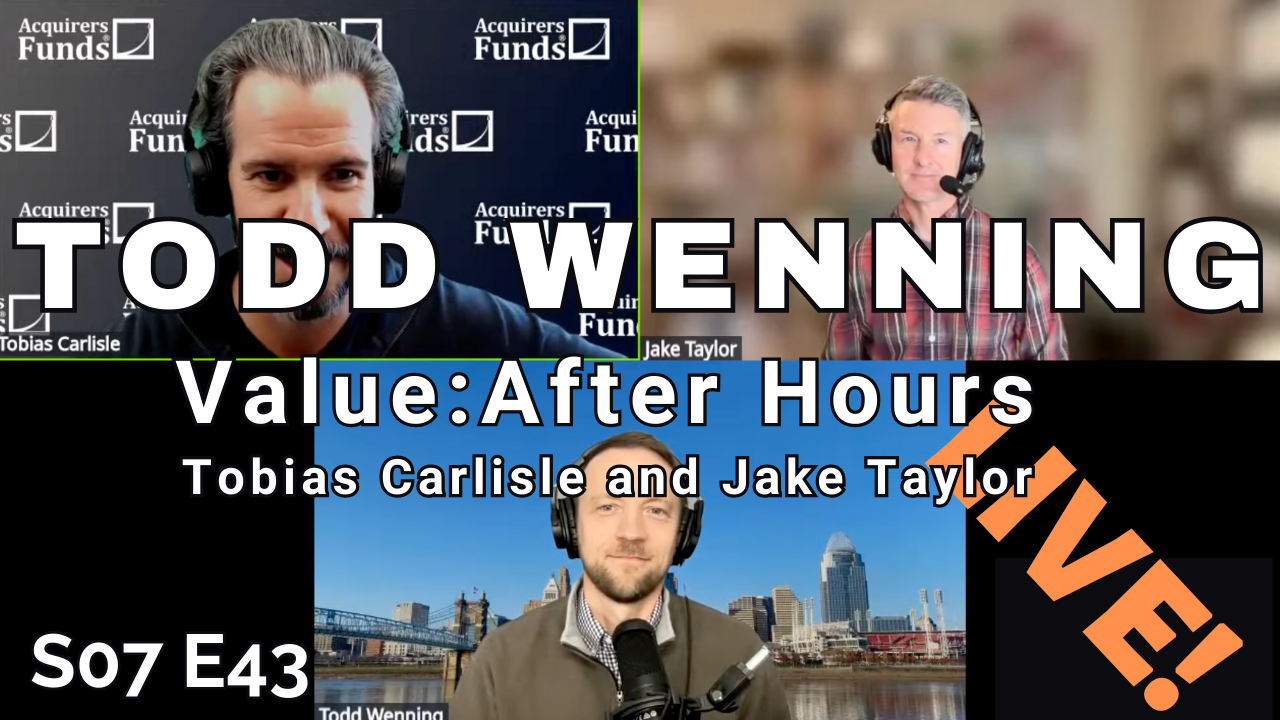
During their recent episode, Taylor, Carlisle, and Todd Wenning discussed Old Dominion Freight Line: A Case Study in Network-Effect Moats. Here’s an excerpt from the episode:
Todd: Yeah, I think cyclical could be moaty. I think when they have downswings in their industry, that’s a good time to pick them up. Because I think the moatiest companies in a cyclical industry are the ones who are most durable and can continue to think longer-term, while some of their competitors are freaking out, maybe trying to drop price, trying to get volume in through, cover those fixed costs while they can have a more long-term perspective.
I think one company in my portfolio that has been doing that, and I think will continue to be strong in their industry is Old Dominion Freight Line, which is a less than truckload company that has networks and nodes across the US. I think they’re the second largest LTL freight company in the US behind FedEx Freight.
Tobias: What’s LTL?
Todd: Less-than-truckload. So, there’s two major types of trucking. There’s truckload, which is what you might see driving on the highway where they’re taking one trailer from the shipper right to the end destination, so point A to point B. Whereas LTL is a shipper you rent or you buy a part of the trailer, so you might put a couple of pallets on a trailer at ODFL, and they’ll take it to their local service center or their warehouse where it’ll be unpacked off the trailer, put on another trailer, going to another destination with other products from other trailers, and so it can get broken up and shipped.
If you’re shipping something from, say, Florida to Washington state, it might be on three or four different trucks that go along. So, you’re not just hiring one trailer to take you from Florida to Washington, it might be put one truck, taken off, put on another one, so on and so forth. So, having that operational efficiency, that really strong culture, that Old Dominion Freight Line has to make sure that they are on time and there’s no damage to the materials.
You can imagine how many opportunities you have to break something when you’re taking things on and off a trailer three or four times. And Old Dominion has a 99% on time and less than 0.1% claims rate. So, it’s a very, very small breakage issue.
Tobias: So, what’s the moat that you need a network of these depots and trucks around the country to make it work?
Todd: Right. So, think about if you had a billion dollars, let’s say, to take on Old Dominion, it would be really hard to do that in a reasonable amount of time. First, you have to build the service centers. You have to find the locations. A lot of locations that ODFL has, they’ve had for decades. So, they’re in these population centers. Now, they’ve been built around. So, if you’re trying to do that today, you’re going to have a NIMBY effect, where people don’t want to have your service center right in the middle of their neighborhood, you got to go further and further out from the population center.
So, ODFL’s been benefited from these long existing spaces where they’re still in city centers and city approximates. And so, you have to find the real estate that’s attractively placed, and then you have to find local orders. You have to have salespeople who go out and try to get enough volume into your service center to cover those fixed costs. So, it’s a very difficult process to do. It takes a long time to do it.
The returns on invested capital are really nice, but they’re not super attractive where you might throw out all the stops to build these things. So, if you come in and you’re saturating the market and dropping prices, that’s going to impact everybody’s returns on invested capital, including your own. So, there’s a little bit of an efficient scale moat that happens there as well.
So, what I chalk up their moat, too, is it’s like a physical network effect. They have these 250 or 260 nodes in their network across the country. So, they can get things from California to Maine in two days, one day. That’s because they have these networks, these nodes in place across the country. And so, as they add new nodes, they can serve more customers, the whole network becomes more and more valuable.
You can find out more about the VALUE: After Hours Podcast here – VALUE: After Hours Podcast. You can also listen to the podcast on your favorite podcast platforms here:

 Breaker

 Overcast


 RadioPublic


 Stitcher

 Undervalued Private Credit Investing: Finding Value in Discounted Lending Funds
 Where Is the Deep Value in Canadian Stocks This Week?
 Investing Beyond AI: Why Traditional Businesses Could Still Thrive