Ray Dalio: The Future Belongs to “Brilliant People Working With Brilliant AI”
Monday, December 8, 2025 · Johnny Hopkins
In his interview with Oxford Union, Ray Dalio distills the forces shaping markets, stating “everything is driven by five big forces,” beginning with the critical “money, credit, debt, economic and market force.”
The current debt dynamic is central, as “when debts rise relative to incomes… debt service payments rise relative to incomes and they squeeze out other spending.”
This mechanic underpins his analysis of sovereign balance sheets, leading to a sobering conclusion: “I think that all fiat currencies are in trouble.”
For Dalio, the issue is foundational, as “debt is money and money is debt,” and with too much debt, “you’re going to devalue money.”
This directly informs his view on assets, noting “gold is the oldest money” and is regaining its role as a “storehold of wealth.”
Beyond macroeconomics, Dalio’s principles offer a methodology for investment decision-making itself. His core equation, “pain plus reflection equals progress,” is essential for refining one’s process.
He advocates for systematic thinking, explaining “I would think about my criteria for making those decisions and I would write them down. Those became my principles.”
He sees modern tools as transformative, arguing “the future lies in brilliant people working with brilliant AI.”
This partnership is necessary because “the idea that you’re going to wrestle around with everything in your head and juggle it and make winning decisions is obsolete.”
Ultimately, Dalio’s Oxford Union discourse emphasizes understanding mechanics over ideology. He advises investors to “understand how reality works really the mechanics of it,” warning that preconceptions can be a barrier.
“You come out of here probably thinking you’re smart or that you know a lot and and I think that that could stand in the way of your open-mindedness.”
In an era defined by the five large forces, success will belong to those who combine studied historical perspective with disciplined, principle-based reflection.
You can watch the entire interview here:
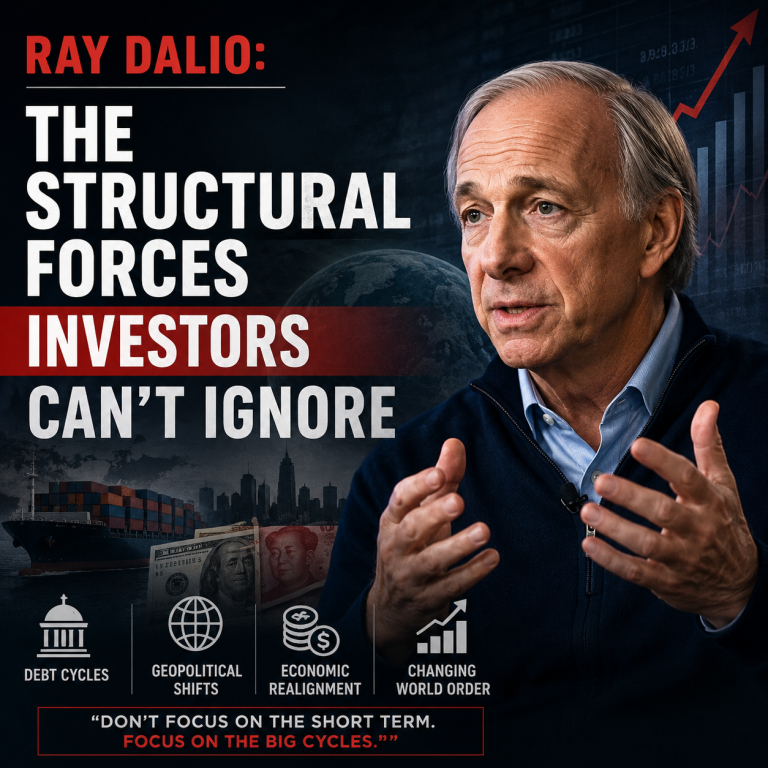 Ray Dalio: The Structural Forces Investors Can’t Ignore
 Where Are the Highest-Quality Value Opportunities This Week?
 AI Spending Boom: Are Big Tech Companies Taking on Too Much Debt?