
Navigating The AI Bubble: An Agnostic Investor’s Guide From GMO
Wednesday, December 3, 2025 · Johnny Hopkins
The speculative frenzy around Artificial Intelligence has all the hallmarks of a classic investment bubble. In GMO’s latest quarterly letter, Co-Head of Asset Allocation Ben Inker lays out the evidence: valuations rivaling the 2000 dot-com peak, stocks soaring on partnership announcements, and quantum computing firms trading at over 1,000 times sales despite competing with tech titans. “It certainly looks like a bubble to us,” Inker writes, noting the “next-level” conviction that “this time is different.”
For investors paralyzed by the fear of missing out or the fear of a crash, Inker offers a crucial framework: think like an “agnostic investor.”
This investor recognizes the bubble risk but operates under the baseline assumption that markets are generally fairly priced. The dilemma in past bubbles was that protecting a portfolio required drastic, potentially costly bets.
The good news? “The 2025 AI Bubble looks… much more like the 2000 Internet Bubble, in which a bubble-agnostic investor could have owned a portfolio with a reasonable risk/reward trade-off in either a bubble or a business-as-usual scenario.”
The key insight is that today’s market, unlike the Everything Bubble of 2007-08, still offers compelling alternatives without forcing investors to de-risk entirely.
“Today, non-U.S. equities, deep value stocks, and liquid alternatives offer returns that look reasonable or better, regardless of whether AI is in a bubble,” Inker states. GMO’s analysis shows a positive risk/reward slope of +0.4, meaning investors are still being paid to take risk—just not in the most overpriced U.S. large-cap segments.
The practical takeaway is clear: investors can and should rotate away from the AI epicenter. “Tilting a portfolio away from AI names and toward those assets may save investors a lot of pain if it turns out we are in a bubble without meaningfully reducing expected returns if financial markets are somehow still fairly priced today.”
GMO’s own Benchmark-Free Strategy exemplifies this, holding roughly 50% in equities heavily skewed to non-U.S. and deep value, 28% in liquid alternatives, and 20% in Treasuries. This portfolio has outperformed the S&P 500 year-to-date, proving “it has not been necessary to lean into the AI trade to achieve strong returns.”
For the uncertain investor, certainty is not required. As Inker concludes, “As bubbles go, AI looks like one of the easy ones for an agnostic investor to handle.”
You can find the letter here:
It’s Probably A Bubble, But There Is Plenty Else To Invest In
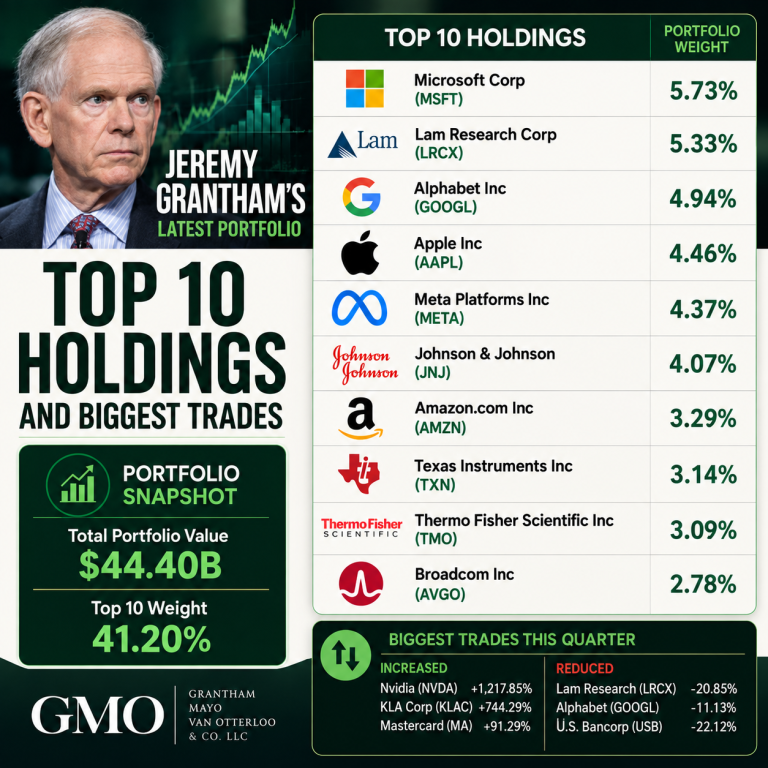 Jeremy Grantham’s Latest Portfolio: Top 10 Holdings & Biggest Trades
 Where Are the Highest-Quality Value Opportunities This Week?
 AI Spending Boom: Are Big Tech Companies Taking on Too Much Debt?