
VALUE: After Hours (S07 E42): Tim Melvin on Community Banks and Small Caps in Europe, Hong Kong and Japan
Sunday, November 30, 2025 · Johnny Hopkins
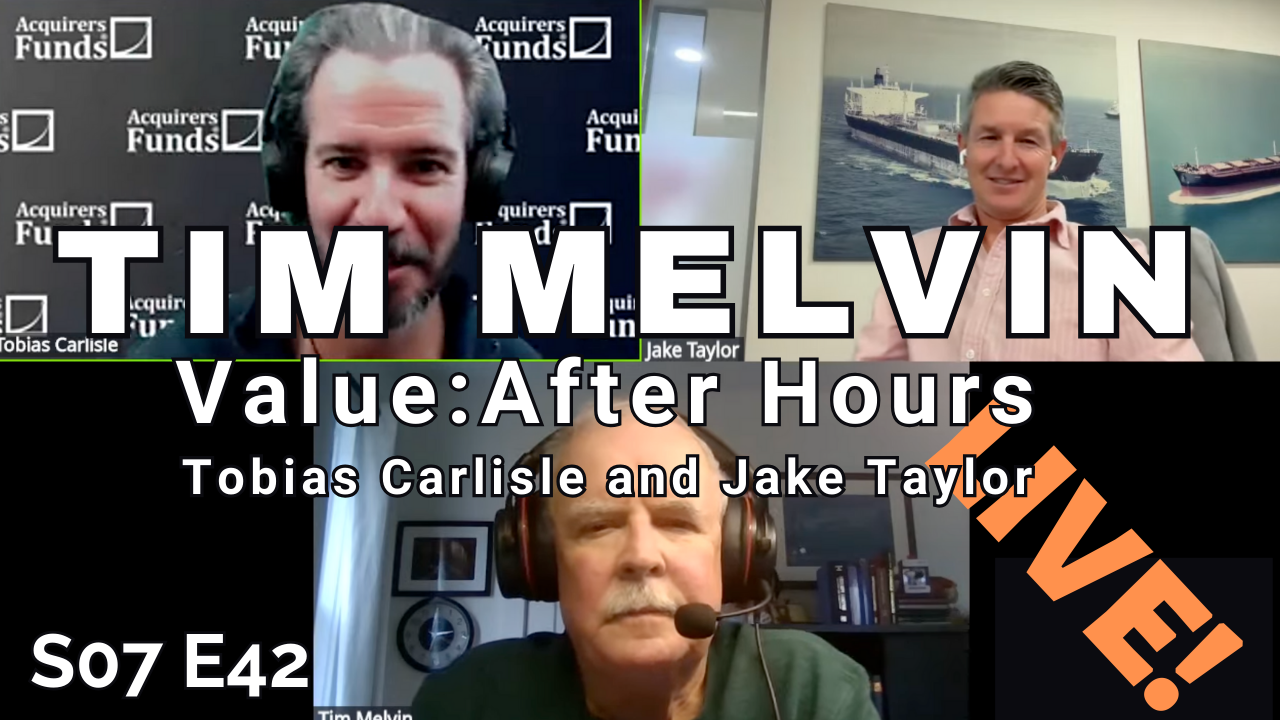
During their recent episode, Taylor, Carlisle, and Tim Melvin discussed:
- The Only Numbers That Matter in Banking: Capital, NPAs & Book Value
- Global Value Opportunities: Japan, Hong Kong & Europe
- Best Small Community Banks Right Now
- Goodyear & CarMax Are Great Buys
- Small Banks vs Big Banks: Why Local Loans Are Safer Than Towers
- Succession Problems and the Aging of America’s Banker Class
- Regulation, Politics & The New Wave of Bank M&A
- Buyouts vs. Long Holds: How To Think About Exits
- Mauboussin Veggies: The New Economics of Intangible-Heavy Businesses
You can find out more about the VALUE: After Hours Podcast here – VALUE: After Hours Podcast. You can also listen to the podcast on your favorite podcast platforms here:

 Breaker

 Overcast


 RadioPublic


 Stitcher

TRANSCRIPT
Tobias: I’ve got the little livestream icon, which means I think we’re live. This is Value: After Hours. I’m Tobias Carlisle, joined as always by my cohost Jake Taylor. He’s in London, England. And our special guest today is Tim Melvin. How are you, Tim?
Tim: I’m doing fantastic down here in Greensboro, North Carolina today. Just did a high-speed drive [Tobias laughs] across the city of Greensboro, because I was stuck in a doctor’s meeting. And I forgot we did this live. So, I told, “We can reschedule, we’ll do it at 2 o’clock.” So, we made it, so we’re here. Thanks for having me. [Jake chuckles] I appreciate it.
Tobias: Yeah. Good job, Tim.
Jake: Killed three pedestrians and–
Tim: Well, my wife just took the keys, because she said I drive like a Texan. Well, she drove here like a Texan running for the border. But we made it.
[laughter]Tobias: I love it. Tim, old friend of ours, we’ve talked quite a few times over the years. Let’s talk community banks. You’ve got a community bank investor newsletter.
Why Community Banks Still Work
Tim: Yeah. We’ve been doing that one for a really long time. Although you run across other stuff that’s interesting– Community banks have been my greatest love since the early 1990s in the aftermath of the SNL crisis. We just stayed with it.
We’ve turned it very quant in nature. Because I know people that can go on these long esoteric lectures about banks, and reserve banking, and the SOFR-EFFR spread, and what’s wrong with the banking system, and this, and then non-depository finance. None of it matters all that much. It is a lot of fun to talk about, okay, especially some of the stuff with non-depository financial institution loans and. But if there’s a series of numbers and if you get them right, you’re going to make money.
Tobias: Hit us with those numbers.
The Only Numbers That Matter in Banking: Capital, NPAs & Book Value
Tim: Hit us with the numbers. Real easy. Capital levels, okay? We want to look at equity to assets, we want to look at CET risk-based capital. The higher that number is, the better. I’m addicted to converted thrifts. So, over 15 and 20, I will just own that stock and not part company with it, because there’s– At that point, there’s the cockroaches, Keith Richards, and that bank left after the apocalypse.
[laughter]Tim: So, you want to have that buffer against anything that can go wrong, because something’s going to go wrong. Then the other is non-performing assets. What you’re looking for here is you’re just looking for bad loans, foreclosures that they can’t get rid of. You want that number to be as low as possible.
I use a cutoff of 2%, which in today’s environment might sound a little high, because we’ve gotten spoiled, because they’ve been so low. But I choose a hard percent cutoff. God could be running the bank. If He’s got an over 2% NPA, I’m out. I told that to John Allison one time, who does think he’s got of the banking industry. I said, “John, if you ever go 2%, I have to sell you stock.” Johnny’s a good old Arkansas boy. He says, “Well, Tim, I don’t expect we’ll ever get there.” I said, “Okay, well good, then I’ll just–” [Jake laughs]
Those are the two key fundamental numbers that we’re always going to take a peek at the amount of uninsured deposits. Just paying attention to that number kept you out of Silicon Valley Bank, okay? So, we’re going to take a peek at that particular number. But then, the only other number that we’re really caring about– If we’ve got a great loan portfolio and we’ve got lots of capital, most of this stuff in between doesn’t matter that much. It matters if you’re a professor or you want to pontificate.
Avoiding Blowups: How Simple Rules Keep You Out of Trouble
But if your idea was to make money in community bank stocks, then it’s really just a lot of talk, because everything’s going to show up in those two numbers or book value, okay? If book value is going south, something’s wrong. No matter how good the story is, no matter how good the narrative, the stock might look, the momentum, whatever it is, all that can be excellent. If book value is going south, something’s wrong, okay?
So, we want to look for book value that’s at least staying stable, and then price to book is everything. You make all your money in small banks when you buy them. If you get that right, you get a bank with all the other criteria and you can get that thing at 85% of tangible book value– I steal the phrase from Marty Whitman, “If you get all the other stuff right and you get the cheap price to book value, tangible book, by the way, it’s going to be really hard not to make money.”
Tobias: Do you find these banks have a lot of exposure? I’m not entirely sure what the reason Silicon Valley Bank fell over. That was more related to their asset side they’d stuck it in Treasuries and they’d had more front month Treasuries that were very sensitive to the move up in rates. That’s what [crosstalk] Silicon Valley?
Tim: Yes. But they also had the uninsured deposits were just these very large non sticky deposits. They were large deposits over the $250,000 mark. So, once they got a whiff of a scare, they were gone, because they had no insurance over that level. Silicon Valley Bank’s big problem was long dated low coupon bonds. They had put all of their assets into that for the most part, and then they had–
Jake: But those are safe.
Tim: Well, yeah, they are until everybody wants their money back, and then you got to take the mark on them. There was a whole combination of stuff that went on at Silicon Valley Bank that it was never a banking crisis, it was a regulatory crisis. Because in the rush to pass new regulation in the aftermath all that– If you stop to realize that the regulators on all four banks had completely dropped the ball. I just said, “Oh, they own Treasuries, we’re not going to worry about that.” So, if you were following just the simple rules, you never got caught in that.
And the same with Silicon Valley Bank at one time was a great bank. I can remember back in the 1990s thinking I was a super freaking genius, because I found this bank that was banking all the tech companies and were collected warrants. I bought it at $15 and I’m a genius, I sold it at $45, then I sat there calmly watched it to go to $600.
[laughter]Tim: So, yeah, if you get those numbers right, you’re usually going to avoid most of the other problems that are going to come up in the banking sector. People over complicate this.
Tobias: What sort of– Sorry, JT.
Jake: Is there more or less economic sensitivity with the smaller regional banks compared to say like the bigger banks?
Tim: Less. The small regional banks, I think it’s a wonderful life. That’s what we’re going for is the Bailey building– [crosstalk]
Jake: Yeah. What Jimmy Stewart–
Small Banks vs Big Banks: Why Local Loans Are Safer Than Towers
Tim: Yeah. They have no loans on large office towers and downtown buildings. That’s been one of the funniest things to sit back and watch over the last couple years. Well, community banks have the massive exposure to commercial real estate. I’m like. “Yeah. Give me more of this.”
This is Joe’s gas station and Fred’s doctor’s office. A four-story Office tower on the edge of town that’s full of accountants and doctors and lawyers local advertising magazines and brokerage agencies and real estate firms, these folks were coming to work when they weren’t supposed to. They never had the empty office problem, they never had the vacancy problem. There will be a rollover problem on the loans. That’s a fact. You’ve got all this loan that was out there, some of it’s going to roll over, the rate will go up. That’s going to be a very easy pass through.
And indeed, when you look at commercial real estate loan losses in community banks, they’re really low. Most of the problems in the banking area that you see, the commercial real estate office, it’s at big banks. It’s a big number, but it’s a big number on a massive balance sheet. So, I hate to say it doesn’t matter, but it doesn’t really matter that much. It’s the same with today’s hot button. Non-depository financial institution loans, that’s the bad word. That’s what’s lending to private equity funds, to private credit, to commercial lenders outside the banking system, fintech lenders, which by the way is code for subprime in a suit.
Jake: This is what you would call the shadow banking system now?
Tim: That’s the shadow banking. And the shadow banking industry is backed by the banking industry. There may be some problems that show up there, but it’s not the First Bank of Peoria’s problem. It’s Jamie Dimon’s problem, because all of that paper’s on the larger bank sheets for the most part. Community banks taking deposits, they make local loans. One of the things I love especially–
I deal in really small banks for the most part. They know the buyer, they know the piece of property, they know who tenants are probably going to be. They’re very well associated with what’s going on here, so they know the deals not to do and the deals that you can go ahead, maybe bend the rules on a little bit, which gives them some insulation.
What you’ll see in community banks when the economy slows down is those with CNI heavy portfolios, commercial and industrial, they’ll start to feel it, because Rosie’s Salon has no customers and she can’t make payment. So, we will see some of that. But even if you go back to 2008, when things were blowing up, it was only the banks that did stupid things that got into deep trouble. By the way, all crises were created by banks. Every banking crisis is created by bankers doing something stupid.
During the little 2023 banking crisis that really wasn’t a banking crisis where the four banks failed– I forget who it was, but it was a great shot. It was just a shot of a guy from the knees down in khaki slacks, and he cuffs on the slacks and tassels on the loafers. I just said, “If your banker dresses like this, you don’t have anything to worry about.”
[laughter]Jake: What’s the old joke, Tim, about the small-town banker that won’t lend anything–[crosstalk] no, anything further than he could see from the top of the water tower?
Tim: Yeah, exactly. If I can’t see from the top of the water tower, I’m not going to make the loan. That is just a tremendous business. It’s not like I didn’t discover this. People have been doing this for a very long time. Everybody holds up– Peter lynch as the great growth stock investor. I’m not taking anything away from Peter Lynch. He’s one of the greatest investors of all time.
Go back and take his fund returns apart. He owned when he retired– In 1989, was it? He owned every thrift in the United States, because he had a guy that– This guy’s job was to go around the country and put money in the mutual thrifts, so that when they converted, Peter could buy the IPO and all the stock, because that’s layup money. The rules have changed. It’s not as easy, but he owned literally every thrift. If he could get them that met his guidelines, he continued to buy them right up to the day he left. Because at its core, small town banking can be a very good business.
Now, right now, it is a much tougher business than it was back then, because regulatory costs are higher. Jamie Dimon spends a billion dollars a month on technology. First Bank of Peoria cannot do that. They have to go out, they have to find the licensing deals and agreements. It gets very complicated now, because when you go out and you acquire technology from a vendor, you’re not just responsible for your employers to the regulators, you’re now responsible to your vendors, to the regulars for your vendors employees behavior. So, it’s a regulatory nightmare.
Succession Problems and the Aging of America’s Banker Class
The other thing that we’re seeing in community banks is succession. It’s a problem. We had a bunch of banks started in the 1980s and 1990s, particularly in the 1990s after the Riegal Act was signed by President Clinton. These guys are getting old. Really old. They’re older than me old, and they’re looking for a door. Nobody graduated Yale this past spring and said, “You know what I’m going to do? I’m going to go to work at a three-branch bank in the Midwest. I’m super stoked.” Not even the last guy in the class, the NBA class had that top of brain. So, succession’s a problem. So, all of this–
Jake: I’m surprised that’s not– There aren’t search funds that are trying to do something about that, because that sounds maybe more fun and interesting than going and running an HVAC roll up.
Tim: Well, yeah, but you get paid a lot more money to run the HVAC roll up. You want to have some fun– [crosstalk] You have some fun, go in and pull the 10-Ks. Look at the salaries these guys are getting. A small-town banker getting a quarter million bucks, that’s top dollar. The smaller regionals, $400,000, $500,000. Dilute the stock with stock options and then go to the shareholders meeting.
Jake: [laughs]
Regulation, Politics & The New Wave of Bank M&A
Tim: Look, I’ve been to shareholders meetings in the basements of churches with these things. It’s all the local business people, and they know what you did, they know who you did it with, and they know if you padded your own pocket a little bit, and you’re going to pay a price for it.
But what this is doing is, and delayed for a few years now, but it’s kicking off another wave of acceleration of consolidation. Consolidation has been grinding on, and then you’ll get pickups. Under the Biden administration, I don’t care about the politics of it, they did not like banks, they did not like M&A. When you put the two together, they killed deals that they shouldn’t have killed.
They killed a couple of deals where I went through and I looked, I’m like, “Why did they kill this deal?” There was no reason. They just could. They drug their heels on others. It was a very hostile environment for bank, and banks, and bank M&A. Again, politics aside, this administration is very friendly to banks. They’re rolling back regulations.
Michelle Bowman, whose family owns a bank in Council’s Bluff, Kansas, Farmers & Drovers Bank. Big bank. I’m sure you’ve all heard of it. [chuckles] It’s been around for a long time and it’s still only got $200 million assets. She’s a community banker. She’s worked teller line, she understands what it means to be a small-town banker. So, they’re size fitting the regulation and they’re making M&A easier. We’re already starting to see it. I think we’ve had a sudden burst. And in the last few months, banks we’ve held for the last couple years, we had four of them bought. I think 2006, you’re going to see a real acceleration of this.
Jake: Do you want to get bought out, or do you just want to earn the ROE?
Tim: No, I want to get bought out.
Jake: Okay. [laughs]
Buyouts vs. Long Holds: How To Think About Exits
Tim: Now, look, if you get the right buyer, then I’ll hold the bank for a long time. I love telling the story about John Allison of HomeBanc shares. I wrote a bad article about his bank one day. I said, “Stock was really expensive.” John Allison, if you don’t know who he is, it’s worth reading about him. But he and his partner, Bunny Adcock, okay? So, you got Johnny and Bunny bought out a bank with FDIC and just assistance back in 1990 in Conway, Arkansas. Small bank, $25 million.
Johnny’s really good businessman and he’s brilliant guy. So, I wrote this article one time at Real Money and I said, “Hey, good bank, but that’s almost three times book. That’s ridiculous.” This man tracked down my phone number and called my cell phone on Saturday morning at 11 o’clock.
Tobias: [laughs]
Tim: I pick up the phone, I’m like, “Who the heck–” I got a friend in Conway. I’m like, “Did Chris change his phone number? Let me see who this is.” He’s like, “Tim, this is John Allison, the CEO of that bank you wrote about yesterday. I don’t think you were very nice to me.”
[laughter]Jake: You some bitch.
Tim: Yeah. [laughs] That was implied, believe me. But I got to know John, and he’s a great banker. He does about a deal a year, and he’s never made a bad deal. If John Allison buys one of my small banks, and it’s happened a time or two, I keep the HomeBanc shares that I get, because it’s a great bank.
So, you make this decision whether you’re going to keep the acquiring back on a case-by-case basis. Yeah, I generally speak it, I want to get bought out. Absolutely, I want to get bought out. You’re looking at almost an arbitrage there, 85% or less, a tangible book. Deals are currently averaging about one and a half. I will take that spread all day. Where it gets to be magic is if you can get it at 85% of book value, and they grow the book at 10% a year, then big things start to happen.
Tobias: Do you have any names, Tim, that you can take us through just to give us a flavor of what it’s like?
Best Small Community Banks Right Now
Tim: I had pulled a couple up here. Let me just get back to the portfolio here. Bear with me one second, guys, because as you know I was running very late [chuckles] coming in here today. There we go. It’s up here.
Jake: Could I ask a more meta question before that while you’re digging?
Tim: Sure. Absolutely.
Jake: Look, do young people have– Because I imagine that they’re a little bit more inclined toward digital, a little less wanting to go into the bank locally. Maybe that’s less important. Maybe I’m wrong about this. But I’m just imagining a less sticky customer base with the younger generation relative to maybe their parents or their grandparents. Is that intuition accurate?
Tim: Not really. So far figuring this part out and we’ve seen some other bank figure it out, if you can meet their needs. In other words, don’t make them come into the branch. Offer them the digital services. It’s a transition for a lot of bankers, but you have to get the tech right. If you get the tech right, they’ll stay with you.
Now, they’re not old enough for this to be a definitive statement. making a statement about the longevity of a 25-year-old would be silly at this point in time. But it does seem that if you can meet their needs digitally, they will stay with you. We haven’t tested this yet, but we will in the next banking crisis that comes along, how soon they discover the importance of FDIC insurance, although we’ve seen a little bit of data SoFi. Their deposits went up when they started offering insured accounts.
Something about Americans, we love that FDIC insurance, especially small depositors that really don’t maybe not understand the banking system and how it all works. They like the feeling that the government’s going to back them up if things go wrong, and punish the bad guys. I think if you meet them digitally, they’ll stay with you. However, if you cannot meet them digitally, you do have a problem, and that’s actively driving M&A. You’ll also see the usage of AI continuing playing a big role in this going forward, too. But let’s do some names now.
Guys, the names I’m about to give you are small banks, okay? If you use a limit order on any of the banks, I’m about to tell you about, your major contribution to the day will be buying lunch for a trading desk at a small brokerage firm [Tobias laughs] somewhere in the Midwest of America. It’s going to be the best lunch they’ve had all year. So, one of my favorites, and this is a former converted thrift, Toby. It’s the North Shore Trust & Savings Bank. It’s now called NSTS Bancorp. The symbol is NSTS. It’s a really small bank. It does not trade a lot on a day-to-day basis, guys. So, please be smart, use a limit order.
But in a world where a 10 is a high equity to asset ratio, they have a 29, it trades at 70% of tangible book value. Just a super cheap, small branch, northern Chicago suburbs, former thrift, trades by appointment from time to time. But you would have to work so hard to lose money in that bank. It’s crazy.
Two days ago, I would have given you Blue Foundry Bank, but they got bought out. [chuckles] RBB Bancorp out in LA, they are Korean bank. They do business with the Korean-American community. Trading at 77% of book value, a 3% dividend, and a 12 equity to asset ratio.
Tobias: When you see that equity to asset ratio, when they’re more conservative like that, what does that indicate about what they’re doing in the business? Why do they tend to run more conservatively?
Tim: Well, A, they’re more conservative. B, in the case of like NSTS or some of the other former thrifts, they took in a bunch of cash during the thrift conversion offering. And in a thrift conversion offering, here’s what happens, Toby, we have a $100 million bank, okay? We’re a thrift, we’re owned by our depositors. We decide to go public. Now, we have a $100 million in assets. So, we’re going to sell $10 million shares at 10 bucks, that’s $100 million. So, at offering closes, what do we have? We have $10 million shares outstanding, but we have $200 million in assets. So, we’ve sold stock at $10, it’s now worth $20–
But we’ve bought in just a ton of cash assets, and they tend to just be there– They’ll just hold them in short term securities, collect the money off of that. It is a very conservative approach to banking. It’s very old-fashioned approach to banking. But generally speaking, the banks that hold higher capital ratios are the ones that will not get in trouble when things do go bad.
As Charlie Munger said, “You can make a lot more money avoiding stupidity than you can by being the smartest guy in the room.” So, bankers with high capital ratios, really conservative, happy to hold capital. The excessively high ones tend to be former thrifts.
Tobias: Just the RDB, which is the– Was it RDB, the Korean-American Bank?
Tim: RBB Bankcorp. Yes.
Tobias: RBB.
Tim: Yes. They’re in LA, but they’ve got branches around the country. I’m shocked that they have not been purchased yet, because there’s been a general consolidation among some of the more ethnically oriented banks.
Tobias: What’s the story with RBB beyond that– They’re well capitalized– They’re–
Tim: Well capitalized. They serve the Korean-American business community. And that is the story. That’s a really loyal– The Korean-American banks on the West Coast. There’s some branches in like Washington D.C., I believe. They tend to have just this really super loyal deposit base. They come to them first for loans. So, just a great business. But there’s been a lot of consolidation in that space.
Tobias: Why do they tend to trade cheaply?
Tim: Nobody cares about them. I mean, that’s just bottom line. Nobody really cares about them. They see them as completely– If you just do it by the numbers, they’re all commercial and industrial and real estate in LA. Real estate in LA causes cancer. We all know that.
Tobias: [laughs] It says it on the door.
Tim: It says it on the door. There’s a warning. All of the ethnic banks are trading very cheaply right now. They’re just out of favor, nobody’s paying attention, they’re not AI banks, they’re not a sexy story, so everybody’s just standing aside.
Tobias: And what return would you expect absent to take out in something like RBB?
Tim: Well, it’s going to trade up to book at some point in time when the banks come back into favor. If they can continue to earn a double-digit multiple on ROE, then I think a double digit compounded return is reasonable to expect over time. That doesn’t happen overnight.
Tobias: And so, what returns are they getting on equity or assets and something like that?
Tim: Let’s take a look at RBB. RBB right now is doing a 7 on ROE and a very low ROA. This also makes them a very attractive takeout target. It’s RBB really to me is a takeout target more than anything else.
Tobias: Mm-hmm. Okay. Let me give a quick shoutout to everybody who’s at home. JT’s just fallen off briefly, so we’ll see. He would ordinarily give us veggies at the top of the hour. He’s back. I’ll give a quick shout out, JT, and then we’ll do some veggies.
Jake: Yeah, it’s fine.
Tobias: Lausanne, Switzerland, what’s up? Surbiton. Cleveland, Toronto, What’s GX, Barney? Main streets of GX. You got to help me out there. Is that Georgia? Boise. So, I got an instruction on saying Petah Tikva, and I’ve failed terribly. But Petah Tikva, what’s up? Valparaiso, what’s up? Kauai. Good for you. Tallahassee.
Monterrey, Mexico. Jupiter, Florida. Sam’s already won. Toronto. Lisboa, Portugal. Fort Collins, Colorado. I think that’s it. San Antonio. Everybody’s taking a break for Thanksgiving. JT going to hit us with the veggies, and then we’ll come back. We’re going to talk small-caps with Tim.
Mauboussin Veggies: The New Economics of Intangible-Heavy Businesses
Jake: Yes, sir. All right. So, today, I wanted to hit us with what’s new in Michael Mauboussin’s updated capital allocation paper that came out a few weeks ago. So, it’s not going to be a full recap, it’s just what’s changed since the earlier version of it that I think I did a book report on already at one point.
So, the big picture is that this new data from 2024 and into 2025 makes the story even clearer than it was that– US corporates right now are cash machines really in an intangible heavy world with a lot of option value that’s concentrated in a very small set of the mega-caps. So, here are seven observations from the white paper.
Number one. Intangibles are now clearly driving the capital stack. 2024, US corporate capital deployment was roughly $7.5 trillion. Intangibles which are R&D and investment in the SG&A line Items now are 13% of sales and are bigger than CapEx now, which is saying something. So, the center of gravity in the capital allocation universe has definitely shifted to the intangible world.
Number two. Leverage today is lower than history, which might be a bit of a surprise to you even after a decade of cheap money. So, this is non-financial corporates debt divided by total capital around 15% today versus 26% historically. This has happened after historically low rates. So, contrary to probably the usual narratives. The US corporate is actually entering the next regime under levered versus history.
Long run return on invested capital including intangibles is around 9%. That’s basically they’re generating more cash than they productively reinvest at this point. So, it does tend to support these structurally higher payout ratios. Excess cash and short-term investments are 7.5% of assets up from 5.8%. So, half of all the excess sits in fewer than 70 companies and a quarter of that is in just 10 companies.
Tobias: [laughs]
Jake: So, the real capital allocation option in the system is locked inside a very small group of mega-caps. And their decisions are going to end up moving the whole ecosystem really. So, we got to pay attention to that.
Number five is the– The index is obviously flipped to intangible heavy sectors. So, IT healthcare communication went from 26% of the S&P 500 in 1970 to more than 50% today. So, now, really like the benchmark itself is built on intangible heavy models. CapEx and R&D growth are effectively a four-firm story. The first half of 2025 CapEx is up 15% year over year. 60% of the incremental dollars came from Amazon, Meta, Alphabet, and Microsoft. So, this infrastructure build out in AI is very extremely concentrated.
So, basically, if you own or you’re underweight those four, you’re taking very specific capital cycle bets today, one way or the other. I don’t know necessarily which one’s right. Working capital is no longer much of a lever that used to be. Net working capital fell from 30% of assets to sub 10% today. So, that classic free up working capital play is though that was the in the NBA playbook is mostly done. For many businesses, there just isn’t really much juice left to squeeze out of that lemon.
So, summing this all up, more intangibles, less leverage, huge concentration of optionality in capex and a handful of firms. So, as an investor, that forces really a simple question, like what game are you actually playing in this world right now? Are you underwriting old school CapEx stories in an economy that’s running increasingly on code and customer acquisition costs, or are you deliberately betting on a small handful of giants that will hopefully, profitably deploy all these cash flows and this cash into a very uncertain AI future? So, with that I’ll let you, gentlemen, place your bets wisely.
Tobias: One of the series that I track is margins for S&P 500, S&P 400, S&P 600. They’re clearly all of them are close to all-time highs, or they’re all at all-time highs. Buffett comment, it’s been echoed by a few different investors like Jeremy Grantham.
Jake: Grantham also. Yeah.
Tobias: Hussman, as well, have all said, “Anytime you see profit margins above 6%, you’re likely to see some mean reversion.” But the S&P 500 is at like 14.9, like plus 14, which is more than two times, obviously 6%. [chuckles] Is any of that–
Jake: The math checks out.
Tobias: [chuckles] Is that a product of working capital optimization, or is that just they can charge higher prices than paying out less on the other side? Anything that you’ve seen that explains that?
Jake: James Montier did a piece on this about– It was a bit of a mea culpa. I think that was even in the title of it. He had predicted, being a GMO guy, that profit margins would mean revert. This what he wrote in like 2012 or something.
Tobias: Yeah.
Jake: And then, he looked back at it a decade later, and they had not been reverted, and if anything, they’d gone the other direction. His answer was that a lot of it had to do with government stimu– like running deficits basically was one of the primary takeaways as to why that was the case.
I think there’s also probably a reasonable argument of, call it, regulatory capture or lack of anti-trust, probably. There’s some pretty cozy comfortable oligopolies and monopolies that exist that are just earning super normal profits. So, who knows? That’s a very big complicated system to try to ascribe to a couple of variables is quite difficult.
Tobias: The monopoly thing is funny though, because even in the small-caps, they’re running it historically high margins.
Tim: I think low cost of debt might play a role here too, because money has been– [crosstalk]
Jake: Yeah, interest expense very low.
Tim: Really cheap since 2009. I think that probably plays a role in there.
Jake: Corporate taxes, too. Low.
Tim: Yes, thankfully. [chuckles] Let’s not do away with that. No mean reversion there, guys.
[laughter]Tim: Lower’s better.
Jake: Well, we’ll see. You balance that against the guillotine risk, and maybe it’s not the worst thing in the world.
Tobias: [laughs]
Tim: Then there’s that.
Tobias: What did you take away from the piece, JT? What should we be looking at?
Jake: I told you 120% of my knowledge just now in the–
[laughter]Jake: No. Like I said, I think it’s going to come down to a handful of companies and what do they do with their cash that’s going to dictate a lot of the return on capital, a lot of the profit margin numbers. Because they’re just such huge companies. They make up a ton of the market cap, and they create a lot of the economics that is accounted for in the S&P. So, as they go, so go with the index.
I don’t know, when I think about some numbers I’ve seen where the– I think starting next year, there’s going to be, what, like $500 billion of depreciation flowing through these income statements next year? That’s not an insignificant number to mark against your earnings.
Tobias: Yeah.
Jake: Should at some point, that stuff has to matter. So, I don’t know, we’ll find out.
Tobias: There was a paper– I think it’s a 2005 paper, something like that the investment factor paper where they said that basically you want to avoid companies that making these very high investments because they tend to underperform. The problem is that since that paper came out, that whole relationship has flipped and the investors are the ones that have outperformed. But the full data set says that investors underperform. I don’t know, I think it’s either one of us–
Jake: That’s every data set right now, isn’t it? Literally everything. It’s like, “Do you want to be right from the last 10 years or the last 100 years, because there’s polar opposites?”
Tobias: That’s a choice. Yeah. That’s exactly right.
Jake: It’s enough to drive a sane man [laughs] off the edge.
Tobias: When the going gets tough, the weird turn pro. Is that the–
Tim: Right. Hunter Thompson, “When the guy gets the tough, the weird turn pro.” Yes.
Jake: [chuckles]
Tobias: Well, speaking of one area that has been dead and left behind, let’s talk small-caps.
Tim: Okay.
Jake: Great segue. [laughs]
Tobias: Let’s start with this. What’s the attraction of small-caps, Tim?
Tim: There’s not much.
[laughter]Tim: When you look at small-caps you can find bargains– You know this, Toby. You’re in the same space by default using The Acquirer’s Multiple you tend to come up with cheaper stocks. But right now, we’re in that phase where the stuff that you can find keeps going down. So, [chuckles] it’s just that environment, at least in US based stocks.
Tobias: I will say that that may be turned around at the beginning of November.
Jake: Oh boy. There we go.
Tobias: We’re measuring value runs in fruit fly lives these days.
Jake: Yeah. It’s been three Liz Trusses.
[laughter]Tobias: It’s been three weeks of not being waterboarded.
Global Value Opportunities: Japan, Hong Kong & Europe
Tim: Yes. Well, everything’s up to date rather nicely. But when you look even at small-caps in the US market right now, if you apply credit filters, you’re still not coming up with a ton of names. As I said, what you do come up with continues to go down. Now, where outside of small banks where I can point and say, “That’s cheap. I want to own a lot of that.” Right now, it’s Europe and Asia.
Jake: In Asia, is it primarily Japan or where you finding– [crosstalk]
Tim: Actually, yeah.
[laughter]Jake: Tim just did a Hail Mary with–
Tim: [laughs] Yeah. We’re buying Hong Kong.
Jake: Okay.
Tim: Look, I brought Swire Pacific, and I brought it and recommended it, bought it in my own account. Swire Pacific owns 82% of Swire’s property. That portion that they own of Swire’s properties is more than their market cap. They also own 45% of café or airlines. Oh, and most of the coca cola bottles bottlers in southeast Asia. So, it’s reasonably financed. There’s a 5% dividend. What’s the knock on it? It’s in Hong Kong, right?
Jake: Yeah.
Tim: China has been the quietest bull market, I think, in the history of the world, because we’ve all sat around for two years talking about how terrible China is.
Jake: Uninvestable, even.
Tim: Uninvestable, the government’s failing, they’re not using oil. It’s awful, it’s terrible. And the stocks just keep going up, and up, and up, and up. [Jake chuckles] It really hasn’t happened in Hong Kong so much. We’re playing a little bit of catch up. But God, it’s cheap. I look at the property markets, and they’re not having the same office vacancy problems and apartment vacancy problems were here in the United States. They have a PR problem, because they’re still kicking off cash.
As China continues to develop, Hong Kong is going to continue to play a bigger role. If you look how close Hong Kong is to the tech centers in China, as the Chinese technology industry develops, it’s really good for Hong Kong. Now, that’s all the big macro stuff, and that’s really cool stories. The truth is I’m buying it, because it’s too cheap not to buy.
Jake: Yeah. I was just there last week In Hong Kong, and it’s first time I’d ever been there. I really liked it. It’s amazing, these—Basically, if you took New York and put it on an island and, or a tropical island and just built it into the side of the mountains, it’s pretty incredible.
Tim: Right. It had no EPA overlooking the harbor and all.
Jake: [laughs]
Tim: Yeah, that’s Hong Kong right there, man. But things are happening in Hong Kong, and they’re pretty good.
Jake: Yeah, just– [crosstalk]
Tim: Yeah. They’re so close to the technology centers of mainland China that I think that’s going to be a big carry through. The fact that you can buy this stuff so cheap, get paid a nice dividend– Look, I didn’t put my net worth into it, and I don’t recommend anybody else do. But as part of a diversified portfolio of global stocks, Hong Kong is cheap, Japan is certainly cheap.
I’m going to have some great fun Thursday at my son-in-law’s expense, because he’s an economist and he’s been explaining to me all the ins and outs and financial intricacies of why Japan was on the verge of failure for a couple years now, and why their banking system, the carry trade blowing up. It was terrible and awful. I’m just sitting here going, “Yeah, but they doubled and they still traded 80% a book. So, I don’t really care about your argument anymore.” [laughs] So, we’re still finding some value there.
We own European shipping. A.P. Moller – Maersk is still sitting there and the stock is ridiculously cheap. We started doing this over a year ago. Just take the old Ben Graham perfect stock rule, right? Under book value, less than a 0.4 debt to equity, current ratio two or more pays a dividend, and it’s crushing US stocks. Just makes the Mag-7 look sickly over the last several years. And they’re still cheap.
Jake: That’s a narrative violation.
Tobias: [chuckles]
Tim: You know, my life is a narrative violation, so I’m comfortable with that. [laughs]
Tobias: Why are they trading so cheaply?
Tim: Because they’re Europe, right?
Tobias: yeah.
Jake: [chuckles]
Tim: US is now like this massive dominant player on the year the global stage, the global economy, global markets, and Europe is seen as these totally 1,000,000% incompetent, stumbling, bumbling fools and idiots who get everything wrong. There are grains of truth in that. If I was going to write a script on how to really screw up your energy policy, I would just take government policy from Germany and a couple other nations around Europe and write my movie.
They’ve made a lot of mistakes. But you got a lot of great businesses in Europe. You’ve got a lot of 200-year-old businesses that have seen it all, and done it all, and they’re still there. And much like California, as much as we point fingers and go, “Ha-ha-ha,” there’s still a lot of people living there and they’re buying things and they’re buying clothes and they’re driving cars. Although in California, I think that’s a felony.
Tobias: [laughs]
Tim: Sorry, Toby, I had to the shot. Europe is still there. It still exists, it’s still doing well, it’s still got great businesses. It warms my heart as an old man, they have a dividend first policy. They like to pay dividends. And then, you look at what’s really happening in Japan, where they looked around and said, “Look, you can’t keep doing this cross ownership, this little gentle corporate mafia thing that we’ve been doing for centuries.”
I can remember the first time I invested in Japan it was, because Marty Whitman bought all these property and casualty companies in Japan. Marty is one of the smartest guys that ever lived. By his own admission, he got lazy at the end. But when he was working, [Jake laughs] he was killing it, and he thought he was going to go and play activist. [chuckles] That was funny.
Now, we all did eventually make money in the stocks, but he thought he could put the squeeze on them and– No, they all owned the majority interest of each other. It was like this impossible thing to unwind and activism. He complained to the government. But yeah, that’s nice. “What are you doing here, white man? Can you get out of Japan?” Today, they looked around, they said, “We’re going to need foreign capital to do all these things, so we have to loosen the restrictions.”
The main stock exchange said, “Look, you got a year. Get your price up over book value or we’re going to delist you. You got to end your cross ownership.” So, now, all of a sudden, activists are winning. Elliot actually won an activist campaign. This is like a huge deal. We’re seeing buybacks, and all kinds of 20th century United States markets stuff [Tobias laughs] going on in Japan. It’s really good for the stock market, and you can still buy these really good businesses with great balance sheets, by the way, for less than book value.
So, I know there’s all sorts of double top secret financial stuff going on in the background, because my son-in-law goes on and on and on about it. I don’t really care. It’s like the SOFR-EFFR rate that everybody was all jacked up about last week. Well, I looked at it. Yeah. Okay, that’s because of treasury issuance. Are we done talking about that now? iI’s all great, and it’s all conspiracy theory, and it gets clicks and likes. It doesn’t matter that much if I can pay 80% of book value, and they don’t owe anybody any money, and they have good credit and lots of cash. Update. Your prime minister can be the biggest that ever walked. I’m probably still going to make money. So, yes, Europe and small banks are really where we’re focused right now.
Jake: I’ve heard that rumblings that Korea is five years behind Japan at this point as far as that story of corporate governance reshaping a lot a lot of heavy balance sheets that could potentially be unwound.
Tim: Yeah. I think we’ll eventually get there. And right now, the Korea electric power is cheap. It’s been cheap forever. But if you buy it when it looks like North Korea is ready to invade– I’ve made money every time they’re doing– It’s like, I want to send the guy a Christmas card and say, “Please threaten to invade. [Tobias laughs] I need some cash.” [laughs]
Jake: He’s your best [unintelligible 00:47:02]
Tim: yeah. [laughs] He’s a great indicator. He threatens to invade, stocks sell off, we buy a little bit, he doesn’t invade. It’s the old, and it’s still one of my all-time favorite market stories is the guys at Tweedy, Browne.
Howard Browne went out to lunch one day– I forget which one of who was– Joe Riley was on the desk. It was Bay Pigs. Not Bay Pigs, I’m sorry. The Cuban Missile Crisis. All of Wall Street’s scared to death. Markets are dropping like a stone. The market was already down before the missile crisis. Things are collapsing. Now, Tweedy, Browne– This is old school value. They were Ben Graham’s broker. They’ve been around a minute or two. Okay, I’m going to have to call that back.
So, Howard goes to lunch, he comes back, Joe’s at the desk. Everybody’s huddled around the little black and white TV where they’re predicting the imminent end of the world, as the ship comes ever closer. He’s calling every broker on Wall Street, and he’s just buying and buying and buying and buying stocks. Howard says, “What the hell are you doing, Joe? There could be nuclear war. We could all be dead.” And Joe said, “That’s right. If there’s nuclear war and we’re all dead, nobody’s going to care. They’re not going to be here to care. [Tobias laughs] But if they don’t have nuclear war, we’re going to make an enormous amount of money. Firm had one of its best years ever.”
Tobias: [crosstalk] on margin. You might never have to pay it back.
[laughter]Tim: Right. [crosstalk] Yeah. Korea’s been like that for a long time. Every time there’s an invasion risk, it sells off and you can make some money there. But they are well behind Japan and making big corporate governance changes. They still have a lot of the interlocking going on.
Tobias: That’s the carry trade thing. Is that a risk to the Japanese stock market, or is that a risk to the American stock market?
Tim: I think it’s a risk to every other developed market in the world more so than Japan. That’s not the way the story is being told. Yeah, because the idea was you borrowed the cheap money there and then you bought stuff somewhere else.
Tobias: And their rates have been rising, their rates are the highest that they’ve been in 20 or something. 20 [crosstalk] years.
Tim: Yeah, over 30 years now. It’s been a long time since rates were this high in Japan. But it doesn’t seem to be impacting Japanese stocks at all. It had went down one day last week, but so did everything else on the planet.
Tobias: Anything in America, Tim, that you find interesting outside of the banks?
Tim: Not that I’m aggressively committed to at this point in time. We did buy some of the Amrize spinoff, AMRZ. It’s building supplies and materials, aggregates, concrete, asphalt. It’s going to be a lot of building in this country. A lot. We are going to be building the data centers, we’re going to be– Look, you get to write off manufacturing facilities and factories under the big beautiful disaster. Oh, Bill, I’m sorry.
So, you’ve got that construction, you’ve got reshoring of factories. There’s a lot of homes that have to be built, where millions of homes short. That’s going to use a lot of building materials. This thing gets spun off by a Swiss company, by the way. Nobody cares about it, nobody understands it. It’s a great business that has done nothing, but drop since the spin off. So, we bought a little bit of that.
Goodyear & CarMax Are Great Buys
Let me just pull up the actual sheets here, so I can talk from a position of authority. We bought Goodyear Tire and Rubber actually with the $2 billion capital infusion from asset sales. The fact that they make their most of their tires in the United States puts them in a very good competitive position against most other tire companies. Bought some of that before that began its run.
Tobias: And EVs are not a threat to tire companies. If anything, EVs chew tires.
Tim: Yeah, that’s what I’ve heard. I’m not a big tire expert, but Goodyear is an old American company. They were doing everything right, is trying to undo the mistakes of the past. It’s hard for me to find a lot that I want to be really super aggressive about in the United States right now, because the indexes are at ridiculous levels. I don’t care how you cut or measure that.
When a 40-cape ratio was a 40-cape ratio, and when I look at credit spreads, they’re about as tight as they’ve been. They’ve weakened up a little bit. But that’s a lethal combination. You go back through history and you find sub 3% high yield credit spreads and a cape ratio say of over 30, I mean, that’s lethal. So, I’m being very cautious, and it’s got to be super cheap. We bought CarMax when it imploded, just because I love CarMax.
Tobias: [chuckles]
Jake: Remember the other times when you had a tight spread and a high cape– [crosstalk]
Tim: 1999. You can’t go too much further back, because you didn’t really have a high yield credit spread that was measurable before then. But 2007, you got into the same situation, and 2019, you got into a very similar situation. Look, it’s not a you must act immediately right now the market’s going to drop tomorrow. But it’s screaming something about forward returns and the– Guys, I’m not sure what this is, but it’s a doctor’s office. I think I have to take it. Give me two seconds.
Jake: Emergency.
Tobias: JT, we would tell us a little bit about-
Jake: Toby.
Tobias: -your trip to Hong Kong. What are your learnings of Hong Kong, make benefit glorious nation of Value: After hours?
Jake: [chuckles] Yeah, I did a little Asia swing of Tokyo, Hong Kong, and then Shanghai. Generally speaking, it’s similar to our trip earlier this year that we did together, where you just come away from it thinking, gosh, there’s so much commerce happening on this side of the planet, and that when you’re living on the other side, you just take a little bit or you’re just a little blind to. Chinese people really want to work hard, try to get ahead, make money.
Tobias: 996?
Jake: Build businesses. Yeah, it’s as 996 as ever. It’s just really impressive. They’re working quite hard there.
Tim: Sorry, I had to step away for a minute there, guys.
Jake: No problem.
Tim: I only caught part of the Asian thing, but I did– Henry McVey and his team at KKR, they’re really good on macro, by the way. If you’re only really one macro guy, for me, it might be him. One of their major themes is inter-Asian commerce. They see it as huge because of the ongoing arguments between the United States and China on trade. They’re doing more and more business between themselves, and amongst themselves, and they see it as like a really high return investable area.
Jake: That’s interesting. Yeah, you can imagine that. If the supply chains do a little reconfiguring.
Tobias: Who are the big beneficiaries out of that? Vietnam, Singapore.
Tim: Vietnam, Singapore, to be sure. I’m still doing some work on that. I haven’t got anywhere near as far along as I’d like to be. But just– [crosstalk]
Jake: It got to be inflationary for the West, because those cheap goods and services or goods at least are getting redirected somewhere else?
Tim: You would think so. So far everything that I’ve thought would be inflationary for the West and for the United States hasn’t shown up yet. My nightmare all-
Tobias: We just don’t count it.
Tim: -shows up at once.
Jake: Well, part of.
Tim: It’s funny that everybody’s celebrating now. The tariff revenue is getting ready to go up, because all of the pre-tariff rush of stockpile building is now gone. So, that’s great. It’s going to increase tariff revenue. But last time I looked, tariff revenue was a tax that was inflationary. I think the first quarter of next year could be interesting on the macro stuff.
Tobias: That’s the first time they actually stopped start hitting. That’s the first time they actually start counting, because everything up to this point has been pre-tariff inventory that they’ve been selling down.
Tim: That’s part of it. The other part of it is there’s a couple things. A, lot of tariffs were staged in. B, according to Goldman, and I’ll rely on them because they’ve got guys at the ports counting these things and I don’t, corporations have been eating over 50% of the costs. The foreign nations have been 88%. That’s been the number and it’s going to stay the number, I think.
But the corporations, if you listen to the calls, they’re saying, “Yeah, we ate some. We can’t keep doing it.” Because it’s killing Target and Walmart and some of the other people that it’s crushing margins. Well, they’ve got shareholder to answer to. So, I think the first quarter could be interesting depending on how the Supreme Court decision goes. But I don’t think we’ve seen the last of the tariff move be yet.
Tobias: What’s the decision before the court? Whether they–
Tim: Decision before the court is whether he was allowed to do it or not.
Tobias: Right.
Tim: I know the answer. I’m just not sure how they’re going to roll.
Jake: Yeah.
[laughter]Jake: Right.
Tobias: What’s the answer? Yes, he’s allowed to do it?
Tim: No.
Jake: No.
Tim: No.
Tobias: Okay.
Jake: [crosstalk] the job.
Tim: If they wrote that he has the authority, they’re all going to be suffocated from tying themselves up in knots and we’re going to have to get a whole new court.
Tobias: I see.
Tim: [chuckles]
Tobias: So, what happens when they say he’s not allowed to do it?
Tim: There’s the $24 question. None of us know.
[laughter]Tobias: Okay.
Tim: Really, that’s just going to be massively confusing, because technically, they’ve got to give all the money back.
Tobias: [laughs]
Jake: Can you imagine why? What are they going to– Such a mess.
Tim: It’s going to absolutely going to be a mess. We could do a whole show on this, but we shouldn’t. [laughs]
Tobias: I try not to fall too closely. No idea.
Tim: I love macro and politics, but it doesn’t make me any money. It took me a while to come to that conclusion, because I love to talk about the macro stuff and get down to the details and read about it and dig into it. And it’s fun I’m from the D.C. area. My parents were work for the government. I cut my teeth on politics. I love politics, but it makes me no money. So, when I have to sit down here–
EV to EBIT, price to tangible book value, credit rating, and I can’t care about anything else. [Tobias laughs] Because if I’m honest, macros cost me more money than it ever made me.
Jake: I wondered before if like the value factor as a thing has made money, because it is just relatively agnostic about anything macro. You’re almost always buying in the face of something scary macro-wise.
Tobias: Yeah.
Tim: Yeah. I think done correctly. I think that’s probably 100% right, because you’re always contrarian.
Tobias: Well, that’s my thought, too, that you’re buying stuff just before it tips over the edge. But it doesn’t tip over the edge, it comes back.
Tim: Yeah. That’s one of the reasons I love the small bank area, by the way. There’s a certain idiot proof factor to this. And to illustrate, after the–
Jake: [crosstalk] they got.
Tim: Yeah. After the crash of 2000, we bought a whole bunch of banks, because they were cheap. These were good banks, they were small town banks, they didn’t own any Internet stocks, they’d made any loans to pets.com, or any of that. So, great little banks trading literally at half a book. This is party time for a guy like me.
But then, we got a really accelerated consolidation wave. So, these things were going out one or two a day. It was fun. But as we get up to 2007, two things are happening. One, we’re starting to see NPAs creep up in banks with large mortgage books. They go over two, I’m out. So, we’re selling there.
But when we get a takeover and I’m looking around and I’ve got cash and I need to invest it, there’s nothing under book, and there’s nothing with the below 2% NPAs. So, I’m literally got cash. If it wasn’t for SPAC arbitrage, I might have starved to death in 2007. Yeah.
Jake: [laughs] Yeah.
Tim: The guy that taught me that, he’s on my Christmas card list forever. [laughs]
Tobias: Tim, we’re coming up on time. So, give us the names of your– It’s Community Bank Investor.
Tim: Yeah, it’s just The Community Bank Investor, that was hosted over on Substack.
Jake: THE Community.
Tim: THE Community Bank Stock Investor.
Tobias: And Tim’s Flagship Report.
Tim: Tim Melvin’s Flagship Report. Yeah, we have our own hosting. You just Google it. It’s right there. It’s subscriptions or we do lots of free content. We just finished a study this morning that’ll go out free to everybody on stocks under five PE ratios that are expected remain. It’s pretty cool study, by the way. It was a lot of fun to do. The drawdowns are not for the faint of heart, but it’s actually ridiculously profitable.
Jake: [laughs]
Tobias: And if folks want to get in contact with you or follow along with what you’re doing, what’s the best way to do that?
Tim: You know what? Shoot me an email, guys. Just timmelvin@gmail.com. Please email me. I love talking about this stuff, and I’ll get back to you usually within a few hours.
Tobias: Good one. JT, any final words?
Jake: Happy Thanksgiving to everybody in the US. Enjoy your family time, stop thinking about the markets for a little while, and give it a break, and just appreciate the life that you have around you.
Tobias: Amen. We’ll be back next week, same time, and then we’ll figure out how many shows we’ve got left for the end of the year. I think we’ve got a few.
Jake: Few left in us? [laughs]
Tobias: We got a handful left before we collapse at Christmas. All right, guys.
Tim: Toby, thank you so much. I really appreciate it. I love coming on.
Tobias: Pleasure. Thanks for having you. It’s been great. Feedback’s been great. And folks, happy Thanksgiving. We’ll see you on the flip–
 Undervalued Private Credit Investing: Finding Value in Discounted Lending Funds
 Where Is the Deep Value in Canadian Stocks This Week?
 Investing Beyond AI: Why Traditional Businesses Could Still Thrive