
VALUE: After Hours (S07 E41): Jonathan Boyar on opportunistic value in $UBER, $UNF, $HHH, $MSGS, $BATRA and $MRK
Sunday, November 23, 2025 · Johnny Hopkins
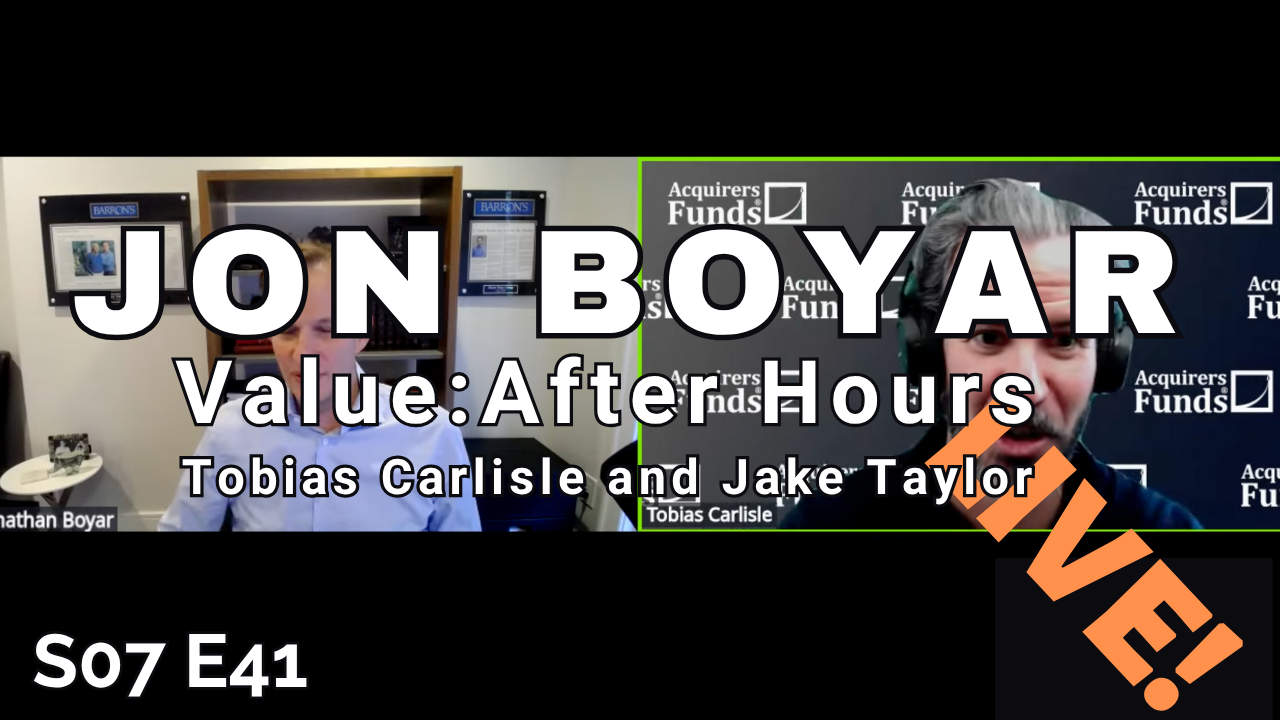
During their recent episode, Taylor, Carlisle, and Jonathan Boyar discussed:
- How to Avoid Value Traps Before They Blow Up
- The Rise of Passive Investing Is Distorting Markets
- Why Asset-Heavy Businesses Are Undervalued — And How Investors Can Profit
- The Only Real Market Edge Left: Why Time Arbitrage Still Works
- HHH: Bill Ackman’s Berkshire-Style Experiment or a Value Trap
- Why Small-Cap Stocks Are Being Ignored
- The Hidden Opportunity in Trophy Assets: Knicks, Rangers, and the Braves
- Uber as a Long-Term Compounder?
- Why Healthcare Might Be the Most Mispriced Sector in the Market Today
- The Forgotten Forty: How Boyar Finds Its Best Catalyst-Driven Ideas Each Year
You can find out more about the VALUE: After Hours Podcast here – VALUE: After Hours Podcast. You can also listen to the podcast on your favorite podcast platforms here:

 Breaker

 Overcast


 RadioPublic


 Stitcher

TRANSCRIPT
Tobias: I think we’re live. This is Value: After Hours. I am Tobias Carlisle. Not joined today by Jake. He’s on the road. He’ll be back next week. But special guest today is Jonathan Boyar of Boyar Value. Welcome, Jon. Good to see you again.
Jonathan: Great to see you. I think Jake was absent last time.
Tobias: Was he really?
Jonathan: I [crosstalk] personally. [laughs]
Tobias: As soon as he found out you were on, he– No, no, I’m kidding. It’s been planned out in advance. We’ve known each other for a long time. I remember we used to meet on the floor of the Value Investing Congress.
Jonathan: Yeah. When people used to go to conferences.
Tobias: That’s right.
Jonathan: Those were the days.
Tobias: That was a long time ago. [Jonathan chuckles] Folks who don’t know you, tell everybody a little bit about Boyar Value.
Jonathan: Sure. Boyar Value Group started in 1975. It’s a family run business started by my father Mark. We started as a research boutique, basically serving hedge funds, mutual funds, family offices, looking at stocks in a completely different way, what would an acquirer pay for a business.
Tobias: I love it. Great approach.
Jonathan: Yeah, which I’m sure is something you can appreciate. Basically, taking a private equity approach to public markets. We developed a good reputation in the value community. And over time, we formed Boyar Asset Management in 1983. And today, we have two businesses still the same. We have a research business that’s still going strong, and a money management business, serving high-net worth individuals and institutions. So, it’s a hybrid approach.
Tobias: And take us through a little bit more about the philosophy and the strategy. You’re looking for special situations, or just things that are undervalued on an acquisition basis?
Jonathan: So, we consider ourselves opportunists. We’re not traditional values. We were talking about before, names that we like include Uber, but we also are in some of the value camp as well. It’s really to take that business person’s approach. If something’s selling at a material discount to what an acquirer would pay for the entire business, it’s something that really interests us. But that’s really just step one of the equation.
Step two is to catalyst what’s going to make that stock ascend in value over a reasonable period of time. We’re more patient than most to us a reasonable period of time is two, three, four years. This way it helps us avoid value traps, and that’s why we take that catalyst approach.
Tobias: Over the period that you’ve been running– You guys continue to work together a little bit. I know he continues to sign the docs that go out along with you.
Jonathan: Yeah, he’s still involved, going strong I think at 84. He’s doing great. He helps with the idea generation, and I’m running the day-to-day operations and also portfolio manager and help with the research effort. So, we have a great team. We have myself, and my father, and then four great analysts, many of which have been with us for quite some time.
Everyone on our team is a generalist. We really don’t believe in industry specific analysts. We like to say, “Industry analysts can tell you everything there is to know about a stock,” except when to buy it.
Tobias: Yeah, that’s right. [chuckles]
Jonathan: So, we just want people to come up with ideas that they think are timely. I think what gives us our edge on the money management side is our research operation, because we have to continuously come up with ideas for a really sophisticated audience.
They really challenge us. They challenge us on those ideas. They ask us these assumptions behind our models. They ask us if we’re crazy. It’s really helpful. And then, of course, they pitch us ideas where we’re very cognizant that they’re pitching their own book. But a lot of the ideas are quite good.
Tobias: Have you seen an evolution from– Your dad started in 1975. The markets have changed materially. Even since 2010, the markets have changed pretty materially. Have you seen an evolution over that period that you’ve been running Boyar?
Jonathan: Absolutely. When my dad started the business, this was the biggest technological advancement that you have. If you’re able to afford $1,000 for a calculator or whatever it costs, that gave you an edge. Now, you have access to so much information from Substack, various things on the internet, etc.
So, we started as a real deep value, net-net type of shop. We even had a report and net-net reports. And that has changed to– We’ve really gravitated more towards quality, which I know is something that a lot of people say. But it’s more avoiding the really deep value situations. We’re looking at something that we want to own for a long period of time. I don’t want to own a mediocre business for three, four, five years. It’s good for a trade, but not necessarily good for a long-term investment.
Tobias: Does that mean that the sources of market inefficiency have changed over time, where previously it was probably informational mostly that’s a net-net world? And then, maybe a calculator means that you can calculate a little bit faster. But today, what are the major sources of inefficiency today, do you think?
The Only Real Market Edge Left: Why Time Arbitrage Still Works
Jonathan: I think really the major source of inefficiency is time arbitrage. I think that’s really the only thing left. There are very few people who are looking at things on a two, three, four-year basis. Like, the rest of the world, they just want instant gratification, and they want to know what’s going to do well over the next six months to a year. I think it’s a lot harder to do that then what is a business going to look like under normalized conditions. So, I think that’s what really gives us our edge.
Why Small-Cap Stocks Are Being Ignored
Also, another I guess edge is small-cap and micro-cap names are all, but ignored. Many of the names we follow have one, two, three analysts. So, there are some people just not looking at the names.
Tobias: Do you think that that normalization is a little bit harder over the last five years given the– We had COVID stimulus that it’s just been a weird market in between. I feel like there’s been quite a lot of sogginess since 2022 when a lot of that COVID stimulus worked its way through.
Jonathan: Yeah. No, we’re living in extremely interesting volatile times with once in a century thing happening every few years. So, yes, normalized is difficult to predict, but you can get it within the ballpark of a range. Obviously, you can’t really prepare for a pandemic or you don’t want to necessarily invest as if a pandemic is going to happen in five years. You might want to keep a larger than average cash position if you’re worried about the future as a hedge. But I think generally your point is well taken.
Tobias: What misperceptions do people have about modern value, given that it’s underperformed, hasn’t done really well? There aren’t a lot of defenders. I think most people would say they’ve transitioned to quality growth.
Jonathan: Mm-hmm. Well, I think the misperception it doesn’t work. I would disagree with that. I think over a long period of time trying to buy something for less than it’s worth is a sound strategy. It might not have worked over the last 10, 15 years, but I think it’s a strategy that’s worked well for decades and decades, and I think it will continue to work.
But I don’t know if there’s a misperception, except that I think people might think low-quality stocks, etc. I mean, value is a big tent from GARP to net-net to deep value to special situations to asset plays. I personally dislike the term value investing. I think it’s something that’s made for consultants more of an opportunistic investing, is I think a better way to describe it.
Tobias: Take us through your idea generation process. How do you guys come up with new ideas?
Jonathan: Yeah. I wish I could come with a clever answer and say we have this great proprietary formula that spits out these ideas. It’s a very manual process. Our team, as I said, it’s four analysts, plus myself and my father. They’re just paid to read. They’re paid to come up with ideas specifically outside the mainstream, to be contrarians. And that’s what they do. We’re forced to continuously come up with ideas, because we have this institutional research service that people pay a lot of money for and they want these new ideas. I think a lot of portfolio managers run into issues where they recycle their ideas. This keeps us fresh.
But we have probably four or five buckets that we come up with for ideas. We love looking for companies with hidden assets, assets that are not properly reflected on the balance sheet. That’s something that we like. We really like great consumer franchises. We particularly like them when they’re masked by a corporate name.
What I mean by that, is if I told you the name Acushnet– I don’t know if you’ve heard of it or not. Most people haven’t– It’s a golf club manufacturer. When they’re masked by these corporate names, they own Titleist, etc., people tend to ignore it. We like looking at fallen angels, the one starlings of Wall Street that are now unwanted, unloved. You have to be very careful about value traps when doing that.
We like special situations, spinoffs, but you have to be very careful. Some spinoffs are horrible. Sometimes your company is spinning off a problem. So, there’s no shortages of ways you just have to look for the right pitch.
Tobias: How do you prospectively identify a value trap?
How to Avoid Value Traps Before They Blow Up
Jonathan: It’s difficult, if not impossible. I mean, part of it is just gut feeling from doing this for a long time. But if you can find a reason for a stock not to languish for over a reasonable period of time, that lessens the odds of it being a value trap. But any value investor that’s a hazard of being in the business, you have to really take a hard look and see is this a cyclical or a secular problem. We made our share of mistakes, especially with these content companies five, six, seven years ago, where we didn’t anticipate how the world would change with streaming. You learn from that, and that’s what you have to do.
I’m trying to now figure out a company like Comcast, which is statistically cheap. Is that a value trap? And that’s something that we wrestle with internally. So far, the answer is we don’t think so. But after what happened with the content companies five years ago or so, we’re open to the disruption theory.
Tobias: How do you know when something’s temporarily depressed versus structurally challenged?
Jonathan: I guess you have to look at why it’s challenged. The reasons people are saying what the company is saying, and that’s again, more art than science.
Tobias: What’s the first thing you like to look at when you’re researching a company?
Jonathan: I just like to get to know how they make money and why someone would want to use their product or services. I know that’s simple, but if you can’t get a handle on the value that they create for customers, why– That’s the first thing you want to do, and just read as much as humanly possible about it. It takes a while. We rarely will buy something quickly and we do months and months and months of research on something.
Tobias: What role does management play? How hard are you looking at management?
Jonathan: More and more lately. I think that’s something that I’ve grown– I used to come up with, “Hey, just find a great business.” Management’s great or great salespeople. They’re only going to tell you that everything is fantastic.
I personally never met a CEO who’s told me business is terrible. So, they’ve gotten that where they are for being great salespeople. But trying to hear them, especially in larger companies, interviewed as much as possible on either on podcasts or on TV, etc., and just see what makes them tick. Are they good? Is there alignment? Are they in it for the long term? So, I think management– It’s getting more and more important to our process.
Tobias: How do you think about downside protection and permanent impairment of capital?
Jonathan: No, it’s a great question. I think the only way to do that is, one, never use leverage. Extremely important. And two, you have to buy something at a significant margin of safety. And that’s your downside protection. It sounds simplistic, but that’s really what it is. Companies that have a lot of leverage, we’re not adverse to buying them, but I think we would size our position accordingly.
Tobias: How do you think about valuation? What are your favored valuation methods? When do you deviate from them?
The Hidden Opportunity in Trophy Assets: Knicks, Rangers, and the Braves
Jonathan: It’s what would an acquirer pay for that business that we look. In the private markets, is it RevPAR, in the hotel industry, whatever someone– That’s the essence of what a business is really worth is what is someone willing to pay for the entire business. That’s how we look at it. There are things where you have some of the parts stories, I think, is also critically important.
We’ve been quite vocal on a company like Madison Square Garden Sports, for example, which is controlled by James Dolan. It owns the New York Knicks and the Rangers. The enterprise value I think is $5.5 billion. The Knicks alone probably worth $10 billion, the Rangers probably worth $4 billion. So there, I think, I have a decent margin of safety there. If that’s something where you’re not buying this for the cash flow, you’re buying it as a trophy type asset– And that’s what people buy them for. So, that’s how you analyze it.
Tobias: Yeah. So, you have to look at that in the context of it’s worth a lot to negotiated transaction, because the most successful guy in town at the time will try and buy that for as much money as he can. But in the interim, they don’t make a lot of money because they’re run–
Jonathan: Yeah, these are not statistically cheap companies. But one, the economics are only getting better with TV deals, etc. and the globalization of some of these sports. Yeah, it’s the ultimate trophy, these things. The last time the Knicks went on sale were I think 1992, at least early 1990s. So, when they do come up for sale, people are willing to pay up.
Tobias: How do you incorporate qualitative research into the quantitative research?
Jonathan: We just read everything there is to know about a company. I mean, we’re just curious. We ask people what they think about the product or service, we utilize the product or service ourselves. But you really want to have cold hard data, too. You don’t want to invest on anecdotal evidence or you want to do deep research, but you’re also human and you just want to see why someone using this product or service.
Tobias: Do you want to take us through some of the names in the Forgotten Forty, the Boyar Forgotten Forty? Tell folks what that is first?
Jonathan: Oh yeah, absolutely. The Forgotten Forty, it’s our flagship product that comes out December of every year. It’s our Christmas gift to our clients. It’s our 40 best ideas for the year ahead. As I mentioned, we’re normally long-term, patient investors. But every year, we take a look at all the companies that we research in our coverage universe, and which ones were going to do the best, because catalyst, we identify, and then we do one-page snapshots of them. People love it. It’s a great reference guide. We sell it on an à la carte basis, and people seem to really like it.
Right now, we’re looking through all the names and seeing– We’ve made no final choices yet, but what interests us, what we think is going to do well in the year ahead. One name, I can’t say if it’s going to be in the Forgotten Forty or not, but a company like UniFirst, UNF, this company that probably most of your listeners have not heard of it. It’s a garment rental business. It’s the third largest one. Not exactly the most exciting company in the world. Cash rich balance sheet. Trades at about $160 a share.
Earlier in January of this year, Cintas made an offer for the entire business. First offer, $275. They barely even negotiated with them. It’s a family-controlled business. Those are tough you’re dealing with family dynamics. That was probably one of the reasons they didn’t negotiate. And so, we have cheap stock trades at eight- or nine-times EBITDA, and the margins are much lower than Cintas. The multiple is significantly lower than Cintas, and there’s a lot of things that they can do to turn around the company. So, the worst-case scenario is you have a good turnaround situation.
But what’s gotten us interested recently is about two or three days ago, Engine Capital, I think that’s the name of the company, this activist fund put as part of a proxy. They’re going to have themselves and the grandson of the founder. So, clearly, there’s family dissension in there. And the goal is to try and sell the company. They would get a lot more than $161 a share. I think they would get a lot more than $275 a share, which was Cintas’s first offer.
And so, now, you really have that catalyst. Before, you just had a cheap stock with a couple of ways to win, now I think management and the families can be pressurized to deliver value for shareholders, whether that’s increased buybacks, which could happen, raising the dividend, operational improvements, lots of ways to win.
Tobias: How do they get so much cash on the balance sheet? How do they let that build up? Do you know what the reason for that has been?
Jonathan: Conservativism. The founder was very conservative. They were saving up for acquisitions that some of them they did, most of the time they didn’t, and that’s the only reason. It’s a good business. 90% or so, I think retention rate. I think they’re third in the market. They have national accounts. Is it a great business? No, but it’s a very good business.
Tobias: Is it uniforms that they’re renting, or what are they renting?
Jonathan: Yeah, uniforms that they’re renting to companies like– I’m not saying that they’re a client, but UPS, for example, they don’t have their– [chuckles] The drivers aren’t going home and washing their uniforms. They’re giving it to them, they take care of it, and have some distribution system. So, they’re the ones that take care of the business.
Tobias: What about Uber? I think that’s an interesting one. We discussed that last time you’re on, too. But I think it’s worked, and it continues to be interesting. What’s the story there?
Uber as a Long-Term Compounder?
Jonathan: Yeah. No, Uber is one of our highest conviction ideas. It’s sold off a little bit in the last month or so, along with pretty much everything else. A lot of the fears around the company are unfounded. People think robotaxis are going to kill them. I think they’re going to be a beneficiary of that trend actually.
It’s a well-run company. They’re going to return about 50% of cash flow to shareholders in the form of buybacks. Dara has done a fantastic job. They’re going to different verticals. They’re becoming a super app. I think they’re growing EBITDA 30% per year for the past three years or so. It’s been really impressive. Its high fixed cost, low variable costs, so they’re in the right part of the cycle, and this could be one of those– I hate using the word long-term compounders, but this is a great business that’s not absurdly expensive and something I’d want to own for long periods of time.
Tobias: Why do you think Waymo is not a threat?
Jonathan: Because I don’t think there’s just going to be one autonomous vehicle company, and no one’s going to want to have like six different apps. There’s going to have to be a central aggregator of these things, and I think Uber has the best platform to do it. So, Waymo may be a winner, but I think there’s room. Just like there are lots of different car companies that are doing well, there’ll be lots of different autonomous vehicles that are doing well. I think Elon Musk has promised the moon. I would never bet against him, but I don’t think he’s going to be the only winner in this game.
Tobias: We touched on it briefly before, but the Madison Square Garden, MSG Sports and the Braves, what’s the story there?
Jonathan: Yeah, again, Madison Square Garden Sports is the trophy assets. Big fan of them. We like things that they are scarce assets. It’s like, you’re buying a publicly traded collectible. You see these trophy assets go on sale, you see the Lakers go for $10 billion, you see just a 10%, a minority stake in the New York Giants, the football team go for $10 billion. What was it? The New England Patriots, I think $9 billion for minority stake.
So, something that Dolan can do if he’s not going to sell the whole team is just sell a minority stake, use the proceeds to buy back a ton of shares, so that he also can split the company into two, have a publicly traded New York Knicks team, have a publicly traded Rangers team to help showcase value.
Another team, Atlanta Braves Holdings. It’s controlled by John Malone. So, you can’t really have as different a set of owners as you do between having John Malone and James Dolan. Malone is a cold-blooded capitalist, and I think he would sell the Braves as soon as he got a legitimate offer. It’s also worth noting that it’s been one of the few stocks that he’s been making open-market purchases for in his empire.
He’s simplifying his empire. He’s been more of a seller than a buyer recently. The two-year spin off milestone from Liberty Media has already approached, so there’s no tax consequences if it was bought or sold. They also own valuable real estate selling for about $39 a share. We think conservatively it’s worth about $60.
There’s another catalyst. A lot of people aren’t talking about this, but in the next couple of years, I think 2027, there’s a tax law change where if you’re a public company, not a private company, but if you’re a public company, you cannot deduct for income tax purposes, the salaries of your top five highest paid employees.
And in most businesses, that’s not a huge deal. But on the New York Knicks payroll, when it’s $150 million and they’re making $175 million a year, that’s a big deal. So, they’re at a huge competitive disadvantage to their privately traded counterparts. So, I think that could be an impetus of a sale for Knicks, Rangers, or the Braves.
Tobias: Let me just give a quick shoutout to folks who are– Warren Buffett, From the Land of Retirement. What’s up? Petah Tikva, Israel. Breckenridge. Toronto. Cleveland. Bendigo, Victoria. Must be daylight saving in Aus, because the Aussies are awake.
Boise, Idaho. Durham. Lausanne, Switzerland. Bellevue. Limerick. What’s up, Colm? Tomball, Texas. Jupiter. Toronto. Edinburgh. Valparaiso. New London. Holland. Michigan. Cessnock, New South Wales. The Aussies are up. Fremont, California. Tampa. It’s good having you guys here. JT is on the road. He’s in China. Back to China again. Can’t stay away.
Jonathan: That’s amazing that you have this worldwide audience. That’s really cool.
Tobias: It’s a good spread, isn’t it?
Jonathan: Yeah. The Aussies are waking up early for you.
Tobias: Well, I guess it’s morning there. It’s tougher in the summer when we’re on daylight saving, and they’re not– But we can do it this time of year. Okay, that’s good stuff.
We’d ordinarily have JT’s veggies. You can write it down. He’s not here to do it this week, so there’s no time stamp this week, folks.
Do you have any thoughts on passive? Has the rise of passive affected the markets, do you think?
The Rise of Passive Investing Is Distorting Markets
Jonathan: I think 100%. Listen, passive, for the most part, has been active significantly and I could see why investors would gravitate toward it. But it’s distorted the markets. I’m not saying anything new, but the S&P500 is now a basically technology fund for all intents and purposes. So, I don’t think individual investors know how much risk they’re taking. Someone who’s buying an S&P 500 fund and holding it for the next 20 years, I think it’ll be fine. These things tend to work themselves out, but for people maybe with shorter term time horizons, they could be in for some pain.
One of the things that was interesting, and I was looking at it before, and it was in our latest quarterly letter– This has to do with those top 10 names dominating is J.P. Morgan guide to the market. I don’t know if you ever look at it. It’s a free guide that you can just download from their website. It’s fantastic. They had a graphic that showed for the last by decade. You had 1985, 1990, etc., up until 2025, the top 10 in terms of market cap. So, no company over that period has remained in the top 10 for any of those decades. The most were four and the four that were–
The most were two. Two of them were for four decades. That was Exxon and GE. Not names that I necessarily would want to own now. Of today’s 10 largest companies, only 4 were on the list a decade ago and just 1 appeared two decades ago. So, the S&P 500, there could be significant rotation within it. Who knows, maybe the Mag-7 will continue to outperform. But people need to be careful.
Tobias: I think they quietly switched out Netflix for Nvidia in that they quietly-
Jonathan: Just needed an end.
Tobias: -switch out the– [Jonathan chuckles] Something gets changed every now and again. Do you think that the decline–? You straddled that period where there was ubiquitous sell side coverage and that seems to have gone away. Has that hurt the markets, do you think?
Jonathan: It depends how you look at it. I think it’s given us opportunities. I think as we were talking about offline, I think what’s going to– Obviously, being a small and mid-cap investor has been extremely painful over the last decade or so. Besides interest rates getting lower, I think what’s really going to help small-cap investors is the fact– Once you start getting M&A activity, and that will highlight the discount to intrinsic value, many of these companies are– You’re starting to see that. You see that with WBD looking for deals. I think EXALTA announced this morning, they’re merging with Nikon. You see Topgolf Callaway Brands selling 60% of Topgolf.
So, companies are starting to do things to help highlight value, and I think that’s what’s going to be the spark for that eventual small-cap run. The structural parts of the market and having less coverage has certainly hurt. But I think for people who are long-term patient investors, it’s going to really help.
What’s amazing is there some really large companies with very little sell side coverage. I had Thomas Peterffy on my podcast who is Interactive Brokers. He has one or two sell side coverage. He’s a huge firm. Loews, the Tisch family company, has no sell side coverage. Univers, which is a smaller company, I think has two or three. So, the research business is a tough, business and it’s not particularly profitable for the banks, so they stopped doing it.
Tobias: Why do you think Interactive has such a low– Why is it not covered more broadly? Because it seems like most people in the financial industry know what Interactive is, so it would seem natural that they would want to cover it?
Jonathan: I asked him that. I agree with you and his response was, well, he went public with that reverse– The same way Google did.
Tobias: Oh, I see. Yeah.
Jonathan: And didn’t have an investment banker, and I guess they don’t do that many deals. They keep a ton of cash on the balance sheet.
Tobias: Right.
Jonathan: So, brokers just ignore them.
Tobias: There’s no other fees available?
Jonathan: Yeah, [chuckles] not particularly. So, it’s an indictment on the sell side, because it’s been a fantastic performer over pretty much any period of time.
Tobias: Do you think that that disappearing of the self-coverage has– Is that the cause of the underperformance of fundamental strategies, or is that a result of the underperformance of fundamental strategies?
Jonathan: Can you say that again?
Tobias: There was a change in the law following. I think that was like a 2000– The 2000 crash, they changed the law to separate out the sell side coverage, so they couldn’t use it to support the transactional side. It seems like that’s really that, or maybe a little bit after that, we really started seeing the underperformance of fundamental strategies versus–
So, there’s two potential causes. One, it’s just passive. The passive bid constantly hitting the biggest, and so those are the companies that perform the best. Or, alternatively, there’s nobody to shine a light on the smaller mid-sized companies– Most folks aren’t focused on the market. They’re a little bit time poor. They need that sell side research to help them out there.
Jonathan: It’s a very unsatisfying answer, but I think probably a little bit of both. I don’t think there’s a one type thing. think a lot of it’s one of the greatest momentum trades of all time is just investing in the S&P over the last couple of years. You have flows into these funds every 15th of the month or the 30th whenever people cash their paychecks. And buy the dip has been a fantastic strategy. It’s a great strategy until it isn’t. [chuckles]
Tobias: It’s not unprecedented, though. I’ve tried to show this a few times in a few different ways. I’ve looked at equal weight versus the market capitalization weight version of the S&P500, or you can compare the largest 100 stocks to the 500. So, in the equal weight versus the 500, that equal weight is the substitute for small, and the 500 is the bigger companies. And then, if you compare the 500 to the 100, the 100 become the bigger companies.
Or, you can look at Mag-7 versus the 100, which gives you that increasing levels of concentration into those biggest companies. It seems to me that at every level, the very long-term experience is that bigger companies have tended to underperform smaller companies. You can see that in small-caps relative to mid-caps relative to S&P500 relative to the biggest of the biggest. But there are clearly these periods of time, and there are about a half a dozen of them going back 100 years, where you get probably a change in the market, where there’s a new technology that comes in and it upends the market.
I just wonder, if it’s these companies growing so big relative to every other company in the market, that’s what causes that phenomenon to occur where you see these very big companies outperforming, even though the experience is over the very long-term of the smaller companies tend to outperform.
This one that we’re in at the moment started in, say, it depends on how you measure it. But certainly from 2015 today, so it’s a decade, it’s a little bit more than a decade, the way I measure it. That’s the second longest in the data. And the longest one is 1945 to 1961, which was, I guess that’s 16 years, 15 and a bit years. So, we’ve got potentially a little bit further to go, but I think that in terms of rising above that trend, we’re way, way above trend. We’re very close to the– As big as we’ve ever got relative.
So, I’m fairly positive about the fact that we turn around at some point here, but it’s been very painful getting here. I don’t really know the cause. I know that Michael Green favors a passive bid, but I think it’s just a feature of the market that it doesn’t. It just happens.
Jonathan: Yeah. No, I think it’s– People say, “Oh, it’s different this time,” which obviously are dangerous words. They cite the fact that private companies are staying private for longer, and that’s taking some of the gains from the smaller companies, because maybe that’s true or maybe it’s just cycle like everything else, and people are used to having cycles in the period of 3, 5, 10 years, and really can’t look past that over long periods of time. We’re just not wired for that.
So, I firmly believe that some of these smaller companies that are well run– You look at the difference between the S&P 600 and the Russell 2000, and you point that you’ve done a very good job on X. The times where it’s a junk rally, the Russell 2000 outperforms and when it’s actually a quality small-cap rally, the 600 outperforms. I think it’ll be very healthy when you have a sustained S&P 600 rally for a long period of time, and that’s when you know things will shape up.
Tobias: I posted this chart yesterday, but it showed 35 years of the 600 versus the 2000. The 600, which has the profitability and quality filter. They are slightly bigger companies, has trounced the 2000, which has no quality filter. You can see it in the chart there’s a 2000 spike, there’s a 2021 spike, and there’s this 2024 to 2025 spike that we’re going through now. It seems to me that we’re in that looking at that chart, it’s a long way above trend. So, I’ve been watching that just waiting for that to break down.
I’m a fundamental value guy. I look at the 600 as being like, that’s still fairly bloated and junky compared to what you can get out of a concentrated portfolio of genuinely undervalued, cash flowing businesses. I think it’s easier to explain it in that 600, because folks can understand that concept that it’s a passively selected index.
Jonathan: Have you ever found out why they don’t have 600 names in it?
Tobias: No. Why is that? I didn’t know that.
Jonathan: I don’t know, I’m asking you. [laughs]
Tobias: Well, the Wilshire 5000. There’s not 5000 companies to stick into it anymore.
Jonathan: Yeah, [chuckles] I always found that interesting or funny.
Tobias: There’s lots of causes. Like, Sarbanes-Oxley in 2000 made it so much more expensive for small companies to go public. And so, that’s pushed a whole lot of companies to stay private for longer. But now, I think we’ve got this funny private bubble as well, where a lot of these private names are at valuations that they just wouldn’t get in a public market. And then, every now and again, they come public and get smashed to pieces.
There was a Twitter account yesterday saying, “The public markets are brutal to these companies,” like these things are down 60% plus when they– They have a little pop when they come out, because they restrict the amount that they sell and then they promote it heavily and they have a ramp for the first few days where they shift all the shares that they want to sell, but then these things collapse pretty quickly after that.
Jonathan: I think StubHub is down significantly. They tried to go public multiple times, and they just picked the absolute wrong time to do it. But yeah, no, [chuckles] a real measure of value is the public markets versus the private markets in terms of– It’s quite striking.
Tobias: Get to mark your own homework. You always do a little bit better than when the teacher does it? [chuckles]
Jonathan: I know. There’s a lot of things that worry me, that’s one of them. The private credit is an accident waiting to happen. There’s a lot of danger signs.
Tobias: It’s always credit. Credit goes first in some way, shape, or form.
Jonathan: Yeah. Well, it’s always greed which then leads to that. But yeah, no credits. You look at the credit spread, you’re not getting paid at all. I don’t know why anyone is buying a corporate bond now where the spread that you’re getting compared to treasuries is almost nothing. I’d rather just keep it in treasuries and take my risk on the equity side.
Tobias: It’s not investment advice, but HYG vs TLT is always something interesting like that. How do you maintain conviction when a trade’s going against you?
Jonathan: I take it off my screen.
[laughter]Tobias: ignore it.
Jonathan: I ignore it. One, I buy things slowly over time. That’s one thing. But yeah, you just know the business. We have stocks within our team where if it goes against us, we’ll let another analyst take a look at it, because sometimes you just have the psychological bias. That’s something you really have to train yourself on.
And also, being willing to admit you’re wrong, and being early by six years is to me the same thing as being wrong. [laughs] So, you have to be very humble in this business. But you also can’t be swayed by short-term moves. But if something’s not working out for a year or two, you really have to reevaluate the thesis.
Tobias: That would have kept you out of Dillard’s. Didn’t work for the first six years, and had a 10 bagger in the seventh year. But that’s-
Jonathan: Yes.
Tobias: -okay. You’re going to miss a few like that.
Jonathan: Yes. No, Dillard’s was– We did an issue– We used to do these summer thematic pieces 2005, I think we did in 2005. Companies worth more dead than alive, and Dillard’s was one of them. Wow, that was a lesson in patience.
Tobias: It was a little bit of a benefit of the COVID stimmy, I think, as well.
Jonathan: Yes, yes.
Tobias: Do you feel like there are any industries today that are particularly fertile for mispricings?
Jonathan: We spend most of our time on things we can touch, feel, and understand. So, we tend to gravitate towards things like consumer-oriented names, communications, financials, industrials. So, it’s hard for me to say that– We don’t generally take a sector view. We do it one stock at a time. If I look at our portfolio though, we have a decent amount of insurance names partially, because they’ve done quite well. Being in this, I’m worried about the start of a hard market. So, that’s something I keep in the back of my mind. We’re generally sector agnostic, and we try– When we’re building a portfolio, we’re okay having a decent sector bet, but we do it by accident, not necessarily with– We do it on a stock, by stock basis.
Tobias: I think I’ve seen healthcare is one sector that– There’s been a lot of discussion on Twitter at least about healthcare, and I think that there are some interesting healthcare names, biotech as well as being a little bit adjacent to healthcare. But you’ve got a few healthcare names that you think are interesting? Do you want to go with Merck? Do you want to start with Merck?
Why Healthcare Might Be the Most Mispriced Sector in the Market Today
Jonathan: Yeah. No, they’re hated. You’re worried about government, intervention, etc., but that’s been the story on healthcare names since Hillary Clinton tried to remake healthcare in the 1990s. But overall, they’ve been pretty good bets. So, yeah, Merck’s interesting. People are worried about the 2028, 2029 Keytruda expiration, which it seems like they’re going to be able to extend the patent for some of their medications longer than that. Plus, they have a very good pipeline, plus they’re getting a lot of amount of free cash flow that they’re being able to invest in other drugs.
You have a company like Medtronic that has done nothing for years. It finally looked like it woke up, and that’s something we’re happy about. A company called Cooper which is– Their main business is contact lenses. They also do some women’s health. There’s a lot of interesting companies within the healthcare sector. You want ones with good balance sheets that can withstand short-term pressures. Something like Merck and Pfizer, you’re getting paid handsomely to wait.
Tobias: Yeah. What about Pfizer?
Jonathan: No, we like that. That’s certainly more hated than Merck. Merck would probably be our choice of the two. But if you want to diversify, I don’t think you can go wrong with both. Again, not investment advice.
Tobias: Has there been any political blowback from the vaccinations, or just general market revulsion to the vaccinations? I don’t watch a lot of network TV, but I catch it whenever there’s a Super Bowl or something like that. I’m always shocked at how much pharmaceutical advertising there is, particularly, because I come from a country that they banned it. So, I’m always shocked at how much there is on. And then, it’s just wall to wall coverage.
Jonathan: Yeah. No, it is amazing how much money they spend on ads. I think in Australia, it’s probably decent public policy not to do that. Is there a blowback? You’re talking about Pfizer specifically or just–
Tobias: Well, not necessarily all of them, but Pfizer, I just thought was one of the ones that was out front and center. I think Moderna. The Moderna stock price chart is–
Jonathan: Oh God. Yeah.
Tobias: It’s something worth having a look at if you haven’t seen it. [chuckles] Makes it– [crosstalk]
Jonathan: Yeah. No, it’s not a pretty chart to say the least. I think a lot of the price concern has been the RFK factor. There was also a big sugar high on Pfizer specifically going out of COVID. I don’t think people realized how little people wanted the vaccines post the pandemic. So, that’s obviously been a factor. They also made a large acquisition, put on a lot of debt and it’s too early to tell how that acquisition is going. So, there’s certainly a lot of uncertainty in there, and that’s why I think you have to place your bet accordingly.
Tobias: Have you looked at HHH? Is that something you can– [crosstalk]
HHH: Bill Ackman’s Berkshire-Style Experiment or a Value Trap
Jonathan: Yeah. We’ve looked at it. It’s, at this point, a show me story. Bill Ackman took control of the company. It looks like he’s going to buy an insurance company, and try and turn it into the Berkshire Hathaway model. Who knows? I mean, he’s a great investor. I have a lot of respect for him. Maybe he’ll do it, maybe he won’t. Their traditional master plan community business is doing really, really well. We’re going to have to wait and see to see what Bill buys.
One, for the insurance company, and two, he’s going to use the insurance company to buy common stocks I believe, and also to buy other businesses with the float. The one thing I really like about it is looking at it, there’s really no situation where he makes a lot of money and shareholders don’t. So, that’s something that I think is worth pointing out.
Tobias: He’s got quite a generous compensation plan there. I haven’t looked at it in detail. What is it?
Jonathan: It has something to do with the– I believe it’s from memory, because I wrote a letter– I think was six months or so ago objecting to it. He since toned it down, but basically, they get– I believe some sort of carry. I could be wrong based on how the share price per share value is created. If the stock does well, he’ll make a lot of money. But that’s fine. HHH really was going nowhere fast before he came in, so it’s hard to– Yeah, we’ll see.
Tobias: Are there any industries that you guys avoid entirely? Are there things you won’t touch?
Jonathan: I just think we can’t understand. Like, a biotech, heavy technology, commodity-oriented businesses. We stay away generally from energy, although we do own Loews which is and written about it which has some energy exposure. That’s the Tisch family Loews, not the home improvement company. But we’ll pretty much go anywhere. We’ll go in any market cap pretty much any sector just where we can make money for our clients.
Tobias: Do you think the market consistently misunderstands asset heavy businesses?
Why Asset-Heavy Businesses Are Undervalued — And How Investors Can Profit
Jonathan: Certainly, seems that way for the time being. Some of the part stories, asset heavy stories– The Madison Square Garden Sports, for example, is a big one. It doesn’t necessarily do a great job with real estate holdings either– And that might go back to what we were talking about before with less analyst coverage. I’m not really sure, people tend to not give it credit.
Tobias: There’s no real plan to sell the asset. So, in the interim, you got slightly subpar flows out of it. Is that the [crosstalk] to it?
Jonathan: Yeah. But if it’s not needed in the day-to-day operations or you can do something like MGM did and do some deal with Blackstone and to monetize their real estate— Yeah, I guess you have to look at every situation differently, something like a retailer where you hear Target owns a whole bunch of stores, the real estate is worth a significant percentage of the market cap. But they have to have their store somewhere. It’s needed in the day-to-day operation. So, you have to take everything on a case-by-case basis.
Tobias: Let’s talk a little bit about portfolio construction. How concentrated do you guys like to be in the funds?
Jonathan: We treat each client individually. So, it’s just not like a model portfolio. So, we’ll go as low as 25, 30 names, as high as 50 or so. We want to be able to make meaningful bets on companies. We generally like the top 10 names to be 30% to 50% of the portfolio, if possible. We are sector agnostic, as I mentioned before, but we pay attention to it just to make sure we, by accident, owning 50% financials, for example. So, we’re going to look very different than almost any of the indices. And that’s fine by us.
Tobias: What’s your sell discipline? How do you think about selling?
Jonathan: We’re reluctant sellers. Most of our time clients are taxable. So, my dad is instilled in me, “It’s not what you make. It’s what you keep.” So, if you own a great business, if you look at our top holdings as a firm, you’ll see a lot of Home Depot, you’ll see a lot of Ameriprise, you’ll see a lot of J.P. Morgan. We bought all those or the majority of those in 2007, 2008, 2009. When you can buy companies like that that have done–
That are great companies and buy them cheaply, selling them are very difficult, because you have to find something that’s 25% better after paying capital gains tax. So, if it’s a high-quality business, our sell discipline is different than when our business is maybe a medium quality business. I don’t mind having large positions in companies amp to purchase.
Tobias: Do you have any macro considerations? Do you think about macro at all?
Jonathan: I think anyone who says they don’t think about macro is lying to you. If you read the paper, you’re thinking about macro, and somehow it seeps [Tobias chuckles] into your brain. Someone can always paint the story that the sky is falling, that things are terrible and there’s always a reason not to buy stocks. But historically, that’s been the wrong move.
I think about it and maybe if I’m a little cautious on the market, if new money comes in, I’ll invest it more slowly. I try not to let it influence our day-to-day decisions as much as humanly possible.
Tobias: What’s the next 5, 10, 20 years look like for value or for fundamental strategies?
Jonathan: I hope better than the last 15 to 20.
[laughter] Listen, how AI is going to change everything, I have absolutely no idea how it’s going to change finance, how is it going to change medicine, how is it going to change law. Look at how much investing has changed. We started with the calculator to now where everything is at the tip of your fingers. I can’t even imagine what it’s going to be 15, 20 years from now. But I still think that time arbitrage will be one of the few things that AI will not be able to help investors with, because people are inherently not patient.Tobias: It doesn’t seem that the trend towards more information has helped people better investors. So, I don’t know that AI helps people necessarily.
Jonathan: No, absolutely. It’s more the process of investing and getting that information. But yes, no, I don’t think investors are well served by having television networks talk about the DOW in crisis. I love when now on CNBC, they say or the headlines, “DOW down 800 points.” It’s nothing– [crosstalk]
Tobias: Nobody knows what that means.
Jonathan: Yeah, yeah, yeah. [chuckles]
Tobias: I see that the CNN fear and greed meter– It’s an extreme fear. [laughs] We’re off about 3%. I don’t know what drives that. I know literally the components that drive it, but I don’t know why it seems to swing to extreme fear so quickly.
The Forgotten Forty: How Boyar Finds Its Best Catalyst-Driven Ideas Each Year
Jonathan: One thing I don’t do a good enough job is writing down how you feel at certain periods of time. One of the things that I did and I just I wish I bought more was during Liberation Day was buy an equal weighted basket of our Forgotten Forty. I just did it. I think I did it on April 10th. The plan was to do it a couple more times.
The thing’s up like 37%. The timing was just really lucky. But think about how much hasn’t been that long of a period of time, and everyone thought the world was ending that the economy was going to implode. Listen, I think it was a horrible policy idea and we can– I don’t want to get into politics, but you certainly can have a long conversation about that. But yeah, the S&P goes down four or five points or down four or five days in a row. Who cares? It’s certainly not the end of the world.
Tobias: We’re coming up on the end of the interview. Jonathan, if folks want to follow along with what you’re doing or get in contact, what are the best ways of doing that?
Jonathan: Sure. We’re @boyarvalue. If you want to know more about the Forgotten Forty, just go to boyarvaluegroup.com/value and/or just go to boyarvaluegroup.com, and you can find us and we’d love to hear from anyone.
Tobias: Good stuff. Jonathan Boyar, Boyar Value. Folks will be back next week, same bat time, same bat channel. JT will be back. He’ll have some veggies, and some new insights on China, I’m guessing. So, look forward to seeing everybody then.
 Undervalued Private Credit Investing: Finding Value in Discounted Lending Funds
 Where Is the Deep Value in Canadian Stocks This Week?
 Investing Beyond AI: Why Traditional Businesses Could Still Thrive