
VALUE: After Hours (S07 E40): Why Apple and Microsoft Could Fall 50–70% and Still Be Overvalued
Tuesday, November 18, 2025 · Johnny Hopkins
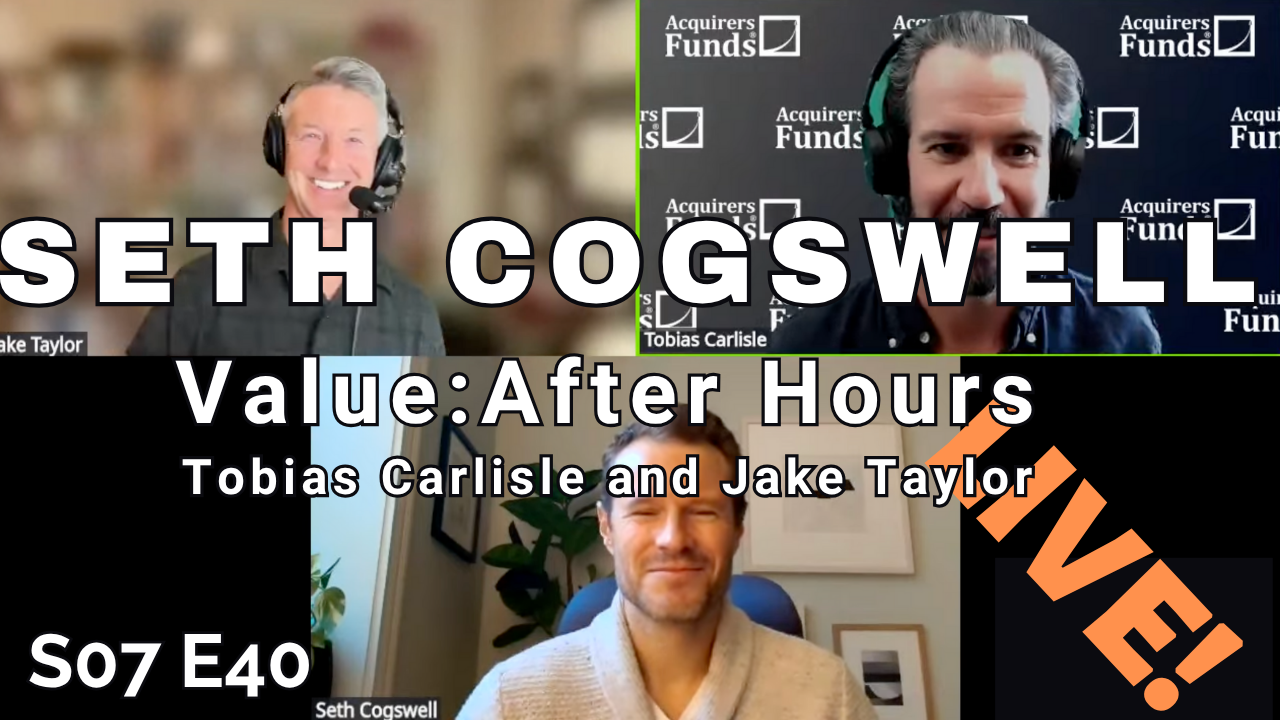
During their recent episode, Taylor, Carlisle, and Seth Cogswell discussed Why Apple and Microsoft Could Fall 50–70% and Still Be Overvalued. Here’s an excerpt from the episode:
There’s a few great examples right now. There’s probably a lot of great examples right now. Apple, Apple’s an awesome company. Two of my closest friends work there. I wish it well. I love their products. But its current PE is $39 or so. Long-term, it’s $14 to $15. That’s its average where it’s at for a long time. That means that Apple could drop 50% tonight and it would still be really overvalued relative to its historic norm.
Again, great company. But same with Microsoft. Microsoft has a price of sales of almost $14 now. One of my favorite quotes within the market is a quote by Scott McNealy, who is the former CEO of-
Tobias: Sun Microsystems.
Seth: -Sun Microsystems. I believe he was getting a hard time for losing people’s money. I’m sure he was sued for people investing at the peak of the tech bubble, and then getting mad at him. But he was like, “Look, I’m running the company. You’re the ones that paid 10 times price of sales. That meant that over 10 years, we had to return every single penny in revenue just for you to break even. Not make money for you to break even, which assumes that we have no employees.
We’re running a big company. We had a lot of employees. It assumes that we have no cost of goods sold or R&D. We’re a tech company. We have to constantly innovate. And also assumes that you don’t pay taxes. If you guys don’t pay taxes, you go to prison. So, don’t come to me about you paying 10 times price to sales.”
The thing is, both Microsoft and Oracle are 40% beyond that. So, 40% beyond the very peak of the tech bubble. Now, we’re in a dynamic time. I don’t know how this plays out with AI. I have a sense of how it plays out, but regardless, I don’t know how it’ll play out. But the main thing to answer your question, is that’s just risk. 40% beyond the tech bubble, maybe it works out, but what if it doesn’t? And so, that’s our goal, is to really avoid that what if. Because what if almost always comes to pass. It does very often.
And so, Microsoft, again, awesome company, seems to be leading the AI battle at the moment. But it could drop 70%, and it wouldn’t be a big deal. It would not be a steal if Microsoft drops dropped 70%. Maybe on a PE basis, it would be a lot more attractive.
So, again, that focus on valuations and avoiding companies that should go down, let alone a whole lot, is probably our biggest, our greatest value add. But another area where I feel will be very important over the next decade is debt. We all know that if we max out our credit cards to go buy a boat or something, that it’s probably not going to work out very well. We’re headed for some pain.
In the last decade, companies took on more debt than any time in history, not to build better companies that could then pay that interest, pay down that principal, and make profit on top of it. They just bought back stock. Buying stock has some benefits. But if you really think of it as most simplest form, basically, these companies mortgage their futures because they got to pay that back at some point, and then they handed that cash to discerning individuals who were selling their stock.
Tobias: [laughs]
Seth: Again, it’s neither good nor bad buying stock. It could be both ways. But if you’re mortgaging your future to do it, that’s taking on risk. And they did that when interest rates were quite low. Interest rates are now a lot higher. So, more than likely, these companies are going to have to a lot of them are going to have to refinance at higher rates, which will hurt profitability.
Profitability is one of the main arguments for better or worse. I actually think it’s a dumb argument. But one of the main arguments for higher PEs or higher multiples. So, if you see profitability decline and you see multiples decline, now you’ve got like a double whammy and contraction. And that just assumes the company is performing just as well as it always has. That’s not assuming any adversity. That’s assuming just reality. And so, avoiding that, I believe, will be a significant value add going forward.
Tobias: You’re starting to sound like us, Seth.
Jake: [laughs]
Seth: I think that’s as a complement.
Tobias: Fitting right in.
Jake: Other than that, though.
Seth: Let’s go.
Jake: Yeah. [chuckles]
Tobias: What a crazy bet.
Jake: Yeah. [chuckles]
You can find out more about the VALUE: After Hours Podcast here – VALUE: After Hours Podcast. You can also listen to the podcast on your favorite podcast platforms here:

 Breaker

 Overcast


 RadioPublic


 Stitcher

 Undervalued Private Credit Investing: Finding Value in Discounted Lending Funds
 Where Is the Deep Value in Canadian Stocks This Week?
 Investing Beyond AI: Why Traditional Businesses Could Still Thrive