
VALUE: After Hours (S07 E38): The Chipmunk Analogy: Reputation, Risk, and Survival
Wednesday, November 5, 2025 · Johnny Hopkins
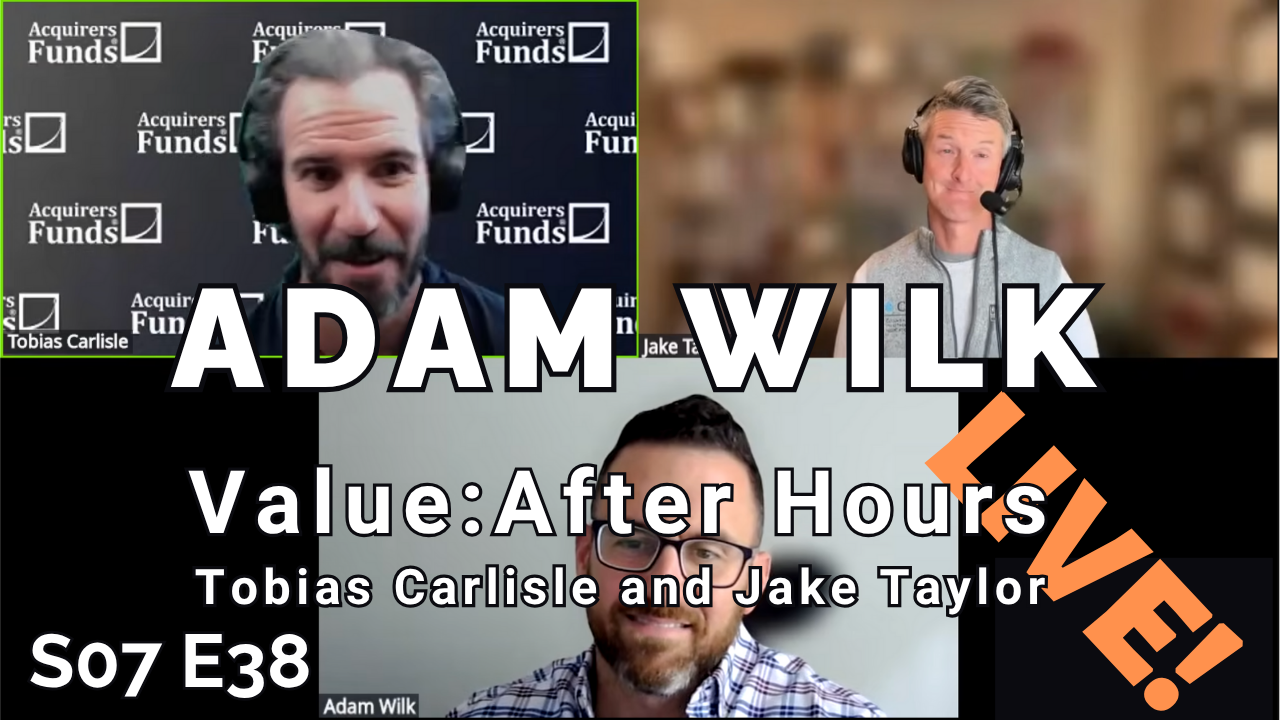
During their recent episode, Taylor, Carlisle, and Adam Wilk discussed The Chipmunk Analogy: Reputation, Risk, and Survival. Here’s an excerpt from the episode:
Jake: [chuckles] All right. Well, we are back with fan favorite animal themed episode. And this time, it’s chipmunks. I’m sure you’re thinking, well, Alvin, Simon and Theodore? No, not quite, but we’re after the squeaky kind that chase each other around trees.
So, there’s this small clearing on the Vermont-Quebec border, where on summer mornings, the forest hums with the sounds of survival. There’s a fluttering of wings, there’s a crackle of a twig, sometimes the sharp squeal of a chipmunk. And it’s sounding the alarm.
And in that clearing, behavior Ecologist Charline Couchoux spent her days watching, listening, and recording, and then decoding what these little mammals were saying to each other. She began with distress calls. So, these chipmunks will use categorical alarms, one for hawks above, another for ground predators like snakes or foxes. And it’s not just noise. There’s signals that are shaped by survival. But the real discovery wasn’t that chipmunks had this language, it was that each chipmunk used that language differently.
Some were chatterboxes of fear, squealing at every little movement, broadcasting panic at the drop of a pine cone. Others were nearly silent, these stoic little philosophers of the forest who seemed to be saying, “Well, we’ll just see how things play out.” These weren’t just moods either, by the way. They were consistent patterns of behavior, what we might even call personalities.
Now, personality isn’t a word that biologists use very lightly. It suggests something stable, and enduring, and consistent, and even maybe even intentional through time. But what Couchoux found is that these temperaments, what they classified their terminology, were shy versus bold. So, shy being the ones who get freaked out. They’re skittish. And then, bold are the ones who will just stand there no matter what and not squawk. They persisted over time. And across situations, it even shaped the chipmunks relationships with each other. So, in essence, the forest had its introverts and its extroverts.
Now, once you start to think about animals having personalities, the next question is, what does that mean for the way they communicate? And if a certain chipmunk screams at every passing breeze, others eventually stop listening to it. Couchoux tested this. She recorded distress calls from both shy and bold individuals, and then played them back to the colony. And the chipmunks paid attention to the bold ones, the ones who rarely cried wolf. The overreactors, they started to ignore them.
This is quite fascinating, because it’s not just like an instinct. It’s actually some rudimentary form of reputation management amongst these chipmunks. They track reliability. They remember who to trust. So, over time, credibility becomes its own currency. And the fewer times that you spend it, the more valuable it is. And of course, we too, live in a soundscape of alarms, some real, most not. And like those chipmunks, we learned to turn most of it out. There’re always these market commentators that are calling for a market crash every 10 seconds. Eventually, we start to ignore them. Then, of course, there’s Mr. Buffett and he learned long ago that the more sparingly you speak about this, the more weight your words carry. He’s only made a handful of market predictions over the decades that he’s been doing it the best that anyone’s ever done it.
Of course, 1969, he folded up the partnership when he couldn’t find investments that made sense. But he was back in 1973, 1974, an oversexed man in a whorehouse to use his colorful language. It’s not mine. It was a simpler time in the 1970s. Then almost nothing until 1999 when he damn near top ticked the dotcom bubble with that, sounding an alarm in Fortune Magazine. Then he’s back in 2008 with Buy American. I Am in New York Times Op-Ed. And then, in 2021, it was more subtle, but he was warning new investors that the game wasn’t as easy as they thought it was. So, clearly, this guy knows what he’s talking about.
We could draw some more analogies from our little chipmunks. From a purely evolutionary standpoint, you might think that the bold chipmunks would win. So, they spend less time panicking and more time filling their bellies. And more food means more energy, which means more offspring, which equals more genetic success, like all connects together.
Well, not quite. Couchoux’s data revealed there’s a trade-off. The chipmunks who squawked a lot actually lived longer. They may have had fewer offspring because of their conservatism, they’re squawking and running around and not eating, but they survived more seasons. And the bold ones, they reproduced quickly, but they also tended to die younger. So, hawks and foxes were trimming this genetic line earlier.
Think back to last week’s conversation with Luca about the different ski racer types. But this is what evolutionary biologists call a life history trade off. It’s a balancing act between risk and reward, reproduction and survival. It takes place on a fast versus slow continuum. The fast types mature quickly, and they pour energy into reproduction, and they also accept higher mortality. And the slow types invest in maintenance, and vigilance, and reproduce later and less, and survive more of the bad years. So, this variation persists, because shifting environments periodically favor different points on that slow versus fast continuum. The feasting years tend to reward speed, and the famine years reward caution.
So, investors, we face that same life history choice with capital. Some are bold foragers. They run hotter, higher gross, accelerating businesses that are always on the come inflection of being profitable, crowded names, leverage at every level that they can get it. And in the fat years, they eat like kings and they put-up eye-popping numbers and they reproduce quickly. AUM pours in, new funds are spawned, the brand litters the forest with offspring. The catch is the survivorship. A single hawk comes along which might be in a liquid tape or a policy shock or some factor winner, and that trims that lineage fast. So, they have great arithmetic returns, but poor geometric survival.
So, other investors are more like sentinels, where they worry about everything, even the occasional bad thing that does actually come to pass. They under bet every edge, they keep powder dry, they embrace boredom, stay well within the edge, and they reproduce much more slowly, often subsisting on meager returns for long stretches. But they live longer. And their compounding engine requires a lot of time to ever approach anything that would be impressive. They’re never quite top quartile in any given year, but somehow, they managed to be at the top of the leaderboard after decades of plying their craft.
So, the question to really ask yourself isn’t like, which chipmunk temperament is best. But it’s which temperament best matches the current environment with your liabilities, with your clients, and with your own personal psychology. So, it’s okay to run hot if you can acknowledge it about yourself, and maybe take some measures to mitigate and be a little bit more safe about how you’re doing it.
But if a perfectly ordinary minus 30% drawdown would trigger margin calls, and redemptions, and force you out of the game, you’re likely that bold chipmunk that’s gorging out in the open who’s going to be easy lunch for a hawk at some point. So, the takeaway to remember is that the arithmetic heroes get the headlines, but the geometric survivors are the ones that own the track records.
Tobias: Good one, JT.
Jake: Thanks.
You can find out more about the VALUE: After Hours Podcast here – VALUE: After Hours Podcast. You can also listen to the podcast on your favorite podcast platforms here:

 Breaker

 Overcast


 RadioPublic


 Stitcher

 Undervalued Private Credit Investing: Finding Value in Discounted Lending Funds
 Where Is the Deep Value in Canadian Stocks This Week?
 Investing Beyond AI: Why Traditional Businesses Could Still Thrive