
VALUE: After Hours (S07 E38): Small Cap Investing and Lessons from Scouting
Thursday, November 6, 2025 · Johnny Hopkins
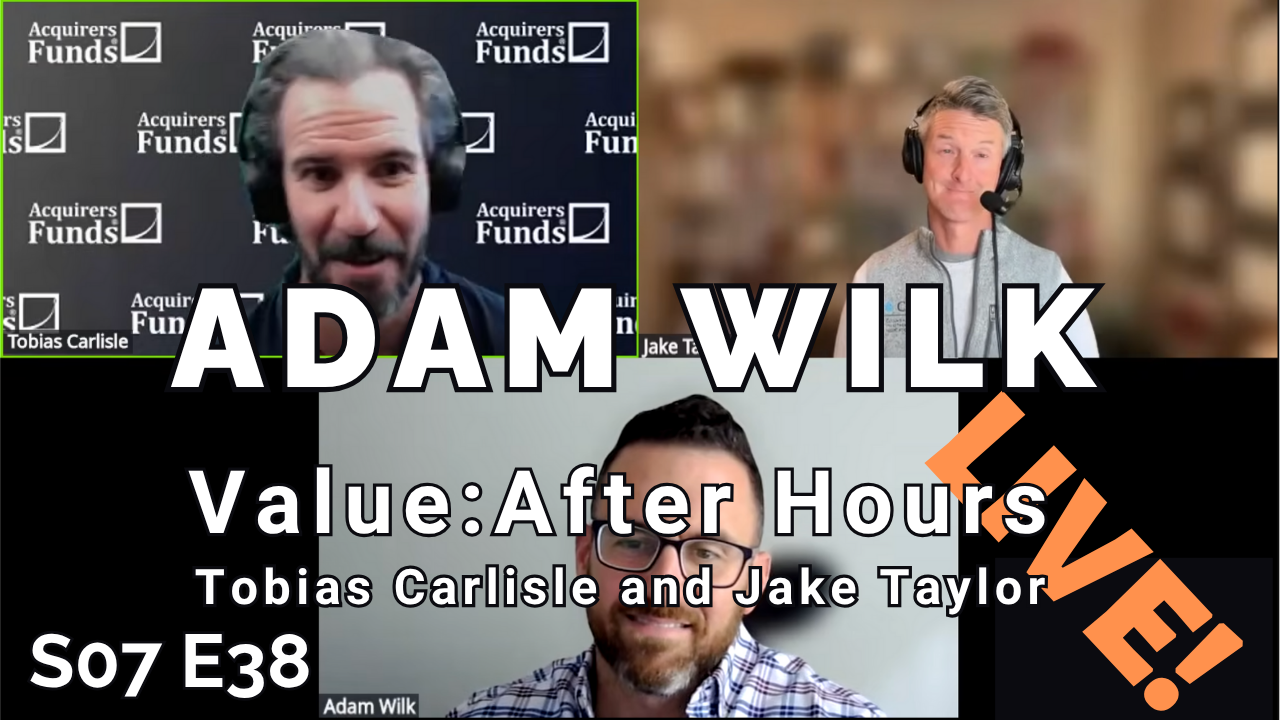
During their recent episode, Taylor, Carlisle, and Adam Wilk discussed Small Cap Investing and Lessons from Scouting. Here’s an excerpt from the episode:
Tobias: Adam, small caps have had a rough run for the last decade or so. How do you assess the small cap opportunity as it stands now?
Adam: Yeah. Yeah, echoing what you said, I think it’s been a rough stretch, and up until very recently and maybe we’ve even revisited that. I think valuation spreads between small and large have been quite significant relative to history. I’m not sure what changes that at the moment. We’re in an environment where I think people are overly focused on large cap, tech, AI theme, and even international small cap businesses versus US small cap, which is primarily where I focus.
There have been multiple periods over the last couple of years that– What I’ll say is, so relative to history, I think valuations look good. Having said that, today, given the change of the makeup of the index and the alternatives out there, the Russell 2000 is not the greatest vehicle for exposure to small caps in my view. I think a majority of the businesses in the index are low quality, unprofitable. There’s a big focus on healthcare and finance.
Jake: It’s okay to say shitcos on our show.
Adam: Okay, all right, good.
[laughter]Adam: Well, yeah, after the stories you just told, I think I have permission to use bad language. This is a bit self-serving to say this, but I think the active management approach is a better way to get exposure to small caps or even like the S&P 600. But those companies are much larger than where I typically fish. And so, the opportunity set seems good in one hand, but on the other hand, the options for exposure to small caps broadly is not that great.
I view my job similar to when I was working in basketball as a talent evaluator and professional. You obviously look at every player, but the you whittle your universe down to the select ones that you think will make it, and can fit your team, and are what you’re looking for. And so, that’s really what I do on the small cap side. I’m trying to find high-quality businesses with good management teams that we can purchase at cheap valuations. But it’s somewhat outside of or different from what you can get broadly.
I don’t spend a ton of time thinking about the market or macro and that sort of thing, but just having been in the space for over a decade, I think, it’s just become very clear that this group of company is viewed as just lower-quality as a whole. I’m not sure what changes that I don’t think we’ve seen persistent or consistent flows into small caps. This year has been okay, but just relative to what history has said.
There’s also another interesting angle to that, too, which is in the land of trillion-dollar companies, some of their market caps in the Russell even below $10 billion, that’s a small public company today. And that I think is very different dynamic than what we’ve seen in the past as well. Sometimes you can have a mid cap or approaching $10 billion public company that is misperceived, or overlooked, or underfollowed, just given that it’s again on the smaller end of things, and given the dominance of passive investing and quantitative based strategies and the needs for liquidity there. And so, when that happens, I think the $1 billion, $2 billion, $3 billion dollar businesses can be pushed even further down the spectrum.
I think the industry as a whole and the dynamics surrounding small caps have been a difficult stream to swim up recently. But what I’ve prioritized, too, especially as people lean toward the same themes and companies recently are companies that are helping themselves close that valuation gap. And so, I love a cheap business that’s quality, that’s that the market is not recognizing as much as the next guy. I think earnings growth and good capital allocation, etc., will close all valuation gaps over time. I hope it’s still true that stock prices follow earnings per share or returns on invested capital. I’ll hang my hat on that.
I think it’s also helpful when you have a management team who is aggressive in realizing value for the business, but also wanting to close that gap, whether it’s instituting a significant buyback program, or doing M&A maybe when they have the opportunity to do so, or just acting in the interest of shareholders. One, because they are, I like to invest in owner operators and people with skin in the game. But two, because that’s a path to realize value even if the market is not or you’re not getting flows or multiple expansion. So, there’s a few companies in the portfolio today that represent that sort of theme.
It’s almost like what David Einhorn said, “Not quite that extreme,” but in the past when you invested in small caps. There was a more heavy active managed universe. You could buy a company for eight times earnings, you could sell it to a fidelity long only for 13 times, and you make a decent spread on that, and maybe you get some earnings growth in between, etc. But now, he’s looking for things that trade at four to five times earnings that are buying back stock hand over fist, or paying a dividend, or whatever the case may be. I don’t go that far out on the extreme in terms of the entire portfolio, but I do stand by that point about how it’s very attractive to have companies that are again helping themselves close that valuation gap.
And so, not relying on flows and multiple expansion is important. There’s also some companies in the portfolio that are growing pretty significantly that I think the market has noticed or will continue to notice. I think maybe two ways about it, like I stated, the opportunity set, excuse me, for somebody like myself is very good, but at the same time, I do understand why maybe the universe, generally speaking, is hated at this stage.
Jake: Adam, what else did you learn from scouting that helps you now as an investor?
Adam: Yeah.
Tobias: Well, tell us a little bit about scouting. What’s that like?
Adam: It was a blast. One of those jobs, I think, that never felt like work for one day that I did it. One of the things that I got an incredible amount of exposure to was just the human side of evaluating a person, and sitting interviews with people– Hundreds or probably didn’t reach thousands, but hundreds of interviews over the years and cross referencing those with everything else that I was doing and trying to pull some pattern recognition out of that, I think, set the stage in a very helpful way for what I’m doing now.
Being in a meeting and knowing something about a player, because you’ve done a channel check or something, and then watching them lie to your face about something like, they don’t do drugs or they don’t have a bunch of girlfriends or whatever-
Tobias: Anymore.
Jake: Yeah. [laughs]
Adam: It colored my view a little bit. Yeah, yeah, it opened my eyes to the maybe naive way that I approached it initially. And so, I like to say I have a good BS detector these days, and that part of it is very helpful. Just getting that again human side and understanding that people will be dishonest and do what’s in their best interest, and that opened up.
The other biggest thing I learned was the power of incentives and how that opens the door for what results you’ll see over time, is what people are incentivized to do, whether it’s a coach, a general manager, a player. Just getting exposure to the very human element that is a part of sports was just really, really interesting. Again, helped set the stage for what I’m doing today. So, I can get into more specifics, but again, we would probably need another hour to get through all of that.
You can find out more about the VALUE: After Hours Podcast here – VALUE: After Hours Podcast. You can also listen to the podcast on your favorite podcast platforms here:

 Breaker

 Overcast


 RadioPublic


 Stitcher

 Undervalued Private Credit Investing: Finding Value in Discounted Lending Funds
 Where Is the Deep Value in Canadian Stocks This Week?
 Investing Beyond AI: Why Traditional Businesses Could Still Thrive